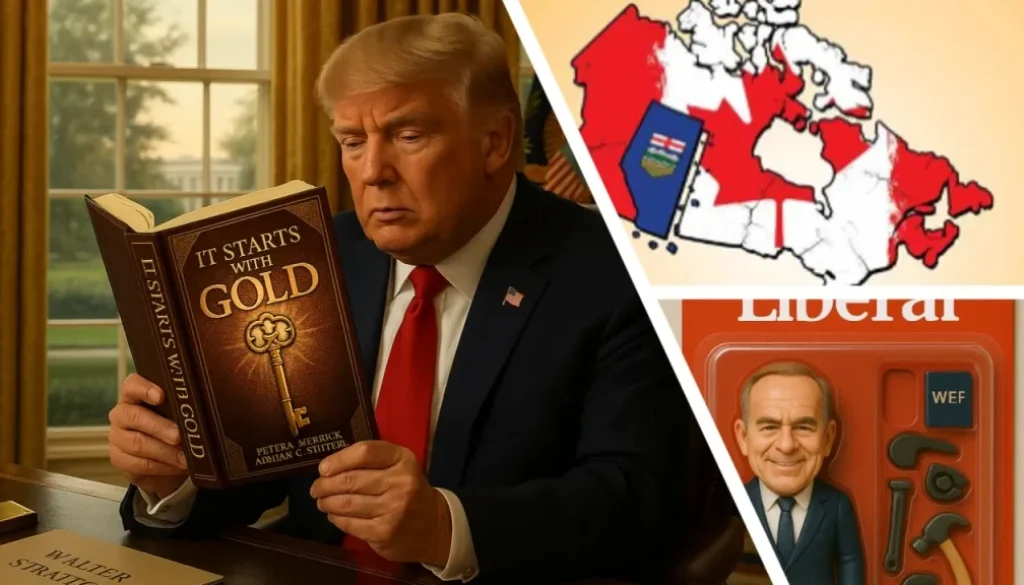
Breakup of Canada: Could Alberta Separate and What Would It Take?
By Peter J. Merrick, TEP® and Adrian C. Spitters, CFP®, co-authors of the international bestseller It Starts With Gold™ and the forthcoming book Guns, Gold & Land™
This analysis continues a series of long-form investigations published in The Merrick Spitters Reset Report™
The urgent themes discussed in this article are explored in greater depth in our #1 international best-selling book, It Starts With Gold™, co-authored by Peter J. Merrick and Adrian C. Spitters. In the book, we reveal how financial systems are collapsing and how individuals can prepare before it is too late. Visit www.ItStartsWithGold.com.
Since the federal election on April 28, 2025, when Mark Carney and the Liberal Party formed Canada’s new government, a question has returned to kitchen tables, shop floors, and farmers’ fields across Alberta. Can Alberta leave Canada? And if so, how?
It is a serious question, one rooted in a growing sense of alienation. Many Albertans feel that their values, industries, and contributions are no longer respected by Ottawa. They believe they are being governed by leaders who do not understand them and, worse, do not care to. This feeling is not new. It has been building for years. What is new is the figure now sitting at the top.
Mark Carney is not a man of the West. He was not shaped by the land or its people. He built his career in global banking boardrooms, not in provincial legislatures. After working for Goldman Sachs in London, Tokyo, and New York, he became Governor of the Bank of Canada and then Governor of the Bank of England. He holds Canadian, British, and Irish citizenships and has spent more of his life abroad than at home. Alongside his roles at the United Nations and the World Economic Forum, Carney became one of the chief architects of global finance, pushing policies like Net Zero, digital currencies, and ESG controls. These are not policies made for farmers, small businesses, or working Canadians. They are designed by and for a class of global elites.
In our international bestseller, It Starts With Gold, we explore how figures like Carney are advancing a system that prioritizes centralized control over local voices. His appointment as Prime Minister did not feel like a democratic victory. It felt like the final step in a quiet shift, where Canada’s decisions are shaped more by international agendas than by the will of the people.
This is why Albertans are asking if staying in Canada still makes sense.
Alberta Cannot Just Leave — But There Is a Legal Path
Canada is made up of ten provinces. Each has its own government, but all are part of a national system governed by the federal Parliament in Ottawa. Alberta cannot simply leave by declaring independence. There is no exit clause in Canada’s Constitution. However, there is a legal process that begins with the will of the people.
Step One: A Vote by the People
Alberta would first hold a referendum. This is a vote where every adult in the province is asked a clear question, such as:
Do you want Alberta to become an independent country?
If the majority says yes, that does not mean Alberta leaves the next day. What it means is that Alberta now has the democratic right to begin serious discussions with the rest of Canada.
Step Two: Negotiations Begin
According to the 1998 Supreme Court of Canada ruling in Reference re Secession of Quebec, if a province holds a referendum with a clear question and a clear majority votes to leave, then the federal government is constitutionally required to enter into good faith negotiations. These talks would be more than political theatre. They would need to address how to divide public assets, settle the national debt, define borders, determine how laws and taxation would be handled, and decide which federal programs would remain or be removed. Other provinces and Indigenous peoples would also need to be part of this process, since Canada’s Constitution is a shared agreement between all its parts. The court made it clear that while no province has a right to unilaterally separate, a strong democratic mandate cannot be ignored.
Step Three: Changing the Constitution
For Alberta to leave legally, Canada’s Constitution would have to be amended. This requires agreement from the federal Parliament, the Senate, and seven out of ten provinces, representing at least fifty percent of the Canadian population. This is no small task. It was designed to make sure no part of the country could be carved away lightly. Still, if Alberta spoke clearly and consistently, and if the rest of Canada saw it was not a passing protest but a true desire to part ways, change could follow.
Step Four: Becoming a New Country or Joining the United States
If a constitutional agreement were reached, Alberta would be free to determine its future. It could choose to become a fully independent country or explore joining the United States.
If Alberta chose independence, it would begin by writing its own Constitution and forming new laws. It would create government departments to manage health care, taxation, national defense, trade, and immigration. Alberta would need to decide whether to keep using the Canadian dollar temporarily or create its own currency. It would also apply for membership in international organizations like the United Nations and the World Trade Organization. Alberta would need to form new diplomatic relationships and create systems for issuing passports, managing borders, and securing its economy. It would be a large and complex effort, but for many Albertans, it would offer the chance to build a nation that reflects their values.
Some Albertans, however, may not want a separate country. They may prefer to join the United States. That option would only be possible after Alberta had separated from Canada through the legal process already described. Once independent, Alberta could formally apply to join the United States as its fifty-first state.
This path would require approval from both the House of Representatives and the Senate in Washington. The President of the United States would also need to sign the agreement. Alberta would likely be expected to adopt U.S. laws and regulations, switch to the U.S. dollar, and operate within the American system of federal and state governments. This has happened before. Texas was once its own republic before becoming a U.S. state in 1845. While joining the United States would come with challenges, Alberta’s economic strength and shared cultural ties with American border states could make such a proposal viable.
Whether Albertans choose to stand on their own or join another union, the decision begins with them. A clear and united voice is the first step toward either future.
A Moment of Decision
This is not about politics. It is about identity. Alberta’s people are hardworking, self-reliant, and grounded in the land. They do not ask for handouts. They expect to be left alone to thrive. But under Mark Carney’s leadership, the direction of Canada is moving fast toward global regulation, financial surveillance, and top-down control. Carney built his career serving international banks and institutions that do not answer to voters. That is not a system designed for the benefit of provinces like Alberta.
Albertans have never wanted to leave the country they helped build. They have been among its strongest contributors. Yet today, they find themselves questioning whether their values still belong in this version of Canada.
As we write in It Starts With Gold, a people without sovereignty are no longer citizens. They are subjects. If Alberta’s voice is no longer heard, then the people have every right to ask where they go from here.
And if enough Albertans say yes to independence, the rest of Canada will have no choice but to listen.
We wrote It Starts With Gold™ to warn Canadians and Americans of this exact outcome.
To find out more, order your own copy of It Starts With Gold™ from Amazon today. Visit https://mybook.to/GOLD