The Great Food Seizure: How ESG and Traceability Threaten Farms
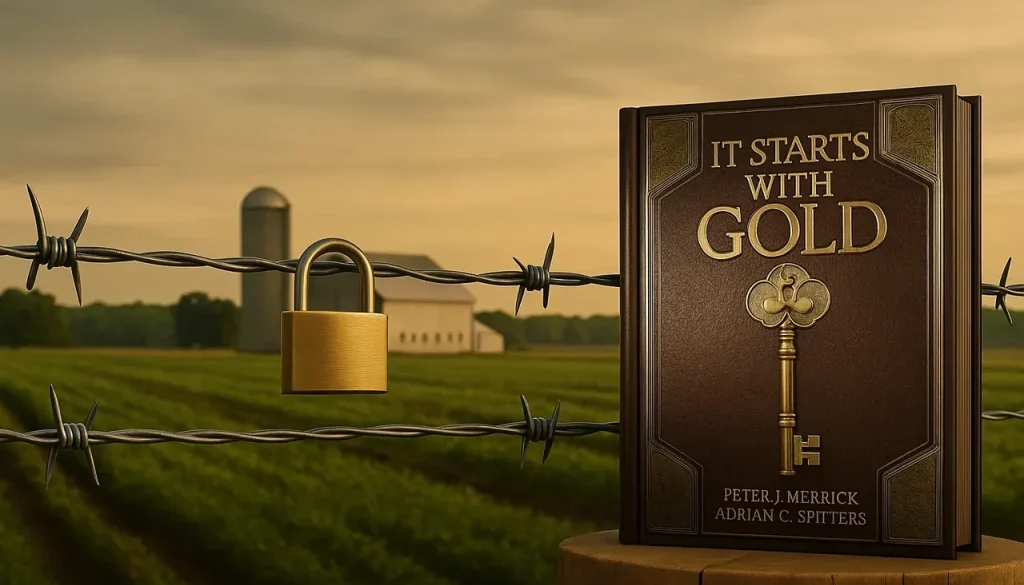
By Peter J. Merrick, TEP® and Adrian C. Spitters, CFP®, co-authors of the international bestseller It Starts With Gold™ and the forthcoming book Guns, Gold & Land™
This analysis continues a series of long-form investigations published in The Merrick Spitters Reset Report™
ood Safety Was Just the Beginning. The New Regime Is About Control.
The deeper themes explored in this article are expanded in our #1 international best-selling book, It Starts With Gold™, co-authored by Peter J. Merrick and Adrian C. Spitters. The book outlines how emerging systems of digital oversight under the banner of sustainability, traceability, and compliance are being used to reshape how we live, work, and own.
We examine how legal, financial, and technological tools are converging to reconfigure traditional rights into conditional privileges. From food production to personal property, the trend is clear. Access is being tied to approval. It Starts With Gold™ offers a clear-eyed look at what is changing, why it matters, and how individuals and communities can prepare. Visit www.ItStartsWithGold.com to learn more.
Traceability: The Digital Fence Around Farming
Traceability began as a system to track food products and livestock to prevent contamination and manage outbreaks. But as the systems evolved, the original goal gave way to a broader mandate. Real-time surveillance and control. In Canada, the Traceability Adoption Program introduced by the British Columbia Ministry of Agriculture incentivizes farmers to adopt barcode scanners, radio-frequency identification systems (RFID), and GPS-linked devices to log all animal and crop movements.
As of 2024, over 2,000 British Columbia farms have received funding under the Traceability Adoption Program to implement traceability technologies. While marketed as safety tools, these systems are being absorbed into an international data architecture that goes far beyond public health.
The implementation of RFID systems can be financially burdensome for farmers. Costs include purchasing RFID readers, which can range from $2,000 to $8,000. Handheld scanners are priced between $1,000 and $4,500, and RFID tags vary from $0.10 to over $10 each, depending on the type and quantity purchased. Integration and deployment services can add another $5,000 to $10,000 to the overall project budget. These expenses can be prohibitive for small and medium-sized farms, potentially leading to increased consolidation in the industry.
In the United States, the United States Department of Agriculture (USDA) developed the Animal Disease Traceability framework, which requires RFID tagging and premise identification to enhance response times in the event of an animal disease outbreak.
These traceability platforms are being integrated into a broader infrastructure that enables:
-
-
- Remote and automated shutdowns of farms
- Algorithm-driven culling and quarantine orders
- Enforcement of emissions-based restrictions
- Real-time compliance scoring integrated with climate goals
-
Farmers are no longer making decisions independently. They are responding to alerts generated from dashboards monitored by regulators, environmental, social, and governance officers (ESG), and compliance auditors.
The Canadian Food Inspection Agency: From Safety to Seizure
The Canadian Food Inspection Agency (CFIA) has become a key federal enforcer of this transformation. Initially established to protect animal health and food safety, the CFIA’s role has expanded dramatically under the framework of digital traceability and biosecurity enforcement.
It now serves as the front-line implementer of seizure and destruction powers, often pre-emptively. Under the Health of Animals Act, the CFIA can enter farms without a warrant, mandate the destruction of animals based on questionable test results that cannot be challenged.
A high-profile case occurred on December 30, 2024, when the CFIA ordered the cull of approximately 400 ostriches at a farm in Edgewood, British Columbia, following confirmed avian influenza in two dead birds. Over 60 additional ostriches had died, showing symptoms. The farm owners challenged the order, claiming the flock was recovering and demanding proof of the CFIA’s test results. They were denied access to the lab data. When they asked to have an independent test done to verify the health of the remaining birds, they were threatened with fines of up to $200,000 or six months in jail. A judge temporarily paused the cull, but in May 2025, the Federal Court upheld the CFIA’s decision. The ostriches remain alive, as owners and protesters continue to resist enforcement.
This case highlights the CFIA’s evolving role not as a safety regulator but as an enforcer of conditional agricultural rights. When traceability data, algorithmic assessments, or subjective reports flag non-compliance, the CFIA now has the power to act without direct physical evidence or transparency.
This trend is accelerating. Through integration with climate and environmental, social, and governance (ESG) scoring, the CFIA is shifting from food safety oversight to climate-based enforcement.
PricewaterhouseCoopers and the World Economic Forum: Orchestrators of the Control Grid
PricewaterhouseCoopers (PwC), a multinational professional services network, has transitioned from accounting into global governance consulting. As a formal strategic partner of the World Economic Forum (WEF), PwC helps governments and corporations implement traceability systems and ESG compliance protocols across food systems.
The World Economic Forum’s Food Action Alliance outlines a vision of digitized, climate-compliant food production that aligns all stages of the supply chain with international emissions targets. PwC facilitates this vision by:
-
-
- Designing carbon-tracking tools that integrate with traceability infrastructure
- Drafting governance frameworks to measure and audit farm performance
- Aligning agricultural policies with net-zero financial disclosure standards
-
This system bypasses local autonomy. Food production becomes a climate-data operation. Farmers are repositioned as administrators whose job is to conform to global benchmarks rather than steward local soil and livestock.
Brookfield Asset Management: The ESG Enforcer in Agriculture
Brookfield Asset Management, one of the world’s largest investment firms with over USD $850 billion in assets under management, has taken a leading role in embedding climate compliance into capital deployment. Under the ESG stewardship of Prime Minister Mark Carney during his tenure as Vice Chair, Brookfield integrated climate scoring and traceability into its agricultural and real asset strategies.
Brookfield’s model includes:
-
-
- Purchasing farmland and processing infrastructure in North America
- Requiring ESG performance from portfolio companies
- Scoring assets based on emissions and climate exposure
- Monetizing carbon credits based on traceability-generated farm data
-
Traceability provides the data. ESG frameworks determine compliance. Brookfield determines access to capital. Farmers who do not align lose access to critical financing, leasing opportunities, and insurance.
Mark Carney: Canada’s Climate Czar and Global ESG Architect
Mark Carney, Canada’s current Prime Minister, has held influential financial leadership roles including Governor of the Bank of Canada, Governor of the Bank of England, and United Nations Special Envoy on Climate Action and Finance. Carney also co-founded the Task Force on Climate-related Financial Disclosures, which set the global benchmark for climate risk reporting in financial markets.
Carney has long promoted the fusion of environmental policy with digital finance. In agriculture, this translates into:
-
-
- Carbon scoring of farms based on satellite, drone, and traceability data
- ESG-based lending criteria and compliance-linked insurance
- Digital identification for farms tied to emissions and land use reporting
- Tokenization of food units and land-based carbon credits
-
Carney’s influence enables an economy where the right to produce food is no longer protected by property rights but granted through climate conformity.
Bill 7: A Blueprint for Seizing Farms Under Predicted Risk
British Columbia’s Emergency and Disaster Management Act, known as Bill 7, enables the provincial government to act pre-emptively during emergencies or forecasted crises. It gives sweeping authority to:
-
-
- Declare climate-related emergencies in advance
- Seize or restrict access to farmland
- Destroy livestock or halt operations without compensation
- Appoint private contractors to enforce orders
-
The 2023 CFIA ostrich order, while federal, foreshadowed how predictive enforcement can override due process. But a greater threat looms. Part 4 of Bill 7, which was shelved after public backlash in spring 2024, is expected to be reintroduced in fall 2025. If passed, it will formalize:
-
-
- Government right of entry to private lands based on predictive modelling
- Confiscation of food-producing assets for climate adaptation
- Asset management by third-party contractors without owner consent
-
Under this regime, provincial and federal systems will work together to erase agricultural sovereignty under the justification of emergency preparedness.
Carbon Finance and Central Bank Digital Currency: The Next Layer of Enforcement
The integration of traceability with financial technology is already underway. Farms and producers will soon be scored based on their emissions and land use. These scores will determine:
-
-
- Eligibility for subsidies
- Access to crop insurance
- Approval for loans and input financing
- Market access through national or international portals
-
The final step is integration with central bank digital currencies (CBDCs). Prime Minister Mark Carney has championed CBDCs as tools for climate management. Once paired with traceability, CBDCs will enable:
-
-
- Real-time penalty application for emissions violations
- Programmable restrictions on farm purchases
- Carbon quotas embedded into payments for inputs like fertilizer or feed
-
Food production and distribution will be digitized, monitored, and enforced with the same tools used in digital surveillance and social credit systems.
From Canada to the United States and Around the World
Canada is the pilot. British Columbia is the test site. Under Prime Minister Mark Carney, Canada’s provinces are being incentivized to align with the federal climate agenda. This turns voluntary programs into mandatory compliance frameworks.
In the United States:
-
-
- The United States Department of Agriculture is rolling out the Animal Disease Traceability framework
- The Securities and Exchange Commission is enforcing climate disclosures
- Pilot programs for central bank digital currencies are being developed by the Federal Reserve
- The Inflation Reduction Act ties farm aid to carbon reduction metrics
-
Globally:
-
-
- The United Nations requires ESG compliance for development financing
- The Netherlands is expropriating farms to meet climate targets
- The European Union is implementing the Green Deal and Farm to Fork Strategy
- The European Union’s Carbon Border Adjustment Mechanism penalizes non-compliant producers
-
What happens in Canada will not stay in Canada. It is a model for international replication.
The End of Agricultural Sovereignty or a New Beginning
This is not about safety. It is not about sustainability. It is about control. The fusion of traceability, ESG metrics, and programmable finance is redefining what it means to own and operate a farm.
Farmers are no longer producers. They are participants in a climate scoring system. Food is no longer nourishment. It is a carbon token. Governments are no longer facilitators. They are enforcers.
But all is not lost.
In It Starts With Gold™, we offer more than a warning. We offer a roadmap. Farmers and food producers can push back by forming local cooperatives, rejecting conditional government grants, and choosing private capital that respects autonomy over ESG alignment. Communities can support decentralized food systems and invest in real assets such as gold, land, and private enterprise that cannot be digitized or deactivated.
This system only works if we consent to it. That consent can be withdrawn. Farmers were the first builders of civilization. They can be the first to reclaim it.
The tools for resistance exist. The future has not yet been programmed.
To find out more, order your copy of It Starts With Gold™ from Amazon today: CLICK HERE
Sources
Traceability and Global Food Control Infrastructure
- PwC – Reconfiguring the Global Food System
- World Economic Forum – Food Action Alliance
- Farms To Food Markets: Providing Solutions And Collective Action For Sustainable Food Systems
- Task Force on Climate-Related Financial Disclosures (TCFD)
- UN-convened Net-Zero Asset Owner Alliance
Traceability Programs in Canada
- Government of British Columbia – Traceability Adoption Program
- Traceability funding programs – Province of British Columbia
- Traceability Adoption Program – Investment Agriculture Foundation of BC
- Traceability Adoption Program – Program Guide 2025/26 (PDF)
- CFIA Food Traceability: Ensuring Safety and Compliance in Canada
- CFIA – National Livestock Traceability
- Canadian Food Inspection Agency – Traceability Regulations
Technology and Costs of Compliance
- RFID Technology in Food Processing – Agriculture – Manitoba.ca
- The Cost of An RFID System: An Estimated Budgeting Breakdown
- RFID warehouse management system cost in 2025 – CPCON
U.S. and Global ESG Enforcement
- USDA – Animal Disease Traceability Framework
- Brookfield – Net Zero Asset Owner Alliance (UNEP-FI)
- SEC Proposes Rules to Enhance and Standardize Climate-Related Disclosures for Investors
- White House – Inflation Reduction Act Rural Impact
Legal and Media Coverage of the Ostrich Case
- Global News: Protesters opposed to agency-ordered cull at ostrich farm prepare for long-term stay
- Farmers Forum: Court upholds order to kill 400 British Columbia ostriches
- Vernon Matters: Judge grants temporary reprieve to hundreds of B.C. ostriches facing avian flu cull
Legislation Enabling Seizure and Emergency Powers