Why Poultry Farmers Are Silent on the Edgewood Ostrich Cull
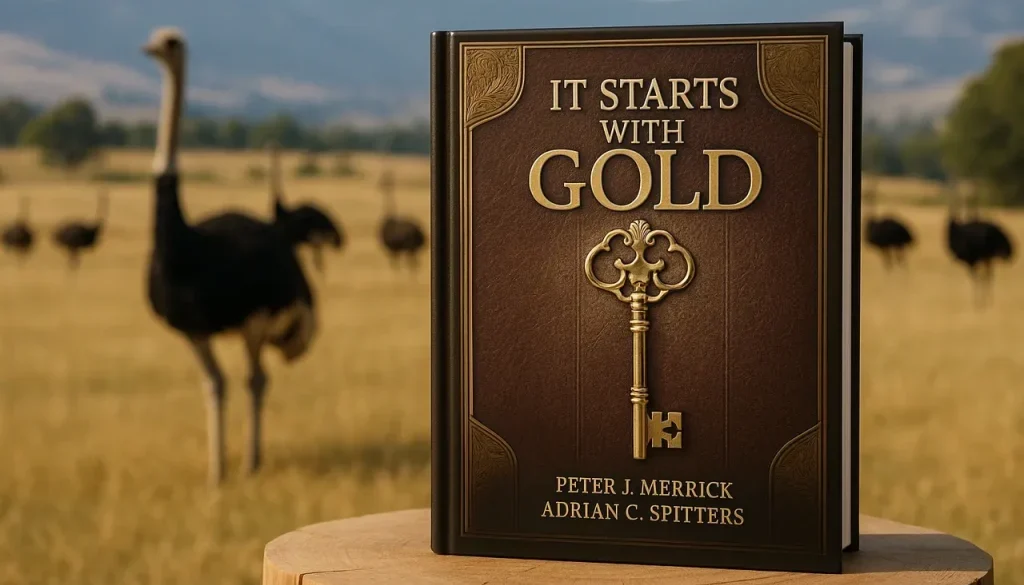
By Peter J. Merrick, TEP® and Adrian C. Spitters, CFP®, co-authors of the international bestseller It Starts With Gold™ and the forthcoming book Guns, Gold & Land™
This analysis continues a series of long-form investigations published in The Merrick Spitters Reset Report™
How Biosecurity is Becoming a Tool of Control, Not Protection
Urgent themes explored in this article are expanded in our #1 international best-selling book, It Starts With Gold™, co-authored by Peter J. Merrick and Adrian C. Spitters. In the book, we examine how modern regulatory systems, while often implemented with good intentions, can reshape personal and property rights into conditional privileges, gradually redefining how individuals live, farm, and own. Visit www.ItStartsWithGold.com.
The Edgewood Cull: What Happened
In late December 2024, the Canadian Food Inspection Agency (CFIA) issued an order to cull approximately 400 ostriches at Universal Ostrich Farms in Edgewood, British Columbia, following the detection of highly pathogenic avian influenza (HPAI) on the premises.
The outbreak was believed to have originated from wild ducks that landed on the farm’s pond. Subsequently, 67 of the farm’s 468 ostriches died from respiratory infections between December and early January. The farm reported that the remaining birds appeared healthy and were showing signs of natural resistance or herd immunity to the virus.
Despite the absence of new illnesses for several weeks, the CFIA maintained its position, citing standard protocols that require the humane depopulation of all poultry on infected premises to prevent further spread of HPAI.
The farm’s owners sought legal intervention, resulting in a temporary stay of the cull order pending judicial review. However, the Federal Court ultimately upheld the CFIA’s decision, allowing the cull to proceed.
The situation has drawn national attention, with community members and animal advocates protesting the decision and calling for additional testing and consideration before any further action.
While protests erupted locally, Canada’s commercial poultry sector remained completely silent. That silence is not an oversight. It is a warning.
What the CFIA Order Really Represents
The CFIA maintains that the cull followed established avian influenza protocols. Yet no transparent evidence has been made publicly available proving the virus was present in the ostriches themselves at the time the cull was ordered. No appeals were permitted before enforcement. And no independent testing was authorized to verify the CFIA’s findings.
This departure from transparent, science-based intervention marks a troubling shift in Canadian food policy. What unfolded in Edgewood fits a broader pattern we document in It Starts With Gold™: the use of biosecurity as a regulatory shield behind which property rights are overridden, business models dismantled, and independence punished. When government decisions are unchallengeable and emergency protocols override due process, the rule of law begins to erode.
What the CFIA Stands to Lose If the Ostriches Are Allowed to Live
If the Canadian Food Inspection Agency (CFIA) allows the ostriches to live, it risks a loss of institutional authority. The decision to cull was made publicly, backed by federal enforcement, and upheld by the courts. Reversing that action would undermine its credibility in future emergency declarations.
More critically, allowing visibly healthy ostriches to survive after a positive test undermines the central premise of the CFIA’s mass culling protocol. If one farm successfully defies the policy and suffers no further outbreak, the scientific and moral justification for future culls could collapse. The CFIA also risks broader public scrutiny of its data integrity, test validity, and decision-making processes. In a system built on unchallenged compliance, one exception could set off a cascade of resistance, litigation, and regulatory reforms.
Allowing the ostriches to live not only challenges the narrative of containment, it also exposes the agency to reputational risk, institutional liability, and potential loss of centralized control over livestock disease policy.
Why Poultry Farmers Remain Silent
Canadian poultry farmers are not staying quiet out of indifference. Their silence is a product of structural dependency, regulatory fear, and economic vulnerability.
First, most commercial poultry operations function under Canada’s supply-managed quota system. This system grants farmers a fixed volume of production rights that are expensive to acquire but essential for survival. Speaking publicly against the Canadian Food Inspection Agency (CFIA) puts those rights in jeopardy. One perceived act of dissent can trigger compliance audits, withdrawal of certifications, or even quota suspension.
Second, producers are financially entangled. Many are carrying high debt loads on barns, equipment, and quota purchases. Their lenders, insurers, and marketing boards all operate in cooperation with CFIA protocols. Even informal criticism risks sending the wrong message to those institutions, jeopardizing loans, insurance renewals, or processor contracts.
Third, farmers are surrounded by a culture of compliance. Veterinarians, inspectors, and agricultural extension agents are often trained to follow CFIA directives without question. Farmers who defy that culture risk being isolated from their professional networks.
Fourth, the legal climate offers no protection. There is no whistleblower protection for farmers challenging CFIA orders. There is no funding for independent diagnostics. Once an order is issued, the process favours enforcement, not review.
Lastly, fear of reputational destruction is real. Speaking out risks being branded as anti-science, irresponsible, or a threat to public health. For a farm family with children in 4-H or involved in agricultural communities, that stigma is unbearable.
Farmers are rational. They see what happened in Edgewood. They know it could happen to them. So they say nothing, not because they agree, but because they know the system is not designed to tolerate disagreement.
Why the Ostrich Farm Was Treated as an Enemy
Universal Ostrich Farm was not part of Canada’s regulated poultry economy. It did not operate under quota. It did not sell processed meat into the industrial food system. It was independent, unconventional, and vocal about agricultural self-reliance. In a system moving rapidly toward total traceability, that makes it a threat.
What made the ostriches dangerous was not disease risk. It was the farm’s refusal to submit to the centralized control model being rolled out under the banners of climate, health, and biosecurity. The destruction of its flock sent a message to every other independent farmer: comply or be erased.
How Compliance Is Being Redefined
We are entering a world where food production is no longer based on skill, tradition, or stewardship. It is being transformed into a programmable system where every input, from feed to genetics, is tracked in real time. Environmental, Social and Governance (ESG) scoring, carbon traceability, and disease surveillance technologies are converging to create a regulatory environment where the right to farm is conditional.
This system does not recognize land ownership or animal ownership in the traditional sense. It replaces them with conditional operating rights based on your compliance score. And once these frameworks are fully digitized, noncompliance will be enforced automatically. That is why what happened in Edgewood matters far beyond ostriches.
What Happens If the Silence Continues
1. Legal Precedent Becomes Normal Policy
Without challenge, these actions become precedent. Emergency depopulation orders will no longer require evidence of sickness, only a proximity alert. Soon, being located near a positive test site will be enough to justify enforcement.
2. Ownership Is Replaced With Licensing
Traditional farming rights are giving way to conditional access. This will apply not just to animals, but to farmland, water, and even seed usage. Owning a farm may no longer mean the right to operate it.
3. Digital Control Supersedes Local Judgment
Local veterinarians, farmers, and co-operatives will be overridden by national data dashboards and centralized directives. Algorithms will determine biohazard zones, culling schedules, and distribution eligibility.
4. The Next Generation Inherits a Compliance Grid
Children growing up on farms today may never experience what it means to make decisions based on the weather, the animals, or their instincts. Instead, they will be operators inside a permissioned food matrix where every action requires approval.
Global Implications
This issue is not confined to Canada. Across the Western world, similar mechanisms are being quietly deployed. The World Organization for Animal Health (WOAH), World Economic Forum (WEF), and other international bodies are pushing digital livestock identification systems, traceable vaccine compliance, and automated cull protocols. These are being tied to trade access, Environmental, Social and Governance (ESG) lending terms, and climate targets. What begins on a small ostrich farm in British Columbia is being exported globally through policy harmonization.
There Is Still Time to Push Back
Farmers and consumers alike must recognize what is unfolding. Agriculture is being redefined. If the silent majority continues to accept this, the transition will become irreversible. But if even a fraction of independent producers, food co-ops, and private citizens speak out, organize, and realign their supply chains outside the compliance system, the model can be disrupted.
We offer real-world solutions in It Starts With Gold™, from legally protecting assets outside the digitized grid to building food security alliances that do not rely on centralized distribution.
Silence may seem like the safest choice. But it comes at the cost of your voice, your land, and your children’s ability to farm. That is why this moment matters.
To find out more, order your own copy of It Starts With Gold™ on Amazon today. CLICK HERE
The views expressed are those of the authors and are intended to encourage informed public discussion.