Is Canada Still Sovereign or Quietly Being Reclaimed?
By Peter J. Merrick, TEP® and Adrian C. Spitters, CFP®, co-authors of the international bestseller It Starts With Gold™ and the forthcoming book Guns, Gold & Land™
This analysis continues a series of long-form investigations published in The Merrick Spitters Reset Report™
Is Canada Sovereign, Or Still Ruled by The Crown And Corporate Power?
At the heart of Canada’s identity lies a question few dare to ask: Is Canada truly sovereign? While most citizens assume the country gained full independence long ago, a growing number of legal scholars, political commentators, and concerned citizens argue that Canada may still operate under the lingering control of foreign and corporate powers.
This article examines the legal, historical, and political claims behind this debate, exploring whether the Canadian state serves its people or remains a managed jurisdiction shaped by external interests.
“This article explores a growing debate about the legal foundations of Canadian sovereignty and the influence of global institutions on national governance. It is presented as an opinion and is intended to inform and invite dialogue.”
Setting the Stage: A Nation by Design, or by Default?
The maple leaf flies on government buildings. Canadians elect members of Parliament, pay taxes, and follow Canadian laws. In everyday practice, Canada appears to be a sovereign nation.
But functioning is not the same as being.
Sovereignty is not a performance. It must be secured through clear legal steps: constitutional declarations, formal independence, and rule by the people. When examined closely, Canada’s foundations raise a disturbing possibility.
Did Canada ever lawfully become sovereign? Or are citizens living under an illusion managed by those who never left?
Sovereignty Without a Break?
Countries that broke from British rule took bold, irreversible steps. The United States fought a war. India passed its own independence act. Ireland and South Africa cut legal ties entirely.
Canada took a softer path. There was no declaration of independence. No vote. No break.
Instead, Canada’s governing authority developed through a series of British statutes, Letters Patent, and Crown approvals. Autonomy was granted but never claimed.
Without a single moment of rupture, Canada’s foundation remains vulnerable to interpretation. This leaves a legal grey area. Nations are either sovereign by law or subordinate by omission.
Legal Evolution Without Popular Consent
Supporters of Canada’s current legal standing often point to three milestones:
-
-
- 1867: The British North America Act made Canada a self-governing Dominion
- 1931: The Statute of Westminster gave Canada legislative independence
- 1982: The Constitution Act and Canada Act patriated Canada’s Constitution
-
By this view, Canada earned sovereignty through legal evolution. Its Parliament makes laws, its courts rule domestically, and its Governor General answers to Canadians.
These points are valid in form, but critics argue they lack substance. Each milestone was initiated under Crown oversight, not citizen mandate. Canada’s so-called sovereignty is based on a process of permission, not a declaration of authority.
End of debate?
Not quite.
The Counterargument: Assumed Authority Is Not Legal Sovereignty
Critics argue Canada never lawfully declared independence. The Constitution was drafted in London and approved by the Queen. Even the 1982 patriation was completed under royal authority.
They argue:
-
-
- Letters Patent still authorize the Governor General
- Courtrooms still display the Royal Coat of Arms
- Elected officials still swear allegiance to the Crown, not to the people
-
Supporters of this argument say that without an act of formal rupture, Canada cannot claim to have broken from the Crown’s ultimate authority. And if that authority remains, what does that say about taxation, property rights, and the rule of law?
The Hudson’s Bay Company and the Colonial Blueprint
In 1670, King Charles II granted a royal charter to the Hudson’s Bay Company. It controlled Rupert’s Land, nearly 40 percent of modern-day Canada. The company acted as a government, managing land, trade, and law.
This was not symbolic. It was legal and enforceable. The Hudson’s Bay Company issued permits, collected revenue, and exercised judicial power.
When Rupert’s Land was transferred to Canada in 1869, it was a private sale, not a revolution. No referendum was held. No constitutional convention took place. Critics argue this proves Canada was built as a corporate jurisdiction, not a democratic nation.
Some historians argue that the legal framework of Canada’s territorial acquisition is more akin to a merger than a founding. Sovereignty was assumed through transaction, not declaration.
Legal Challenges and Courtroom Rejection
Sovereign citizen movements have tried to challenge Canada’s legal authority in court. These efforts have been consistently rejected.
In the 2012 Alberta case Meads v. Meads, Justice Rooke ruled that these arguments were pseudo-legal, wasting judicial time. Courts refuse to entertain claims that Canada does not legally exist.
This decision has been cited hundreds of times in dismissing challenges to Crown authority. But critics ask: if the system itself is in question, can its judges be trusted to hear the case?
Courts defend the structure. They do not investigate the origins of that structure. And therein lies the unresolved conflict.
The Constitutional Risk: Built on Assumptions?
If Canada never became sovereign under law, then everything from land ownership to taxation exists under Crown permission. If global recognition fades, does the entire structure collapse?
This question moves from legal theory to practical consequences.
Emergency powers used during recent national crises have shown how quickly individual rights can be suspended. Without a constitution born of the people, what protects citizens from a future where rights become temporary privileges?
This is no longer theoretical. A shift is underway.
Enter Mark Carney: The Technocrat at the Helm
Mark Carney became Canada’s 24th Prime Minister in 2025. He is a former Governor of the Bank of Canada, the Bank of England, and United Nations Special Envoy for Climate Action and Finance. He also served as Vice Chair of Brookfield Asset Management, one of the largest global real estate and infrastructure investment firms deeply embedded in public-private partnerships.
Carney’s government has moved quickly:
-
-
- Reducing dependence on the United States through new trade strategies
- Strengthening national defence amid U.S. threats
- Replacing consumer carbon taxes with green industrial incentives
-
Carney claims to be restoring sovereignty. Critics claim he is consolidating control.
Carney and the Crown: A Relationship Hidden in Plain Sight
Carney has long collaborated with King Charles III. As United Nations Special Envoy, Carney helped launch the Sustainable Markets Initiative and co-authored the Terra Carta with Charles, an environmental charter that reframes global finance around planetary governance.
King Charles has praised Carney’s vision. Carney has echoed the King’s belief in “inclusive capitalism,” where corporate stakeholders, not citizens, drive global policy.
The partnership is clear. So is the concern.
Is Mark Carney governing Canada, or managing it on behalf of global institutions, royal patrons, and corporate boards?
Is This the Recolonization of Canada by Another Name?
Three actors, Carney, Charles, and Brookfield, form a powerful triangle.
-
-
- National policy is now set against global climate frameworks
- Real assets are migrating into the hands of firms like Brookfield
- ESG (Environmental, Social, Governance) metrics are used to shape individual behaviour
- Sovereignty becomes symbolic while decision-making shifts upward
-
At the same time, national land registries are moving online. Carbon limits are being tied to property development and energy use. Digital ID proposals are expanding under climate and financial security frameworks.
If Canada’s sovereignty was already in question, this new structure may finish the job.
Not through force.
Through data, compliance, and control.
Alberta’s Sovereignty Movement: A Constitutional Flashpoint
Alberta’s response to federal climate policy has reignited the sovereignty debate. Premier Danielle Smith’s government passed the Alberta Sovereignty Within a United Canada Act in December 2022, empowering the province to reject federal laws deemed harmful to its interests.
In 2024, Alberta invoked the Act to oppose Ottawa’s net-zero electricity regulations, arguing they threaten the province’s energy security and economic stability.
Smith has also suggested that a referendum on Alberta’s separation from Canada could be included in the 2026 ballot if sufficient public support emerges.
This movement underscores the tension between federal climate initiatives and provincial autonomy, highlighting the complexities of governance and sovereignty within Canada.
So, Is Canada Sovereign? Or Is It Still a Crown Colony in Disguise?
Legal documents say Canada is sovereign. But documents are only as meaningful as the power that enforces them. If true independence was never claimed, it can be reversed. If governance is performance, it can be rewritten.
Canadians are no longer choosing between left and right. They are choosing between managed autonomy and true sovereignty.
This is not just a Canadian issue. Every nation participating in international frameworks must ask to whom their governments answer and who owns their infrastructure, land, and citizens’ data.
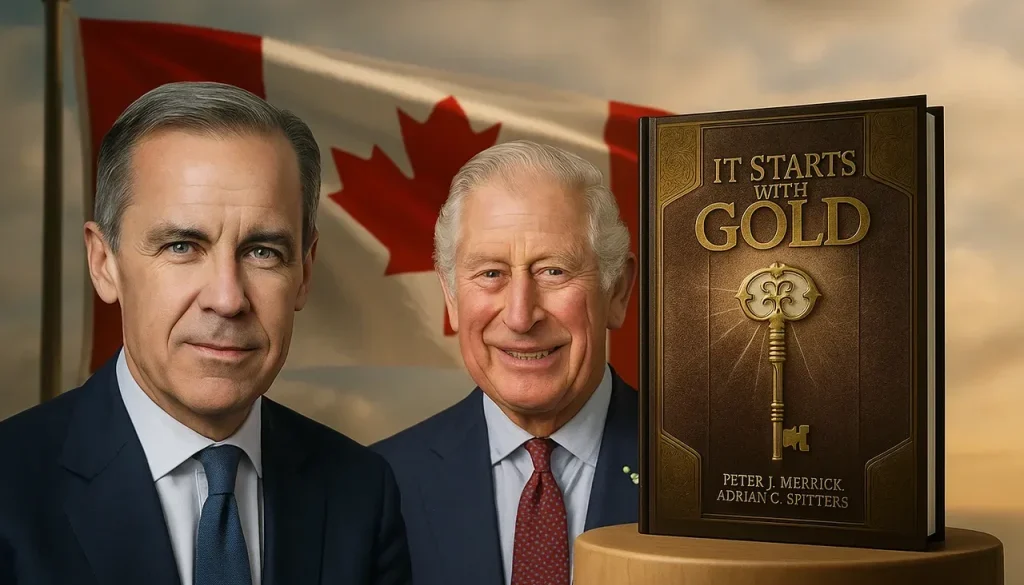
We expand on these urgent themes in our #1 international best-selling book, It Starts With Gold™, co-authored by Peter J. Merrick and Adrian C. Spitters.
In the book, we reveal how financial and legal structures have been quietly rewired to serve external powers and how ordinary citizens can reclaim control. Visit www.ItStartsWithGold.com.
We can still make a difference. But only if we see the structure for what it is.
To find out more, order your own copy of It Starts With Gold™ from Amazon today. CLICK HERE
References
- Hudson’s Bay Company History – HBC Heritage
- British North America Act (Constitution Act, 1867) – Justice Laws Website
- Statute of Westminster, 1931 – UK Parliament
- Canada Act 1982 – UK Legislation
- Constitution Act, 1982 – Justice Laws Website
- United Nations Member States – Canada
- Meads v. Meads, 2012 ABQB 571 – CanLII
- Mark Carney Biography – World Economic Forum
- Sustainable Markets Initiative – Official Website
- Terra Carta – Sustainable Markets Initiative
- Brookfield Asset Management – Overview
- Alberta Sovereignty Within a United Canada Act – Wikipedia
- Alberta invokes Sovereignty Act to fight federal net-zero rules – Lethbridge News Now
- Time Magazine – Alberta’s Separatist Threat Could Split Canada
- Danielle Smith: The Alberta Premier who could split Canada with 2026 secession vote
- Alberta stands against “unconstitutional” regulations pushing Trudeau’s net zero agenda
- Wall Street Journal – Canada PM Carney in Talks with U.S. on Economic-Security Deal
- Associated Press – King Charles Warns of U.S. Annexation Threat
- TIME – What PM Mark Carney Means for Climate Change
- El País – Canadian Sovereignty Lessons for Europe
- The Guardian – Crown Questions Surface as King Visits Canada
- The Times – King Charles Declares Canada Strong and Free