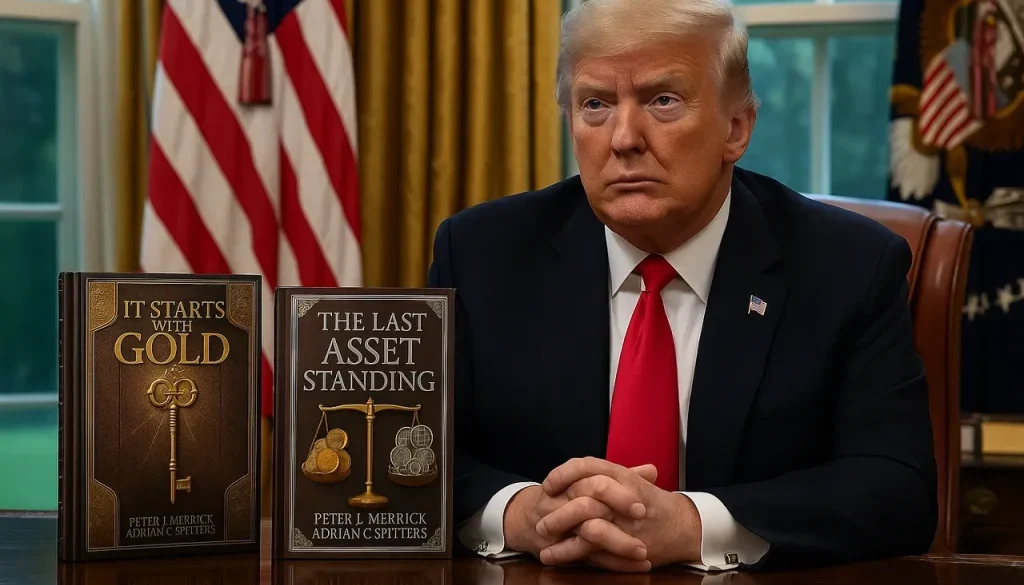
Weaponizing Gold: Trump’s Push to Audit and Revalue U.S. Reserves
By Peter J. Merrick, TEP® and Adrian C. Spitters, CFP®, co-authors of the international bestseller It Starts With Gold™ and the forthcoming book Guns, Gold & Land™
This analysis continues a series of long-form investigations published in The Merrick Spitters Reset Report™

Central banks are stockpiling gold as nations prepare for a post-dollar world, reshaping U.S. policy and Canadian sovereignty.
Do you find value in the articles we write? Please subscribe to our weekly newsletter, It Starts With Gold™: SUBSCRIBE.
By Peter J. Merrick, TEP® and Adrian C. Spitters, CFP® co-authors of the #1 International Bestseller It Starts With Gold™
Trump and the Gold Revaluation Debate
Donald Trump has long emphasized the symbolic and strategic value of gold. His calls to audit Fort Knox were once dismissed as populist theatre. Today, analysts suggest they may represent preparatory steps for something much larger: a sovereign revaluation of U.S. gold reserves.
The United States officially holds 147 million ounces of gold, carried on the federal balance sheet at $42.22 per ounce, a figure unchanged since 1973. At current market prices of roughly $3,000 per ounce, that same gold is worth over $440 billion. On paper, however, the federal government still records it at only $6.2 billion.
Revaluing these reserves to reflect market reality could add about $750 billion in balance sheet capacity. In more aggressive scenarios, such as pricing gold at $10,000 or even $20,000 per ounce, the United States could unlock several trillion dollars in new collateral. This would allow Washington to refinance debt, fund strategic initiatives, and stabilize the U.S. dollar’s global standing without requiring additional foreign borrowing.
Analysts say this is not simply a financial accounting trick. It could serve as economic shock therapy, designed to restore credibility to U.S. finances and signal to the world that the United States can still defend its monetary sovereignty.
Trump’s interest in auditing and revaluing U.S. gold reserves has been interpreted by some as part of a larger geopolitical strategy. In a world where the U.S. dollar is being slowly displaced from global trade and where BRICS nations are stockpiling gold at unprecedented levels, such a move would send a clear message: America will not sit idle while other nations rewrite the rules of the financial system.
Why Gold Is No Longer Just a Hedge
Gold is no longer the panic asset it once was. Historically, it served as a hedge against crises, something investors turned to during market crashes or runaway inflation. That era is over.
Today, gold has been reclassified as a core asset base for nations preparing for a post-dollar world. It is no longer a passive store of value. It has become the bedrock of national economic security, collateral for sovereign debt, and the cornerstone of new trade systems being developed outside U.S. control.
Between 2022 and 2024, central banks purchased over 1,000 tonnes of gold annually, the highest volumes in modern history. Independent analysts believe the true figures are far higher when considering unreported purchases, off-market transactions, and opaque state channels.
Key examples:
- China officially reports holding 2,280 tonnes of gold. Independent estimates, accounting for domestic production, covert imports, and off-balance-sheet purchases, suggest that China’s actual holdings may exceed 5,000 tonnes.
- Russia has divested from much of its U.S. dollar reserves and officially holds over 2,300 tonnes of gold, continuing to accumulate more through channels designed to avoid Western scrutiny.
- India has nearly doubled its pace of gold accumulation in the past two years, positioning itself as one of the fastest-growing official buyers.
This deliberate accumulation reflects three primary objectives:
- Sanction-proofing reserves: Gold cannot be seized or frozen like foreign exchange reserves held in other jurisdictions.
- Hedging against fiat instability: In a world of ballooning sovereign debt and currency volatility, gold provides an unencumbered asset immune to counterparty risk.
- Building a new trade framework: BRICS nations and their allies are actively developing gold and commodity-backed settlement systems to reduce dependence on the U.S. dollar.
This is not about nostalgia for the gold standard. It is about rebuilding monetary autonomy in a fragmented and increasingly multipolar financial world.
The Two-Tier Financial System
Central banks and global institutions are not just buying gold. They are restructuring the financial system around it.
A two-tier system is emerging:
- For central banks and elites: Tangible, unencumbered physical gold stored in secure state reserves.
- For the public: Digital claims on value in the form of tokenized assets, gold-backed stablecoins, and Crypto. These are programmable, fully traceable, and subject to freezing, expiration, or geographic restrictions at the discretion of their issuers.
This creates a structural imbalance. Central banks are insulating themselves from systemic shocks by holding physical assets while transitioning the public to digital instruments that can be manipulated or rescinded.
This is not about financial empowerment. It is financial containment.
How the U.S. Dollar Dies Slowly at First
Currencies rarely collapse overnight. They decline through gradual disuse.
The U.S. dollar has dominated global trade for decades. That dominance is now eroding one transaction at a time:
- China and Russia are settling major energy deals in yuan and rubles.
- India and the United Arab Emirates are conducting oil transactions in rupees.
- Saudi Arabia, once the anchor of the petrodollar system, is openly exploring gold-backed settlement agreements for energy trade.
This is how reserve currency status is lost, not through a dramatic event but through replacement in bilateral and multilateral agreements.
As more nations settle trade in alternative currencies or gold, global demand for dollars decreases. Over time, this weakens the dollar’s purchasing power, erodes its credibility, and undermines its status as the world’s primary reserve currency.
The BRICS bloc is not waiting for the dollar to fail. It is engineering a parallel financial architecture designed to bypass the U.S. system entirely.
Trump’s Revaluation Play
Analysts suggest Trump’s focus on gold revaluation is a direct response to this changing landscape. Auditing and repricing America’s gold reserves could:
- Strengthen the dollar by bolstering its backing with real assets.
- Provide immediate fiscal relief to reduce the need for foreign borrowing.
- Fund strategic national priorities, from infrastructure to industrial policy.
It would also send a clear message to BRICS nations: the United States has the means to defend its monetary position using the same assets they are stockpiling.
However, for ordinary citizens, the benefits of revaluation are indirect. Unless they hold physical gold, they will not share in the value created by such a policy.
Tokenization and the Stablecoin Trap
Gold-backed stablecoins are being marketed as “sound money for a digital age.” They appear to bridge the gap between the security of gold and the convenience of digital currency. But this narrative is misleading.
Tokenized gold is not the same as physical gold. It remains a redeemable claim, not an outright asset. Issuers can freeze accounts, geofence transactions, or even program expiry dates into these instruments.
This is not a return to hard money. It is the soft rollout of Central Bank Digital Currencies (CBDCs) by stealth. By introducing tokenized gold as a “trustworthy” option, central banks normalize programmable money among traditionally skeptical populations, easing the transition to fully controlled digital currencies.
BRICS and the Hidden Gold War
The BRICS bloc, now including Saudi Arabia and the United Arab Emirates, is quietly conducting one of the largest gold accumulation programs in history.
This is not about investment returns. It is about power. By building a commodity-backed trade system, BRICS nations are preparing to set the rules of a new monetary order.
This is already in motion. Settlement networks and pilot programs for gold-backed trade are underway, representing a profound challenge to U.S. financial hegemony.
Canada’s Strategic Blind Spot
Canada eliminated nearly all of its gold reserves decades ago. This leaves the country:
- Without a sovereign hedge against monetary realignment.
- Dependent on foreign-controlled frameworks, with no meaningful leverage in a post-dollar system.
- Exposed to currency shocks in a gold-driven trade environment.
This is not just a policy oversight. It is a national liability in a world where gold is once again the cornerstone of monetary sovereignty.
Real Protection Outside the System
The financial system is being rewired. Central banks are quietly stockpiling gold as the ultimate hedge. Governments are pushing citizens toward tokenized, programmable assets. BRICS is constructing a gold-backed trade ecosystem to rival the dollar.
Meanwhile, Canada has left itself dangerously vulnerable by holding no meaningful gold reserves.
For individuals, the lesson is clear: do not confuse tokenized gold with real gold. As we argued in It Starts With Gold™, physical gold in your possession remains the last truly independent asset in a world where everything else, from cash to property rights, is becoming conditional, programmable, and compliance-based.
The urgent themes discussed here are expanded on in our #1 international bestselling book, It Starts With Gold™, co-authored by Peter J. Merrick and Adrian C. Spitters. In the book, we reveal how to navigate asset confiscation risks, resist surveillance finance, and rebuild wealth outside the programmable system.
At our firm, we help clients protect their wealth by Owning Assets in Order of Asset Confiscation, prioritizing what is most secure and safeguarding what is most vulnerable. Book your complimentary review here to learn how to structure your wealth for what is coming.
Final Thoughts
Central banks are stockpiling physical gold to insulate themselves from the risks of their own policies. Governments are encouraging the public to adopt programmable, traceable money. BRICS nations are leveraging gold to challenge the United States’ financial dominance. Canada, lacking reserves, risks subordination in any new order.
For individuals, the message is clear: do not confuse tokenized claims with true ownership.
To find out more, visit: www.ItStartsWithGold.com.
Order your own copy of It Starts With Gold™ from Amazon today.
Stay informed. Stay protected. Subscribe to It Starts With Gold™ on Substack to get the latest article straight to your inbox. 👉 SUBSCRIBE HERE
This article represents an opinion based on publicly available information and analysis. It is intended for informational purposes only.
References
- MarketWatch – China may be secretly stockpiling gold. Why that spells trouble for the U.S. dollar
- MarketWatch – Trump’s talking about auditing Fort Knox. It might be a $750 billion maneuver
- Bloomberg – Central Bankers Are Still Buying Gold After Record Bull Run
- Bloomberg – US Gold Revaluation Idea Attracts Market Attention, Skepticism
- World Gold Council – Central Bank Gold Reserves Survey 2025
- Reuters – Central banks favour gold over dollar for reserves, WGC survey