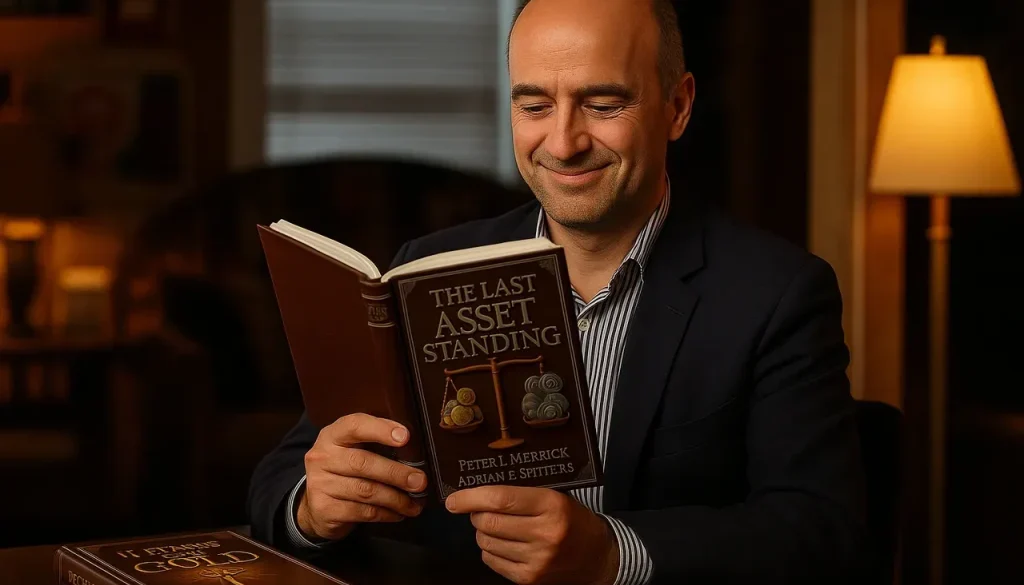
Protect Wealth as Global Money Cracks Under Pressure
By Peter J. Merrick, TEP® and Adrian C. Spitters, CFP®, co-authors of the international bestseller It Starts With Gold™ and the forthcoming book Guns, Gold & Land™
This analysis continues a series of long-form investigations published in The Merrick Spitters Reset Report™
Central Banks Hoard Gold, Digital Currencies Rise, And The West Risks Losing Financial Independence
A profound shift is unfolding in the global financial system. Central banks are hoarding gold at levels not seen in decades, while governments are racing to roll out programmable currencies that could redefine the meaning of ownership itself. For those in the United States, Europe, and across the broader West, these developments are no longer abstract. They are urgent warnings that financial autonomy is at risk, and the time for defensive action is now.
This article explores why gold is returning as a cornerstone of sovereign strategy, how programmable money threatens personal and economic freedom, and what individuals in the West can do to protect their wealth before it is too late. It also draws on the insights of economist Richard Werner, who has spent decades exposing the hidden powers of central banks and their far-reaching influence over economies, politics, and even war.
Richard Werner: The Economist Who Pulled Back the Curtain
Richard Werner is a German-born economist who has spent his career challenging the financial establishment. He studied at the London School of Economics and earned his doctorate at Oxford University. In the 1990s, he worked in Japan as a consultant to the Bank of Japan, where he witnessed firsthand how central banks manipulate economies. His book Princes of the Yen (2001), which became a bestseller in Japan, exposed how central banks use credit creation to engineer booms and busts as a means of restructuring economies. It sold more copies than Harry Potter in Japan that year and remains one of the most influential works on central banking.
Stay informed. Stay protected. Subscribe to It Starts With Gold™ on Substack to get the latest article straight to your inbox. 👉 SUBSCRIBE HERE
Werner’s work goes far beyond academic theory. In a recent interview, he revealed how central banks like the U.S. Federal Reserve and the Bank of England, both of which operate as privately controlled entities, wield extraordinary, often unchecked power. He connected the rise of central banking to warfare, explaining how these institutions have historically financed wars and exploited crises to consolidate financial power. Werner also exposed the disturbing links between the banking system, intelligence agencies like the Central Intelligence Agency (CIA), and the military-industrial complex. His conclusion was stark: central banking has long been a mechanism for both economic control and geopolitical dominance.
The Gold Rush Nobody Is Talking About
While mainstream media fixates on stock market fluctuations and short-term interest rate policies, central banks are quietly engaging in what can only be described as a modern gold rush. According to the World Gold Council, central banks added 415 metric tonnes of gold in the first half of 2025, a pace 41% higher than the 2010–2021 average, despite a slowdown in the second quarter to 166 tonnes, still well above historical norms. By the end of 2024, official gold reserves reached nearly 36,000 tonnes, levels approaching those of the 1960s, when gold underpinned the Bretton Woods system. Surveys of reserve managers show that 95% expect global gold holdings to rise in the next 12 months, with 43% planning to increase their own holdings.
Poland, Turkey, China, and India stand out among the largest buyers, but this is a global movement. These reserves now represent roughly 20 percent of all central bank reserves worldwide, making gold the second-largest reserve asset after the U.S. dollar. This surge is not about diversification alone. It is about power.
The sanctions imposed on Russia in 2022 revealed a chilling truth: reserves held in Western-controlled financial institutions can be frozen or seized overnight. Gold, in contrast, is a no-counterparty asset. It cannot be digitally blocked, erased, or politically weaponized. Nations like China and Russia understand this and are building gold stockpiles to shield themselves from the geopolitical leverage of Washington and Brussels. For them, gold is a tool of resistance against a dollar-centric system they view as unstable and increasingly hostile.
For Western citizens, this raises a sobering question: if even powerful nations no longer trust the current financial order, how safe are individual savings held within that same order?
Programmable Money: A New Kind of Control
While central banks hedge with physical gold, they are simultaneously experimenting with a tool of unprecedented control: programmable money.
Central Bank Digital Currencies (CBDCs) are at the forefront of this effort. As of mid-2025, 137 countries representing 98% of global GDP are exploring CBDCs, with 72 in pilot or launch phases. The Bahamas, Jamaica, and Nigeria have already rolled out fully operational versions. Major Western economies, including the European Central Bank’s digital euro project, the Bank of England’s “Britcoin,” and advanced research by the U.S. Federal Reserve and Bank of Japan, are also moving steadily toward implementation. These digital currencies are marketed as innovations to promote inclusion and efficiency, but the reality is far more complex and far more dangerous.
Programmability means that money becomes software. It allows governments to encode rules directly into currency. In Thailand, for example, a government-issued digital wallet for economic stimulus excluded certain merchants and prohibited cash conversion, effectively dictating how and where citizens could spend their funds. Legal experts warn that this kind of conditional spending erodes the fundamental characteristics of money as a neutral medium of exchange.
This power goes far beyond stimulus programs. Imagine a future where governments can restrict purchases of certain goods, freeze funds based on political activity, or impose expiration dates on savings to enforce consumption. These are not conspiracy theories. They are features openly discussed in policy papers by central banks and organizations like the Bank for International Settlements.
Richard Werner has described CBDCs as “the ultimate tool of control,” warning that their implementation could lead to a future where governments can track, limit, and even cancel transactions at will. For Western societies that claim to champion individual freedom, this presents a paradox. By embracing programmable money, they risk building the infrastructure for financial surveillance and behavioral control, fundamentally altering the relationship between citizens and their governments.
How Central Banks Create Money vs. How Banks Create Money
Richard Werner’s research forces us to confront a critical truth: central banks and commercial banks do not create money in the same way, nor for the same purposes.
Central banks like the U.S. Federal Reserve create “base money.” This is the money used by commercial banks to settle transactions with one another and meet regulatory requirements. Base money creation typically enters the financial system through mechanisms like government bond purchases or emergency liquidity programs. It is a tool of policy, often designed to influence interest rates, stabilize the banking system, or fund government borrowing.
Commercial banks, by contrast, create “broad money” through the process of credit creation. When a bank issues a loan, it does not lend out existing deposits. It creates new money on the spot by crediting the borrower’s account with a deposit. This newly created money can be used immediately for transactions, which is why commercial bank lending has an outsized impact on the real economy. Werner’s empirical research proved this point in Japan, directly observing that bank loans expand the money supply by creating new purchasing power.
This distinction was at the heart of one of the most puzzling financial phenomena of the late 1980s and early 1990s: how Japanese investors managed to purchase iconic U.S. assets like Rockefeller Center and Pebble Beach while Japan itself was facing a bursting real estate bubble and a collapsing stock market. According to Werner, the answer lies in credit creation. Japanese banks, flush with aggressive lending policies, were creating new credit in yen and dollars, empowering domestic investors to buy premium foreign assets even as their domestic markets teetered. The scale of this credit creation explains how Japan, despite its internal economic turmoil, managed to flood international markets with capital and secure trophy properties in the United States.
Understanding this dynamic matters today. It reveals why bank-driven credit booms often fuel asset bubbles far beyond domestic borders and why unchecked commercial lending can destabilize entire economies.
Why Western Nations Are Vulnerable
Western nations remain deeply tied to the U.S. dollar and a legacy banking system that is losing credibility abroad. Yet, they are lagging behind in hard-asset accumulation. While China and other BRICS nations use gold to insulate themselves from Western sanctions and currency volatility, much of the West continues to prioritize digital financial innovation over real, tangible reserves.
This leaves Western economies doubly exposed. On one hand, they risk losing influence as gold-backed trade networks and reserve diversification by BRICS nations undermine dollar dominance. On the other hand, they are racing toward programmable currency systems that may hand unprecedented power to their own central banks, power that could be turned inward on their own citizens during a crisis.
According to the International Monetary Fund, the U.S. dollar’s share of allocated official currency reserves slipped to 57.74% in Q1 2025, down from roughly 71% in 1999. This decline reflects a slow but steady move away from the dollar as countries diversify into gold and other currencies. In this new monetary order, the West could find itself squeezed between external challengers and internal overreach, a position of declining sovereignty that will filter down to the individual level. Those holding tokenized claims within centralized systems could discover that their “money” is not theirs at all.
At our firm, we assist clients in structuring wealth by Owning Assets in Order of Asset Confiscation. We prioritize the most secure assets and safeguard those that are most vulnerable.
Book your complimentary review to learn how to structure for the shifts ahead.
Practical Strategies for Defense
- Emulate Central Banks with Physical Gold If central banks trust gold to protect against systemic shocks, individuals should do the same. Physical bullion, held securely and outside the banking system, offers a defense against both inflation and financial censorship.
- Reduce Dependence on Programmable Systems Programmable money will likely become unavoidable in mainstream transactions, but individuals can limit their exposure by holding non-programmable assets. This includes physical gold, real estate, and in some cases, decentralized assets that resist unilateral government controls.
- Diversify Across Jurisdictions Western citizens should consider diversifying asset holdings internationally. Exposure to multiple jurisdictions can reduce the risk of any single government asserting complete control over wealth.
- Build Layers of Liquidity In times of crisis, access to liquid assets is vital. This does not mean keeping all assets in banks. Instead, build a hierarchy of liquidity, some immediately accessible, some insulated for long-term protection.
- Support Local Banking Initiatives Werner advocates for decentralized, state-owned banks like the Bank of North Dakota. These institutions can serve communities, support small businesses, and reduce dependence on mega-banks tied to the Federal Reserve system.
The Stakes Could Not Be Higher
The developments we are witnessing are not academic. They are deeply personal. A shift away from neutral, bearer-based money toward programmable, conditional currency marks a turning point in economic history. It is a turning point that could render traditional concepts of ownership obsolete if left unchecked.
For the United States and its allies, this is also a geopolitical battle. Losing control over the global monetary order will reverberate through trade, defence, and domestic stability. Yet the real crisis will be felt in households when savings lose their independence and every transaction becomes subject to scrutiny and approval.
Hope Through Action
While these threats are serious, they are not insurmountable. Individuals still have the power to safeguard what they own. Central banks have shown the path forward: hold tangible, unencumbered assets. Wealth, when structured properly, can withstand the turbulence of a monetary reset.
Collective pressure can also influence how new systems are implemented. If citizens demand privacy-preserving features and strict limits on the programmability of digital currencies, governments will be forced to incorporate those protections.
We believe there is still time to act. Those who plan ahead will not only preserve their wealth but also their autonomy in an era that increasingly seeks to erode it.
Final Thoughts
Central banks are stockpiling physical gold to insulate themselves from the risks of their own policies. Governments are encouraging the public to adopt programmable, traceable money. BRICS nations are leveraging gold to challenge the United States’ financial dominance. Western nations, lacking adequate reserves, risk subordination in any new order.
For individuals, the message is clear: do not confuse tokenized claims with true ownership.
These urgent themes are expanded upon in our number one international best-selling book, It Starts With Gold™, co-authored by Peter J. Merrick and Adrian C. Spitters. In the book, we reveal how individuals can structure and secure wealth in the face of monetary centralization trends using the framework of Owning Assets in Order of Asset Confiscation. Visit www.ItStartsWithGold.com.
To find out more, order your own copy of It Starts With Gold™ from Amazon today. CLICK HERE
References
- World Gold Council – Central Bank Gold Reserves Survey 2025
- World Gold Council – Gold Demand Trends 2025
- FXStreet – Central Bank Gold Buying Slows in Q2 but Remains Above Average
- China’s covert gold buildup and strategic dollar escape
- IMF – Currency Composition of Official Foreign Exchange Reserves (COFER)
- Federal Reserve – The International Role of the U.S. Dollar (2025)
- Atlantic Council – Central Bank Digital Currency Tracker
- European Central Bank – Digital Euro Project
- Bank of England – Digital Pound (“Britcoin”) Project
- Programmable money projects and conditional spending risks
- Richard Werner Exposes the Evils of the Fed & the Link Between Banking, War, and the CIA
- Tucker Carlson And Richard Werner Just Exposed The Banking Cartel (Reaction)