Gold, Bail-Ins, and the Coming Digital Trap: A Wake-Up Call
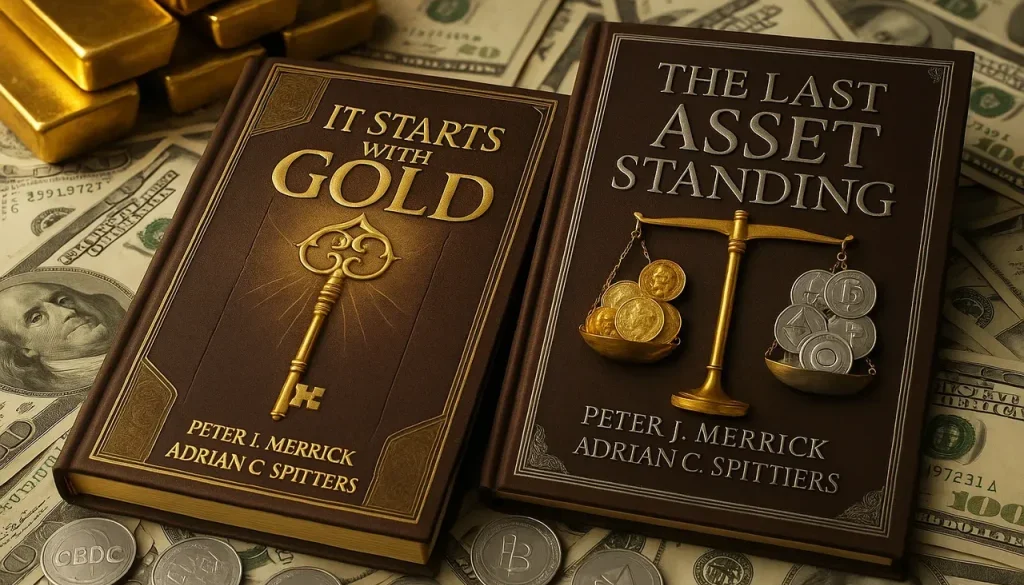
By Peter J. Merrick, TEP® and Adrian C. Spitters, CFP®, co-authors of the international bestseller It Starts With Gold™ and the forthcoming book Guns, Gold & Land™
This analysis continues a series of long-form investigations published in The Merrick Spitters Reset Report™
As Central Bank Digital Currencies near rollout, wealth faces the greatest confiscation threat in modern history
This article explores how Central Bank Digital Currencies, bail-in statutes, and custody structures converge into what could become the largest wealth transfer in modern history. It is presented as an opinion and is intended to inform and invite dialogue for both U.S. and international readers.
The Clock Is Running Out
A recent podcast with a seasoned precious-metals and markets analyst confirms what many already suspect: the global financial system is not lurching toward instability by chance. In their view, it is being guided toward a controlled demolition. The sequence this expert outlines is credible: market shock, targeted bail-ins, and the steady replacement of cash by Central Bank Digital Currencies.
Where this article diverges from more aggressive forecasts is the speed. The rollout of Central Bank Digital Currencies and the turning of financial assets into digital tokens will not be a single weekend event in the United States or across allied economies. It will be phased, with pilots, updates to how banks settle with each other, and then a gradual pull into full retail use. That slower pace is not a comfort. It is a trap. People confuse a gradual tightening with safety and lose critical time.
Stay informed. Stay protected. Subscribe to It Starts With Gold™ on Substack to get the latest article straight to your inbox. 👉 SUBSCRIBE HERE
To protect your wealth from what is unfolding, we advocate Owning Assets in Order of Asset Security. Put first what others cannot easily freeze, use, or take. Keep core assets under your direct control. Then spread access across different countries and companies, so one problem does not stop you. Only after that should you add assets that depend on an institution’s promise to pay. With this base in place, timing is a tactic, not the plan.
Aggressive Timeline Claim
Disclaimer: The timeline below reflects one commentator’s opinion and speculation. It is not based on hard facts, official announcements, or verifiable implementation schedules.
Below is the compressed timeline as promoted by a precious-metals commentator. It assumes a near simultaneous cascade that forces CBDC adoption within weeks.
- July to September 2025 A coordinated cyber or banking outage topples funding across Western markets.
- October 2025 The European Central Bank flips the switch to a retail digital euro.
- November to December 2025 The United States and Canada follow within weeks with retail CBDCs.
- Weeks 1 to 4 after launch Cash conversion windows impose punitive exchange schedules that worsen each week.
- By early 2026 Cash is fully withdrawn and CBDCs run daily life across Western allies.
Debunking the Compressed Timeline (and What a Real Rollout Looks Like)
Public facts do not support that pace:
- Europe is in a preparation phase, not a retail go-live in October 2025. The European Central Bank is working on the rulebook, privacy choices, merchant feedback, prototypes, and the legal groundwork, not immediate retail issuance.
- Switzerland’s live testing is wholesale (bank-to-bank) and extends well beyond 2025. The Swiss National Bank’s partner work runs into 2026 and beyond. This is backbone plumbing, not overnight retail adoption.
- The United Kingdom is still designing and consulting. No decision has been taken to issue a retail CBDC, and any move would sit later in the 2020s and require legislation.
- Canada states there is no decision to issue a digital dollar. The Bank of Canada has scaled down its work and would only move forward if Canadians, through elected representatives, decide to proceed.
- The United States has made no decision and would only proceed with a law from Congress and support from the executive branch.
- Early retail deployments show adoption challenges. Nigeria’s eNaira has faced real-world hurdles with public use.
What this means in practice: crisis may act as a catalyst, but the path is staged. First come wholesale rails that settle between banks and market systems, plus clear laws and privacy rules. Then come small retail pilots. Only after testing and fixes would broad retail use arrive. Expect years, not weeks.
From Fiat to Failure: Why Gold Still Holds the Line
History leaves little room for optimism about the long-term survival of paper money once it is cut off from gold. Over time, more money is created, and each unit buys less. That is not just higher prices at the store. It is dilution of the money itself.
Gold and silver are different. They are not anyone’s promise and do not rely on an institution to make you whole. Across wars, regime changes, and inflations, they protect buying power. They cannot be turned off by a policy switch.
Bail-Ins: The Quiet Law That Makes You an Unsecured Creditor
In many Western countries, the post-2008 model puts losses on shareholders, creditors, and, where applicable, large depositors. In Canada, bail-in powers sit in federal law and can turn certain long-term bank liabilities into shares during a failure. Separately, the Bank Act is scheduled for routine review in 2026. That review date is not a switch-on for bail-ins and should not be read as a deadline or trigger.
For the United States, Federal Deposit Insurance Corporation coverage applies to eligible deposits up to set limits. It does not cover stocks, bonds, mutual funds, or the contents of safe deposit boxes. Brokerage accounts fall under the Securities Investor Protection Corporation, which protects up to 500,000 dollars with a cash sub-limit. These safeguards do not guarantee market value and do not stop failure procedures that restructure liabilities.
Real-world cases show how fast losses can arrive. In 2013, some Cyprus depositors with large balances took cuts near half their savings. In 2015, Greece set daily withdrawal limits around 60 euros. These are case studies, not theories.
CBDC Rollout: Crisis as Catalyst, but a Phased Transition
Central Bank Digital Currencies will not be introduced during calm seas. Policymakers will leverage a crisis narrative to justify speed and scope. The likely path begins with wholesale rails that settle between banks and market infrastructures, followed by constrained retail pilots. Across major jurisdictions, central banks are prioritizing wholesale settlement upgrades and live pilots before any broad retail launch.
Respected voices in the macro and gold space reinforce a more realistic rollout:
- Willem Middelkoop, Dutch author, investor, and founder of the Commodity Discovery Fund, well known for The Big Reset. He frequently comments on gold, macroeconomics, and monetary system shifts, and has discussed CBDC timelines in interviews such as this Palisades Gold Radio.
- Catherine Austin Fitts, former U.S. Assistant Secretary of Housing and investment banker, now publisher of The Solari Report. She is a vocal critic of CBDCs, digital identity, and centralized financial control systems, as outlined in her Solari CBDC Portal.
- Academic voice: An unnamed university or think-tank researcher providing analysis on city-level CBDC pilots, such as those described in the NBER Working Paper on India’s Retail CBDC Pilots and the BIS Project Tourbillon Report.
- Senior central banking speeches: Public remarks from central bank leaders on CBDC development, such as Christine Lagarde’s July 2025 remarks the Federal Reserve’s CBDC FAQ, the Bank Of England And HM Treasury’s 2024 Digital Pound Consultation Response, and the Bank of Canada’s Digital Dollar Page confirming scaled-down work and no-decision stance.
- Lynette Zang, Chief Market Analyst at ITM Trading, known for her research and public commentary on gold, silver, CBDCs, and systemic risks, including tokenization timelines. See also her talk on A Full Surveillance Economy Under CBDCs.
- Peter Hambro, a veteran bullion-market executive, argues that central banks are accelerating gold accumulation and that “paper gold” structures can distort price discovery, a view echoed by analyses alleging heavy reliance on derivatives in official-sector operations, such as BullionStar Singapore’s “BIS: Central Banks Are Rigging the Gold Market Using Paper Gold”.
- Martin Armstrong, a cycle analyst, warns that CBDCs are a tool to eliminate cash and tighten tax and compliance controls, stressing that adoption will be staged but persistent once legal structures are in place, as also noted in his post “CBDC – The Real Target.”
Taken together, these voices point to the same conclusion: crisis may be used to accelerate milestones, but a retail Central Bank Digital Currency arrives only after multi-year groundwork. Legal authority, privacy rulebooks, digital identity, merchant and point-of-sale integration, wholesale settlement upgrades, and parallel tokenization all have to be built and tested through staged pilots first. Central bank gold buying and market plumbing shifts signal preparation, not an overnight switch, so expect a phased rollout rather than a sudden flip.
Programmable Money: The End of Financial Freedom
Central Bank Digital Currencies are not simply dollars in an app. They can have built-in rules. That means limits on what you buy, how often, where, and under what conditions.
Automatic compliance, carbon quotas, travel blocks by location, and time windows all become possible. Some policy papers in the West already discuss using CBDCs for targeted payments, fast tax collection, and focused stimulus. Once cash is removed, there is no untracked option inside the system.
The Great Taking: The Illusion of Asset Ownership
Most investors think they own the stocks in their brokerage accounts. In the United States, most shares are held in street name, which means a central securities depository holds legal title through a nominee, and customers hold a beneficial interest. This setup is fast for trading, but rules can change in a crisis. Regulators and courts can freeze, convert, or pause transfers to keep markets stable. The film The Great Taking raises this risk to the wider public. Whatever one’s view of the film, the custody facts are public and not disputed.
Credit Unions Are Not Immune
Some Americans treat credit unions as safer. They have a different regulator and insurance, but in a system-wide funding crunch they face similar stress. Large withdrawals can be delayed and special measures can be used. The same is true for similar cooperative models abroad.
Safety Deposit Boxes: A False Sense of Security
Banks rent safe deposit boxes. The contents are not deposit accounts and are not insured by the FDIC. Contracts often deny responsibility for what is inside. History shows that in crises, authorities can seal boxes, audit contents, and, in certain cases, restrict access or seize items. In 1933, when the United States ordered the handover of monetary gold, bank-held metal was targeted first. If you do not control the keys or the country, you do not fully control the asset.
How the Wealthy Are Preparing
Families with significant wealth who understand money cycles are repositioning. They buy physical gold and silver, split storage across stable countries, and add productive land, water rights, and steady energy systems. They avoid real estate that does not produce cash flow or self-reliance. For small, everyday trades, silver is often more practical than gold because it can be used in smaller amounts.
This Is a Global Shift
While this article often cites the United States, allied countries will face similar steps. The Bank for International Settlements coordinates research and tests across central banks. The International Monetary Fund releases policy guides and handbooks. In Europe, the European Central Bank leads work with lawmakers. In Switzerland, the central bank has moved from lab work to live pilots that connect tokenized securities with central bank money. As Europe builds the wholesale rails and legal base, allies will follow at the infrastructure level, then step into retail use in stages.
Our Framework: Owning Assets in Order of Asset Security
At our firm, we assist clients in structuring wealth by Owning Assets in Order of Asset Security. We prioritize the most secure assets and safeguard those that are most vulnerable.
Book your complimentary review to learn how to structure for the shifts ahead.
Final Thoughts
The largest wealth transfer in modern history will not be a single weekend event. It will arrive in waves. There will be shocking moments such as bank holidays, funding freezes, capital controls, and headline bail-ins. Then there will be slower squeezes such as staged Central Bank Digital Currency rollouts, wider use of digital tokens for assets, and the steady removal of cash.
The sequence is set. The timeline is elastic. That elasticity is exactly why preparation matters.
The urgent themes in this article are expanded on in our #1 best-selling book, It Starts With Gold™, co-authored by Peter J. Merrick, TEP® and Adrian C. Spitters, CFP®. In the book, we reveal how to prioritize assets by security, diversify across jurisdictions, and use resilient money and real property to ride out a digital clampdown.
To learn more, Visit: www.ItStartsWithGold.com or
Order your own copy of It Starts With Gold™ from Amazon today. CLICK HERE.
References
- Bank Act, Section 21 and resolution powers, Government of Canada
- European Central Bank digital euro preparation phase, Third Progress Report and press release, July 16, 2025
- European Central Bank digital euro timeline hub
- Swiss National Bank extends and expands Project Helvetia, press release, June 30, 2025
- Project Helvetia overview, Swiss National Bank
- International Monetary Fund Central Bank Digital Currency Virtual Handbook portal
- International Monetary Fund Working Paper, Nigeria’s eNaira, One Year After, May 16, 2023
- International Monetary Fund Fintech Note, Central Bank Digital Currency Adoption, 2024
- Cyprus bail-in precedent, Reuters, 2013
- Greece capital controls and 60-euro withdrawal limits, The Guardian, June 29, 2015
- FDIC, Financial Products Not Insured by the FDIC
- FDIC, Understanding Deposit Insurance
- U.S. SEC Investor Bulletin, Holding Your Securities
- Securities Investor Protection Corporation, What SIPC Protects
- DTCC Operational Arrangements, nominee and eligibility language
- DTCC Blanket Issuer Letter of Representations, beneficial ownership and nominee details
- Federal Reserve, Money and Payments: The U.S. Dollar in the Age of Digital Transformation, Discussion Paper
- Federal Reserve, Financial Stability Report note on CBDC authorization
- Bank for International Settlements, Agustín Carstens, Central banking: embracing change
- Executive Order 6102, full text, American Presidency Project
- The Great Taking, documentary hub with film and source materials
- Willem Middelkoop interview on system reset timelines, Kitco News, March 7, 2025
- Catherine Austin Fitts, Solari Report, Take Action: Stop CBDCs
- Lynette Zang, Wall St and DC look to tokenize everything. CBDCs soon, ITM Trading, Dec 8, 2023
- Andy Schectman interview, The Deep Dive
- Martin Armstrong, CBDC: The End Of Money, film page
- Martin Armstrong, CBDC: The Real Target, analysis
- Bank of England, digital pound overview and updates
- Bank of Canada, Contingency planning for a digital Canadian dollar
- Impact of Retail CBDC on Digital Payments, and Bank Deposits: Evidence from India. NBER Working Paper No. 32457 (May 2024; revised Mar 2025).
- Bank for International Settlements. Project Tourbillon: exploring privacy, security and scalability for CBDCs. BIS Other Publications No. 80 (Nov 29, 2023).
- Palisades Gold Radio. Willem Middelkoop — The Commercial Bank Silver Cabal Is Cracking (Interview page).
- Federal Reserve. Central Bank Digital Currency — FAQs.
- European Central Bank. Press Conference — 24 July 2025 (Transcript/Video).
- Bank of England and HM Treasury. Response to the Digital Pound Consultation Paper. January 2024.
- Bank of Canada. Digital Canadian Dollar (project status and resources).