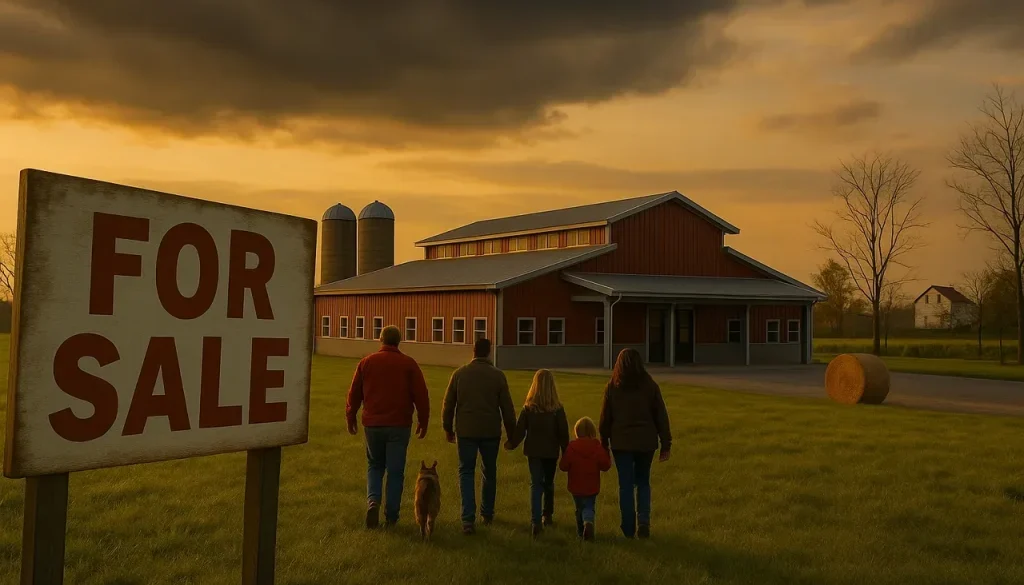
Farm Roll-Overs: The Hidden Tax Bomb
By Peter J. Merrick, TEP® and Adrian C. Spitters, CFP®, co-authors of the international bestseller It Starts With Gold™ and the forthcoming book Guns, Gold & Land™
This analysis continues a series of long-form investigations published in The Merrick Spitters Reset Report™
How Ottawa’s Fiscal Crisis Could Trigger the Largest Wealth Transfer in Canadian History
Canada’s Hidden Pool of Tax Revenue
The Government of Canada, burdened by record deficits and a national debt that has surpassed C$1.3 trillion, now spends more than C$54 billion annually just to cover interest. Reports from the Parliamentary Budget Officer (PBO), an independent fiscal watchdog, warn that these deficits are “structurally entrenched.” The major credit-rating agencies have echoed the same concern. Canada’s federal finances have reached the point where conventional taxation cannot fill the gap.
When governments reach a fiscal crisis, they hunt for untapped sources of wealth. One of the largest is hidden within family-owned farmland through the intergenerational farm roll-over, a rule in the Income Tax Act of Canada that allows farmers to transfer ownership of qualifying farm property to their children or grandchildren without paying capital gains tax, the tax owed on the profit realized when a capital asset is sold for more than its original purchase price.
Under this rule, the property can be transferred to the next generation at an elected amount, usually between its adjusted cost base (ACB) and its fair market value (FMV). Most families elect an amount near the ACB to defer capital gains, allowing the tax to be postponed until the property is sold or transferred outside the family. The result is that tax on the accrued gain is deferred, not erased. Each transfer preserves the adjusted cost base (ACB) from decades earlier, meaning that the gap between what the land cost and what it is worth continues to widen. What looks like protection is, in reality, a deferral that grows larger with every generation.
When the farm is finally sold, or when no rollover applies at death or transfer, the accumulated gain becomes taxable all at once. The tax liability can consume a large share of the sale proceeds. Ottawa sees this as an immense pool of unrealized revenue, a potential windfall it could unlock with a single policy change.
History proves that distressed governments often seize private wealth. Argentina nationalized private pension plans in 2008; Ireland raised property taxes on farmland during its 2010 crisis; Cyprus froze and confiscated a portion of bank deposits in 2013. Even Canada has changed the capital gains inclusion rate, altering the percentage of gain that is taxable. The lesson is clear: deferral is not protection. It is a promise that the government can choose to collect whenever convenient.
👉 If you like what we write, please subscribe to The Merrick Spitters Reset Report™ and receive a digital copy of our international bestseller, It Starts With Gold™, along with our white paper, Last Asset Standing™ and early updates on our forthcoming book, Killing Crypto™.
A Legacy Built to Be Taken
We write not as detached commentators but as financial advisors who have guided farm families for decades. We have watched fathers hand ledgers to their sons, mothers struggle to keep the land in the family, and children inherit both soil and stress. Both of us were born in Canada. We know its promise and its failures.
Today, Canadian farm families stand in a system that punishes ownership. What is promoted as a safeguard, the farm roll-over, is actually a ticking time bomb. Each generation that defers capital gains adds to the tax exposure of the next. When the final sale happens, the compounded tax bill can be staggering.
This is not mere policy drift. It reflects a deeper political reality: a government desperate for revenue will inevitably look to accumulated private wealth. The roll-over system makes farm families an easy target.
The Farm Roll-Over Trap
Canadian tax law allows parents to transfer qualifying farmland to children or grandchildren without paying capital gains tax, provided that the property meets the “farming-use” conditions set out for qualified farm property (QFP). This is the mechanism known as the intergenerational roll-over.
The rule does not erase the tax; it postpones it. Each successor inherits the land along with the latent liability. The deferred gain is triggered when the property is sold, when a transfer occurs to someone who does not qualify for the rollover, or upon death if no further deferral applies. In that moment, the gain becomes taxable, and the resulting capital gains tax bill can sharply reduce the family’s after-tax proceeds.
One planning tool, the Lifetime Capital Gains Exemption (LCGE), provides limited relief. For 2025, the Lifetime Capital Gains Exemption (LCGE) allows each individual to shelter up to $1.25 million in capital gains from tax when disposing of qualifying farm or fishing property. However, many family farms are worth far more than that threshold, meaning that large portions of their appreciation remain fully taxable when sold. Without early planning, the tax exposure can reach into the millions.
The danger lies in how easy it would be for Ottawa to change the rules. The federal deficit makes the temptation obvious. Restricting the roll-over or lowering the LCGE could instantly unlock billions in deferred revenue. For farm families, such a move would feel less like a policy tweak and more like detonation, the destruction of the financial legacy they have built over generations.
A family’s greatest asset could become its greatest liability, not because of market forces but because of legislative ones.
Ottawa’s Weaponization of Uncertainty
In recent years the federal government has repeatedly floated proposals to increase the capital gains inclusion rate, including the 2024 plan to raise it from one-half to two-thirds, the proportion of a realized gain that is taxable. Although that plan was later deferred and ultimately cancelled, it revealed how easily Ottawa can alter the rules when fiscal pressure mounts. Even when proposals are delayed or revised, the mere suggestion erodes confidence. Families rush to update succession plans; accountants and lawyers scramble to recalculate exposure; and farmers conclude that the rules could change again at any time.
This uncertainty is not accidental. Governments in fiscal trouble often use policy ambiguity to condition the public for heavier taxation. Argentina’s pension takeover began after years of contradictory statements. In Cyprus, reassurances that deposits were safe came only weeks before they were frozen. Canada’s own history of sudden capital-gains rule changes fits the same pattern: trial balloons, leaks, and reversals that soften the ground for the eventual blow.
Taxation, once justified as a means of funding government, has evolved into an instrument of control. The power to impose tax, and to alter exemptions at will, gives Ottawa a lever over every transfer of wealth, including the intergenerational transfer of farms.
Regulatory Overreach: The Canadian Food Inspection Agency (CFIA)
The Canadian Food Inspection Agency (CFIA), the federal body charged with protecting food safety and animal health, has become a symbol of regulatory overreach in agriculture. Through mandatory livestock culls and sweeping biosecurity orders, legal directives intended to contain disease outbreaks but often issued pre-emptively, the CFIA can wipe out an entire operation overnight.
Farmers who question or resist these orders are frequently portrayed as reckless, regardless of evidence. Compensation seldom reflects true market value, and payments may be delayed for months. The destruction of herds or flocks can bankrupt families long before relief arrives. Independence disappears, not through drought or flood, but through the pen of a regulator.
The recent Universal Ostrich Farm case in British Columbia (BC) illustrates this power imbalance. The farmers maintained that their birds were healthy and that relocation offers from buyers in the United States proved their commercial value. Yet the CFIA pressed ahead with a mass-cull order in the name of “avian influenza control.” The dispute escalated into court proceedings and national headlines.
When a federal agency can erase years of work with a single directive, it is clear that independent farming operates under constant threat. The same vulnerability exists within the tax system. The deferred liability embedded in every farm roll-over represents another trigger that the government can pull at any time.
Traceability: The Surveillance Net
A growing web of traceability programs, systems that digitally record and track livestock, crops, and farm inputs, has been written into Canadian law in the name of biosecurity and market access. These programs require farmers to tag animals, log movements, and upload data into central databases.
While presented as tools to protect consumers and strengthen trade, traceability also enables government surveillance of every stage of production. Non-compliance can trigger administrative fines, loss of operating licences, or even the destruction of animals.
For farmers already struggling under debt and compliance burdens, a failed audit or minor clerical error can escalate quickly. For families holding land with roll-over-deferred gains, a compliance penalty can force liquidation, and when the farm is sold the deferred capital gains tax comes due. What was once a bookkeeping issue can become a financial catastrophe.
Climate Finance: The Trojan Horse
Agriculture has been pulled into the architecture of climate finance, a global policy system that ties credit, insurance, and access to capital to carbon-emissions reporting and environmental, social, and governance (ESG) performance metrics. Ottawa and its allies now value farmland not for its yield but for its emissions profile.
Programs such as the Agricultural Climate Solutions Program, launched by Agriculture and Agri-Food Canada (AAFC), promote “sustainable practices” but increasingly pressure farmers to finance new technologies and carbon-credit schemes with debt. Credits, penalties, and complex reporting obligations now determine who survives.
In British Columbia, Bill 7, the Emergency and Disaster Management Act, incorporated the United Nations (UN) Sendai Framework for Disaster Risk Reduction 2015–2030, a global agreement intended to guide governments in managing climate-related emergencies. The Act gives provincial officials broad authority to restrict land use or seize property during declared emergencies.
For families with farms carrying decades of deferred gains, one climate emergency declaration could make operations unviable, leading to a sale that crystallizes the tax liability and drains the family’s accumulated wealth.
UNDRIP, DRIPA, and the End of Property Rights
The United Nations Declaration on the Rights of Indigenous Peoples (UNDRIP) and its provincial implementation through British Columbia’s Declaration on the Rights of Indigenous Peoples Act (DRIPA) were introduced to strengthen reconciliation. Yet these frameworks have also injected uncertainty into long-established land titles.
The Haida Gwaii decision by the Supreme Court of Canada (SCC) confirmed that governments must consult and, in some circumstances, accommodate Indigenous claims even on privately held or leased lands. For farmers who depend on the ability to use, transfer, or pledge land as collateral, evolving interpretations of title raise new financial and legal risks.
The danger is double: farmers face the possibility of ownership challenges under UNDRIP and DRIPA at the same time as they carry deferred capital-gains exposure that will be taxed on disposition. The convergence of the two forces, legal uncertainty and fiscal confiscation, could permanently reshape rural Canada.
Digital Identity and Programmable Money
The Bank of Canada, the country’s central bank, continues to study the creation of a central-bank digital currency (CBDC), a government-issued electronic form of money. While presented as a convenience and a hedge against private cryptocurrencies, a CBDC is programmable, meaning that transactions could be monitored or restricted automatically according to government-set rules.
In such a system, tax collection and regulatory enforcement could be embedded directly in code. Farmers could find their access to payments, loans, or subsidies conditioned on compliance with carbon targets or livestock quotas. Refusal could mean frozen accounts and forced liquidation of assets, events that would trigger the tax liability deferred by the roll-over.
The 2022 freezing of protestors’ bank accounts under the Emergencies Act, carried out without court orders, provided a preview of what programmable money could make permanent. A CBDC would allow the same control without emergency powers, at the level of individual transactions.
The Global Consolidation of Farmland
All of these pressures, taxation, regulation, traceability mandates, climate policies, and potential financial surveillance, drive family farmers toward the same endpoint: selling.
Institutional and foreign investors are rapidly acquiring Canada’s most productive farmland. Studies by the National Farmers Union (NFU) and Statistics Canada (StatCan) show that pension funds, investment firms, and corporate buyers now control an increasing share of arable land. As family farms disappear, food production and agricultural wealth concentrate into fewer, more powerful hands.
This is how economic sovereignty erodes, not through invasion but through exhaustion and forced surrender.
The Multigenerational Risk Map
Every Canadian farm family is now exposed on multiple fronts:
- Tax Detonation: Deferred gains build through roll-overs, creating a large taxable event when the property is finally sold or transferred outside the family.
- CFIA Overreach: The Canadian Food Inspection Agency can destroy herds or flocks through regulatory orders with little recourse.
- Traceability Mandates: Mandatory digital tagging and reporting systems can create compliance traps that lead to forced liquidation.
- Climate Finance: Debt-based sustainability programs tie farm viability to global ESG frameworks.
- Emergency Powers (Bill 7): British Columbia’s climate-linked emergency law authorizes operational restrictions and land seizures.
- Property-Rights Uncertainty: Court rulings and UN frameworks challenge the security of ownership.
- Digital Surveillance: Central bank digital currencies and national digital identity systems could link financial access to compliance.
- Global Asset Capture: Institutional investors and foreign entities are acquiring farmland as families capitulate.
- Interest-Rate Shock: Higher borrowing costs squeeze cash flow and threaten solvency.
- Succession Pressures: Younger generations are reluctant or unable to continue farming, leading to sales that crystallize deferred taxes.
- Insurance and Compliance Costs: Environmental and ESG-linked insurance structures increase fixed expenses.
- Export Controls and Carbon Tariffs: International trade barriers reduce profitability and competitiveness.
- Historical Precedents: Multiple nations have confiscated or heavily taxed private assets during periods of fiscal crisis. Canada has changed its capital-gains rules before; it can do so again.
The warning signs are no longer subtle. Ottawa has built a financial system that quietly transfers wealth from those who produce to those who govern. Every deferral, every regulatory change, and every new reporting rule strengthens that grip. With deficits mounting and public finances in decline, the temptation to collect from the nation’s most successful builders will soon be impossible to resist.
As these pressures converge, one truth becomes unavoidable: the system is closing in on private ownership. Every mechanism, from taxation and regulation to digital surveillance and climate finance, narrows the space for families to protect what they have built. The farm roll-over, once seen as protection, now functions as a tracking device for future taxation.
To survive in this environment, families must think globally, act strategically, and plan beyond Ottawa’s reach. That begins with taking advantage of the tools available through international tax treaties and cross-border wealth structures that protect capital from domestic policy risk
Survival Demands Planning
Without comprehensive planning, farms built over generations may collapse in a single transaction. With strategic preparation, especially through cross-border wealth planning structures that lawfully leverage the Canada–United States Tax Treaty, families can protect far more of their capital.
A farm valued at $10 million with no plan could face a seven-figure tax bill on sale. Through professional planning, families can preserve millions for their heirs. The choice is clear: continue deferring tax into Ottawa’s future grasp, or act proactively to control the outcome.
Cross-border planning is not abandonment. It is self-defence, a way for Canadians to secure their legacy within an increasingly globalized financial system that rewards indebtedness and penalizes ownership.
Book a Meeting With Us
If your family farm faces succession or sale decisions, the time to act is now.
Together, we bring over seventy years of combined financial planning and estate structuring experience. Adrian C. Spitters, CFP®, and Peter J. Merrick, TEP®, have guided Canadian families through complex wealth transitions and multigenerational planning.
During a confidential review, we will:
- Assess your rollover and estate exposures
- Map cross-border and treaty strategies to preserve capital
- Provide a clear roadmap for protecting your farm’s legacy
👉 Book your complimentary review meeting today
Stay Informed and Strengthen Your Position
👉 Sign up for The Merrick Spitters Reset Report™ to receive a digital copy of It Starts With Gold™, our white paper Last Asset Standing™, and early updates on our forthcoming book Killing Crypto™.
In It Starts With Gold™, we explain how to build a foundation of tangible, non-digital assets, evaluate them by security, and prepare for systemic shocks while maintaining control of your future.
Stay informed. Stay prepared. Take action while you still can.
Would you prefer a hard copy of It Starts With Gold? You can order one from Amazon now.
References
- Government of Canada: Fiscal Reference Tables 2025
- Parliamentary Budget Officer: Fiscal Sustainability Report 2025
- Bank of Canada: Government of Canada Bond Yields and Debt Statistics
- Department of Finance Canada: Budget 2024: Capital Gains Inclusion Rate Changes
- CBC News: Ottawa Hikes Capital Gains Inclusion Rate in 2024 Federal Budget
- CPA Canada: CPA Canada helps navigate tax uncertainty
- Canada Revenue Agency: IT268R4: Inter Vivos Transfer of Farm Property to Child
- Canada Revenue Agency: Farming and Fishing Property: Transfers to a Child
- Canadian Tax Foundation: Nuances in Farm Rollover Rules
- BMO Private Wealth: The Capital Gains Deduction and Intergenerational Farm Property Rollover
- RSM Canada: Tax Implications of Farmland Rollovers
- Fillmore Riley LLP: Sowing the Seeds of Succession: Tax Planning for Intergenerational Farm Transfers
- RBC Wealth Management: Transferring Your Farm to the Family (PDF Guide)
- The Guardian: Order to Cull Over 400 Ostriches in Canada Sparks Protests
- North Shore News: Stay of Ostrich Cull in Southeast B.C. an Ongoing Potential Health Risk, CFIA Says
- Castanet News: Ostrich Farm Pushes Back at CFIA Statement
- National Farmers Union: Losing Our Grip: Farmland Ownership and Concentration in Canada (2022 Update)
- Statistics Canada: Farmland Values and Ownership Report
- Farm Credit Canada: Farmland Values Report 2024
- Government of British Columbia: Declaration on the Rights of Indigenous Peoples Act (DRIPA)
- Supreme Court of Canada: Haida Nation v. British Columbia (Minister of Forests), 2004 SCC 73
- Government of British Columbia: Bill 7: Emergency and Disaster Management Act (2024)
- United Nations: Sendai Framework for Disaster Risk Reduction 2015–2030
- Bank of Canada:Exploring a Digital Canadian Dollar
- Bank of Canada: Summary of Public Consultation on a Digital Canadian Dollar (2023)
- Reuters: Canada Moves Closer to CBDC Framework as Consultations Expand
- Government of Canada: Agricultural Climate Solutions Program
- Government of Canada: Sustainable Agriculture Strategy Discussion Document (2024)
- United Nations Environment Programme: Climate Finance for Agriculture
Peter J. Merrick, TEP®, and Adrian C. Spitters, CFP®, are wealth advisors and co-authors of It Starts With Gold™.