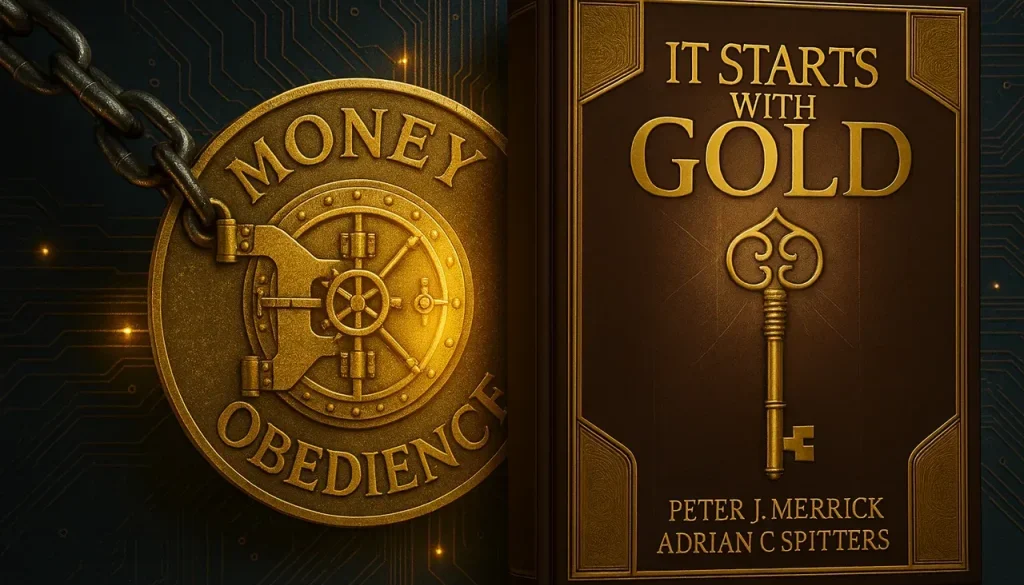
Money Once Measured Value. Now It Measures Obedience
By Peter J. Merrick, TEP® and Adrian C. Spitters, CFP®, co-authors of the international bestseller It Starts With Gold™ and the forthcoming book Guns, Gold & Land™
This analysis continues a series of long-form investigations published in The Merrick Spitters Reset Report™
A hidden financial coup replaced productivity with compliance. Only holders of real assets will withstand the reckoning ahead.

By Peter J. Merrick, TEP® and Adrian C. Spitters, CFP® Co-authors of the international bestseller It Starts With Gold™ and the forthcoming Killing Crypto™
This article represents the authors’ opinion based on publicly available financial data and historical analysis.
The Hidden Coup
Catherine Austin Fitts sounded this warning after decades inside the financial system. Her investigation into trillions in missing U.S. government funds reveals that the modern financial order no longer measures productivity. It measures submission.
The financial system that people were raised to trust no longer behaves like a free market. It has become a managed mechanism of compliance. Catherine Austin Fitts, former United States Assistant Secretary of Housing and Urban Development and founder of The Solari Report, calls this shift a financial coup d’état.
In her video presentation, Financial Coup d’État: $36 Trillion Missing, Fitts explains how this hidden financial takeover unfolded behind the illusion of democratic governance. She details how massive sums were quietly moved off the books through complex accounting maneuvers, black-budget programs, and classified expenditures. Her message is simple and alarming. When trillions vanish from public accounts without accountability, financial systems stop measuring real economic output and begin enforcing control.
According to her research, more than thirty-six trillion dollars have disappeared from United States government accounts through concealed transactions, black-budget programs, and classified expenditures. These are not accounting errors. They represent a transfer of power from public institutions into private networks that now operate beyond law, oversight, or national loyalty.
The evidence is public but rarely discussed. United States Department of Defense (DoD) and United States Department of Housing and Urban Development (HUD) audits show trillions in “undocumentable adjustments.” In 2018, the United States government formalized the practice by adopting Federal Accounting Standards Advisory Board (FASAB) Statement 56. That policy legalized secret spending and allowed entire financial statements to be withheld from public view.
In simple terms, the books were closed. The world’s largest economy now operates with two sets of accounts. One is visible to taxpayers and the press. The other is reserved for the ruling class and the military-industrial complex.
This secrecy was codified, not accidental, when Federal Accounting Standards Advisory Board (FASAB) Statement 56 allowed classified spending to override standard disclosure laws, institutionalizing a dual financial reality inside the United States.
This hidden system was built with the very taxes and savings of the citizens it governs. What began as minor budget concealment after World War II evolved into a vast network of shadow financing. It no longer exists to protect democracy. It exists to protect those managing its decay.
The missing trillions are not a financial crime in isolation. They reveal a deeper reality. Democracy has been replaced by administrative secrecy. The public still votes, but the outcomes are managed by systems that no longer require consent to function.
As you read on, the next step is what secrecy does to price discovery, risk, and the credibility of markets.
👉 Subscribe to The Merrick Spitters Reset Report™ and receive a digital copy of our international bestseller, It Starts With Gold™, along with our white paper, Last Asset Standing™ and early updates on our forthcoming book, Killing Crypto™.
The System Has Gone Dark
The consequences of that hidden architecture are now visible in the structure of global finance. Since FASAB 56, markets have detached from traditional measures of accountability. The Bank for International Settlements (BIS) estimates that global notional derivatives exceed one quadrillion dollars, figures that dwarf global GDP. Some independent analysts, using broader calculations that include shadow banking and off-balance-sheet exposure, believe the true total could surpass four quadrillion dollars, underscoring how deeply the global economy is now entangled in financial engineering.
The BIS also reports that more than eighty trillion dollars in dollar-based derivatives remain off-balance-sheet, hidden from public scrutiny. Meanwhile, the International Monetary Fund (IMF) warns that global debt has climbed above three hundred fifteen trillion dollars, far outpacing any measure of economic productivity.
The expansion of these shadow assets has created a second financial universe where leverage, not value, dictates power. Most citizens still believe the stock market or their pension funds reflect real economic growth. In truth, they are tied to a synthetic ecosystem built on paper claims, collateral chains, and complex swaps that no regulator fully understands.
Hidden leverage becomes policy when losses can be socialized and disclosures can be sealed. Once that dynamic is in place, off-balance-sheet risk stops being an exception and becomes the operating system.
Yet this hidden leverage now sits beneath everything from mortgages to pension funds. What appears as “growth” in retirement accounts often represents exposure to unseen derivatives that depend on artificial liquidity, not genuine productivity.
Meanwhile, the infrastructure of finance has merged with the technology sector. Firms like Palantir Technologies provide surveillance and data-analysis systems for governments, banks, and intelligence agencies. Artificial Intelligence (AI) now filters every loan, monitors every transaction, and models every citizen’s financial behavior.
What once served as a financial system now functions as a digital nervous system of control. The justification is always framed around national security or stability. In practice, these terms have become the moral camouflage for an economy that measures obedience more than productivity.
Every payment, every account, and every transaction is recorded, analyzed, and graded for risk. The line between consumer data and national security data has vanished. The global economy is no longer built on trust. It is built on surveillance.
When Catherine Austin Fitts said that we are governed by people waging war on us, she meant that this control structure is not accidental. It is the logical outcome of a world where information is power, money is information, and privacy has become subversive.
A Parallel Financial Universe
Behind the public economy lies a second, far larger one. It is the architecture of what some have called the Deep State, but it operates more accurately as a supranational financial order. Its existence is sustained through off-book accounting, covert funding, and privatized control.
This network emerged from the postwar national security apparatus. What began as secret funding for intelligence and defense operations evolved into a global shadow system that channels trillions of dollars through shell corporations, derivatives, and asset rehypothecation. The same corporations that built the bombs and satellites of the Cold War now design the data centers, climate algorithms, and smart-city grids of the twenty-first century.
The same pattern echoes across continents. Institutions such as the Bank for International Settlements (BIS), the International Monetary Fund (IMF), and the European Central Bank (ECB) continue to call for transparency while engineering even greater consolidation behind the scenes.
Each crisis in modern history has strengthened this system. The 2008 financial meltdown justified bailouts and emergency lending facilities that funneled liquidity into the same institutions responsible for the crash. The pandemic of 2020 created a new excuse for mass fiscal intervention and data integration between banks, governments, and pharmaceutical companies. Each event advanced the fusion of state and corporate power under the banner of protection.
The European Central Bank (ECB) and the Bank for International Settlements (BIS) have both acknowledged that the concentration of financial power inside opaque derivatives structures now represents a systemic risk to global stability. Yet those same institutions remain the architects of the very system they warn against.
In the old world, banks managed money. In the new world, they manage behavior. Capital allocation has become a form of governance.
The central banks that once acted as monetary stabilizers have redefined their purpose. Their new mandate is to maintain order, not balance. They now function as the quiet enforcers of a digital hierarchy that blurs the boundary between finance and state authority.
This is not capitalism. It is administrative technocracy, a model that converts money into compliance. It uses liquidity as a weapon, regulation as a filter, and access as a leash.
The Collapse of Trust
Every monetary system in history has rested on a single, fragile foundation. Confidence. Once trust is broken, the entire structure collapses, regardless of how powerful or advanced it appears to be.
For decades, people have been conditioned to equate money with stability. They were told that central banks could control inflation, that governments would always meet their obligations, and that financial institutions were the guardians of public prosperity. Yet every crisis of the modern era has exposed that illusion.
The collapse of the Bretton Woods system in 1971 was the moment when money ceased to represent value and became a tool of policy. When President Richard Nixon closed the gold window, he detached the dollar from the metal that had anchored it to reality. Overnight, every major currency in the Western world became fiat.
At first, this seemed like liberation. Governments could now issue debt without restraint, stimulating economies through credit expansion. The stock market soared. Housing boomed. The middle class grew, and the illusion of prosperity deepened. But the foundation of that prosperity was paper, not production.
Once the gold anchor was removed, the age of synthetic wealth began. What followed was the financialization of everything: homes, health care, education, and even time, all traded as assets detached from tangible value.
By the 1980s, deregulation and globalization began to feed a speculative culture. Wall Street no longer finances businesses. It financed bets on bets, derivatives, leveraged buyouts, and interest-rate swaps. In 2008, the system nearly imploded under its own weight. The bailout that followed did not repair the system. It rewired it.
The financial crisis of 2008 marked a turning point. Rather than restore balance, governments and central banks chose to institutionalize moral hazard. The same institutions that had caused the collapse were rewarded with new powers and unlimited access to liquidity. The public was left with debt, inflation, and stagnation.
From that moment forward, finance ceased to serve the economy. The economy became the excuse for endless financial manipulation.
The International Monetary Fund (IMF) now reports that global debt has exceeded three hundred fifteen trillion dollars. The Institute of International Finance (IIF) confirms that debt continues to grow faster than world Gross Domestic Product (GDP) in nearly every major economy. The math no longer works. The system survives only because it can issue more promises than it can ever repay.
Money, once a tool of exchange, has become a mechanism of control. The credit that fuels modern society is no longer backed by productivity but by faith in institutions that no longer deserve it.
The Rise of the Surveillance Economy
When financial systems fail, political systems compensate by increasing control. The post-2008 world ushered in a new era of surveillance capitalism, a merger between the banking system and the digital architecture of Big Tech.
Artificial Intelligence (AI) now drives the allocation of credit, the pricing of risk, and the identification of unusual activity. Data collection is the new form of taxation. Every digital interaction leaves a behavioral footprint that feeds algorithms designed to measure and influence compliance.
Born from post-9/11 counterterrorism work funded by the Central Intelligence Agency (CIA), Palantir’s defense tooling evolved into a civilian-tracking layer woven through finance, law enforcement, and social governance.
The implications of this are profound. It means that finance and surveillance are no longer separate domains. They have fused into one network of behavioral control. The justification is always efficiency or security, but the result is dependency. Citizens are managed not through ideology, but through digital architecture.
The promise of smart cities and cashless economies is a polite way of describing a world where participation is conditional. Access to credit, mobility, and even basic services can be regulated through programmable money. The shift to Central Bank Digital Currencies (CBDCs) is being presented as modernization. In truth, it represents the final stage of financial centralization.
This is not about innovation. It is about obedience.
The End of Economic Reality
For the first time in history, global debt, derivatives, and monetary creation have detached completely from real production. The Bank for International Settlements (BIS) reports that more than eighty trillion dollars in dollar-denominated derivatives now exist outside the regulated banking system. That figure does not include unreported contracts circulating through private exchanges and shadow banking structures.
In practice, this means that the world’s financial system is leveraged beyond comprehension. A chain reaction in one corner of the derivatives market could wipe out the liquidity of entire nations.
When claims outgrow collateral, spreadsheets become politics and politics replaces accounting.
Beneath the complexity lies a moral problem, not a mathematical one. A civilization that replaces labor and production with leverage and illusion cannot sustain legitimacy, no matter how sophisticated its financial engineering becomes.
The system continues to function only because the participants agree to believe it will. It is not built on capital. It is built on confidence.
Yet confidence is the first casualty of deceit. When people lose faith in the honesty of their institutions, they do not merely withdraw their money. They withdraw their consent. That is the moment when systems built on illusion begin to crumble.
The governments of the world know this. That is why their focus has shifted from wealth creation to wealth control. They no longer attempt to grow economies through innovation. They seek to preserve authority through restriction.
Why Precious Metals Still Matter
Gold and silver exist outside the digital system. They do not rely on algorithms, banks, or permission. They have survived every currency collapse in history because they are immune to the lies that destroy paper wealth.
This is why every family, business owner, and nation faces the same decision today: whether to trust an abstract system of promises or to anchor their security in something that exists beyond code and decree.
In that choice sits the difference between custody and control.
For thousands of years, gold and silver have served as the ultimate measure of value. They are not promises, policies, or programs. They are matter itself. Civilizations have risen and fallen, but the metals remain constant. Each time a financial empire collapses, gold and silver quietly return to their original role as money.
When the United States abandoned the gold standard in 1971, it did not destroy gold’s power. It only severed the connection between truth and the currency people used every day. That disconnection allowed governments to create wealth through debt, but it also guaranteed that the system would eventually devour itself.
The European Central Bank (ECB) has acknowledged that a major revaluation of gold could destabilize the derivatives market. The statement was brief and technical, yet it carried enormous meaning. It was an admission that the global financial system is still tethered to gold’s real value, no matter how many digital abstractions are built around it.
The World Gold Council (WGC) reports that central banks are now buying gold at the fastest pace in half a century. Nations like China, Russia, and Turkey are leading the shift. They are exchanging paper reserves for tangible metal as part of a global strategy to reduce exposure to the United States dollar.
These countries understand what the public has been trained to forget. Power belongs to those who hold what cannot be printed.
Owning gold is not a bet on the future. It is a defense against theft in the present. It protects against the slow confiscation of purchasing power through inflation and the fast confiscation that occurs when systems freeze or fail.
Silver deserves equal respect. It has served both as a monetary metal and an industrial necessity. Its dual role gives it unique strength during transitions between monetary and productive cycles. In periods of financial repression, silver’s affordability also makes it the metal of the people.
The authors of It Starts With Gold™ describe precious metals as the first and most secure tier in the hierarchy of wealth protection. They are the moral starting point for any structure built to endure systemic failure. Gold and silver form the base upon which every other asset class must stand if it is to have meaning.
Owning them is not an act of speculation. It is an act of independence. It is a declaration that one’s wealth will not be defined by the integrity of institutions, but by the reality of what exists.
A Moral Foundation for Wealth
Wealth is not an accumulation of numbers. It is a reflection of values. A nation that builds wealth on debt and deception is not creating prosperity. It is engineering collapse.
Gold and silver restore the moral dimension of economics. They remind people that value must come from labor, honesty, and discipline. They cannot be printed to solve a political problem or erased to hide a mistake. They expose corruption by their mere existence.
Throughout history, moral decay has always preceded monetary collapse. When societies lose the distinction between price and value, they lose their freedom. When everything can be manipulated, nothing can be trusted.
Fiat money corrodes not only balance sheets but the moral imagination itself. It teaches people to consume rather than create, to borrow rather than build, and to mistake speculation for achievement.
Gold demands truth. It punishes waste. It rewards those who save and produce rather than those who speculate and deceive. That is why every major civilization has returned to precious metals after each period of economic ruin.
The reason is psychological as much as financial. Gold reconnects people with reality. It forces them to confront the limits of creation and the necessity of restraint.
In contrast, fiat money removes those limits. It promises abundance without effort, security without sacrifice, and power without accountability. Over time, those promises destroy the culture that believes them.
Real wealth is built on character. It requires patience, humility, and foresight. It cannot be borrowed into existence or sustained by illusion. When money loses its moral anchor, society itself becomes unmoored.
Gold and silver restore that anchor. They reintroduce the discipline that governments and corporations abandoned long ago. They draw a clear boundary between what can be owned and what can only be imagined.
To hold physical gold or silver is to hold proof that truth still exists in a world that denies it. It is a silent protest against manipulation and a private affirmation of freedom.
The Great Revaluation
A silent shift is already underway. The same central banks that publicly dismiss gold as outdated continue to accumulate it behind closed doors. The same financial institutions that promote digital currencies maintain physical bullion reserves as insurance against their own systems.
History suggests what will come next. Every great debt cycle ends the same way, through revaluation. When the burden of debt becomes mathematically unpayable, governments must choose between default and devaluation. In either case, currencies lose credibility, and gold rises to reveal the truth that paper concealed.
The modern financial system has reached that point. Global debt now exceeds three times the world’s total economic output. Interest rates cannot rise without triggering collapse, and they cannot fall without accelerating inflation. Policymakers are trapped in a paradox of their own design.
The only path left is a controlled transition into a new system. That transition is already being framed as a digital evolution. Central Bank Digital Currencies (CBDCs) will be marketed as solutions to inefficiency, corruption, and tax evasion. In reality, they will complete the merger between finance and surveillance.
Gold will play the opposite role. It will stand as the benchmark of honesty against which all forms of digital control will be measured. When the world finally loses faith in the illusion of debt-based money, it will rediscover the value of what cannot be corrupted.
Those who act before that revaluation will not merely survive it. They will shape the terms of the next economy, one defined not by credit but by collateral, not by speculation but by sovereignty. The winners will own settlement assets, not promises about them.
Every crisis is a form of truth-telling. The coming crisis will expose the fact that most of what people call wealth is merely a claim on someone else’s promise. Those who hold real assets will not need promises.
The Duty to Withdraw Consent
Every financial empire depends on the cooperation of its subjects. It survives not because its people believe in it, but because they continue to participate in it. The modern system requires that people deposit their savings, service their debts, and invest through the same institutions that profit from their dependency.
The mechanism is subtle but powerful. Most citizens do not consciously consent to the system. Their participation is assumed. The financial order relies on habit, distraction, and trust. It relies on the belief that the only way to live securely is to stay within the structure that defines security for them.
Catherine Austin Fitts described this dynamic as the engineering of consent. It is how the system converts individuals into assets to be managed. The process does not require force. It only requires that people remain too busy or too afraid to question it.
Each time someone leaves their wealth within the banking system, they strengthen the very mechanism that threatens their independence. Each time a person chooses digital convenience over financial privacy, they trade liberty for efficiency. Every small concession accumulates into a collective surrender.
Withdrawal is not rebellion. It is responsibility. It is the act of reclaiming authority over one’s own labor, time, and choices. It is the quiet revolution available to everyone willing to reclaim authorship of their financial life.
To withdraw consent is to stop feeding a structure that is designed to feed on compliance. It is not done in anger or fear. It is done in awareness. It is the decision to redirect energy and capital toward assets that cannot be weaponized against their owners.
That begins by Owning Assets in Order of Asset Security.
Gold and silver form the foundation because they are incorruptible. They cannot be erased by code, seized by decree, or tracked through networks. Above that foundation come tangible assets such as farmland, food supply, and productive energy infrastructure, things that provide sustenance and stability regardless of what happens in financial markets.
At our firm, we help clients build that structure. The goal is not only to preserve wealth, but to protect the freedom it represents. Our work begins where the illusion ends. It begins with ownership.
History has shown what happens to those who wait for governments or financial institutions to act in their interest. The lesson is always the same. The people who survive are the ones who prepare before the system fails, not after.
To act now is to refuse to be a participant in one’s own subjugation.

The Turning Point
The coup is complete. The world is already living under a financial regime that measures obedience rather than value. The next stage will not be defined by a single event or market crash. It will be defined by a moral reckoning, a confrontation between those who still believe in debt as wealth and those who understand that real value cannot be manufactured.
Gold and silver are the final safeguards against this system. They are not nostalgic relics. They are the last line of defense for individuals and nations who wish to remain free. They represent continuity between the physical and the moral, between labor and reward, between truth and illusion.
The coming financial reset will expose the fragility of everything built on credit. When confidence collapses, digital convenience will vanish with it. The institutions that once appeared invincible will be forced to confront the limits of trust.
Those who hold tangible assets will not only endure that transition. They will define what comes after it. They will hold the instruments of sovereignty. Property. Precious metals. Community networks that operate outside centralized permission.
It Starts With Gold™ co-authored by Peter J. Merrick, TEP® and Adrian C. Spitters, CFP®, was written for this moment. It is not a book about speculation or investment strategy. It is a manual for restoring control over one’s life in an age of manufactured dependency. It shows how to build a hierarchy of assets that begins with what cannot be taken away.
In a world where money measures obedience, gold measures truth. And truth, once reclaimed, becomes the foundation of freedom.
It Starts With Gold™, is more than a book. It is a roadmap for surviving the global transition from financial illusion to tangible security.
👉 Sign up today for The Merrick Spitters Reset Report™ to receive a digital copy of our international bestseller It Starts With Gold™, our white paper Last Asset Standing™, and early updates on our upcoming book Killing Crypto™.
Stay informed, stay prepared, and act while choice still exists.
Prefer a hard copy? Order It Starts With Gold™ on Amazon today.
References
- “Financial Coup d’État, $36 Trillion Missing” by Catherine Austin Fitts, The Solari Report (Video Interview)
- The Solari Report, Missing Money Archive
- Federal Accounting Standards Advisory Board (FASAB) Statement 56, Classified Activities (Official PDF)
- U.S. Department of Defense, Inspector General Reports on Financial Statement Audit
- U.S. Department of Housing and Urban Development, Office of Inspector General Audits and Evaluations
- Bank for International Settlements, OTC Derivatives Statistics
- Bank for International Settlements, About BIS and Financial Stability Mandate
- Bank for International Settlements, Huge, Missing and Growing: Dollar Debt Hidden in FX Swaps (Quarterly Review, December 2022)
- International Monetary Fund, World Economic Outlook Database (Global Debt Overview, 2025)
- Institute of International Finance, Global Debt Monitor 2025
- European Central Bank, Financial Stability Review 2025
- Investment funds, risk-taking, and monetary policy in the euro area (ECB Working Paper No. 2605)
- OECD, Global Sovereign Debt Report (2025)
- World Bank, Global Economic Prospects (2025 Edition)
- U.S. Government Accountability Office, Fiscal Outlook and Long-Term Debt Projections (2025)
- Federal Reserve, Financial Stability Report (2025)
- Nixon Ends Convertibility of U.S. Dollars to Gold, August 15, 1971 (Official Transcript, The American Presidency Project)
- Bretton Woods Conference Final Act (1944), International Monetary Fund Archives
- World Gold Council, Central Bank Gold Demand Report (2025)
- World Gold Council, The Relevance of Gold as a Strategic Asset
- World Silver Institute, 2025 Silver Market Review
- The Real Game of Missing Money: The Solari Report” by Catherine Austin Fitts
- World Economic Forum, The Great Reset Initiative Overview
- World Economic Forum, Digital Transformation: Powering the Great Reset
- United Nations, Sustainable Development Goals (Agenda 2030 Framework)
- Palantir Technologies, Official Site
- Palantir Technologies, Government and Defense Solutions Overview
- U.S. Congressional Research Service, The Financial Crisis of 2008: Overview and Policy Response
- It Starts With Gold™ Official Site
- The Merrick Spitters Reset Report™ Official Subscription Page
- Amazon, It Starts With Gold™ (Paperback Edition)
- Last Asset Standing™ White Paper (2025 Pre-Release Summary)