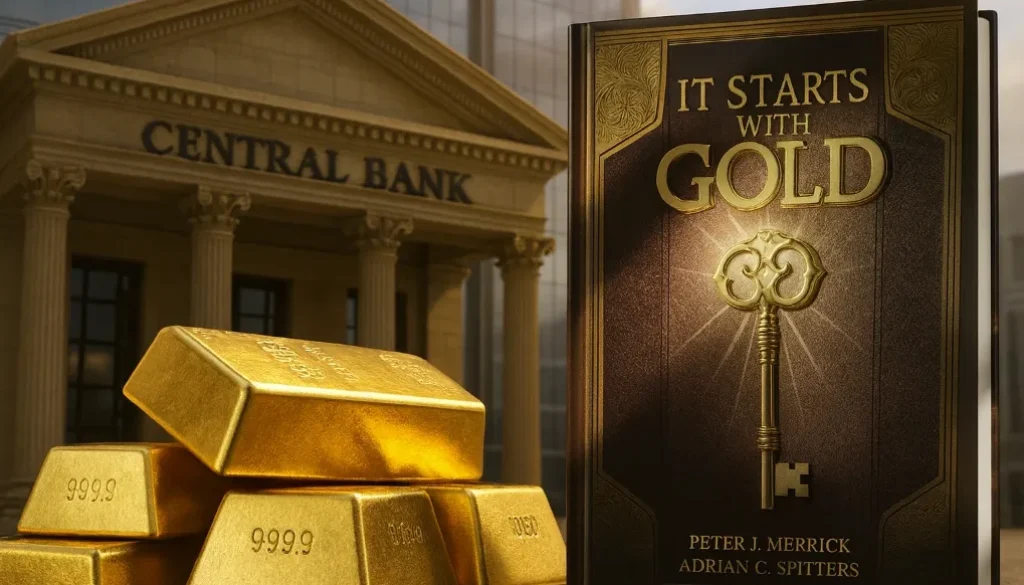
Why Central Banks Are Buying Gold
By Peter J. Merrick, TEP® and Adrian C. Spitters, CFP®, co-authors of the international bestseller It Starts With Gold™ and the forthcoming book Guns, Gold & Land™
This analysis continues a series of long-form investigations published in The Merrick Spitters Reset Report™
A Quiet Story Almost No One Is Telling You
In 2022 and 2023, the world’s central banks bought more than 2,000 tons of gold. That is the most gold they have bought in any two-year stretch since 1950. Seventy-three years. In the first three quarters of 2024, they added another 789 tons and are on pace to pass 1,000 tons again for the full year. Early data from 2025 show the same pattern continuing, with central banks once again on track to buy well over 1,000 tons of gold for the year.
Three years in a row of more than 1,000 tons of official gold buying is not normal. A likely fourth year in 2025 makes it historic. This is not a small adjustment. This is a major shift in how the people who run the money system see the future.
This article is written for the ordinary person who does not live in financial markets. You may have savings in a bank, some money in a pension plan, maybe a retirement account or a small portfolio. You might have heard about gold, but it can sound complicated or extreme. Our goal here is simple. We will explain what central banks are doing, why they are doing it, and what it means for individuals like you, in clear language and short steps.
At the end, you will not need to become an expert. You will only need to decide which side of a very simple line you want to stand on.
👉 Subscribe to The Merrick Spitters Reset Report™ and receive a digital copy of our international bestseller, It Starts With Gold™, along with our white paper, Last Asset Standing™ and early updates on our forthcoming book, Killing Crypto™.
The Numbers That Should Make You Stop And Think
According to the World Gold Council, central banks bought 1,036 tons of gold in 2022 and 1,037 tons in 2023. That is already over 2,000 tons in two years. By the end of the third quarter of 2024, they had bought 789 more tons, and the year is tracking toward another four-digit total. If the current pace continues, 2025 will likely mark a fourth straight year of more than 1,000 tons of official sector buying.
Before 2022, the record was 656 tons in 2018. Before that, you need to go back to the early years after the Second World War to see anything similar. In other words, for most of your lifetime, central banks have not done anything like this.
This is important because central banks do not behave like small investors. They do not sit at home watching a video and then rush to buy because they feel fear of missing out. Their job is to manage an entire nation’s reserves. They move slowly, with long reports, long debates, and long time horizons.
When that kind of institution buys gold in record amounts three years in a row, and likely four, it is not random. It is not a fashion. It is a signal that the ground under the current system is shifting.
Who Is Buying The Gold?
The buying is not coming from small, unstable countries. It is coming from some of the largest and most important players in the world.
China’s central bank reported adding gold for eighteen months in a row through May 2024. In November 2023 alone, it reported 62 new tons. Then it stopped reporting. The most likely reason is not that it stopped buying. The most likely reason is that it no longer wants everyone to see how much it is buying.
On top of the central bank itself, there are Chinese state-owned companies, sovereign wealth funds, and other government bodies that can buy gold without reporting to public databases. When analysts add these pieces together, many estimate that China has quietly accumulated between 1,000 and 2,000 tons of gold since 2022. China is not playing for a short trade. It is positioning for a new monetary world in which the country that holds the most gold has more say when the rules are rewritten.
Russia is another clear example. Its central bank bought around 330 tons in 2022, making it the single largest official buyer that year. It kept adding in 2023 and 2024, even while facing severe sanctions. Today, it officially holds about 2,333 tons of gold, roughly a quarter of its total reserves. That share is even higher than the share of gold in the United States reserves.
India tells a different but equally important story. The Reserve Bank of India has been adding gold slowly and steadily, buying every quarter. It added 33 tons in 2022 and 41 tons in 2023, reaching around 841 tons in official reserves. On top of that, Indian households are believed to hold between 25,000 and 30,000 tons of gold. Families there have lived through many currency devaluations. They know from experience that when paper money fails, gold survives.
Smaller, yet important, players send the same message. Poland grew its gold reserves from 229 tons in 2021 to 359 tons in 2023, an increase of 57 percent in only two years. The governor of the National Bank of Poland said openly that gold is the “ultimate safe asset” and that Poland is preparing for a less stable global monetary system. That is central bank language for “we expect trouble.”
Turkey added about 160 tons in 2023 while its own currency struggled and inflation reached 85 percent. Singapore, one of the most careful financial centers in the world, has quietly increased its gold holdings based on International Monetary Fund data, even though it does not talk much about it.
Different cultures, different histories, different political systems, same choice. They are all buying gold.
What They Are Preparing For
These central banks are not buying gold because they expect a small bump in price. They are preparing for deeper changes in the world monetary system.
First, they see that the present system is built around the United States dollar. Most global trade, savings, and reserves are held in dollars or in assets that depend on dollars. At the same time, the United States government owes around $38 trillion and is paying more than $1.2 trillion per year in interest alone. The debt load is now larger than the yearly size of the economy. There is no realistic path to paying this off through normal growth, taxation, or spending cuts. At some point, the only way out is to reduce the real value of the debt by weakening the currency.
Second, they have watched the dollar being used as a tool of pressure. In 2022, when Russia invaded Ukraine, about $300 billion of Russian reserves held in Western banks were frozen. One day, those reserves looked safe. The next day, they were inaccessible. Every other country with large dollar holdings saw this. They learned that if they anger the United States, their reserves might not be safe either.
Third, they understand that technology and geopolitics are making it easier to build an alternative system. If you can create payment channels that work without Western banks and back them with something neutral like gold, you can trade without relying on the dollar at the center.
It is this combination of unpayable debt, weaponization of the dollar, and new technology that is driving central banks into gold.
The BRICS Gold-Backed Project
Brazil, Russia, India, China, and South Africa form a group known as BRICS. Together they represent about 40 percent of the world’s population and around a quarter of its economic output. Since 2022, they have been working on a currency for trade between their members that is backed, at least in part, by gold.
In August 2023, at a summit in Johannesburg, they invited more countries to join, including Argentina, Egypt, Ethiopia, Iran, Saudi Arabia, and the United Arab Emirates. Some said yes, some are still considering, but it is clear that the circle is widening.
The basic design is simple. Each member country contributes gold into a shared reserve. That gold backs a new unit of account used to settle trade between members. For example, when China buys oil from Russia, it pays in this BRICS unit, backed by gold, instead of dollars. When India buys commodities from Brazil, it uses the same unit. If Saudi Arabia joins, it can sell oil to China without demanding dollars.
This strikes at the heart of the “petrodollar” deal that has supported United States power since the 1970s. Under that old arrangement, major oil producers agreed to price oil in dollars. That forced any country that needed oil to hold dollars, which created constant demand for United States currency.
Now we see cracks. In March 2023, Saudi Arabia completed its first oil sale to China, settling in Chinese yuan instead of dollars. Russia and India now trade using rubles and rupees. China and Brazil trade in yuan and reais. Southeast Asian countries are building payment systems that do not run through the dollar.
Every trade that moves away from dollars lowers global demand for dollars by a small amount. Over time, many small changes add up to a large shift. Central banks see this process clearly in their own data. Gold is their anchor in the middle of this shift.
How A Gold Revaluation Erases Debt
Central banks also know that there is an old trick that governments can use when they face too much debt. That trick is called gold revaluation.
The United States government officially owns 8,133 tons of gold. That is about 261 million ounces. At a current market price of around $4,000 per ounce as of November 17, 2025, those reserves are worth around $75 billion.
However, on the government’s books, that gold is still recorded at an old official price of about $42 per ounce, set many years ago. At that price, the gold reserve is valued at only about $11 billion. The gap between the book value and the real market value is very large.
If the government decides to change the official price to something far higher, for example $20,000 per ounce, the gold on its balance sheet would suddenly appear to be worth more than $5 trillion. That would allow it to claim that a large portion of the money supply is now “backed” by gold.
On the surface, that sounds like a return to discipline and sound money. In practice, it would be a hidden devaluation. If gold jumps from $4,000 to $20,000, the dollar itself has lost about 87 percent of its value relative to gold. The same loss of value shows up slowly in the price of food, energy, housing, and other goods. The real burden of the 37 trillion debt falls sharply, not because it was repaid, but because the measuring stick, the dollar, has been weakened.
Creditors, savers, and pension holders bear the cost through inflation. The government and other large debtors gain relief. Central banks know this technique because they have seen it used in the past.
The 1933 Lesson
In 1933, during the Great Depression, the United States was in deep trouble. The economy was shrinking. Banks were failing. Unemployment was about a quarter of the workforce. The government carried a heavy debt load left over from the First World War and the crisis that followed.
President Franklin Roosevelt signed an order that made it illegal for American citizens to hold most forms of gold. People had to turn in their gold and were paid $20.67 per ounce, which had been the fixed price since 1879.
Once the government had collected the gold, it raised the official price to $35 per ounce in 1934. That was an increase of 69 percent. The gold held by the government rose sharply in value on its balance sheet. At the same time, the purchasing power of the dollar fell.
Between 1933 and 1940, the official ratio of government debt to the size of the economy fell from about 40 percent to about 25 percent. The main reason was not careful saving. It was that the value of the currency itself had been lowered through this revaluation. Ordinary citizens who had handed over their gold watched it appreciate while they were forced to hold weaker dollars. They could not buy gold again until the law changed in the 1970s.
This is the playbook central banks study when they talk about gold revaluation today. They know it can happen again in a modern version.
Why Gold And Not Something Else
If central banks are so worried about the system, why do they choose gold rather than stocks, real estate, or digital coins?
Gold has no counterparty risk. It is not a promise from a government or a company. It is not a line in a digital ledger. It is a physical element that has acted as a store of value for thousands of years across every major culture. Governments cannot print gold. Companies cannot make it vanish by going bankrupt. Courts cannot cancel their basic nature.
Gold is also accepted everywhere. If Russia wants to trade with China but does not want to hold Chinese currency, it can settle in gold. If India trades with Iran and neither side fully trusts the other’s currency, they can use gold as the final settlement asset. One ounce of gold is one ounce of gold, whether it was mined in South Africa, Canada, or Russia.
In a world of rising cyber risks, gold has another simple advantage. To steal digital assets, a skilled group can break into systems from a distance and press keys. To steal gold in a secure vault, they must physically break in, defeat security, and move heavy metal. It is not impossible, but it is far more difficult.
Finally, gold has shown how it behaves when inflation is high. In the 1970s, when inflation rose sharply, stocks went sideways in price and lost purchasing power once adjusted for inflation. Gold rose from $35 per ounce to $850. That is a 24 times increase in less than a decade. Central banks look at that history when they face the possibility of severe inflation in the 2020s.
What Central Banks See That You Cannot See
Central banks have three kinds of information that ordinary individuals do not.
They see capital flows in real time. They know which countries are selling United States Treasury bonds and which are buying. In 2022 and 2023, foreign central banks sold hundreds of billions of dollars of these bonds while buying gold. They can see that this is not a theory. It is happening in the data.
They have access to classified intelligence. The People’s Bank of China knows what China’s military is planning in relation to Taiwan. The Federal Reserve has access to information from United States agencies. The Bank of Russia sees internal reports from its own security services. These institutions know how likely certain conflicts are and how those conflicts might lead to new sanctions or the freezing of reserves. They know that if $300 billion of Russian assets can be frozen once, it can be done again to someone else.
They track money supply and prices using their own methods. They know how much new currency has been created since 2020. They know that when you increase the money supply by roughly 40 percent in a short time, it will eventually show up as stronger inflation somewhere. They also know that official inflation numbers can understate this for political reasons.
It is this combination of information that is pushing them into gold at record speed.
Where We Stand In The Cycle
Large shifts in capital usually move through three stages.
In the first stage, the “smart money” moves quietly. This includes central banks, sovereign wealth funds, and very wealthy families. They do not make public statements. They simply buy.
In the second stage, institutional investors notice. Pension funds, hedge funds, and large asset managers begin to increase their gold allocations. They write research notes. They talk about diversification on television. This pulls more money into the asset and drives prices higher.
In the third stage, the general public wakes up. Individuals who never thought about gold before see that it has already risen many times from its old levels. They rush in because they are afraid of missing out. This often marks the later part of the move.
Central banks have already moved. Institutional investors are beginning to follow. Most ordinary savers have not acted yet. That is why there is still a window, but that window is not open forever.
A Simple Framework For Ordinary Individuals
What does all of this mean for someone who is not a central banker and not a hedge fund manager?
It does not mean you should try to trade gold every week. It does not mean you need to understand complex charts. It means that in a world where the people who run the system are buying gold in record amounts, holding zero gold and one hundred percent paper claims is its own kind of risky bet.
The material we are working from suggests a simple starting point. Think in terms of a percentage of your liquid net worth. This means money in bank accounts, non-registered portfolios, and retirement accounts, not your home or the car you drive. For many people, a range of ten to twenty percent of this liquid wealth in gold can act as a kind of insurance.
Inside that range, the core is physical bullion. This means simple one-ounce coins like American Gold Eagles, Canadian Maple Leafs, Austrian Philharmonics, or one-ounce bars from reputable refiners. These pieces are recognized globally. They can be stored at home in a safe if security is strong, or in private vaults. Bank safety deposit boxes are not ideal in a crisis, because banks can be closed by order.
Next, some individuals may hold a slice of their gold exposure in exchange-traded funds that are backed by physical metal, especially inside retirement accounts, where it is hard to hold physical gold directly. These vehicles are easier to buy and sell, though they carry more risk because they depend on the financial system itself.
Finally, a small slice, often around ten percent of the gold allocation, can be put into gold mining shares for those who accept higher risk for higher possible return. These stocks can move up more than the gold price in good times, and down more in bad times.
The exact mix will differ from person to person. The key idea is that some real stake in gold brings your personal position closer to that of the central banks, rather than leaving you fully exposed on the other side.
The Choice In Front Of You
In the last four years, central banks have bought more than 4,000 tons of gold, once 2025 is complete. That is the largest and most concentrated accumulation in more than seven decades. They are not doing this by accident. They are doing it because they can see a system under stress.
They see a world where the dollar’s role is shrinking, where new gold-backed trade units appear, where old debts can only be reduced by weakening paper currencies, and where inflation can rise far faster than the public expects. They know that in such a world, the one asset that always survives currency resets is gold.
You do not have to agree with every detail of their analysis. However, it is difficult to ignore their actions. When the people who design the rules of the game all move their own reserves into the same asset, it is a message.
The real question is simple. When this transition speeds up between now and the late 2020s, do you want to stand on the side of those who hold only promises written on paper, or do you want to stand with those who hold at least some wealth in the same asset the central banks are choosing for themselves?
You do not need to panic. You do not need to become a trader. You do need to decide whether you will act while the window is still open or wait until the headlines arrive and everyone else is rushing in.
Central banks have already made their choice. They are not waiting for a better day. They are buying gold now.
Now that you have seen, in plain language, what they see, the next move is not theirs. It is yours.
A Practical Next Step
If this article has given you a new way of looking at what is happening, your next step should be simple and calm. Begin by getting your complimentary digital copy of It Starts With Gold through The Merrick Spitters Reset Report™. We wrote that book to take the ideas in this article much further and to lay out, in plain language, how to build a life that is less dependent on a fragile system.
As you read, notice where your own situation may be vulnerable. Notice how much of your wealth sits inside the Financial Industrial Complex and how much stands outside it. Notice how you feel when you imagine another large market decline. Those feelings are signals. They are telling you where some adjustments might be needed.
The Four Pillars We Recommend for Certainty
Our team of professionals assist clients in structuring wealth by Owning Assets in Order of Asset Security. We prioritize the most secure assets first and safeguard those that are most vulnerable using the four pillars that form the foundation of long-term financial certainty.
- Gold and precious metals hold real, tangible value. These assets stand outside the financial system and act as the anchor when currencies weaken.
- Alternative investments that reduce systemic risk. This includes private real estate, private credit, and other non-public assets that generate income without relying fully on public markets.
- Private portfolio management that lowers counterparty exposure. Professional discretionary managers provide oversight, structure, and discipline while reducing reliance on mass-market institutions.
- Mutual life insurance instruments that protect capital and individuals. These contracts preserve value, create stability, and offer tax-advantaged growth and estate benefits.
In It Starts With Gold™, we describe how these four pillars operate together as a unified structure to protect wealth and maintain continuity through economic and political uncertainty. Each pillar plays a distinct role: precious metals preserve purchasing power, alternative investments diversify and stabilize income, private portfolio management provides professional oversight, and mutual life insurance strengthens capital protection.
Together, they form a balanced foundation that helps individuals remain secure when one or more areas of the economy are tested.
These are the same principles we follow ourselves and the same framework we use to help clients transition from a vulnerable position to a more resilient one.
We are not here to frighten you. We are here to offer you a way to see clearly, to prepare, and to move through what is coming with more confidence and less shock. The crash has begun, even if it is not yet fully visible on every screen. The individuals who act during this first wave will look back with quiet gratitude. The individuals who wait for the headlines will have a much harder road.
We cannot decide for you. We can only share what we have learned. The rest is in your hands.
The themes in this article connect directly to It Starts With Gold, co-authored by Peter J. Merrick, TEP® and Adrian C. Spitters, CFP®. Within the book, we explain how to establish a tangible-asset foundation, measure risk across various asset classes, and safeguard yourself against systemic shocks while maintaining control over your future. Visit www.ItStartsWithGold.com.
👉 Sign up today for The Merrick Spitters Reset Report™ to receive a digital copy of our international bestseller, It Starts With Gold™, our white paper, Last Asset Standing™, and early updates on our upcoming book, Killing Crypto™.
Prefer a hard copy? Order It Starts With Gold™ on Amazon today.
References
- It Starts With Gold – Official Website
- It Starts With Gold – Amazon Listing
- World Gold Council – Central Bank Net Purchases & Sales
- World Gold Council – Quarterly Gold Demand Trends
- IMF International Financial Statistics – Global Reserve Data
- Bank for International Settlements (BIS) – Global Debt Statistics
- Bank for International Settlements (BIS) – Debt securities statistics
- Institute of International Finance – Global Debt Monitor
- U.S. Treasury – Debt to the Penny
- Congressional Budget Office – Long-Term Federal Debt Outlook
- U.S. National Archives – Executive Order 6102 (1933 Gold Confiscation)
- Federal Reserve Bank of St. Louis – Money Supply (M2SL)
- BRICS Information Portal – Official BRICS Communications
- People’s Bank of China – Official Releases
- Central Bank of Russia – International Reserves
- Reserve Bank of India – Press Releases and Reserve Data
- Reuters – Saudi Arabia / China Oil Sale Settled in Yuan
- Reuters – India & Russia Agreement to Trade in Rupees
- U.S. Treasury – Gold Reserves (Book Value and Market Value)
- U.S. Department of State – Nixon and the End of the Bretton Woods System, 1971–1973” (Milestones in the History of U.S. Foreign Relations)
- Federal Reserve History – “Nixon Ends Convertibility of U.S. Dollars to Gold and Announces Wage/Price Controls”
- Federal Reserve History – Gold Reserve Act of 1934
- BIS – Global Derivatives Statistics (Notional & Market Value)
- OECD – Derivatives and Systemic Financial Risk
- SWIFT – Global Payments Currency Shares
- IMF – Research on Global De-Dollarization Trends
Disclaimer
This publication is for general information and educational purposes only. It discusses broad economic themes, historical patterns, and the structure of the global financial system. Nothing in this article is financial, legal, tax, or investment advice, and it should not be interpreted as a recommendation or solicitation to buy or sell any financial product, security, or real estate.
The views expressed reflect professional observations and opinions based on publicly available information at the time of writing. These views may change as market conditions, government policy, financial regulations, or economic circumstances evolve. The scenarios described are illustrative and are not predictions of future events.
Readers should not act on the information in this publication without seeking advice from qualified professionals who can consider their personal situation, goals, and risk tolerance. All investments carry risk, including the potential loss of principal. Past performance does not guarantee future results. Changes in monetary policy, interest rates, or global markets can materially affect outcomes.
The authors provide professional services only through their regulated affiliations. Nothing in this publication constitutes personalized guidance to any individual or entity. While reasonable efforts have been made to ensure accuracy and completeness, no guarantee is given. For recommendations tailored to your circumstances, please consult a licensed financial advisor, tax specialist, or legal professional.