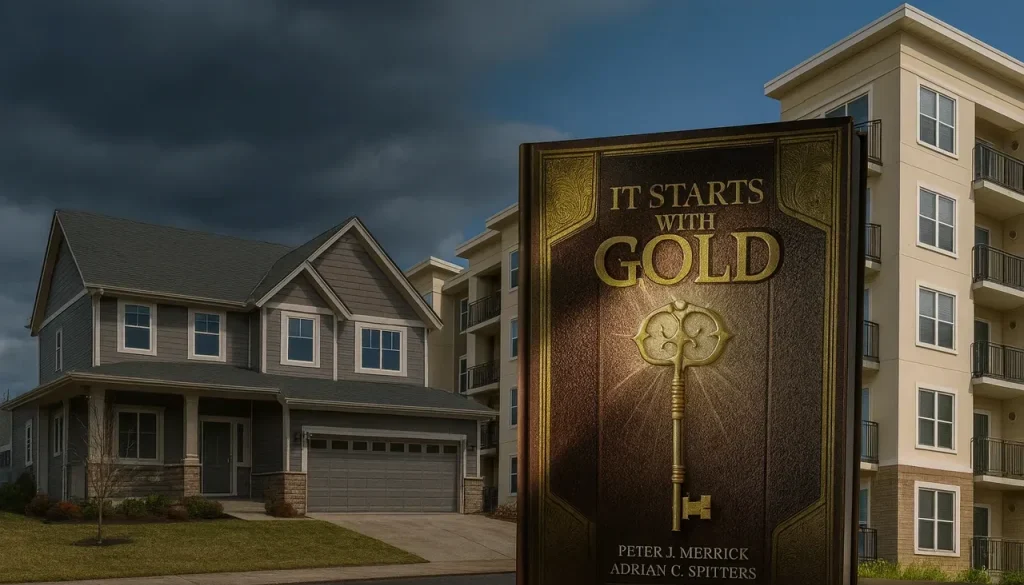
Why Homeownership Is Falling While Multi-Family Rentals Endure
By Peter J. Merrick, TEP® and Adrian C. Spitters, CFP®, co-authors of the international bestseller It Starts With Gold™ and the forthcoming book Guns, Gold & Land™
This analysis continues a series of long-form investigations published in The Merrick Spitters Reset Report™
Families Now Face a Choice Between Failing Ownership and Multi-Family Stability
By Peter J. Merrick, TEP® and Adrian C. Spitters, CFP®, co-authors of the international bestseller It Starts With Gold™ and the forthcoming Killing Crypto™
This article presents an opinion based on current data and is intended to inform and invite dialogue about why homeownership is weakening across North America while purpose-built multi-family rentals remain resilient.
A Slow Collapse Few Want to Admit
Many still believe homeownership offers security, while others now see it as a structure that no longer reflects economic reality.
Families across North America are confronting a shift that many hoped would never arrive. The traditional owner-occupied housing model, once viewed as the safest pathway into the middle class, is no longer functioning the way earlier generations believed it would. A house was supposed to be a store of stability, a hedge against volatility, and a foundation families could build on. Yet the math that supported this belief is breaking down.
For decades, homeownership depended on a simple formula. When interest rates fell, carrying costs dropped. When wages rose, affordability improved. When demand surged, values climbed. These forces created the illusion that the system could never reverse course. Today, each one of those assumptions is strained. Wages lag behind costs. Municipal taxes climb every year. Insurance premiums rise faster than incomes. And interest rates remain at levels that even seasoned homeowners struggle to service.
This is not a temporary fluctuation. The pressures bearing down on homeowners represent a structural reset, not a short-term correction. The conditions that allowed homeownership to operate as a stable wealth-building strategy no longer exist at scale. And the people feeling this shift most acutely are the individuals who trusted the system the most.
👉 Subscribe to The Merrick Spitters Reset Report™ and receive a digital copy of our international bestseller, It Starts With Gold™, along with our white paper, Last Asset Standing™ and early updates on our forthcoming book, Killing Crypto™.
Why Owner-Occupied Housing Is Breaking
The breakdown becomes clear when listening to the experiences of homeowners across British Columbia, Ontario, and major U.S. metros. Their stories start differently but end the same way. They purchased when confidence was high, when demand appeared insatiable, and when the belief in continued appreciation overrode caution. They expected rents to cover costs or valuations to rise. Many bought pre-construction units believing they were getting ahead of future scarcity.
Then conditions changed. Interest rates rose. Strata fees climbed. Insurance costs spiked. Rents flattened. Household budgets tightened. The properties they once viewed as assets began behaving like liabilities.
Homeowners who contact realtors in Kelowna describe an identical moment of realization. Their unit will not sell for the price they need. It will not rent for enough to cover the mortgage, the strata fees, the taxes, the insurance, and the maintenance that comes faster than expected. They begin absorbing hundreds of dollars each month, then thousands, then more as renewals hit. Savings drain. Lines of credit grow. There is no relief.
Homeowners across Canadian cities share the same experience. They cannot sell at a sustainable price. They cannot rent without subsidizing the losses. And they cannot keep the property without damaging the rest of their financial life. The story unfolds in different regions, but the pattern repeats with unnerving precision. The old model exposes individuals to concentrated risk at a time when the economic cycle offers no support.
The Pre-Construction Collapse Reveals the Depth of the Shift
The most alarming signal comes from the collapse of the pre-sale condominium market. This model once formed the backbone of urban development in Toronto, Vancouver, and other high-growth regions. Developers relied on investor pre-sales to secure financing from lenders. Buyers relied on years of rising valuations to justify the purchase. Lenders relied on demand to justify large construction loans.
That system is breaking.
Altus Group data shows that the Toronto region recorded more than a year of new lows in pre-construction sales. In one month, the entire City of Toronto registered twenty-five condominium sales. Not twenty-five percent. Twenty-five units total. For a city of three million people, this is virtually zero demand.
Vancouver shows similar patterns. New home sales have collapsed from nearly twenty-five thousand units during the bull market to roughly four thousand for the same period. Developers are pausing projects, reducing scale, or exiting entirely. The architectural billings index in the United States, tracked by the American Institute of Architects (AIA), shows eighteen consecutive months of contraction. Canadian architectural and design firms report identical slowdowns.
This is not ordinary. It is a breakdown in future supply creation. It signals that households are unable or unwilling to take on the risk of ownership in the current environment. And it reveals how vulnerable individual homeowners have become in a system that once depended on endless investor participation.
Why Rental Housing Does Not Break Under the Same Pressure
Purpose-built multi-family rental housing behaves differently. It is structured for long-term resilience, not speculation. It spreads risk across many units instead of concentrating risk on a single family. It uses professional management rather than individual guesswork. Its revenue comes from occupancy, not appreciation.
Even when rents soften, purpose-built rental operators adjust using tools unavailable to homeowners. They offer incentives, manage turnover, restructure financing, or optimize operational costs. Their survival does not depend on rising valuations or falling interest rates. It depends on shelter demand, which remains constant even during economic downturns.
Owner-occupied housing lacks these mechanisms. A homeowner cannot increase revenue sources. They cannot spread risk across multiple tenants. They cannot negotiate large-scale financing packages that lower their exposure. When their costs rise, they absorb the full weight themselves.
Softening Rents Do Not Threaten Multi-Family the Way Rising Rates Threaten Homeowners
Reports from Rentals.ca and Urbanation show that asking rents in Canada have declined for twelve consecutive months. Incentives are increasing. Yet this decline has not undermined the stability of purpose-built multi-family buildings. These operators plan for cycles. They expect fluctuations. Their financing is structured over longer terms. Their risk models account for downturns.
Homeowners do not have this luxury. When their mortgage renews at a higher rate, there is no stabilizing mechanism. When their property taxes climb, there is no mitigation plan. When strata fees jump because of rising insurance premiums or deferred repairs, they cannot spread the cost across a portfolio.
This difference explains why rental housing continues to function even when the wider housing market weakens. The model is built for resilience.
North American Data Confirms the Direction of the Shift
Patterns across the United States mirror those in Canada. The United States Census Bureau (U.S. Census) reports stagnating homeownership among younger households. Mortgage Bankers Association (MBA) data shows elevated delinquency risks among larger loans. The Federal Reserve Bank of New York reports increased financial stress among borrowers renewing debt. These signals reveal a continental correction.
Owner-occupied housing is becoming more fragile. Multi-family rental housing continues to expand. The divergence is clear, and the reasons are structural rather than temporary.
Demographics No Longer Support the Old Model
Birth rates across North America remain far below replacement levels. Wage growth remains weak relative to housing costs. Immigration policy shifts reduce short-term population pressure. Younger households carry higher debt loads and face fewer high-paying opportunities than previous generations.
Homeownership relies on a constant supply of new qualified buyers. That supply is shrinking. No amount of optimism can change the demographic trendline.
Multi-family rentals, by contrast, require only the natural demand for shelter. That demand persists even when economic conditions deteriorate.
Institutional Capital Shows Where the Future Is Going
Large institutions across North America have already adjusted to this reality. They have no emotional attachment to the myth of homeownership. They follow data, risk models, and long-term demographic trends. That is why capital continues to flow into purpose-built multi-family rentals even while owner-occupied housing loses momentum.
These institutions seek durable income, predictable demand, and stable operating structures. Multi-family rentals offer all three. Owner-occupied housing offers none. Families carry the full downside. Operators distribute the risk. Banks recognize this difference. Pension funds recognize this difference. Private equity recognizes this difference. They have quietly repositioned themselves into the only segment of housing that still functions under extreme stress.
People often assume this shift is accidental. It is not. It is the result of professionals accepting what ordinary households have not yet fully confronted. The owner-occupied model no longer aligns with the financial realities of this decade. The multi-family model does.
This creates an unavoidable decision for families. They can remain in a structure that exposes them to concentrated risk, or they can position themselves alongside stable assets built to withstand economic shifts. One direction leads to erosion. The other leads to endurance. The system does not allow a neutral choice.
The Ownership Market Is Not Coming Back Soon
Real estate cycles do not move quickly. After the early 1990s downturn in Canada, inflation-adjusted prices took more than a decade to return to previous levels. After the Global Financial Crisis, stability returned only because governments and central banks used tools that no longer exist today. Interest rates cannot fall nine hundred basis points. Government debt loads limit major fiscal interventions. Municipalities cannot keep raising property taxes without intensifying homeowner stress.
This leaves the ownership market exposed for a long period. Families hoping for a rapid rebound may find themselves waiting longer than their budgets can tolerate. A home can only absorb so much financial pressure before it begins damaging the rest of a household’s stability.
Meanwhile, rental housing simply adapts. When rents rise, it benefits. When rents soften, it recalibrates. Scale and design give it options homeowners do not have.
Why Multi-Family Rentals Offer Stability While Owner-Occupied Homes Crumble
Multi-family rentals are designed for economic turbulence. They use long-term financing that does not reset every five years. They operate with multiple units, spreading risk. They negotiate maintenance and insurance contracts in bulk. They manage tenant turnover with professional teams. Their survival depends on occupancy across a portfolio, not on one person’s salary.
A homeowner does not operate with these advantages. Their mortgage renewal can destabilize their finances overnight. Their insurance premiums can climb with no offset. Their taxes can rise with no negotiation. Their maintenance costs can spike unpredictably. And when the market turns, they cannot adjust the way a purpose-built rental operator can.
This structural difference is the heart of today’s divergence. Owner-occupied homes are built on an outdated model of financial certainty. Purpose-built rentals are built on resilient cash flow and diversified stability.
North America Is Moving Toward a Multi-Family Future
People will always need shelter, but the form of shelter they rely on changes with the economic era they live in. The era of easy homeownership is ending. The era of institutional-grade rental stability is expanding. This trend is not limited to Canada. The United States is experiencing the same shift. Europe is already far ahead.
Families who understand this transition early have an opportunity to reposition their financial lives toward structures that endure. Families who ignore the trend may find themselves carrying liabilities that cannot survive the next economic cycle.
The shift is deeper than a market change. It is a political, demographic, and financial reordering of how shelter is provided and how stability is built.
A New Framework for Families Who Refuse to Be Exposed
Many households feel the strain. They feel as though the system is moving against them, and in many ways, it is. But this does not mean families are powerless. It means the old blueprint must be replaced with a new one that fits the world as it exists now.
That blueprint is built on real assets. It is built on tangible value. It is built on structures that survive inflation, volatility, and political uncertainty. It is built on cash-flowing private markets, not speculative public markets. It is built on the foundation we call Owning Assets in Order of Asset Security.
The Four Pillars We Recommend for Certainty
Our team of professionals assist clients in structuring wealth by Owning Assets in Order of Asset Security. We prioritize the most secure assets and safeguard those that are most vulnerable using the four pillars that form the foundation of long-term financial certainty.
-
-
- Gold and precious metals that hold real, tangible value: These assets stand outside the financial system and act as the anchor when currencies weaken.
- Alternative investments that reduce systemic risk: This includes private multi-family real estate, private credit, and other non-public assets that generate income without relying fully on public markets.
- Private portfolio management that lowers counterparty exposure: Professional discretionary managers provide oversight, structure, and discipline while reducing reliance on mass-market institutions.
- Mutual life insurance instruments that protect capital and individuals: These contracts preserve value, create stability, and offer tax-advantaged growth and estate benefits.
-
In It Starts With Gold™, we describe how these four pillars operate as a unified structure to protect wealth and maintain continuity through economic and political uncertainty. Each pillar plays a distinct role. Precious metals preserve purchasing power. Alternative investments diversify income and reduce reliance on public markets. Private portfolio management provides disciplined oversight. Mutual life insurance strengthens capital protection and intergenerational planning. Together, they allow families to remain secure when one or more areas of the economy come under pressure.
Stay informed. Stay prepared. Act while choice still exists.
These insights connect directly to the themes explored in It Starts With Gold™, co-authored by Peter J. Merrick, TEP® and Adrian C. Spitters, CFP®. Inside the book, we show how to establish a tangible-asset foundation, measure security across asset classes, and safeguard against systemic shocks while maintaining control of your future. Visit www.ItStartsWithGold.com.
👉 Sign up today for The Merrick Spitters Reset Report™ to receive a digital copy of our international bestseller, It Starts With Gold™, our white paper, Last Asset Standing™, and early updates on our upcoming book, Killing Crypto™.
Prefer a hard copy? Order It Starts With Gold™ on Amazon today.
References
- Altus Group New Home Sales Data
- CMHC 2025 Mid-Year Rental Market Update
- CMHC Housing Market Outlook 2025
- BMO Capital Markets Housing Research
- Statistics Canada: Fertility In Canada, 1921 To 2022
- Statistics Canada Estimates of Births, By Gender, Annual
- Statistics Canada: Wages In Canada, 1981 To 2024
- Rentals.ca National Rent Report
- Urbanation Rental and Condo Market Reports
- Zonda Urban (Vancouver New Home Sales & Project Data)
- United States Census Bureau Homeownership Data
- Federal Reserve Bank of New York Household Debt Reports
- Mortgage Bankers Association Delinquency Reports
- Federal Reserve Economic Data (FRED)
- CDC National Center for Health Statistics (U.S. Birth Rate Data)
- American Institute of Architects Architectural Billings Index
- Bank of Canada Bond Yield Data
- CMHC 2025 Housing Overview – YouTube
- New Home Sales Slow to Near Zero in Toronto & Vancouver: Steve Saretsky – YouTube
- Kelowna Condo NIGHTMARE! Can’t Sell. Can’t Rent. Can’t Keep It! – James Roffel – YouTube
Disclaimer
This article provides general information based on publicly available data and current market conditions. It is not intended to offer personalized financial, legal, tax, or investment recommendations. Every individual has unique objectives, constraints, and financial realities, and professional guidance should reflect those specific circumstances. All investments involve risk and can increase or decrease in value as market conditions change. The authors provide regulated services through their respective firms, and the views expressed here reflect their professional analysis at the time of writing. Individuals should consider consulting qualified professionals who understand their personal circumstances before making decisions that could affect their financial position.