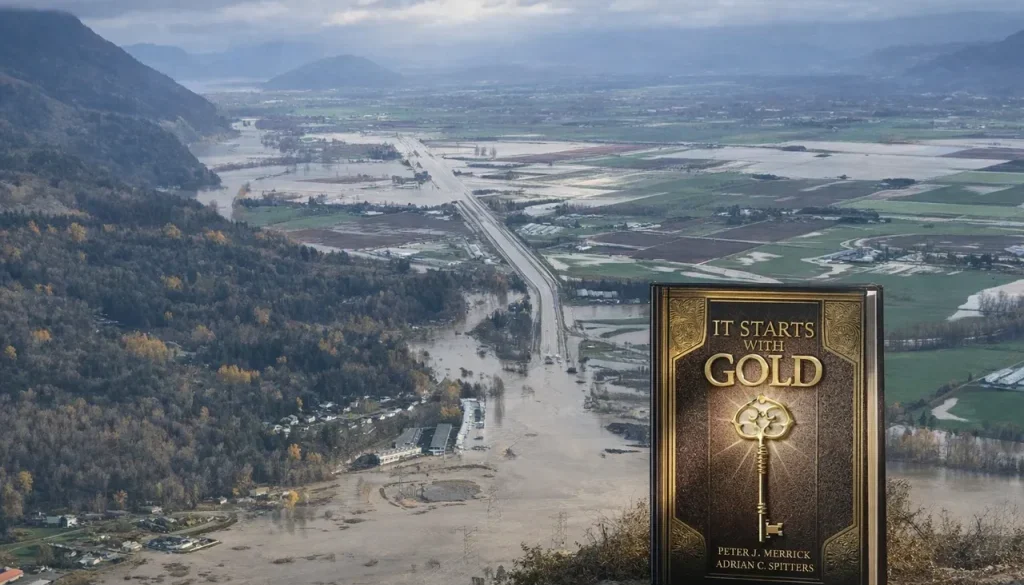
British Columbia Mineral Rights Ruling Signals a New Order
By Peter J. Merrick, TEP® and Adrian C. Spitters, CFP®, co-authors of the international bestseller It Starts With Gold™ and the forthcoming book Guns, Gold & Land™
This analysis continues a series of long-form investigations published in The Merrick Spitters Reset Report™
How British Columbia Entered a Multi-Layered Governance Era Without Public Debate
By Peter J. Merrick, TEP® and Adrian C. Spitters, CFP®, co-authors of the international bestseller It Starts With Gold™ and the forthcoming book Killing Crypto™
A Province Entering a New Era of Authority
British Columbia is living through a structural shift that many residents have sensed, but few have been able to define. The recent ruling involving the Gitxaała Nation has confirmed what has been unfolding quietly across ministries, regulatory bodies, and the courts. The province no longer functions under a single, predictable framework of authority. It now operates through a layered arrangement where legal power, territorial rights, political objectives, and international declarations intersect in ways that reconfigure how land can be accessed, developed, or protected.
This transformation did not begin with the ruling, but the ruling has revealed what had already taken root. The British Columbia Court of Appeal found that the long-standing automated mineral claims system could no longer operate as if the province alone held final authority over land. Instead, the system must now move within the standards defined by the Declaration on the Rights of Indigenous Peoples Act, known as DRIPA, which incorporates the United Nations Declaration on the Rights of Indigenous Peoples, known as UNDRIP, into provincial interpretation. The court determined that the province has a duty to consult before mineral rights are granted, even at the earliest stage of exploration.
👉 Want to read more articles like this? Subscribe to The Merrick Spitters Reset Report™.
A Break from a Century of Predictable Practice
This represents a departure from how land-based industries have operated for more than a century. The earlier Supreme Court decision suggested that UNDRIP was aspirational and not binding. The Court of Appeal rejected that view and held that provincial law must be read in a manner consistent with DRIPA and UNDRIP. The ruling did not create new rights. It recognized rights that already existed but had not been enforced at the level seen today. It also established that the provincial government must interpret its own legislation in a manner consistent with these declarations.
To understand the seriousness of this shift, one must consider what the court actually did. The ruling did not simply tell the province to consult. It placed final authority for interpreting how consultation must occur into the hands of the judiciary while also creating space for Indigenous governments to assert a more formal role in early-stage land decisions. The province no longer controls the process in the way it once did. Authority is now shared among governments that were not equal participants in earlier eras.
Implications For All Land-Based Industries
This change has implications far beyond mineral rights. It determines how forestry projects begin, how agricultural expansions proceed, how municipalities plan infrastructure, and how private landholders understand the long-term security of their property. The decision signals that consultation is no longer a procedural step that can be satisfied with notice. It becomes a structural requirement that influences timing, access, and the certainty on which every land-based industry depends.
Farmers, mining companies, and forestry operators understand that delay is its own form of policy. When the process stretches into years, capital stalls. When approval becomes uncertain, risk rises. When authority becomes difficult to identify, decisions become harder to make. The ruling confirmed what many in these sectors already knew. British Columbia’s land framework is becoming governed by interpretation rather than statute, and interpretation can change faster than legislation.
A wide range of land-based industries will feel these effects beyond farming, mining, and forestry. Ranchers relying on Crown range land, energy producers requiring predictable rights-of-way, real estate developers facing multi-layered approvals, aggregate operators needing consistent land-use decisions, and tourism businesses that depend on tenure renewals will all encounter new constraints. These sectors require long planning horizons and stable governance. They now operate in an environment where certainty is no longer guaranteed.
A Government Responding to a Shift It Cannot Fully Direct
The province has acknowledged this without fully explaining it. Premier David Eby stated that amendments to DRIPA may be necessary because the courts appear to have misunderstood the intent of the legislation. When a government suggests that courts have misinterpreted law, it signals a deeper issue. It reveals a governance environment where the creators of legislation struggle to predict how that legislation will be applied. This is not a debate about consultation. It is a recognition that the legal foundation beneath the province has become more fluid than it once was.
This does not mean conflict is approaching. It means something more difficult to navigate. It means the province is transitioning into a form of shared authority that operates through multiple governments, each with its own priorities and interpretations. For land-based industries, the question is no longer what the law says. The question becomes how competing authorities will interpret the law in any given circumstance.
A Landscape Already Changing Before the Ruling
This shift did not arrive suddenly. Communities across northern and coastal British Columbia have already begun exploring their own models for territorial oversight. Several First Nations have expressed an intention to file similar actions that challenge the current tenure system. Others have issued notices instructing companies not to undertake exploration without direct engagement. These developments were already taking shape when the ruling arrived. The decision did not start the shift. It accelerated it.
The ruling also reset expectations for how consultation is defined. In earlier eras, consultation often meant notification and an opportunity for response. The new structure moves toward negotiation that brings all parties into the process much earlier. Industries that rely on predictable timelines will feel this first. Farmers planning to expand irrigation, mining companies preparing exploration programs, and forestry operators seeking renewal of cutting permits will all interact with this evolving system.
A Province Moving Beyond a Single Point of Authority
None of this means that Indigenous governments are acting improperly. They are asserting rights recognized under Canadian law for decades. The issue is not the assertion of rights, but the speed and breadth with which the framework is changing. British Columbia has created a legal environment where the province is no longer the sole steward of land-use decisions. Authority now exists on multiple levels, which creates uncertainty for industries that depend on long planning horizons and clear rules.
For homeowners, ranchers, and small landholders, the implications are quieter but just as real. When the province no longer holds final authority over how land can be accessed or developed, individuals must navigate a more complex structure. It is a structure that requires understanding not only the Crown’s role, but also the role of Indigenous governments, the influence of international declarations, and the interpretive power of the courts.
This is not alarmism. It is the plain reading of how governance now functions in British Columbia. The ruling did not undermine property rights, but it changed the environment in which property rights are exercised. Those who depend on land, whether for farming, resource extraction, or long-term investment, must understand this shift. The future of land-based industries will be shaped by a governance model that no longer moves in a single direction.
This brings the province into a new era, one where authority is negotiated rather than presumed, where consultation is embedded rather than optional, and where the stability once relied upon can no longer be taken for granted.
Courts, Governments, and Nations Competing to Define Authority
The Gitxaała ruling did more than correct an administrative practice. It pulled British Columbia into a governance model where multiple institutions now hold overlapping claims to authority. The courts signalled that the province must interpret its own legislation in harmony with DRIPA. Indigenous governments asserted their legal position as partners rather than observers. International declarations, once treated as policy guidance, now shape domestic interpretation. Provincial ministries are expected to operate within this new structure, even as they struggle to understand its boundaries.
This creates a form of multi-layered governance that the province has never experienced. Each layer introduces expectations that did not exist before. Each layer holds legal power that can influence the direction of land use, economic development, and resource management. For industries that have depended on certainty, this structure represents a fundamental shift. Predictability is no longer guaranteed. Authority has become shared, and shared authority requires negotiation that takes time, expertise, and patience.
How the Province Lost Control of Its Own Framework
One of the most important aspects of the ruling is what it signals about the province’s legislative process. The government passed DRIPA without fully anticipating how courts would interpret it. The Court of Appeal applied DRIPA in a way the government did not expect. When Premier David Eby suggested amendments to clarify the intent of the legislation, it revealed that the province was no longer steering the legal interpretation of its own policies. Authority had already migrated to the judiciary and to the Indigenous governments referenced in DRIPA.
This is not a small development. It is evidence that the traditional hierarchy of governance is being replaced by a dispersed model where legislation is no longer final. Instead, it is subject to reinterpretation through the lens of broader declarations and rights frameworks. This introduces uncertainty for industries that depend on long-term planning. Companies accustomed to clear procedural steps now face a system where each stage may require engagement with multiple authorities, each possessing the ability to influence outcomes.
Industry Recognizes the Scale of the Shift
Mining associations, forestry organizations, and industry groups responded with caution because they understand the practical consequences of the ruling. Exploration timelines are already long and unpredictable. Adding mandatory consultation at the earliest stages introduces new layers of complexity. Companies must now evaluate whether projects remain viable under the extended timelines and increased costs associated with consultation and negotiation.
Forestry operations will also feel the impact. Tenure renewals, road access, watershed management, and wildlife habitat considerations now intersect with evolving governance structures. The forestry sector has already expressed concern about how this ruling will influence access to timber and the long-term viability of certain operating areas. The Gitxaała decision does not directly regulate forestry, but it reshapes the legal environment in which forestry decisions are made.
For farmers, the implications are subtler but still significant. Water rights, drainage permits, flood mitigation plans, and agricultural expansions occur within land use frameworks that increasingly involve consultation and shared authority. The experience of farmers in the Sumas Prairie, who encountered shifting policies and jurisdictional questions after the 2021 flood, serves as an early example of how multi-layered governance can complicate even basic land management. The Gitxaała ruling reinforces that the era of single-point provincial authority is ending.
Communities Feel the Impact of Rising Uncertainty
Municipal governments have quietly expressed concern that they will be caught between provincial policy, judicial interpretation, and Indigenous governance. Infrastructure planning requires timelines that span decades. When approval processes become fluid, planning becomes difficult. Projects that should take months begin taking years. Communities feel the effects in delayed housing developments, stalled industrial growth, and uncertainty around transportation improvements.
Economic development offices across British Columbia report that investors are increasingly cautious. Capital avoids jurisdictions where the rules are unclear or subject to reinterpretation. This does not mean industry is turning away from the province. It means investors will demand terms that compensate for risk, and those terms may reduce economic opportunities for communities that rely on development.
A Shift That Extends Beyond Mineral Rights
Although this ruling centers on minerals, it is part of a larger transformation in how land, rights, and authority are understood in British Columbia. The recent Cowichan Tribes decision recognizing Aboriginal title in an urban area demonstrates that the legal environment is changing across contexts. Each new ruling interacts with others. Each ruling sets new expectations. Together they form a body of law that will reshape private sector expectations about access, ownership, and long-term investment.
None of this diminishes the legitimacy of Indigenous rights. It simply acknowledges that British Columbia is entering a period where the established structure of authority is being reconstructed. This reconstruction is happening through court decisions, legislative interpretation, and the practical assertion of jurisdiction by Indigenous governments. The province is adjusting in real time, responding to challenges as they emerge, without a clear roadmap for what the final structure will look like.
A Province Searching for Stability in a Moving System
British Columbia has stated that amendments to DRIPA may be introduced to help the system function more predictably. Yet even this raises questions. Amending legislation does not guarantee that courts will interpret the amendments according to the government’s intent. The authority to interpret the law now rests outside the legislative branch. This means the province can attempt to refine the framework, but it cannot guarantee how it will be understood.
This environment is challenging for industries that rely on stable processes. It also challenges homeowners and small landholders who expect predictability in how their land can be used, developed, or protected. When authority becomes shared across institutions with different priorities, outcomes become harder to forecast. Predictability is replaced by negotiation. Negotiation introduces risk. Risk shapes every investment decision, whether it involves a billion-dollar mining operation or a family farm weighing whether to expand operations.
Momentum for Broader Structural Change
Since the ruling, several First Nations have indicated they may file similar legal actions. Others have issued notices stating that exploration activity will not proceed without direct engagement. The Gitxaała Nation has begun developing what it calls a post-colonial mineral management framework. This framework aims to redefine how land access decisions are made, with expectations that the province will be required to participate.
These actions are not isolated responses. They are part of a coordinated movement toward greater jurisdictional presence. The Gitxaała ruling serves as confirmation that the legal environment now supports these efforts. As more Indigenous governments follow suit, industries will encounter new governance pathways that did not exist even five years ago. This is not a temporary adjustment. It is the beginning of a long-term restructuring of how authority is exercised in British Columbia.
A Province Operating Inside a New Legal Reality
The Gitxaała decision did not simply change a process. It changed the foundation beneath the process. British Columbia now operates under a legal reality where consultation is not a courtesy and not a procedural box to check. It is a requirement embedded into the definition of lawful authority. The province can no longer rely on the idea that its systems are legitimate simply because they were established through legislation. Legislation now acquires meaning through interpretation, and that interpretation must align with standards created outside traditional provincial boundaries.
DRIPA was intended to guide reconciliation efforts. It is now functioning as a structural force that shifts how authority is exercised. The courts have recognized DRIPA as a lens through which all relevant legislation must be understood. This means that provincial statutes do not stand alone. They interact with international declarations that set expectations for how Indigenous rights must be respected. As a result, British Columbia now moves within a hybrid legal environment that blends provincial law, federal constitutional principles, and international standards.
The Rise of a Multi-Government Decision Model
This hybrid environment creates a model where decision-making must move across three levels. The first is provincial administration. The second is judicial interpretation. The third is Indigenous governance as defined by territorial rights and obligations under DRIPA. These three levels do not always align. Each may have priorities that differ sharply from the others. For industries that depend on predictable timelines and clear authority, this model introduces new pressures and new risks.
Mining companies that once worked within a defined regulatory schedule must now anticipate extended engagement. Forestry firms that relied on stable tenure agreements must now prepare for earlier involvement from Indigenous governments that may seek different land use outcomes. Farmers who require water management coordination may find themselves navigating conversations across multiple jurisdictions, each with its own mandate and legal authority. These are not hypothetical challenges. They are already happening in regions where consultation is now expected before any action begins.
Why This Moment Feels Different for Industry and Landholders
British Columbia has experienced regulatory change before, yet this moment is different. Previous changes refined processes. This one alters the structure of authority. Companies know how to adapt to new requirements. They struggle to adapt when the identity of the decision maker changes or when the decision maker is no longer singular. Farmers understand how to manage new rules. They cannot easily manage systems where those rules may shift depending on which level of governance is asserting authority.
This is the challenge that land-based industries now face. Every action that touches land has become tied to a broader rights framework. Even those who support the principles behind the shift recognize the difficulty of operating under a system where authority is evolving at the same time decisions are being made. When decisions rely on the interpretation of multiple institutions, outcomes cannot be predicted with confidence. This can affect investment, hiring, expansion, and long-term planning.
Communities and Municipalities Enter the Same Uncertain Terrain
Local governments feel these pressures as well. Municipalities operate at the intersection of provincial policy and community needs. They depend on the ability to plan infrastructure, allocate land for housing, and coordinate transportation initiatives. When consultation becomes a step that must occur at the outset, municipalities must engage with new partners earlier in the process, often before they have defined their own plans. This creates delays that affect residents, developers, and businesses.
Mayors across the province have expressed concern that projects requiring urgent attention, such as flood mitigation, road expansion, or industrial zoning, may become entangled in processes that municipalities do not control. The reality is that the Gitxaała decision affects every layer of planning, from major projects to routine land use adjustments. The cost of uncertainty is measured not only in dollars but also in the time it takes to move essential projects forward.
British Columbia Is Entering a Period of Negotiated Authority
Negotiated authority is not inherently negative. It can create stronger partnerships, improve outcomes, and support long-term sustainability. Yet it also requires time, resources, and a level of administrative coordination that many industries and communities are not equipped to manage. The province is moving in this direction faster than the systems that support it can adapt. This creates gaps where certainty once existed. These gaps make long-term planning difficult for anyone tied to land.
Farmers in regions like the Fraser Valley know what uncertainty feels like. They lived through the 2021 flood and the responses that followed. They experienced shifting communication, unclear jurisdiction, and delayed decision-making at a time when immediate action was required. The Gitxaała ruling reinforces that land management in British Columbia is no longer governed by a single point of authority. It now moves through a framework with multiple stakeholders who must be engaged before any significant step occurs.
Industry Begins to Adjust in Real Time
Some companies have already begun restructuring their consultation processes. They recognize that the old approach cannot satisfy the new requirements. They understand that consultation must occur before investment commitments are made. They see that failure to engage early can result in costly delays or legal challenges. This will reshape the investment environment. Some projects will continue with modified timelines. Others may be abandoned because the risk associated with consultation uncertainty is too great.
The province has expressed interest in creating a clearer consultation framework. Yet clarity is difficult to achieve when the law itself is evolving through interpretation. Legislative amendments may help redefine the process, but the courts will continue to interpret those amendments, and Indigenous governments will continue to assert their jurisdiction. No single authority can dictate the final structure. It will emerge through negotiation, litigation, and political decision-making.
A Province Moving Toward a Different Model of Ownership and Control
While the Gitxaała decision does not alter private property ownership, it alters the environment in which ownership exists. When authority over land use becomes shared among multiple institutions, the influence of private landholders diminishes. They must navigate systems that involve provincial regulators, Indigenous governments, and occasionally federal authorities. Rights that were once exercised directly now require engagement with a broader governance network.
For industries and communities that depend on land, this creates a future where property rights may still be recognized, yet the ability to act on those rights becomes more complex. The ruling did not take property away. It introduced a structure where property decisions must move through pathways that did not exist before.
How British Columbia Entered a Multi-Layered Framework Without Realizing It
The shift currently unfolding did not arrive through a political announcement. It entered British Columbia quietly, through a combination of legislative choices, court interpretations, and long-standing constitutional principles. DRIPA was introduced as a commitment to reconciliation. Many believed it was symbolic. Few anticipated how powerfully the courts would interpret its requirements. The province passed the legislation, believing it would guide policy. The courts read it as a binding directive that reshapes how provincial authority must be exercised.
This difference in expectation is fundamental. It illustrates how British Columbia moved into a system it did not fully design and now must learn to navigate. The government continues to insist it never intended for DRIPA to bind the courts or alter the structure of authority, yet the courts have reached a different conclusion. When legislation is interpreted beyond its original expectation, provinces often lose control of the narrative. That is what is happening now.
Why Land-Based Industries Feel the Effects First
Industries tied to land always feel governance changes before the rest of the population. They operate within long planning cycles. They require coordinated approvals from multiple ministries. They depend on road access, water rights, flood mitigation, and resource permits. When the identity of the decision maker becomes less clear, every step of these processes becomes more complex.
Mining companies face the earliest pressures because mineral claims begin with staking. When staking itself now triggers consultation obligations, the entire sequence shifts. Forestry operators will encounter the same challenge when tenure renewals or permit adjustments require early engagement that was not previously required. Farmers will feel it when irrigation expansions or drainage maintenance require multiple layers of dialogue before work can begin. Homeowners and small developers will see the effects when local governments must engage in longer approval pathways that they cannot fully control.
These pressures do not signal hostility toward industry or agriculture. They reflect a structural recalibration that is changing the role of the province and expanding the role of Indigenous governments. Even those who support the intentions behind these changes recognize that the speed and scope of the shift are creating uncertainty that will shape land-based decision-making for years to come.
A Province Attempting to Reassert Control Without the Tools to Do So
Premier David Eby responded to the ruling by suggesting that amendments to DRIPA may be necessary because the courts appear to misunderstand the government’s intention. This statement reveals more than political frustration. It exposes the limits of provincial authority. When courts interpret legislation through a broader framework grounded in rights that predate the legislation itself, the province cannot simply legislate its way back to the old structure.
This is the challenge facing British Columbia. The province can attempt modifications, but it cannot force the judiciary to adopt its interpretation. Nor can it prevent Indigenous governments from asserting jurisdiction where the legal system now recognizes their rights. Even international declarations, which governments once treated as symbolic, now carry interpretive weight. The province is moving through a structure influenced by forces that its own legislature did not create.
Local Governments Brace for Delays and Rising Complexity
Municipal leaders have privately expressed concern that they are being asked to operate inside a system designed for negotiation, not efficiency. Infrastructure planning becomes more complicated when timelines are extended by early-stage consultation. Housing development slows when approval processes extend beyond traditional municipal control. Agricultural drainage projects stall when overlapping authorities require coordination that municipalities may not be equipped to manage.
This does not diminish the legitimacy of Indigenous decision-making. It simply acknowledges that municipalities often lack the capacity to navigate multi-jurisdictional governance at the pace required by their communities. When the province cannot provide clear direction, and the courts introduce new interpretations, municipalities must absorb the uncertainty. The effects are already visible in extended project timelines and increased administrative burdens.
The Economic Consequences Begin to Surface
Investors observe these developments and adjust their risk models. When authority becomes shared among multiple institutions with different priorities, predictability declines. Predictability is the foundation of investment. Without it, capital becomes cautious. Companies consider whether projects in British Columbia will take longer, cost more, or face greater legal exposure than those in other jurisdictions.
Mining firms ask whether exploration programs should proceed under a system still being defined. Forestry companies evaluate whether long-term operations remain feasible. Farmers and ranchers question whether government support will remain stable enough to justify investments in expansion or infrastructure. These concerns do not emerge from ideology. They arise from operational realities.
The Gitxaała ruling, combined with developing case law such as Cowichan Tribes v. Canada, signals that authoritative control over land is no longer centralized. It belongs to multiple jurisdictions acting simultaneously. This creates a distinct economic environment. It rewards those who anticipate the shift and penalizes those who assume the old structure remains intact.
The Emergence of Parallel Governance Pathways
One of the most significant consequences of the ruling is the formation of parallel governance pathways. Provincial ministries retain authority in areas defined by statute. Indigenous governments assert authority in areas where territorial rights are recognized. Courts determine how disputes are resolved and how statutes must be interpreted. These pathways exist simultaneously. They overlap. They interact. They sometimes conflict.
For decades, British Columbia operated under the assumption that the province held primary jurisdiction over land decisions. That era is ending. The new model does not eliminate the province. It reframes its role. The province becomes one decision maker among several, each holding legitimate authority and each capable of influencing outcomes. The question is no longer who controls the land. The question becomes who must be consulted, who carries interpretive power, and who possesses the legal leverage to shape final decisions.
A Province Entering the Early Phase of Structural Adjustment
This moment represents the early phase of a transformation that will reshape how British Columbia functions. The shift is not fully visible yet because the system is only beginning to operate under its new structure. The consequences become more apparent as more cases reach the courts, as more First Nations assert jurisdiction, and as more ministries confront situations they are not yet prepared to address.
The ruling has also encouraged Indigenous governments to create their own frameworks for land and resource management. Some nations have issued notices requiring direct engagement before any exploration or development proceeds. Others are developing comprehensive land use plans that will operate alongside provincial legislation. These actions demonstrate that Indigenous governments are not waiting for the province to define the process. They are defining it themselves and inviting the province to participate.
This is the new order forming beneath British Columbia. It is not defined by conflict. It is defined by overlapping authority, shared jurisdiction, and evolving interpretation. Those who depend on land must understand this environment before they can operate safely within it.
A Province Moving into a New Era Without Acknowledging It
The ruling has forced British Columbia into a structural transition that political leaders have not fully addressed. The province no longer operates under a single decision-making authority. Instead, it is governed by a multi-layered system where courts, Indigenous governments, and international declarations hold interpretive power that rivals the authority of the legislature itself. This is not speculation. It is the direct outcome of how the courts have applied DRIPA and interpreted mineral tenure law.
This transition is not being announced publicly. It is occurring moment by moment through legal decisions, ministerial adjustments, and the increasingly assertive role of Indigenous governments. The public is not being prepared for this new order because the province itself is still trying to understand it. That uncertainty creates risk. It also creates pressure on every individual and industry that depends on land.
A Single Source of Authority No Longer Exists
For decades, British Columbia maintained the appearance of a unified governance framework. The province issued permits. Municipalities administered zoning. Resource sectors interacted primarily with provincial ministries. Indigenous land rights were acknowledged, but their operational influence remained limited by the structure of Crown authority.
That framework has changed. Courts now require the province to interpret its own legislation through the lens of DRIPA and the United Nations Declaration on the Rights of Indigenous Peoples. This creates a parallel legal pathway that operates alongside provincial law. It also grants Indigenous governments jurisdictional influence earlier in the process than most industries have ever experienced.
The consequence is clear. No single institution can now claim exclusive authority over land decisions in British Columbia. Authority is distributed, and the distribution is accelerating.
Why Predictability Is No Longer Guaranteed
Property rights and investment depend on predictability. Farmers plan multi-decade investments in land improvements. Mining companies design operations that span entire generations. Forestry companies manage rotations that take forty to eighty years to complete. These sectors cannot operate safely in an environment where the identity of the decision maker is uncertain.
The Gitxaała ruling did not eliminate industry. It eliminated predictability. The mere act of registering a mineral claim now carries legal consequences that were not present before. The same logic will influence forestry, agriculture, water rights, and infrastructure planning. When consultation becomes mandatory at the earliest stage, timelines expand. When courts reinterpret statutory provisions, risk models break. When Indigenous governments assert decision-making authority, the province cannot override those assertions without litigation.
Predictability collapses when no one can explain who has final say.
What This Means for Farmers, Forestry Operators, and Mining Companies
Farmers operate on thin margins and rely on stable land use expectations. They need clarity on irrigation approvals, drainage maintenance, and property improvements. When authority becomes shared, even routine work can enter uncertain territory. Rural municipalities may not have the capacity to manage expanded consultation requirements, delaying projects that directly affect farm viability.
Forestry companies will face pressures as tenure renewals and harvest approvals require consultation processes that lengthen timelines. Some nations may welcome forestry engagement. Others may assert conditions that change operational assumptions. Companies that depend on predictable harvest flows will need to adjust to a system that no longer guarantees continuity.
Mining companies now face an entirely different world. Exploration programs cannot begin until consultation obligations are satisfied. Investors recognize that the earliest, riskiest stages of mining development have become more complex. Firms will allocate capital accordingly. Some will continue in British Columbia. Others will shift exploration budgets to jurisdictions where predictability remains higher.
These impacts are not theoretical. They are already visible. Land-based industries are operating in a governance environment that no longer resembles the one they grew up in.
A Province Struggling to Reconcile Its Own Legislation
Premier David Eby has suggested that DRIPA may require amendments because the courts appear to be applying it in ways the government did not expect. This statement reveals a deeper reality. The province cannot easily correct its course because it is no longer the sole author of the governance framework. Courts will continue to interpret DRIPA through constitutional principles. Indigenous governments will continue to develop their own policies. International declarations will continue to influence legal interpretation.
Once a province enters a multi-jurisdictional governance environment, returning to a single authority model is nearly impossible.
Why Ignoring This Shift Is Not an Option
Some individuals hope that political negotiations or legislative adjustments will restore the old order. That belief is not supported by the legal direction already established. The courts have aligned DRIPA with rights that predate the province itself. Indigenous governments are expanding their regulatory presence. Municipalities are adjusting to new approval pathways. Investors are recalibrating their assumptions. The shift is happening regardless of whether British Columbians feel prepared for it.
This moment requires individuals to take responsibility for understanding the structure they now live in. Waiting for stability to return is not a strategy. The old framework will not return. A new one is forming, and those who engage early will be far better positioned than those who assume nothing has changed.
The Warning for Landowners and Resource Operators
British Columbia’s property framework is entering a period where outcomes will depend less on statute and more on negotiation among multiple authorities. This creates both opportunity and risk. Those who adapt to the new landscape can find partners and pathways that support their operations. Those who do not adapt may experience delays, stalled projects, legal disputes, or declining asset values.
This article is not a prediction of conflict. It is a recognition of a structural shift that is already underway. Property sovereignty in British Columbia is being redefined, not through political debate, but through judicial interpretation and the rise of parallel decision-making systems.
Those who depend on land must not ignore this.
A Closing Warning for Those Who Depend on Land
The shift in British Columbia is real. Courts have redefined the legal environment. Provincial authority no longer operates as the single governing force. Indigenous governments now hold direct influence over decisions that affect land, permitting, and project approvals. International declarations guide judicial interpretation. Investors, operators, and landholders are left to navigate a system where stability is no longer guaranteed.
This is not an argument for fear. It is an argument for awareness. Individuals who depend on land cannot afford to assume that the old rules still apply. The province has entered a different governance era, and the responsibility now falls on citizens, farmers, forestry companies, and mining operators to protect their position before the next round of changes arrives.
The Window for Voluntary Preparation Is Shrinking
Transitions of this scale do not happen all at once. They unfold quietly. First, through court decisions. Then, through regulatory adjustments. Then, through industry challenges. Eventually, the change becomes visible, and by that time, it is too late to prepare.
The wise response is to act while choice is still available. This means strengthening financial resilience, establishing structural protection, and positioning assets in a way that does not depend entirely on centralized systems or unpredictable policy shifts. It also means accepting that the environment ahead will reward those who adapt early and penalize those who wait for clarity that may never come.
A Framework Designed for Periods of Instability
When governance becomes unpredictable, financial survival does not depend on hope or political reassurance. It depends on the structure. History shows that individuals who endure systemic transitions are not the ones who predict the future perfectly. They are the ones who arrange their affairs so they can withstand the impact of change regardless of how it unfolds. That is the purpose of Owning Assets in Order of Asset Security™.
Not all assets carry equal security. Some exist outside the financial system. Others are entirely dependent on it. Some retain value when currencies weaken. Others collapse when confidence erodes. Some remain accessible during disruption. Others require permission from intermediaries who may not be able to deliver what they promise. Understanding this hierarchy is the difference between being positioned for resilience and being positioned for vulnerability.
This framework does not begin with chasing returns. It begins with asking the questions that matter during periods of transition. Which assets remain accessible when markets close? Which assets remain stable when policy shifts? Which assets stay under your control regardless of institutional strain? Which assets can withstand political intervention, legal shifts, and financial disruption? The answers lead directly to the Four Pillars of Asset Security™.
The Four Pillars of Asset Security™
- Gold and Precious Metals as Foundational Security: Gold and precious metals form the base layer of asset security because they carry no counterparty risk, no default risk, and no reliance on digital or financial infrastructure. They exist outside the financial system, preserve purchasing power during currency debasement, and remain functional when confidence, settlement systems, or institutions fail. This pillar is not about returns, but about certainty.
- Alternative Investments That Reduce Systemic Exposure: Private real estate, private credit, and other non-public assets reduce reliance on fragile public markets distorted by leverage, derivatives, and policy intervention. Valued by cash flow and utility rather than daily sentiment, these assets generate income independent of market volatility and provide stability when liquidity disappears, and correlations converge.
- Private Portfolio Management and Counterparty Discipline: Most financial assets are held through custodial chains that expose investors to counterparty risk, asset commingling, rehypothecation, and institutional failure. Private discretionary portfolio management introduces stronger oversight, independent custody, and clearer asset segregation, improving transparency and control while reducing exposure to firm-level leverage and systemic stress. These structures help ensure assets remain properly governed and accessible when institutions are under pressure.
- Mutual Life Insurance as Capital Protection Infrastructure: Participating whole life insurance issued by mutual companies provides long-term capital stability, tax-efficient growth, and estate continuity. Unlike market assets, these contracts are not driven by quarterly earnings or public market pressure. This pillar strengthens resilience across political, fiscal, and generational uncertainty by protecting capital and preserving flexibility.
How the Four Pillars Work Together
The Four Pillars of Asset Security™ function as a unified framework. Each pillar contributes a different form of protection. Gold anchors wealth outside the financial system. Alternative investments reduce exposure to public market volatility. Private portfolio management brings professional oversight and counterparty discipline. Mutual life insurance ensures long-term continuity and capital protection.
Together, these pillars change the objective from maximizing returns to preserving autonomy. They give individuals the ability to withstand institutional stress, political intervention, and economic disruption. This framework is not designed for best-case scenarios. It is designed for the world emerging now, where authority is shared, rules are shifting, and stability cannot be taken for granted.
Individuals who embrace this framework position themselves to maintain access, control, and continuity even when traditional institutions cannot guarantee them. They do not depend on stability to succeed. They are structured to remain stable when the system around them changes.
Acting While Choice Still Exists
This article is not written to provoke fear. It is written to restore control.
Systems built on narrative eventually collide with the reality of their own complexity. When this happens, the opportunity for voluntary preparation begins to narrow. Steps that are simple today may become restricted tomorrow.
This is why structure matters more than prediction.
👉 Book a complimentary review to discuss how these principles may apply to your specific circumstances.
These insights are explored in depth in It Starts With Gold™, co-authored by Peter J. Merrick, TEP® and Adrian C. Spitters, CFP®. The book outlines how to build a tangible asset foundation, evaluate risk across different classes of assets, and safeguard wealth during transitions in governance and financial infrastructure. Visit www.ItStartsWithGold.com.
Readers can also subscribe to The Merrick Spitters Reset Report™ to receive a digital copy of It Starts With Gold™, our white paper Last Asset Standing, and early updates on our upcoming book Killing Crypto™.
For those who prefer a physical edition, It Starts With Gold™ is available on Amazon today.
A Final Thought
British Columbia is entering a period where ownership, authority, and access to land will be shaped by forces most citizens never imagined. Those who recognize this early and take steps to protect themselves will secure stability. Those who wait for the province to restore clarity may find that the clarity they expect will not return.
The time to act is now, while the choice is still yours.
References
- British Columbia Court of Appeal. Gitxaała v. British Columbia (Chief Gold Commissioner), 2025 BCCA 430
- DLA Piper – Court orders consultation with First Nations before granting mineral claims in B.C.
- Lawson Lundell LLP. “Recording Mineral Claims Triggers a Duty to Consult: Gitxaała v. British Columbia (Chief Gold Commissioner), 2023 BCSC 1680.”
- Osler. “Supreme Court of British Columbia Finds That Province Has a Duty to Consult on Mineral Tenure Claims.”
- Canadian Lawyer Magazine. “Gitxaała Decision Forces B.C. to Rework Mining Claims Process to Include Indigenous Consultation.”
- Government of British Columbia. Declaration on the Rights of Indigenous Peoples Act (DRIPA)
- United Nations. United Nations Declaration on the Rights of Indigenous Peoples (UNDRIP)
- Government of British Columbia. “Mineral Claims Consultation Framework.”
- MyCoastNow. “B.C. Weighing Amendments to DRIPA Following Landmark Appeal Court Decision.”
- Vancouver Sun. “B.C. Court of Appeal Rules First Nations Must Be Consulted on Mineral Claims.”
- CityNews Vancouver. “Eby Promises Business Leaders to ‘Go to the Wall’ to Protect Private Property.”
- CityNews Vancouver. “B.C. Could Amend UNDRIP Law After First Nations Win Appeal in Mining Case: Eby.”
- CBC News (syndicated via Yahoo Canada). “B.C. First Nations Caution Premier Against Changing Indigenous Rights Law.”
- Mining.com. “British Columbia Court Rules Indigenous Rights Legally Enforceable in Mineral Claims Staking.”
- Fasken. “UNDRIP in Action: British Columbia Court of Appeal Issues Decision in Gitxaała v. British Columbia.”
- MLT Aikins. “UNDRIP Is the Law in British Columbia Today and, We Expect, Tomorrow as Well.”
- Dentons. “Justiciable or Not Justiciable? Gitxaała v. British Columbia.”
- Indigenous Watchdog. “First Nation Appeals Court Decision – Implications for Mineral Tenure and Governance.”
- University of British Columbia, Allard School of Law. Academic Analysis of UNDRIP and Canadian Law
- University of Victoria, Centre for Global Studies. Research on Multilevel Governance and Indigenous Rights
- Mining Association of British Columbia. Industry Statement on the Court of Appeal Ruling
Disclaimer
This publication is intended for educational and informational purposes only. It examines public legal decisions, governance frameworks, and economic risk considerations based on information available at the time of writing. It should not be interpreted as legal advice, financial advice, or guidance for any specific individual, business, or situation.
The analysis reflects the opinion and interpretation of publicly available court rulings, legislative developments, and government policies. These assessments may evolve as new information emerges or as additional legal decisions, regulatory actions, or political shifts occur.
Readers should not rely on this article to make decisions regarding property rights, land use, governance issues, or financial structuring without consulting qualified legal, financial, or tax professionals who can assess their specific circumstances. No guarantee is made regarding the accuracy or completeness of the information presented.
The authors offer professional services through their regulated affiliations, and nothing in this document should be construed as personalized advice. Individuals remain responsible for their own due diligence and for obtaining guidance tailored to their unique needs.