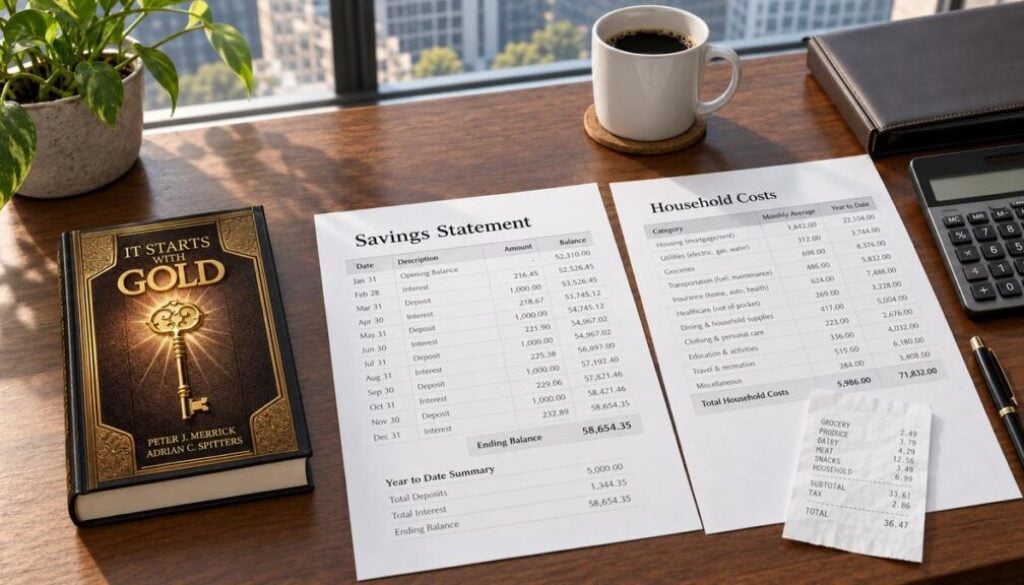
When More Savings Can Still Buy Less
How tax and inflation reduce buying power, and what to check before you reinvest.
By Adrian C. Spitters, CFP®, FCSI®, CEA and Peter J. Merrick, TEP® | Co-Authors, It Starts With Gold™ | Co-Creators, The Merrick Spitters Reset Report™
A Higher Balance Can Still Leave You Short
If you are investing money for retirement, I would keep the amount you need soon accessible. Then I would review how the rest can protect buying power. That applies when a guaranteed investment certificate (GIC) comes due or you sell a business, farm or property. A secure dollar balance can still leave you with less to live on.
Suppose $100,000 earns 4% each year for ten years, with all interest reinvested. The balance reaches about $148,000. At 6% annual inflation, it buys what $82,700 bought at the start, a loss of about 17% before taxes and fees.
Tax can create this gap at lower inflation. In a taxable, non-registered account, 4% interest taxed at an assumed 40% leaves 2.4%. At 3% inflation, buying power falls about 0.58% over one year, before fees. Income within a tax-free savings account (TFSA) is generally tax-free.

Why Government Debt Matters To Savers
A US congressional report put gross federal debt at US$40.25 trillion as of October 5, 2026. In an October 26 Sprott Money interview, economist E.J. Antoni explains that older bonds still carry low rates. Replacing them at higher rates as they mature raises the government’s interest bill.
Jay Martin warns that mounting US debt could push officials to cap government bond rates. He argues that savers would pay the cost if inflation stayed above those rates. He favours gold and other tangible assets in that setting.
The policy is called yield curve control. A central bank buys government bonds as needed to hold selected rates below a ceiling. The United States used rate caps during the Second World War and its aftermath, until the 1951 Treasury-Fed Accord. When inflation exceeds the rate on fixed debt, repayment costs the borrower less in buying power.
Canadian Savings Face The Same Test
On October 28, the Bank of Canada raised its policy rate to 2.5%. It also forecast inflation averaging 3% in 2027. Compare what you keep after tax with how much prices rise for the things you buy.
The dollar’s value matters too. A weaker Canadian dollar can make imported goods and travel more costly. Moving money into US dollars changes which currency you rely on. That money can still lose buying power.
The Monetary Succession Test™ asks what could replace the US dollar. Your decision concerns what your savings depend on today. A currency can stay widely used while buying less.
Keep The Money You Need Soon Accessible
Start with the date you need the money. Keep enough available for planned withdrawals, tax payments and known commitments. Before renewing a GIC, check its maturity date and whether you can withdraw early. Money needed next year has a different job from money intended for the next decade.
A GIC’s guarantee concerns repayment in dollars. Deposit insurance adds protection if an issuer fails. The Canada Deposit Insurance Corporation (CDIC) covers your qualifying deposits up to a combined $100,000 in each insured category at each member institution, including principal and interest. Confirm the issuer and which insurance rules apply before renewing. These protections do not fix what your dollars can buy.
If you owe costly debt, compare paying it down with investing. Avoiding interest can improve your position, although repayment may leave less cash available. I would settle that tradeoff before adding an investment that is hard to sell.
Give Physical Gold A Clear Job
I would review directly owned physical gold for part of the money meant to protect wealth over time. Peter’s dialogue in It Starts With Gold™ makes the point: “You cannot print more Gold out of nothing.” Owning the metal also avoids relying on a bond issuer to repay that part of your wealth.
The World Gold Council reported on October 15 that China’s central bank added 63 tonnes of gold in the third quarter, including 23 tonnes in September. That buying shows gold still has a role in official reserves.
Gold pays no interest, so it needs to fit alongside the assets funding your withdrawals. Its price can fall. Storage and insurance add costs, as does the gap between buying and selling prices. Allow for those costs when choosing how much to hold.
Productive assets have another role. A sound business or rental property can support spending through its earnings. Check the debt and running costs before counting on that income. Sale terms also matter if you may need to get your money out.
Check Ownership Before You Commit
I use Owning Assets in Order of Asset Security™ to test Control, Access, Independence and Continuity. We trace who controls your holdings and how you can obtain cash. We also check which firms you rely on and who could act if you cannot.
For vaulted gold, ask whether the documents establish your legal title to identifiable metal or a claim against a provider. Confirm the storage location, insurance and charges.
If you needed $25,000 for retirement, ask for a written sale illustration. It should show how much metal must be sold to leave that amount after selling costs. Confirm when the cash would reach your bank account, and ask separately about physical delivery.
A gold fund or mining share does not automatically give you title to particular bars. Read the ownership terms before treating different ways of investing in gold as the same protection. Keep those records where the person authorized to act for you can find them.
In Crucible of Tokens, Patrick M. Wood warns: “They take the deed and leave you the key.” He argues that gold tokens replace direct ownership with access controlled by others. If you are offered one, ask who can restrict transfers and what the contract requires before you can obtain physical metal.
Give Each Part Of Your Savings A Purpose
The Five Pillars of Asset Security™ helps connect those different jobs within one plan. Physical gold can reduce reliance on currency and repayment promises. Productive assets and managed investments can support income and growth. The mix should also leave enough money within reach for your needs.
Before you renew a GIC or reinvest sale proceeds, ask your existing advisor to explain how your holdings address buying power and what could limit access. If those answers remain unclear, I would review the ownership and withdrawal terms with you. Your statements give us a place to start, so we can identify which holdings need a closer look.
Continue Your Asset Security Journey™
Follow The Merrick Spitters Reset Report™ for continuing research on money, ownership, Asset Security and family wealth. Subscribe and receive a complimentary digital copy of It Starts With Gold™.
Subscribe to The Merrick Spitters Reset Report™
If you are deciding how to renew a GIC or reposition long-term savings, bring your recent investment or account statements to a complimentary 45-minute virtual introduction with me. We can review where your assets are held, how you own them and how you could access them before considering your next step.
About The Authors
Adrian C. Spitters, CFP®, FCSI®, CEA
Adrian C. Spitters is President and Private Wealth Advisor of PFC Wealth Solutions™ through Performance Financial Consultants Ltd. He is also a Dealing Representative with Axcess Capital Advisors Inc., through which his securities transactions are conducted. He has nearly four decades of experience advising business owners, professionals, farmers, retirees and multigenerational families. Raised on a dairy farm in British Columbia’s Fraser Valley, he focuses on Asset Security, wealth preservation and coordinating specialised professionals around a family’s needs. Adrian is co-author of It Starts With Gold™ and co-publisher of The Merrick Spitters Reset Report™. Read Adrian C. Spitters’ full biography here.
Peter J. Merrick, TEP®
Peter J. Merrick is an international speaker, educator, cross-border specialist and estate planner with more than three decades of experience advising business owners, professionals and family enterprises across Canada and the United States. His work focuses on succession planning, long-term wealth preservation and helping families structure and transition wealth across generations. Peter is co-author of It Starts With Gold™ and co-publisher of The Merrick Spitters Reset Report™. Read Peter J. Merrick’s full biography here.
Disclosure
This article provides general education and commentary, rather than advice based on your circumstances. It is not an offer or a personal recommendation to buy, sell, hold, borrow or transfer assets. Any recommendation requires a review of your objectives, risk tolerance, time horizon, access needs, costs, tax position and reasonable alternatives.
The ten-year illustration assumes constant annual returns of 4%, full reinvestment, constant annual inflation of 6%, no withdrawals, and no taxes or fees. The one-year example and graphic assume a $100,000 non-registered holding, 4% interest, a 40% tax on that interest paid from earnings at year-end, 3% inflation, and no fees or other withdrawals. These are illustrations, not forecasts or available product quotations. Tax treatment depends on the account and personal circumstances. Gold and productive investments can lose value. Income and protection against inflation are not guaranteed. Storage, insurance, ownership documents, account terms and applicable law affect access and outcomes.
Jay Martin’s scenario is attributed to him and is reported from the supplied video transcript. Yield curve control is discussed as a possible policy response, not a policy announced in the Federal Reserve’s October 28, 2026 statement. Economic figures and projections reflect the dated sources listed below and may change. Wood’s tokenization warning is his attributed assessment; a particular product’s rights require a review of its contract.
The Merrick Spitters Reset Report™ is an educational publication, separate from professional advisory services. Reading or subscribing does not create a client relationship. Securities activity is conducted through Axcess Capital Advisors Inc. Where professional services or referrals are considered, the responsible business provides the applicable role, fee, compensation and conflict disclosures. Do not submit account statements through a general subscription form.
Read the Regulatory, Relationship and Editorial Disclosure for the publication’s full relationship and compensation information.
References
- Bank of Canada. “Bank of Canada Raises the Policy Rate by 25 Basis Points to 2½%.” October 28, 2026.
- Bank of Canada. “Understanding Exchange Rates.” Accessed November 1, 2026.
- Board of Governors of the Federal Reserve System. “Federal Reserve Issues FOMC Statement.” October 28, 2026.
- Canada Deposit Insurance Corporation. “What’s Covered.” Accessed November 1, 2026.
- Canada Revenue Agency. “Line 12100 – Interest and Other Investment Income.” January 20, 2026.
- Canada Revenue Agency. “What Is a TFSA.” September 17, 2026.
- Hemke, Craig. “Gold Prices, Rising Inflation & the US Debt Spiral.” Interview with E.J. Antoni, recorded October 26, 2026. Sprott Money, October 27, 2026.
- Jia, Ray. “China Gold Market Update: Q3 Ends with Strong Official Gold Buying.” World Gold Council, October 15, 2026.
- Joint Economic Committee Republicans. “Monthly Debt Update.” October 7, 2026. Data as of October 5, 2026.
- Martin, Jay. “Why I Own What the Government Cannot Print.” The Jay Martin Show. YouTube video. Transcript supplied for this article; reviewed November 1, 2026.
- Merrick, Peter J., and Adrian C. Spitters. It Starts With Gold™. 2025. Chap. 14, “The Financial Industrial Complex,” 186. Supplied preview edition.
- Merrick, Peter J., and Adrian C. Spitters. Owning Assets in Order of Asset Security™. The Asset Security Reference Series, document 1. The Merrick Spitters Reset Report™, 2026. Accessed November 1, 2026.
- Merrick, Peter J., and Adrian C. Spitters. The Five Pillars of Asset Security™. The Asset Security Reference Series, document 2. The Merrick Spitters Reset Report™, 2026. Accessed November 1, 2026.
- Merrick, Peter J., and Adrian C. Spitters. The Monetary Succession Test™. Version 1.0, August 2026. Evidence cutoff July 19, 2026. The Merrick Spitters Reset Report™.
- Romero, Jessie. “The Treasury-Fed Accord.” Federal Reserve History. November 22, 2013.
- The Merrick Spitters Reset Report™. Regulatory, Relationship and Editorial Disclosure. Version 4.2, effective September 18, 2026.
- Wood, Patrick M. Crucible of Tokens. 2026. Introduction and chap. 8. Supplied audiobook transcript.