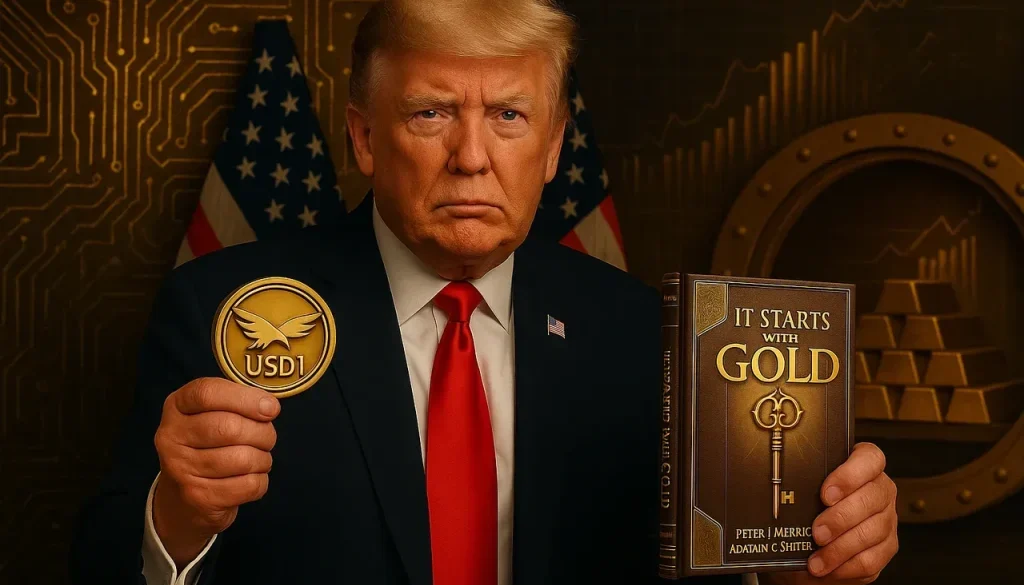
Trump USD1 Stablecoin and the Gold Reset
By Peter J. Merrick, TEP® and Adrian C. Spitters, CFP®, co-authors of the international bestseller It Starts With Gold™ and the forthcoming book Guns, Gold & Land™
This analysis continues a series of long-form investigations published in The Merrick Spitters Reset Report™
“This article represents analysis and scenario exploration. It is not financial advice and does not constitute a political endorsement.”
The setup
Debt climbs. Trust erodes. Policymakers seek a solution that does not resemble a default. The fix many expect is a gold reset delivered over digital rails. By digital rails, we mean the electronic payment networks, blockchain systems, and settlement platforms that move money outside of traditional banking. Stablecoins provide these digital rails, acting as the infrastructure that carries value instantly across borders. A presidentially branded stablecoin named the USD1 provides political cover. A revaluation of gold provides the math.
This article explains how a modern reset could work, why stablecoins are the missing infrastructure, how Donald John Trump’s USD1 stablecoin fits into the plan, and what each reset tier could do to United States debt and solvency optics. It also explains why the Treasury’s statutory book value of gold at 42.22 dollars per ounce is the hidden lever that can transform the federal balance sheet with a pen stroke.
Gold today and why the baseline matters
As of August 16, 2025, the live spot price of gold is about 3,335 dollars per troy ounce. That price is the baseline for every calculation in this article.
The United States reports official gold holdings of about 261.5 million troy ounces. On Treasury books, the metal is carried at a statutory price of 42.22 dollars per ounce. That legal price was set decades ago and has not been updated to market. It produces a book value a little above 11 billion dollars even though the market value is vastly higher.
The difference between book and market is the quiet fuse in a reset. If lawmakers revalue the government’s gold to market, or to a new official price, the federal balance sheet changes instantly without minting new coins or raising taxes.
Debt pressure that invites a reset
Gross national debt passed 37 trillion dollars during the week of August 12, 2025. The Treasury’s Debt to the Penny database shows total public debt outstanding just above 37.089 trillion dollars as of August 14, 2025. Annual interest costs are pushing into the trillion dollar range. Political appetite for austerity is minimal. The math points to revaluation as the path of least resistance.
How a modern revaluation could work
A revaluation does not require circulating gold coins. It requires a decision to change the official reference price of gold, update ledgers, and preserve transactional continuity across the economy.
Stablecoins deliver that continuity. A government could announce a new official gold price and, through rules on reserves, accounting, and custody, allow approved issuers to swap part of their backing from short term Treasuries to gold or gold linked instruments. Wallets would keep working. Balances would remain one dollar units. Under the surface, collateral standards would shift.
In 1934 the United States lifted the official price from 20.67 to 35 dollars per ounce and converted citizen gold at the lower price. Today the same concept would be expressed in accounting entries rather than in physical hand ins. The effect is similar. The state gains balance sheet strength. Savers holding pure cash lose purchasing power. Holders of physical bullion gain.
A second precedent often cited is the Nixon shock of 1971, when the United States suspended dollar convertibility into gold and effectively ended the Bretton Woods system. That move severed the last link between the dollar and gold, ushering in the era of floating fiat currencies. A modern revaluation would be the inverse: instead of cutting the tie, policymakers could reintroduce one, this time through programmable digital infrastructure. The historical lesson is that gold policy decisions have repeatedly reshaped the global monetary order within a matter of days.
Why stablecoins are the rails and the switch
Stablecoins are tokens designed to track the dollar. They are fast, programmable, and usually backed by cash and United States Treasury bills. They already direct large flows into Treasury markets.
A revaluation only needs a legal and technical switch that lets reserve portfolios tilt from bills to bullion or to bullion-linked instruments. That switch can be coded into issuer rules and overseen by regulators. The user barely notices. The system is rebased, meaning the entire financial framework is reset to a new standard of value, shifting its foundation from Treasuries to gold.
On July 18, 2025, the Guiding and Establishing National Innovation for U.S. Stablecoins Act, known as the GENIUS Act, became law. It created a federal regime for payment stablecoins and gave regulators authority over how reserves are held and protected. The framework is the control room for any future switch.
Important clarification: The GENIUS Act requires one to one backing with cash or Treasuries. It does not authorize gold backing. A gold pivot would require new legislation or rulemaking. The mechanism described here is scenario analysis that flows from today’s digital money architecture.
Where Trump’s USD1 Stablecoin fits in
World Liberty Financial, associated with the Trump family, launched a dollar stablecoin called USD1 in 2025. Trump’s USD1 stablecoin is described as fully backed by short term United States Treasuries, dollars, and cash equivalents. Reporting shows rapid traction and high profile placements.
Trump’s USD1 stablecoin sits inside the very channel the new law regulates. If policymakers ever tie stablecoin backing to gold, a coin like Trump’s USD1 stablecoin is a turnkey vehicle for a smooth rebasing from debt to metal. The interface in a wallet stays familiar. The collateral beneath the token changes.
What a revaluation does at each tier
The calculations here use the United States official gold stock of 261.5 million troy ounces, the live gold price of about 3,335 dollars per ounce on August 16, 2025, and total public debt outstanding of about 37.089 trillion dollars as of August 14, 2025. The statutory book value remains fixed at 42.22 dollars per ounce.
- At today’s price (3,335 dollars): America’s gold reserves are worth around 872.1 billion dollars. On the government’s books, however, they are still carried at only 11 billion dollars. That gap represents an unrealized gain of roughly 861 billion dollars. Even so, at current market levels the gold stock would cover only about 2.35 percent of the national debt.
- At 20,000 dollars per ounce: The reserves would be worth about 5.23 trillion dollars, enough to cover just over 14 percent of the debt. Analysts such as Luke Gromen have argued that a move of this scale may be necessary to restore credibility to the federal balance sheet.
- At 50,000 dollars per ounce: The hoard rises to over 13 trillion dollars in value, covering more than one third of the debt. Economist Jim Rickards has long suggested that only a valuation in this range would give the U.S. dollar sufficient backing in a true monetary reset.
- At 100,000 dollars per ounce: Reserves would reach more than 26 trillion dollars, covering over 70 percent of the debt. Investor Peter Schiff has warned that if confidence in fiat currency collapses completely, gold could be forced to these levels or even higher.
A key clarification: Revaluation does not erase the debt. What it does is increase the value of federal assets, improve the appearance of the balance sheet, and create new room to monetize. On paper, solvency looks stronger. In reality, the burden shifts. The dollars held by citizens would buy less in real goods, while the relief lands with the issuer of the debt. The cost falls on savers and wage earners.
Who Wins and Who Loses: The Macro Balance Sheet View
A revaluation does not create wealth out of thin air. It redistributes it. On one side, the federal government gains breathing room. On the other side, households and savers absorb the cost.
Winners
- The United States Treasury. By repricing its gold stock higher, Washington instantly strengthens its balance sheet and reduces the appearance of insolvency without passing legislation on spending cuts.
- Bullion-holding institutions. Central banks and private custodians with deep physical reserves see the purchasing power of their assets multiply overnight.
- Stablecoin issuers with political cover. If reserve rules tilt toward bullion, private issuers positioned early stand to gain enormous credibility and market share.
Losers
- Dollar savers. Anyone sitting in cash, deposits, or digital dollar claims watches real purchasing power fall as the unit of account is devalued.
- Wage earners. Fixed salaries lag behind the reset, producing an invisible pay cut in real terms.
- Bondholders. Long-term debt instruments repay in devalued units, leaving creditors poorer while the issuer benefits.
Why stablecoins make the shift friction light
Without stablecoins, a revaluation would force messy plumbing changes. Banks, merchants, and cross border payment systems would need to recalibrate.
With stablecoins, issuers can alter reserve composition while preserving the user experience. Programmability allows for gates, throttles, and targeted rules. A reset can be operationalized with little warning and with compliance checks embedded in every wallet.
The GENIUS Act’s protections for stablecoin reserves in bankruptcy law also signal that reserve portfolios sit at the center of policy. If a future rule linked those reserves to gold at a defined ratio, the link would be enforceable coin by coin. Users would see a dollar. The system would see a token that must hold a defined share of gold exposure per unit of liability.
Multiple perspectives that matter
Perspective one, the reset as salvation
Supporters argue that a revaluation restores confidence, stabilizes expectations, reduces leverage ratios, and buys time for structural reform. Under this view, shifting stablecoin reserves to include gold builds a hybrid standard that keeps payments fast and collapses default risk.
Perspective two, the reset as control
Critics counter that a gold linked reserve in stablecoins invites programmable rationing and surveillance in exchange for balance sheet optics. Without free redemption into physical metal, citizens hold claims while the state and preferred institutions keep the bullion. That produces a digital scrip with gold backed optics and fiat style control.
Perspective three, a competitive world
Outside the United States, central banks test their own digital settlement rails. The Multiple Central Bank Digital Currency Bridge, known as mBridge, has advanced beyond pilot under participating central banks. The Atlantic Council tracks dozens of cross-border and wholesale central bank digital currency projects. A United States revaluation plan would collide with this trend and face a world with rival rails.
Western allies and the likely spillover
United States allies would live inside the consequences.
Canada holds minimal official gold. Its dollar and banks would feel the shock directly. The United Kingdom sold a large share of its reserves in the early 2000s and has limited insulation. The European Central Bank holds sizable gold but political fragmentation complicates a rapid unified response. Japan remains exposed through heavy holdings of United States assets. Australia is resource rich yet depends on offshore custody for part of its bullion.
In a United States led reset, these allies would need to decide whether to align reserve structures, accept dollar stablecoin rails, or pursue independent hedges.
Outside the Western bloc, countries such as China, Russia, and other BRICS members have been accumulating gold reserves and experimenting with gold-linked trade settlement systems. China in particular has both the digital payment rails and the gold stockpile to mount a credible challenge to dollar primacy. If the United States were to reset on a gold basis, it would collide with these rival efforts, accelerating the contest over which standard, Washington’s or Beijing’s, defines the future of global settlement.
How families and firms would feel it
A retiree on fixed income finds the real value marked down as the unit of account rebases to a higher gold price. A small business sees payment rails tied to digital identity, tax logic, and automated compliance. An investor who holds physical gold outside the system watches purchasing power rise, while an investor with only digital claims faces new rules and potential redemption gates.
This is the deeper pull of programmable money. It preserves the appearance of continuity while changing the foundation under every balance.
Who Wins and Who Loses: The Household and Business View
Behind the balance sheet mechanics are families and businesses forced to live with the consequences. The reset draws a bright line between those with tangible independence and those reliant on digital promises.
Winners
- Families holding physical gold and silver. Bullion kept outside programmable rails retains full value and often gains purchasing power.
- Farm and land owners with productive assets. Land that generates food, water, or energy becomes an even stronger hedge as financial claims are rebased.
- Globally diversified firms. Businesses with offshore bullion custody or revenues in alternative settlement systems face fewer restrictions.
Losers
- Retirees on fixed pensions. Their income streams stay nominally constant but buy less each month.
- Small businesses tied into digital rails. Programmable compliance and tax automation increase operating friction while limiting flexibility.
- Households with only digital claims. Dollars in bank accounts or stablecoin wallets are rebased without choice, leaving families more dependent on the very rails that changed the rules.
The special role of the Trump USD1 Stablecoin
A presidentially linked stablecoin is a powerful adoption channel. If citizens trust the brand and merchants take the token, a policy change to reserve composition propagates quickly. A stablecoin like Trump’s USD1 can also project power abroad. If high profile settlements or trade flows prefer one private dollar over another, reserve mandates for that stablecoin can transmit policy at scale.
Public coverage has chronicled the Trump USD1 stablecoin’s launch, its design as a fully backed dollar stablecoin, and deals that boost its profile. In a system that needs digital rails to run a revaluation, the Trump USD1 stablecoin could matter more than a central bank’s white paper, such as the Digital Dollar Project’s 2020 white paper Exploring a U.S. CBDC, which lays out a conceptual framework for a U.S. central bank digital currency but does not itself create a functioning instrument. A white paper in this context is a formal policy or technical document, a planning tool rather than a live payments vehicle, whereas the Trump USD1 stablecoin is operational and circulating, making it potentially far more influential in real-world digital infrastructure.
Is Trump Aligned With the Needs of the U.S. Economy?
The rise of the Trump USD1 stablecoin forces a deeper question: is Donald Trump, as president, aligned with the long-term needs of the U.S. economy or not?
Arguments for alignment:
Supporters argue that Trump’s instincts are pragmatic. By tying his political brand to a stablecoin, he channels private adoption into the very rails that can absorb a gold revaluation. In this view, Trump aligns with economic survival. A revaluation would strengthen the federal balance sheet, protect the dollar’s global role, and buy time against debt collapse. Trump’s nationalist framing, “America first,” suggests that stabilizing the dollar and projecting power abroad through a dollar-branded stablecoin may indeed serve U.S. interests.
Arguments against alignment:
Critics counter that the alignment is cosmetic. While the balance sheet improves on paper, the burden still falls on ordinary savers, wage earners, and retirees. Trump’s stablecoin may protect the image of solvency, but it does not address structural imbalances like over-leverage, entitlement spending, or industrial hollowing. By offering a politically popular interface, a “Trump dollar,” he may mask the deeper redistribution from households to the state and its creditors. In this sense, Trump’s alignment is more with system optics and political capital than with the real needs of U.S. households.
The unresolved question:
If Trump uses the USD1 stablecoin to secure public trust while shifting reserves toward gold, he may preserve the dollar’s role in global trade. But if he prioritizes political branding over systemic reform, the United States risks entrenching the same fragile structures under a new façade. Whether Trump is aligned or not depends on whether his strategy is truly about restructuring debt and sovereignty or merely about delaying the reckoning with a patriotic label.
Does Trump Stand to Gain Financially From USD1?
Beyond questions of alignment, there is also the matter of incentives. Stablecoin issuers under the GENIUS Act must hold reserves in cash or short-term United States Treasuries. The interest earned on those reserves does not flow to token holders. Instead, it accrues to the issuer. This structure has already turned existing issuers into multi-billion-dollar enterprises, with profits tied largely to Treasury yields.
If the Trump USD1 stablecoin reaches scale, the potential gains are significant. With three-month Treasury bills yielding around four percent in mid-2025, even a modest circulation of ten billion dollars would generate hundreds of millions of dollars in gross annual interest. At fifty to one hundred billion dollars outstanding, the gains could reach into the billions each year before expenses. The larger the issuance, the more powerful the compounding effect.
How much Donald Trump himself would benefit depends on his ownership share in World Liberty Financial and the economics of the venture. But what is clear is that the structure itself provides a powerful incentive. The ability to capture steady interest income on reserves, combined with brand capital and strategic distribution advantages, positions the Trump USD1 stablecoin as more than a political symbol. It becomes both a financial engine and a policy lever, capable of shaping adoption and projecting power at scale.
A broader policy question is whether the yield income on reserves should accrue to private issuers or be directed toward public benefit. Critics argue that allowing a politically connected issuer to capture billions in Treasury interest resembles privatized seigniorage, meaning the profit governments traditionally earn from issuing currency when the face value of money exceeds the cost of creating it. Supporters counter that political branding and private efficiency can drive adoption faster than a central bank could. Where this revenue flows, to public coffers or private hands, will define not only Trump’s benefit but also how fairly the system is perceived.
Does Trump Benefit More From Higher Rates or Lower Rates?
The earnings model for a stablecoin like the Trump USD1 is simple: it captures the yield on the assets held in reserve. When interest rates are higher, the reserves generate more income. With circulation in the tens of billions, a difference of just a few percentage points in Treasury yields can mean billions of dollars in annual revenue for the issuer. From a purely financial perspective, Trump benefits more in a higher-rate environment.
Who Benefits From Higher Interest Rates?
When interest rates rise, the reserves behind a stablecoin like USD1, largely short-term U.S. Treasuries, generate more income. The direct beneficiary is the issuer, which pockets the interest spread after covering operational costs. For Trump’s coin, this means billions in annual revenue can flow to a politically branded entity. Indirectly, the Treasury benefits as demand for government debt strengthens, helping finance deficits. Ordinary savers, however, do not share in this upside; their deposits often earn far less, leaving the perception that seigniorage has been privatized. In effect, higher rates magnify the financial leverage of whoever controls the stablecoin reserves.
Impact on Gold Prices
Higher interest rates typically pressure gold in the short term by increasing the relative yield advantage of bonds. Yet in this context, the story flips. If stablecoin reserves are tied to Treasuries, then higher rates fatten the revenue stream that sustains the system, while simultaneously increasing the long-term risk of debt service costs for the government. That contradiction makes a gold revaluation more likely, not less. Investors watching this dynamic may front-run policy shifts by buying gold, pushing prices upward even as official rates remain high.
Is There an Incentive to Keep Rates Elevated?
Yes. With a stablecoin like the Trump USD1 in circulation, higher rates mean larger profits for the issuer and stronger demand for Treasuries. Policymakers may find themselves incentivized to maintain a “high-for-longer” stance, even if it strains households and businesses, because it secures income streams and keeps the dollar-based system attractive to investors. In other words, what hurts Main Street can enrich both the state and the issuer.
How Higher Rates Support a Reset
The incentives converge. For stablecoin issuers, higher rates deliver larger profits. For policymakers, higher rates keep demand flowing into Treasuries even as debt mounts. Yet those same higher rates also increase the long-term strain of servicing federal debt. This tension pushes Washington toward revaluing its gold stock as a release valve. In other words, high interest rates do not just fatten stablecoin income streams; they also accelerate the timetable for a gold reset. The same policy choice that enriches issuers like Trump’s USD1 stablecoin may lay the groundwork for the revaluation that reshapes the entire financial order.
Does Trump Benefit More From Growth or Contraction?
The answer is more complex when viewed through the lens of the broader economy. In periods of growth, adoption is easier. Businesses and households are more willing to experiment with a new stablecoin, and the scale of the Trump USD1 stablecoin grows with the flow of commerce. In downturns, however, the dynamics shift. A weakening dollar, rising debt costs, or declining confidence in government finance can actually accelerate the adoption of a politically branded stablecoin. In such moments, Trump’s stablecoin is not just a payments tool but a perceived safe harbour within a controlled reset.
The paradox is that Trump may benefit in both cases, but in different ways. In growth, his gain is financial. In contraction, his gain is strategic. In both scenarios, the Trump USD1 stablecoin strengthens his influence, whether by riding economic momentum or by capitalising on systemic stress.
Any transition of this scale would carry operational risks. Stablecoin reserves must be protected against cyberattacks, custodial failures, and legal disputes over collateral. Questions also remain about how courts would treat claims in the event of insolvency or fraud. Without strict auditing and enforcement, the credibility of a gold-linked reset could collapse quickly. These vulnerabilities underline that policy design is only part of the solution; execution and oversight matter just as much.
Risk controls that follow a reset
A reset almost always comes with rules. Expect at least five:
- Identity hardening. Wallets bind to verified identity with risk scoring.
- Programmable limits. Categories of spend can be throttled or blocked.
- Tax automation. Event based tax capture on transfers and gains.
- Capital controls. Pace limits on large conversions with state exceptions.
- Selective convertibility. Redemption for physical metal limited to approved channels.
These design choices exist already in pilots around the world, such as China’s e-CNY, which operates with strict transaction controls, the European Central Bank’s digital euro pilot, which sets caps on individual holdings, and the Bank for International Settlements’ mBridge project, which tests cross-border wholesale settlement among central banks. Merge them with a gold-linked reserve rule for stablecoins and the result is a system that looks sound and feels restrictive.
Counterarguments worth weighing
A pure fiat solution
Some argue the United States can grow out of debt through productivity gains, modest inflation, and lower interest rates that revive the cycle. Under this view, a gold reset is radical and unnecessary.
A central bank digital currency solution
Others argue the country should issue a central bank digital currency and keep control inside the public sector rather than private issuers. Politics in the United States has blocked that path so far, which is why the stablecoin regime moved first.
A market solution
A final view says do nothing. Let markets price debt higher, shrink leverage over time, and avoid engineered resets that distort signals.
These viewpoints deserve airing. The arithmetic of today suggests policy may not wait for slow cures.
Hope before the window closes
The rails are being laid, but you can still choose whether to ride them or step aside.
Own physical metal directly, not only token claims. Hold tangible assets that sit outside programmable rails. Build local trade networks. Focus family planning on control rather than purely on nominal balances. These choices reduce exposure to surprise policy shifts.
Structuring Assets for Maximum Security
At our firm, we assist clients in structuring their wealth by Owning Assets in Order of Asset Security. We prioritize the most secure assets and safeguard those that are most vulnerable.
Book your complimentary review to learn how to structure for the shifts ahead
Final Thoughts
The gap between the Treasury’s book price of 42.22 dollars per ounce and the live price near 3,335 dollars per ounce is an accounting powder keg. At current market, a simple revaluation would add roughly 861 billion dollars to the federal balance sheet. At 20,000 dollars per ounce, the reserve value climbs to about 5.23 trillion dollars. At 50,000, it reaches about 13.075 trillion dollars. At 100,000, it approaches about 26.15 trillion dollars, equal to more than seventy percent of today’s total public debt.
Stablecoins are the rails that could absorb this shift in days, not years. The GENIUS Act built the control room. A high trust stablecoin like the Trump USD1 stablecoin provides the distribution channel. That is the dystopian edge. The system can change its foundation while the interface in your hand barely moves.
The urgent themes raised here are explored in our number one international bestseller, It Starts With Gold™, and will be expanded on in the forthcoming book Killing Crypto™, co-authored by Peter J. Merrick, TEP® and Adrian C. Spitters, CFP®. In these works, we show how a gold revaluation connected to programmable money could transform debt, savings, and sovereignty, and we outline practical steps families can take to preserve their independence. Visit www.ItStartsWithGold.com.
To find out more, order your own copy of It Starts With Gold™ from Amazon today. CLICK HERE.
Stay informed. Stay protected. Subscribe to It Starts With Gold™ on Substack to get the latest article straight to your inbox. 👉 SUBSCRIBE HERE
Do you believe a gold reset through stablecoins could strengthen or weaken U.S. economic sovereignty?
References
Gold Prices and Projections
- Kitco – Live Gold Price, August 16, 2025
- JM Bullion – Gold Spot Price Chart, August 2025
- Business Insider – Gold Prices Hit Records on Recession Risk, April 2025
- Business Insider – Jeff Gundlach Gold Price Forecast, May 2025
- Luke Gromen – Gold $20,000 Thesis
- Jim Rickards – Gold $50,000 Framework, August 2016
- Peter Schiff Predicts Gold Could Soar to $100,000 as US Dollar Weakens – October 2024
- Peter Schiff predicts more gains for gold. Are you prepped for more shocks ahead? July 2025
U.S. Debt and Gold Holdings
- U.S. Treasury – Debt to the Penny
- AP News – U.S. National Debt Tops $37 Trillion, August 2025
- Bureau of the Fiscal Service – Status Report of U.S. Treasury-Owned Gold
Stablecoins and U.S. Regulation
- Reuters – Trump Signs GENIUS Act on Stablecoin Oversight, July 2025
- World Liberty Financial – USD1 Stablecoin Press Release
- Latham & Watkins – Client Alert on U.S. Stablecoin Regulation
- Bank for International Settlements (BIS) – Stablecoins and safe asset prices, May 2025
- Kiplinger – Trump-Era Regulations Broaden Crypto Access, August 2025
CBDCs and Global Finance
- Atlantic Council – Central Bank Digital Currency Tracker
- Bank for International Settlements – mBridge Cross-Border Project
- ECB’s Lagarde urges EU lawmakers to speed up digital euro law – June 2025
- World Gold Council – Central Bank Gold Demand 2025 Update, April 2025
- Associated Press – Supreme Court Grants Trump Broad Immunity, July 2025
Stablecoin Revenues and Yields
- Circle – USDC Reserves & Treasury Income Reports, 2023–2025
- Reuters – US Treasuries face stablecoin-driven demand surge as supply looms June 2025
- WSJ – Why Banks Are on High Alert About Stablecoins, July 2024
- FRED – Market Yield on U.S. Treasury Securities at 3-Month Constant Maturity, August 2025
Historical and Strategic Context
- Nixon Presidential Library – “Address to the Nation Outlining a New Economic Policy,” August 15, 1971
- IMF Working Paper – Gold as International Reserves: A Barbarous Relic No More?
- BIS Working Papers – Stablecoins: Risks, Potential and Regulation
- BRICS Summit 2023 Communiqué – Gold and Settlement Frameworks