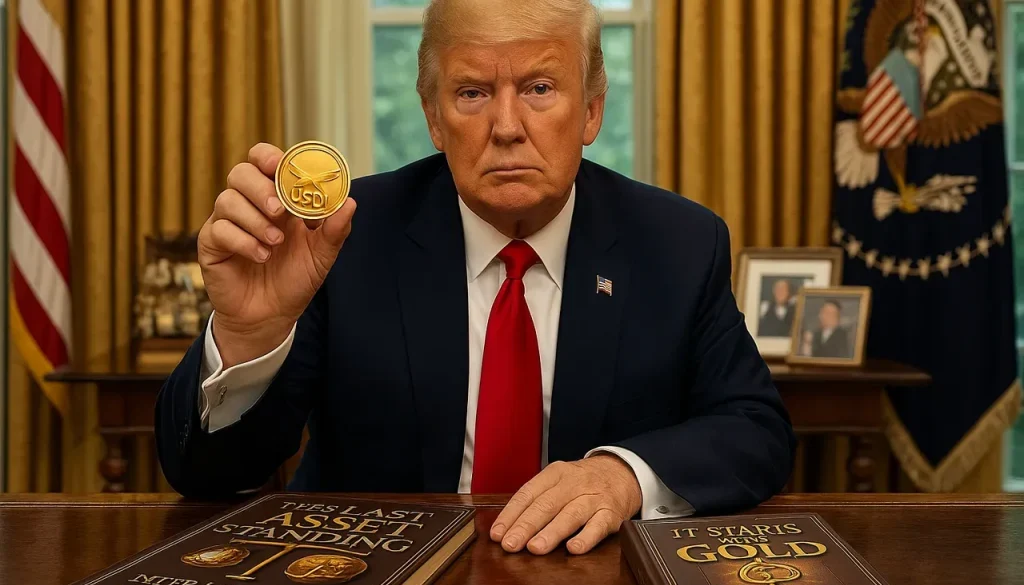
Trump USD1 Coin Confirms Catherine Austin Fitts Warning
By Peter J. Merrick, TEP® and Adrian C. Spitters, CFP®, co-authors of the international bestseller It Starts With Gold™ and the forthcoming book Guns, Gold & Land™
This analysis continues a series of long-form investigations published in The Merrick Spitters Reset Report™
“Perhaps the most chilling element is Trump’s unique conflict of interest. As both President and shareholder, he profits more when U.S. debt grows. The worse the economy gets, the higher the Treasury yields, and the greater the profits for stablecoin issuers like USD1.
In other words, Trump is financially incentivized to run higher deficits, destabilize markets, and drive up borrowing costs. It is a perverse alignment: the nation weakens, while he enriches himself.”
Trump’s USD1 Turns Public Debt Into Private Profit
This article explores one interpretation of recent U.S. legislation and financial moves. It is presented as an opinion piece intended to spark discussion and invite readers to consider the broader implications.
It follows our earlier examination of Catherine Austin Fitts’ warning: the global financial elite are preparing what she called a tender offer for humanity. She argued that public debt, private digital money, and surveillance-ready payment systems would merge into a new regime where citizens no longer control their wealth. For further insight, see: Global Stablecoin Takeover: The Fed’s Bid for 8 Billion Citizens.
At the heart of her theory was the claim that elites would offer an irresistible “upgrade” to money itself: faster, cheaper, and more convenient digital rails. Yet the real goal was to seize sovereignty, concentrate wealth, and effectively lock nations into debt servitude.
That moment is now here.
With the launch of World Liberty Financial’s USD1 stablecoin, co-owned by Donald John Trump and his family, the mechanism Catherine Austin Fitts described has shifted from theory to reality.
The Evolution of Seniorage: From Gold to Stablecoins
To understand why USD1 is so dangerous, we must revisit how governments and banks have historically profited from creating money, an operation known as seniorage.
- The Gold Standard Era Before World War II, currencies were backed by physical gold. Central banks held gold in vaults and issued notes against it. Seniorage profits were limited because money could not exceed gold reserves.
- Bretton Woods (1944–1971) In 1944, the Allied powers met in Bretton Woods, New Hampshire. They agreed to make the U.S. dollar the world’s reserve currency, pegged to gold at $35 per ounce. Other currencies pegged themselves to the dollar. Seniorage expanded because dollars could be created more freely, while still linked to gold.
- Nixon Shock (1971) In August 1971, President Nixon ended the gold peg. The dollar became a free-floating fiat currency. Seniorage exploded. Central banks could now print money limited only by “faith and credit.” Debt became the backbone of money.
- The Stablecoin Era (2020s–today) Stablecoins like Tether, Circle, and now USD1 represent the next phase. They are pegged to dollars or Treasuries but issued by private companies. Seniorage profits flow not to governments or central banks, but to private issuers.
Stablecoins collapse entire layers of financial intermediaries that once provided checks, friction, and accountability in the system. What took decades of global infrastructure to build, including central banks, correspondent banks, and merchant processors, can now be bypassed by a phone wallet and a digital token.
This is what Catherine Austin Fitts foresaw: seniorage, once a public resource, is being privatized at the precise moment nations are drowning in debt.
Trump’s USD1: The Private Capture of Public Money
World Liberty Financial, founded by Trump family members, has introduced USD1 as a stablecoin pegged one to one with the U.S. dollar. Within ninety days, USD1 reached $2.2 billion in circulation, making it one of the fastest growing stablecoins in history.
This growth was not organic. It was fueled by two controversial moves:
- A $2 billion transaction from Abu Dhabi settled in USD1, instantly legitimizing the coin on the global stage.
- A $100 million investment from Aqua1, a shell entity with no verifiable corporate registration, raising serious transparency concerns.
Behind the scenes, engineers linked to Binance, a company once expelled from China for money laundering practices, helped build World Liberty’s infrastructure. PancakeSwap, a decentralized exchange originally supervised by Binance, facilitated most of USD1’s early trading volume.
At the same time, World Liberty Financial announced a partnership with Alt 5 Sigma, a payments platform with integrations across banks and merchants. This move positions USD1 to break into retail adoption, the final barrier before widespread use.
Each step matches Catherine Austin Fitts’ framework: opaque capital inflows, engineered adoption, and tight integration with global finance.
The GENIUS Act: From Public Oversight to Private Capture
The most important piece of the puzzle is legislative. On July 18, 2025, President Trump signed the Guiding and Establishing National Innovation for U.S. Stablecoins Act (GENIUS Act), establishing a regulatory framework for stablecoins.
The Act requires stablecoins to be fully backed by dollars or Treasury bonds and places oversight under the U.S. Treasury, stripping authority from the independent Federal Reserve.
The implications are staggering:
- Stablecoin issuers become major buyers of U.S. debt. Issuers must hold dollars or Treasuries, ensuring demand for government bonds.
- Private profits flow from public debt. Seniorage that once funded central banks now enriches private issuers like World Liberty Financial.
- Trump profits as both regulator and shareholder. As part owner of USD1, he controls the oversight body and benefits personally from every dollar minted.
This is Catherine Austin Fitts’ tender offer realized. The state enforces the trap. Private players capture the profits. Citizens lose sovereignty.
Beyond GENIUS: A Coordinated Three-Bill Strategy
The GENIUS Act was only the beginning. Two other bills, still moving through Congress, could cement Trump’s control. Taken together, they form a legislative trilogy that locks the money supply into private hands:
- The Clarity Act shifts regulatory authority for crypto from the Securities and Exchange Commission (SEC) to the Commodity Futures Trading Commission (CFTC), a body widely seen as more lenient. This opens the door to speculation and systemic risk. The Commodity Futures Trading Commission’s history with crises, from Enron to the 2008 financial collapse, makes this especially alarming.
- The Anti-Central Bank Digital Currency (CBDC) Surveillance State Act prohibits the Federal Reserve from issuing its own retail digital currency, ensuring private issuers like World Liberty Financial dominate the market.
If these bills pass, the Federal Reserve will be sidelined entirely, leaving Trump’s USD1 and its peers as the de facto U.S. digital money.
Stay informed. Stay protected. Subscribe to It Starts With Gold™ on Substack to get the latest article straight to your inbox. 👉 SUBSCRIBE HERE
Judicial Immunity: A Blank Check
Another layer rarely discussed: Trump’s position is strengthened by recent Supreme Court decisions that give him broad immunity from conflict-of-interest laws and constitutional checks such as the Emoluments Clause.
This means that what would normally be a blatant violation, a president profiting directly from the money supply, can proceed without legal consequence. The legislative moves are dangerous on their own. Combined with judicial cover, they become unstoppable unless blocked politically.
How the Tender Offer Extends Globally
Fitts warned this was not a U.S.–only scheme. The tender offer is designed to be global.
By tying stablecoins to U.S. Treasuries, Washington ensures that every unit of digital money created increases demand for American debt. Allies face a stark choice: integrate with U.S.-backed stablecoins or risk being locked out of global markets.
Europe faces survival pressure; the European Central Bank risks irrelevance unless it launches its own competing coin.
Already, stablecoin issuers collectively rank as the 17th largest buyers of U.S. Treasuries, bigger than sovereign nations like Germany and Saudi Arabia. This is no longer a niche crypto play. It is a shift in the architecture of global finance.
The China Comparison
China’s e-CNY (Electronic Chinese Yuan, also called the Digital Yuan) offers a revealing contrast. Issued by the People’s Bank of China, ECNY is authoritarian and state run, allowing total surveillance under government control.
The U.S. model is marketed as capitalism and innovation, yet it achieves the same effect. Citizens transact on digital rails that can be monitored, switched off, or reprogrammed. The difference is that in America, the profits do not flow to the state, they flow to private oligarchs.
Fitts insightfully recognized that both systems, state-controlled China and privatized America, ultimately consolidate control. One does it through centralization, the other through privatization. Both systems ultimately trap citizens in debt dependency.
Opaque Investors: The Shadow Behind USD1
No tender offer would be complete without hidden hands. World Liberty Financial’s investors include:
-
-
- Abu Dhabi government funds, funneled through opaque channels, legitimizing USD1 abroad while tying it to oil wealth.
- Aqua1 Foundation, an entity with no public filings, raising red flags about laundering and foreign influence.
- Justin Sun, a Hong Kong billionaire with a controversial crypto record.
- Binance-linked investors, including founder CZ, currently serving a U.S. sentence but still wielding influence.
-
These connections mirror Catherine Austin Fitts’ prediction that shadow players would backstop the new system, ensuring its launch regardless of public trust. They also raise national security concerns: foreign billionaires and opaque funds now have a direct hand in U.S. debt markets via Trump’s coin.
The Debt Spiral Incentive
Perhaps the most chilling element is Trump’s unique conflict of interest. As both President and shareholder, he profits more when U.S. debt grows. The worse the economy gets, the higher the Treasury yields, and the greater the profits for stablecoin issuers like USD1.
In other words, Trump is financially incentivized to run higher deficits, destabilize markets, and drive up borrowing costs. It is a perverse alignment: the nation weakens, while he enriches himself.
Critics argue this is not speculation, but already underway. They warn that Trump’s incentives may be misaligned with America’s survival as a solvent nation.
Scale and Projections
Stablecoins already represent the 17th largest buyers of U.S. Treasuries. Market projections suggest:
-
-
- Current stablecoin market cap: ~$230 billion.
- By 2028: $2 trillion, or up to 15% of all U.S. short-term debt.
- Trump’s current stake in USD1: ~$4.5 billion.
- By 2028: could exceed $45 billion if adoption grows as projected.
-
Crucially, these timelines align with Trump’s presidency. By the time he leaves office, stablecoins could control as much as 10–15% of U.S. short-term debt, with Trump personally enriched by tens of billions.
Observers note that the tender offer is no longer theoretical. It appears measurable, expanding, and accelerating.
Media Silence and the Urgency of Awareness
One of the most dangerous elements is how little attention this story has received. Mainstream media outlets remain largely silent. Financial industry insiders know what is happening but are complicit, heavily invested in crypto themselves.
This blackout is not accidental. It is what allows the tender offer to advance in plain sight. Unless exposed and resisted, it will soon be irreversible.
What This Means for the West
For the United States, the consequences are historic. The President is no longer just commander-in-chief. He is now a shareholder in the money supply itself.
For Europe, the euro could be reduced to a regional token, secondary to U.S.-anchored digital rails.
For allies, dependence on U.S.-backed stablecoins ties them directly into America’s debt spiral, with no sovereignty of their own.
This reflects the tender offer. It is not merely theoretical; it is becoming operational.
Solutions: How to Refuse the Offer
-
-
- Public Alternatives: Nations must develop transparent, accountable digital currencies that serve the public, not private elites.
- Allied Cooperation: Western democracies must collaborate to avoid ceding power to private financial oligarchs.
- Asset Diversification: Protect wealth with physical assets, gold, silver, and real estate outside digital reach.
- Awareness and Action: The tender offer thrives on invisibility. Public exposure is the first step toward resistance.
-
Hope Beyond the Tender Offer
The story of money has always been a struggle between freedom and control. Each time, awareness has sparked resistance. The tender offer Catherine Austin Fitts described is not destiny. It is a choice.
Citizens can refuse to hand over sovereignty. Nations can build public alternatives. Families can preserve wealth outside the digital rails.
The tender offer is powerful, but it is not final.
Final Thoughts
At our firm, we help clients structure wealth by Owning Assets in Order of Asset Security. We prioritize the most secure assets and safeguard those most vulnerable.
Schedule a complimentary review to prepare for the paradigm shift ahead.
These urgent themes are expanded in our best-selling book, It Starts With Gold™. It reveals how the shift to digital stablecoins fulfills Fitts’ tender-offer warning and why physical gold remains the last store of sovereignty. Visit www.ItStartsWithGold.com.
Order your copy from Amazon today. CLICK HERE.
This is an opinion based on public sources. Inform yourself. Stay sovereign.
References
- Global Stablecoin Takeover: The Fed’s Bid for 8 Billion Citizens
- World Liberty Financial’s USD1 stablecoin reaches $2.2B in under 90 days – CryptoRank
- Trump signs stablecoin law as crypto industry aims for mainstream adoption – Reuters
- As U.S. stablecoins see wave of good news, Trump may have sold platform stake – Coindesk
- House passes first major regulation for crypto industry – Washington Post
- Trump signs stablecoin bill into law – Associated Press
- Trump-era regulations broaden access to crypto – Kiplinger
- Trump-backed World Liberty Financial sets up $1.5bn “crypto treasury” – Financial Times
- PancakeSwap origins and Binance link – Wall Street Journal
- How Much Is Trump Profiting Off the Presidency? – The New Yorker
- Justin Sun controversies – Wikipedia
- Abu Dhabi stablecoin transaction – Wikipedia