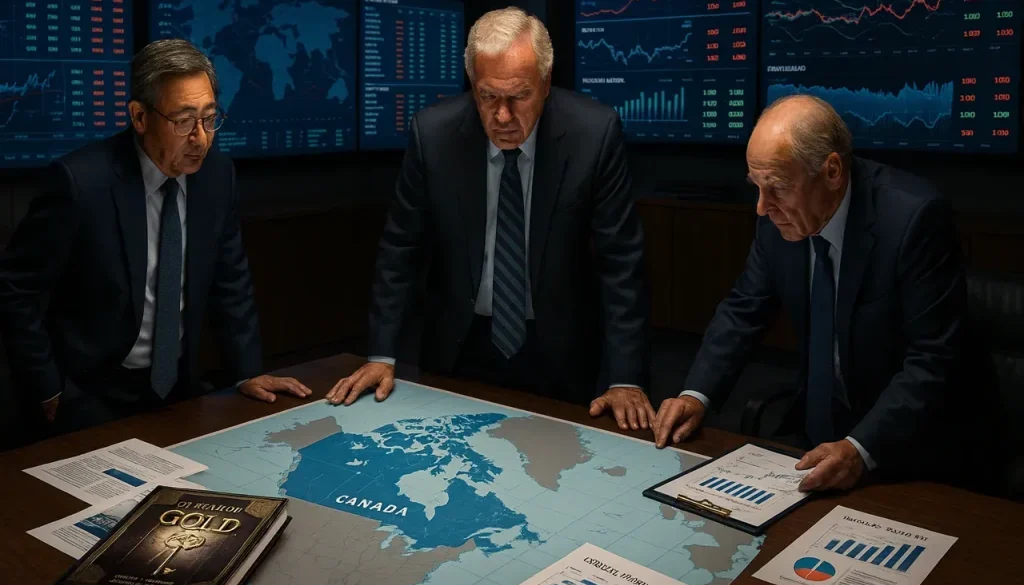
Who Really Wants Canadian Resources
By Peter J. Merrick, TEP® and Adrian C. Spitters, CFP®, co-authors of the international bestseller It Starts With Gold™ and the forthcoming book Guns, Gold & Land™
This analysis continues a series of long-form investigations published in The Merrick Spitters Reset Report™
Why Global Powers Compete for Canadian Land, Minerals, and Energy While Canadians Remain Excluded From Their Own Inheritance
By Peter J. Merrick, TEP® and Adrian C. Spitters, CFP®, co-authors of the international bestseller It Starts With Gold™ and the forthcoming Killing Crypto™
The Global Value of a Nation Canadians Have Never Been Shown
Canada has been described as blessed, wealthy, and resource-rich, yet these words fail to convey the scale of value contained within its borders. Canada holds the largest reserve of fresh water on earth. It holds some of the finest farmland in the Northern Hemisphere. It possesses enormous deposits of oil, natural gas, uranium, copper, nickel, potash, timber, and critical minerals essential for every modern technology. Canada also holds direct access to the Arctic, which is becoming the most strategic trade corridor of the next century. These realities place Canada at the center of global competition. Foreign nations understand the importance of this land. Foreign corporations and global financial institutions understand it as well. Most Canadians, however, have never been given the language, the numbers, or the perspective to grasp the magnitude of what they were born into.
The modern world is entering a century defined by scarcity. Nations with rising populations and declining water supplies are already looking outward for food and water security. Nations with industrial ambitions are hunting for stable access to minerals. Nations that rely on imports to feed their people are pursuing farmland abroad. Nations threatened by internal instability are looking for external lifelines. Canada sits at the intersection of these pressures. This is why the country has become the target of global interest and strategic positioning. Canada is not simply a trading partner to the world. It is a potential anchor for the survival of multiple nations.
👉 Subscribe to The Merrick Spitters Reset Report™ and receive a digital copy of our international bestseller, It Starts With Gold™, along with our white paper, Last Asset Standing™ and early updates on our forthcoming book, Killing Crypto™.
Why Global Powers Compete for Canada
Every major power understands that control over land, water, minerals, and energy determines its future. China, the United States, and the United Kingdom each view Canada as essential to their long-term national strategy, but for different reasons. China sees Canada as a source of minerals, food, and farmland that China cannot supply at home. The United States sees Canada as critical to continental security, industrial stability, and defence integration. The British Crown and the City of London see Canada as part of a long-standing structure that continues to influence valuation, ownership, and institutional behaviour. Beyond these three, the European Union, Middle Eastern sovereign wealth funds, India, Japan, and South Korea all treat Canada as a strategic resource territory. Global financial institutions reinforce this structure by influencing how Canadian assets are valued, managed, and extracted.
The outside world views Canada as one of the most valuable lands of the twenty-first century. Canadians have not been shown this truth, and this has created the conditions that allow foreign interests to assert influence inside the country’s political, economic, and legal architecture.
These global pressures do not operate in a vacuum. They act on top of Canada’s internal governance structure, which in recent years has undergone changes that foreign actors study carefully. Among the most consequential are the legal frameworks that reorganize authority over land and resources.
UNDRIP and DRIPA as Strategic Levers for External Influence
British Columbia became the first jurisdiction in the world to legislate the United Nations Declaration on the Rights of Indigenous Peoples, known as UNDRIP, through the passage of the Declaration on the Rights of Indigenous Peoples Act, known as DRIPA, in 2019. This positioned British Columbia as the national test case for Canada and the international pilot model that global bodies intend other jurisdictions to follow. By legislating UNDRIP through DRIPA, British Columbia became the proving ground for a model of governance that changes who ultimately controls land, resources, and regulatory authority.
Canada initially adopted UNDRIP at the federal level. British Columbia later expanded its reach through DRIPA. These frameworks are often described as tools for supporting Indigenous communities. In practice, they do the opposite. They place Indigenous communities inside a legal structure they did not design and expose them to forms of oversight they cannot control.
UNDRIP and DRIPA create a model of shared decision-making that appears to strengthen Indigenous authority, yet the structure introduces conditions that can later be used to judge, monitor, and overrule Indigenous decisions. Ottawa’s approach positions Indigenous bands as the face of land stewardship while shifting real control upward. The language of “international standards,” “global consultation,” and “multilateral accountability” opens the door for oversight by bodies outside Canada.
Foreign governments and multinational corporations understand this trajectory. They recognize that increased regulatory complexity slows Canadian investment and lowers asset valuations. They also recognize that once land governance becomes tied to international expectations, the authority of Indigenous bands can be challenged on the basis of “administrative failure.” If a band is deemed unable to meet imposed expectations, the authority does not return to Canadians or to the communities themselves. Oversight shifts upward toward federal and international frameworks that enforce those standards, placing final decision-making increasingly in the hands of bodies outside the affected communities.
Indigenous communities are not strengthened by this model. They are placed into a structure where they bear responsibility without meaningful power, and where the final authority sits far above them. This model benefits foreign actors who prefer negotiating with centralized global bodies rather than with local communities or Canadian citizens.
Indigenous communities are positioned as intermediaries in a structure designed elsewhere. They carry the public burden of responsibility while federal and international bodies quietly retain the upper hand. This dynamic uses Indigenous communities as the visible face of land governance, while real authority is engineered to migrate upward into administrative systems they did not create and cannot control.
UNDRIP and DRIPA were introduced as frameworks to protect Indigenous rights, yet the structure places Indigenous communities inside systems they cannot control. The practical result is a loss of authority, not a gain, and Indigenous peoples are positioned as intermediaries in a larger transfer of power that ultimately moves upward to federal and international bodies.
Global institutions promote UNDRIP and DRIPA because these frameworks shift authority from nations to international standards. Canada adopted them more aggressively than most countries, making it uniquely vulnerable.
This legal complexity sits on top of a resource base so valuable that the world cannot ignore it. Foreign powers study legal shifts closely, and every increase in administrative complexity produces economic consequences they can exploit. When Canada adopts international frameworks faster than any other nation, it unintentionally signals that its internal authority structures are weakening.
How UNDRIP and DRIPA Reshape Control of Canadian Land and Resources
UNDRIP was introduced as a global affirmation of Indigenous rights. Most nations endorsed it symbolically. Canada made it partially actionable at the federal level, and British Columbia went further by passing DRIPA, which requires all provincial laws and policies to align with UNDRIP. This affects land use, resource licensing, forestry, water access, mineral rights, and future Crown land classifications.
British Columbia became the first jurisdiction in the world to legislate UNDRIP in this way, positioning the province as both Canada’s test case and the model international bodies expect other regions to follow.
This alignment does not transfer constitutional sovereignty to Indigenous communities. Instead, it places Indigenous governance inside a framework shaped by federal legislation and international standards. Bands are expected to administer land and resources according to norms developed outside their communities. If those expectations are not met, authority does not revert to local communities or to Canadians; instead, decisions move upward toward federal mechanisms that interpret global standards. Ottawa’s policy language increasingly references “international compliance,” “UN monitoring,” and “global best practices,” signalling a shift from local stewardship toward international oversight.
Foreign governments recognized this shift early. Fragmentation across multiple decision points weakens the traditional Canadian chain of authority that once flowed primarily through federal and provincial institutions. China views the fragmentation as an opening to secure long-term access to minerals, agriculture, and land-based infrastructure. The United States sees it as a reason to assert greater continental control. The British Crown benefits from legal continuity that maintains Canada’s alignment with external frameworks. Global banks, multinational corporations, and sovereign wealth funds exploit the increasing complexity to acquire distressed projects at discounted valuations when approvals stall.
Indigenous communities are placed in an impossible position. They carry public expectations of authority without the structural power needed to defend it. They must administer land according to standards they did not create and are judged by international benchmarks that do not reflect their governance traditions. They face blame for project delays even though the regulatory architecture makes such delays inevitable.
UNDRIP and DRIPA were not designed to harm Indigenous communities, yet their operational structure produces outcomes that undermine Indigenous autonomy. By embedding Indigenous governance within compliance frameworks shaped by global institutions, these policies weaken local authority while making Indigenous communities the first to face consequences when administrative expectations are unmet. The harm is structural, not rhetorical.
Although presented as efforts to strengthen Indigenous rights, these frameworks often use Indigenous governments as intermediaries in a much broader transfer of authority. Communities become the public face of land stewardship while real power migrates upward into federal and international systems. They are given responsibility without the corresponding authority to defend it, and they are evaluated according to standards written beyond their cultural and legal traditions.
Rather than creating empowerment, the model places Indigenous communities within a system designed for external oversight. When they struggle to meet imposed expectations, decision-making authority does not return to them or to Canadians. It flows toward the international organizations and federal mechanisms that shaped the framework. Indigenous communities become the frontline actors in a contest over land and resources they did not initiate and cannot win.
The fragmentation created by UNDRIP and DRIPA has become a major accelerant in the global competition for Canadian land and resources. Indigenous communities now stand at the centre of a conflict where they hold visibility but not power. Their position is symbolic, while the substantive authority continues to consolidate above them.
These structural weaknesses extend even further when the operational mechanics of these frameworks are examined. Their full impact becomes clear when we look at how they reshape authority across land, minerals, water, and Crown territories.
When domestic governance becomes fragmented, external powers do not hesitate. They advance their own strategies with precision, seeking opportunities that appear when nations lose internal cohesion. This is most visible when examining how individual foreign powers approach Canada.
China’s Long-Term Strategy for Minerals and Food
China approaches Canada with a level of clarity that Canadians rarely see in their own leadership. China has faced rapid population growth, water scarcity, declining agricultural output, and rising industrial demand. China’s domestic mineral reserves cannot meet its strategic needs. China cannot sustain its economic and political stability without foreign access to potash, copper, nickel, uranium, timber, and agricultural products. Canada supplies all of these.
China does not focus only on acquiring Canadian land or companies. China works through the entire global supply chain. Chinese entities participate in global refining networks, intermediary corporations, technology manufacturing, and commodity logistics that eventually connect to Canadian mineral and agricultural output. Even when Canadian regulations restrict direct ownership, China remains influential through commercial pathways, corporate partnerships, offtake agreements, and long-term contracts. China thinks in decades, not political cycles. Minerals, fertilizer, timber, and food security are not commercial matters for China. They are matters of national survival. This makes Canada irreplaceable to China’s future.
The United States and the Imperative of Continental Stability
The United States views Canada as essential to its stability, strength, and security. American refineries rely on Canadian oil. American grids depend on Canadian natural gas and hydroelectricity. American agriculture depends on Canadian fertilizers and feed inputs. American manufacturing relies on Canadian minerals that move across integrated cross-border supply chains. American defence depends on Canadian airspace, northern territory, and cooperation through the North American Aerospace Defence Command. American Arctic strategy depends on Canadian sovereignty in the North. American water security is reinforced by Canadian watersheds. There is no part of American economic or military planning that does not rely on Canadian continuity.
For the United States, Canadian stability is not optional. A Canada influenced by competing powers threatens the entire American structure. This is why the United States seeks dominant influence over Canadian policy direction, energy strategy, trade, defence, and infrastructure. The United States treats Canada as an extension of continental security, and it acts accordingly.
The British Crown and the Continuity of Control
Understanding Canada’s position requires acknowledging the influence of the British Crown and the legal continuity that still underpins the Canadian state. Canada remains a constitutional monarchy. The Crown is recognized in Canadian courts, legislation, and land administration. Crown land still represents a majority of the Canadian landmass. The Crown holds authority through the Royal Prerogative, which is a collection of powers that were never fully transferred to elected governments. These powers influence foreign affairs, defence, land ownership, mineral rights, and the appointment of key officials. Canadians often believe these structures are symbolic, yet they shape the legal framework through which resource rights and land authority are interpreted. When a nation’s foundational structures remain tied to an external authority, the flow of influence becomes difficult to ignore.
The Crown’s influence also extends into the financial architecture that guides Canada’s economic activity. The City of London is one of the oldest and most influential financial districts in the world. Its reach extends through banking, insurance, commodity markets, and trade financing. Canada’s resource valuation is tied to global markets where London remains central. This connection did not happen by accident. It is the result of centuries of legal and financial continuity that still governs how Canadian assets are priced and traded.
The City of London and the Architecture of Global Valuation
The City of London operates as a global hub for commodity pricing and financial flows. The London Metals Exchange, known as LME, sets global benchmark prices for copper, nickel, aluminum, zinc, and other minerals. These minerals form the backbone of Canadian exports. When pricing power exists outside the producing nation, the producing nation becomes dependent on valuation mechanisms it does not control. This dynamic places Canada in a position where it provides resources yet does not determine their worth.
Commodity exchanges are not neutral marketplaces. They are systems of influence that guide investment, shape extraction, and determine how wealth is distributed. When the City of London’s valuation structure determines the price of Canadian minerals, global investors treat Canada according to those prices. Canadian corporations adjust their strategy based on them. Provincial governments structure royalties around them. Entire economic regions rise or fall according to decisions made thousands of kilometres away. The City of London’s influence over Canadian resource valuation remains one of the least discussed but most consequential aspects of modern economic control.
The European Union and the Pursuit of Stability Through Canadian Supply
The European Union has entered a period of deep structural change. Energy shortages, demographic shifts, geopolitical instability, and external conflict have strained internal systems. Europe cannot produce enough critical minerals, timber, agricultural goods, or fertilizers to meet its own needs. Canada provides all of these with stability. European demand for Canadian minerals has increased as Europe seeks to reduce dependence on regions affected by conflict or political risk. European reliance on Canadian timber and agricultural products has grown as internal pressures mount.
European influence also enters Canada through regulatory alignment. To access European markets, Canadian exporters must comply with European environmental, safety, and industrial standards. This has the effect of shaping Canadian policy, even though the policy pressure originates outside Canada. Foreign jurisdictions often influence Canadian regulations more effectively than domestic political parties. This connection gives the European Union indirect control over segments of the Canadian economy.
Middle Eastern Sovereign Wealth Funds and the Search for Water and Food
The Middle East faces chronic water scarcity and rising temperatures that threaten agricultural production. Nations such as Saudi Arabia, Qatar, and the United Arab Emirates have recognized that long-term food security cannot be achieved within their borders. They must look outward. Canada, with its vast freshwater systems and temperate farmland, stands out as one of the most desirable agricultural regions in the world. Middle Eastern sovereign wealth funds have invested in Canadian farmland, food production companies, and agricultural infrastructure. These investments are not speculative. They are strategic. They reflect a recognition that food and water will shape global stability in the coming decades.
Canada’s agricultural regions could feed far more people than the country currently contains. The fact that foreign sovereign wealth funds view Canadian farmland as a safeguard for their own populations reveals the scale of what is available in Canada. It also demonstrates how foreign actors prepare for the future with clarity that Canadian leaders have not matched.
Each of these nations approaches Canada with different motivations, yet they all benefit from the same underlying issue. Canada’s internal structure makes it easier for external powers to advance their priorities than it is for Canadians to protect their own. This vulnerability becomes even more apparent when the combined effects of UNDRIP and DRIPA are considered.
India, Japan, South Korea, and the Race for Minerals and Energy
India’s population growth has created unprecedented demand for fertilizer, energy, and critical minerals. Canada’s potash and agricultural output are vital to India’s food and industrial security. Japan and South Korea rely heavily on imports to power their industries. Canadian natural gas, uranium, timber, and minerals reduce their reliance on unstable regions. These nations approach Canada with respect for its stability and resources. They understand that their economic future requires a secure supply from dependable partners. Canada fits this requirement perfectly. This is why their companies, governments, and investment funds commit deeply to Canadian projects that secure long-term access.
Global Financial Institutions and Their Quiet Influence
Beyond nations, global financial institutions shape Canada’s economic direction with far greater influence than most citizens realize. The International Monetary Fund, known as the IMF, provides economic guidance that aligns Canada with international frameworks. The Bank for International Settlements, known as BIS, influences central banking policy. The World Bank guides development priorities. The World Trade Organization, known as WTO, shapes trade and regulatory compliance. The Chicago Mercantile Exchange influences energy pricing. The London Metals Exchange influences mineral pricing. Global asset managers such as BlackRock, Vanguard, and State Street shape Canadian corporate governance, determine investment flows, and influence land valuation through their scale.
These institutions build the economic environment in which nations operate. Canada, as a resource producer, becomes heavily influenced by the decisions made in these global centers. The alignment between international institutions and national policy creates a structure in which foreign priorities are often expressed through domestic legislation.
UNDRIP and DRIPA Multiply the Internal Weaknesses Foreign Powers Exploit
Before examining Canada’s internal vulnerabilities, it is necessary to recognize how UNDRIP and DRIPA magnify those vulnerabilities. Canada entered the twenty-first century without a unified national resource strategy, and authority over land and minerals remained divided between federal and provincial governments. The introduction of UNDRIP into federal law and DRIPA into British Columbia law added a third governing layer that foreign powers quickly learned to navigate. Courts have begun applying UNDRIP-related principles even when legislation does not require it, as seen in recent title rulings.
This expanded network of authorities creates a system in which no single Canadian institution can defend a unified national interest. It introduces uncertainty over land tenure, mineral rights, forestry allocations, and water access. It also delays the development of major projects, which places downward pressure on valuations. Foreign corporations and sovereign wealth funds study these weaknesses carefully because they create opportunities to acquire influence or ownership at discounted entry points.
Foreign powers are not causing Canada’s fragmentation. They are exploiting what Canada created. UNDRIP and DRIPA intensified the fragmentation and accelerated the global competition for control.
WOAH as an Emerging International Authority Over Canadian Agriculture and Land Use
The World Organization for Animal Health, known as WOAH, has expanded its influence over national agriculture since the global biosecurity regime changed in 2020. WOAH’s authority grows through federal and provincial alignment with international disease management standards that now govern livestock movement, culling protocols, farm quarantines, and restrictions on agricultural operations.
WOAH presents itself as a scientific body, yet its influence functions in a very similar way to how UNDRIP and DRIPA operate over land governance. Those frameworks shift authority upward through shared decision-making models that appear local but ultimately serve external oversight. WOAH shifts authority upward through animal health standards that appear technical but reshape who controls farmland, food production, and agricultural continuity during declared outbreaks.
WOAH does not merely provide guidance. It sets the conditions federal agencies must meet to maintain export status. It determines when livestock can be moved, when farms must be shut down, and when herds or flocks must be destroyed. Non-compliance threatens international certification, which pressures regulators in British Columbia and across Canada to follow WOAH expectations with little room for local discretion.
This produces the same structure that Canadians now face in land governance. Responsibility appears local, but decision-making rises into international systems. Farmers and regional communities carry the cost, yet the final authority sits far above them.
Why the Fraser Valley Became the National and Global Hotspot
The Fraser Valley of British Columbia has experienced some of the most aggressive responses linked to WOAH-aligned protocols. The region’s dense agricultural corridor makes it an ideal candidate for classification as a high-risk zone under WOAH definitions. Once classified, the region becomes subject to rapid response measures that include mandatory culling, lockdowns, movement restrictions, and extended quarantines.
The clustering of H5N1 detections in the Fraser Valley is not simply a matter of local farming practice. It is shaped by the regulatory framework operating above the region. British Columbia regulators follow WOAH’s interpretation of risk exposure, and the Fraser Valley remains under heightened surveillance. Increased surveillance produces more sampling. More sampling produces more detections. More detections trigger more restrictions, even in cases where livestock show no visible disease.
This cycle helps explain why the Fraser Valley is not only Canada’s hotspot but a global example of how WOAH-aligned biosecurity systems operate. British Columbia is used as a proving ground in the same way it has been used as the proving ground for DRIPA. Once an international body labels a region as high risk, provincial regulators respond according to global expectations and not necessarily according to local conditions or proportional evidence.
How WOAH Fits into the Larger Pattern of External Control
WOAH’s expanding reach fits the same pattern as the governance shifts accelerated through UNDRIP and DRIPA. Local actors absorb responsibility while external bodies determine standards. Communities face the consequences when compliance fails. Authority moves upward and rarely returns.
The Fraser Valley’s repeated lockdowns, culling orders, and ongoing restrictions illustrate this pattern clearly. When international bodies define what constitutes acceptable risk, farmers lose autonomy. When depopulation orders are triggered by protocols developed overseas, the decision is no longer made by producers or provincial officials. It is made by an international institution reinforced by federal alignment.
WOAH’s influence is not only agricultural. It extends into land use, food system continuity, economic stability for rural regions, and long-term control over agricultural activity. And similar to UNDRIP and DRIPA, WOAH introduces a model where Canadians absorb the burden while the real decision-making sits within international systems.
The Internal Structures That Enable Foreign Influence
Foreign powers would not enjoy such deep influence over Canadian resources if the internal structure of the country were strong. The challenge is that Canada’s governance framework was not built to protect national resource sovereignty. Canada operates under a constitutional design that created distributed authority without establishing a unified national resource strategy. Provinces own natural resources, yet they compete against each other in a race to the bottom. One province lowers royalties to attract investment, another matches it, and the cycle continues. This fragmentation prevents Canada from negotiating with the world from a position of strength. It prevents national bargaining power. It prevents citizens from sharing in national wealth.
Federal institutions compound the problem. Ottawa’s bureaucracy operates according to political cycles rather than long-term national planning. Political parties rotate power with little continuity. Policy direction shifts every four years, which creates instability that foreign actors exploit. Universities depend heavily on foreign funding, research partnerships, and international student revenue, which shapes academic influence on national policy. Canadian pension funds, including the Canada Pension Plan Investment Board, the Ontario Teachers Pension Plan, and the Ontario Municipal Employees Retirement System, invest billions outside Canada rather than building domestic control of Canadian assets. National media, which should support public understanding, avoids explaining how foreign influence enters domestic systems.
Canadian courts still interpret Crown land and mineral rights through legal frameworks rooted in the nineteenth century. These frameworks retain ambiguities that are easily influenced by foreign investors, multinational corporations, and global institutions that understand the system better than Canadian citizens do. Regulatory agencies adopt global standards rather than national ones, and this alignment often benefits external actors more than Canadians. The cumulative effect is a nation that possesses immense wealth but lacks the structure to protect it.
How Foreign Powers Compete Inside Canada
Canada has become a silent battleground where foreign interests compete through investment, regulation, trade, academia, media, and political influence. China focuses on minerals, agricultural land, and long-term commercial agreements. The United States focuses on energy, defence, industrial supply chains, and political alignment. The British Crown and the City of London focus on valuation, legal interpretation, and financial architecture. The European Union focuses on regulatory pressure that shapes environmental and trade policy. Middle Eastern sovereign wealth funds focus on farmland and water access. Global financial institutions focus on governance and capital flows.
These influences are not coordinated with each other. They compete. Yet they all succeed because the internal Canadian system does not anchor itself to a clearly defined national interest. Foreign actors bring strategy to the table. Canada brings fragmented governance, political division, and short-term thinking. This imbalance explains why foreign nations often know more about Canadian resources than the citizens of the country itself.
These internal conditions do not remain theoretical. They translate directly into measurable influence across industries, institutions, and political systems. This is where the competition for Canada becomes visible in day-to-day reality.
How UNDRIP and DRIPA Contribute to the Loss of Canadian Inheritance
One reason Canadians receive no direct benefit from the wealth beneath their feet is the absence of a national resource strategy. Another reason is the layered complexity of land and mineral governance. UNDRIP and DRIPA intensified this complexity by introducing shared decision-making obligations across major resource regions. This expands the number of approvals required for any project and increases the number of parties who must agree on extraction, valuation, royalties, and land use.
Foreign governments and multinational entities understand that when a nation’s resource governance becomes divided, the people of that nation lose influence over their inheritance. Complex systems push power upward to external actors who have the legal teams, financial resources, and geopolitical strategies to navigate them. This pattern is now visible across Canadian mining, forestry, agriculture, and energy sectors. While Canadians receive no dividend from national wealth, foreign powers secure long-term supply and strategic advantage.
UNDRIP and DRIPA were not created to deprive Canadians of their inheritance. Yet the way these frameworks operate inside an already fragmented system allows global actors to leverage them for their own gain.
Why Canadians Receive Nothing from Their Natural Inheritance
Canadians have never received a share of national resource wealth because the country never adopted a sovereign wealth model. Nations that recognize resource value create royalty structures that benefit citizens directly. Norway uses its sovereign wealth fund to pay for national services and long-term prosperity. Qatar and Saudi Arabia distribute wealth through directly funded public programs that lift the standard of living. Canada, with far greater natural wealth than many of these nations, adopted a different approach. It exports raw materials at low margins, imports finished goods at high margins, and never channels surplus value back to citizens.
Provincial governments depend heavily on resource revenues to fund operations. This creates political incentives to maximize short-term revenue rather than long-term national inheritance. When provinces own resources independently, they negotiate separately. This weakens bargaining power and allows foreign corporations to secure favourable terms. The lack of a unified national strategy ensures that Canadian citizens receive nothing while external powers benefit from the wealth extracted from Canadian soil.
Why Canada’s Resource Potential Has Been Historically Undervalued
Analysts who studied Canada’s resource base have long argued that the country dramatically undervalues what it owns. Many examined Canada as an integrated resource nation, combining the value of oil, natural gas, minerals, timber, farmland, water, and Arctic access. Their work emphasized a consistent point. Canada captures only a fraction of the value of its raw materials because it exports almost everything in unprocessed form.
These analysts also showed that if Canada refined, processed, and manufactured its own resources domestically, the national economic output would rise dramatically. Nations with sovereign strategies that include full value capture, such as Norway and Qatar, demonstrate how resource wealth can be transformed into long-term national benefit. The exact numbers depend on market conditions, but the underlying principle is clear. When a nation owns world-class resources and builds full value chains around them, citizen prosperity rises alongside national strength.
The Historical Versus Contemporary Valuation Gap
Earlier generations exported raw materials with limited processing. That model remains largely unchanged today. Yet global conditions have evolved. Minerals essential for batteries, energy storage, technology manufacturing, and grid infrastructure have skyrocketed in value. Water and farmland have become strategic assets. Food security has become a defining issue for multiple regions. Oil and natural gas markets have been reshaped by geopolitics. Arctic access has become a new frontier. If Canada captured value across these sectors rather than exporting raw output, citizens would benefit from the full economic potential of the land.
Canada does not lack wealth. It lacks mechanisms that direct wealth to its people. The gap between what Canada possesses and what Canadians receive is one of the largest valuation gaps of any developed nation. Foreign nations understand this gap and exploit it. Canadians experience the consequences without understanding the cause.
The Economic Transformation: If Canada Manufactured Its Own Output
Canada has long behaved as a supplier of raw materials to the world. This economic structure prevents the country from capturing the true value of its resources. Nations that thrive financially do not export raw commodities. They export finished goods that command far higher prices. Canada has the capacity to refine its own oil, process its own minerals, manufacture energy technologies, and produce advanced materials. It could develop high-value technology products, refined petrochemicals, advanced metals, transportation components, and electronic systems. The gap between raw value and finished value is enormous. The difference between exporting crude oil and exporting refined fuels, plastics, lubricants, and chemicals represents billions in lost revenue. The difference between exporting raw minerals and exporting batteries, engines, and electronic components is even greater.
If Canada captured this value, the national income generated would change the country’s financial outlook completely. Manufacturing adds stability, creates employment, strengthens supply chains, and elevates Canada from a resource-dependent nation to a resource-empowered nation. The wealth that leaves Canada every year through the export of unprocessed materials could instead fund infrastructure, education, healthcare, and direct citizen dividends. Analysts who considered full domestic processing showed that Canada’s economic potential expands dramatically when value is captured inside the country rather than exported abroad.
Why Manufacturing Would Redefine Citizenship Wealth
Manufacturing multiplies value. Every stage of processing adds income, jobs, expertise, and national strength. A single metric illustrates this. The value of minerals increases dramatically when transformed into usable products. Nickel becomes batteries. Copper becomes electrical systems. Timber becomes engineered wood. Wheat becomes branded food products. Crude oil becomes refined fuels and industrial inputs. When a nation captures the entire process, its citizens benefit from the full economic potential of the land.
Canada has never built this structure. The absence of a coherent industrial strategy has created a situation in which foreign countries benefit from Canadian inputs while Canadians struggle with rising costs and shrinking purchasing power. If Canada manufactured its own output, the wealth generated would flow into national accounts and citizen dividends rather than foreign corporate balance sheets. This is how resource-rich nations build prosperity for their people. Canada has not taken this path, and the consequences are visible across the entire country.
Yet the transformation does not stop at economic indicators. When a nation controls the full value chain from extraction to manufacturing, the prosperity of its citizens changes in ways that cannot be duplicated under a raw export model.
The Consequences for the United States if Canada Loses Control
The United States depends on Canadian stability to maintain its internal and external strength. If Canada loses control of its resources or its policy direction becomes fragmented by foreign influence, American economic and military planning would be compromised. American factories require Canadian minerals. American farms require Canadian fertilizers. American refineries require Canadian oil. American energy grids require Canadian natural gas and electricity. American defence requires Canadian cooperation through the North American Aerospace Defence Command and Arctic operations. A weakened Canada creates vulnerabilities inside the American system.
If Canada falls deeper under foreign influence, the United States would face disruptions across supply chains that support American cars, electronics, food systems, infrastructure, weaponry, and technology manufacturing. A destabilized Canada would also weaken the northern shield that protects the American homeland. American leaders understand this deeply. It is one of the reasons the United States acts assertively in maintaining influence over Canadian economic and political direction. The stability of Canada is inseparable from the stability of the United States.
The Consequences for the Western Allies
Canada plays a pivotal role in the stability of the Western alliance. The United Kingdom depends on Canadian trade and agricultural output to support food and supply chain security. The European Union relies on Canadian minerals, potash, and lumber to buffer against energy shortages and industrial constraints. Australia benefits from a coordinated strategy across the alliance, particularly in critical minerals where Canada and Australia serve as complementary pillars.
If Canada weakens or drifts into competing influence, the entire Western alliance loses a resource pillar. Five Eyes intelligence cooperation becomes strained. Mineral supply chains are disrupted. Energy stability declines. Food security becomes more vulnerable. Competing powers understand the value of weakening Canada. The Western Allies must understand it too. A resource-independent Canada strengthens the alliance. A resource-dependent Canada undermines it.
The Turning Point Canada Can No Longer Ignore
Canada has entered a decisive chapter. Global powers understand Canada’s value with a clarity that has eluded Canadian leadership for generations. China needs Canadian minerals to survive its industrial future. The United States needs Canadian stability to secure its continental foundation. The British Crown and the City of London maintain influence through legal continuity and valuation architecture. The European Union needs Canadian output to stabilize its internal systems. Middle Eastern sovereign wealth funds depend on Canadian farmland for future food security. Global institutions shape the financial environment in which Canada operates.
The convergence of these pressures shows that Canada’s resource potential is far greater than what citizens receive. Canada exports wealth and imports dependency. Canadians have been disconnected from the inheritance they were born into. The most valuable land in the Western world continues to reward foreign powers while the citizens of the land struggle with rising costs and declining opportunity. This trajectory cannot continue indefinitely without reshaping the country’s future in ways that Canadians may not choose.
The Quiet Betrayal Few Canadians Recognize
The greatest betrayal facing Canadians is not a single policy, institution, or government. It is the fact that the country’s extraordinary natural inheritance has been separated from the people themselves. Canadians live in a country that supplies much of the world with the resources it needs to thrive, yet Canadians struggle with affordability, stagnating wages, and diminished opportunity. Families who should be thriving under the protection of abundant national wealth instead face increasing pressure as foreign interests gain deeper access to Canadian land, minerals, agricultural capacity, and valuation structures.
This separation between resource wealth and citizen prosperity did not happen by accident. It is the result of decades of decisions that prioritized external investors, multinational corporations, global institutions, and foreign governments over the well-being of Canadian families. The disconnect was made possible by fragmented provincial ownership, federal political cycles, external valuation frameworks, and legal structures that preserved ambiguity over land title and mineral rights. Foreign powers saw the opportunities created by this fragmentation. They positioned themselves strategically, often with more foresight than Canadian leadership.
The tragedy is not that foreign nations understood Canada’s value. The tragedy is that Canadians were never shown it.
The Canadian Awakening Has Begun
Despite decades of inattention, a growing number of Canadians now recognize that they have been excluded from their own inheritance. They see foreign land acquisition accelerating. They see global demand for Canadian resources rising. They see international institutions shaping domestic policy. They see investment flows leaving the country rather than building national strength. They see the cost of living rising while the value of their land, minerals, and energy leaves the borders in raw form.
This awakening is significant because it introduces a new clarity. Canadians are beginning to question why their country exports trillions in resource value while they receive none of it. They question why sovereign wealth funds and external powers treat Canadian land as a generational asset while Canadian youth struggle to own homes. They question why earlier analysts estimated that citizens could receive hundreds of thousands of dollars annually from resource dividends, while Canada remains a nation of taxpayers rather than shareholders.
The awakening is not political. It is personal. It comes from the realization that Canadians are the rightful heirs of one of the most valuable landmasses in the world, yet they have never been given a meaningful share of its abundance.
What Canadians Can Still Do
There is a path forward for individuals who refuse to wait for political institutions to correct a trajectory shaped by decades of neglect. Individuals who understand the forces shaping the global economy can take action to protect their families and secure their future. They can shift their thinking from dependency to ownership. They can focus on assets that remain secure during geopolitical change. They can move toward clarity rather than confusion. They can build structures that protect their capital while much of the world enters a new era of competition for land, energy, water, and minerals.
Personal sovereignty begins with acknowledging reality. It grows stronger when individuals protect what they have earned through disciplined planning and intelligent asset allocation. It becomes lasting when families adopt structures that preserve wealth across generations. This is not a theoretical exercise. It is a practical process that Canadians can implement today.
Awareness alone is not enough. Canadians now face a choice between remaining passive recipients of global decisions or positioning themselves to withstand the pressures reshaping the country.
The Moment That Defines the Next Generation
Canada stands at a crossroads. The decisions made today will define the nation for decades to come. If Canadians remain disconnected from the wealth of their land, the country will continue down a path where foreign nations benefit from resources while citizens bear the burden of rising costs and declining opportunity. If Canadians awaken to the true value of their inheritance, they can reclaim sovereignty one household at a time.
The first step is recognizing the magnitude of Canada’s natural inheritance. The second is understanding that foreign powers move toward Canada because they see strengths Canadians have never been encouraged to claim. The third is taking ownership of personal financial security at a time when those who act early place their families on a stronger footing than those who wait.
There is still time for Canadians to position themselves wisely. The window is narrowing, but it has not yet closed. The future belongs to those who can see the structure of the world clearly and act decisively.
The Need for Personal Sovereignty When Nations Lose Their Way
Canada has entered a moment where global powers understand the value of this land more clearly than the people who were born into it. The contest for minerals, farmland, water, and energy will intensify. Governance structures will continue to shift as United Nations frameworks, international standards, and foreign interests influence domestic policy. These trends will not reverse quickly. That is why personal sovereignty now matters more than political promises. Individuals cannot control global strategy, yet they can control how they position their wealth, their families, and their future.
As competing nations position themselves to benefit from Canada’s land and resource base, Canadians cannot rely on institutions that have not protected their inheritance. Individuals must adopt resilient structures that ensure their families remain secure regardless of how national systems shift. This is where true personal sovereignty begins.
Why the Four Pillars Matter in a Time of Rising Global Pressures
The structure we created was designed for periods when nations enter uncertainty, when institutions lose clarity, and when global competition for land and resources begins to accelerate. It provides a framework for families who want stability during a time when foreign governments, multinational corporations, and global institutions exert greater influence across Canadian policy and economic direction.
Our team assists clients in structuring wealth through a disciplined process of Owning Assets in Order of Asset Security. We focus on tangible, resilient, and strategically positioned assets that maintain value when political and economic systems shift. The Four Pillars help Canadians stay anchored while external forces attempt to shape the future of the country.
- Pillar One: Precious Metals as the Anchor of Wealth: Gold and precious metals hold real and tangible value. These assets exist outside the financial system and serve as the anchor when currencies weaken. They protect purchasing power during periods of uncertainty and disconnect wealth from institutions that may face pressure from global events. Civilizations have relied on precious metals for thousands of years for this reason. They are the foundation of long-term stability when national systems enter periods of disruption or transition.
- Pillar Two: Alternative Investments That Preserve Independence: Alternative investments reduce systemic risk by offering exposure to assets that are not entirely dependent on public markets. This includes private real estate, private credit, and non-public holdings that generate income while remaining insulated from the pressures created by central banks, government policy shifts, and multinational financial institutions. These assets provide stability when the public markets become vulnerable to external forces that Canadians cannot control.
- Pillar Three: Professional Portfolio Management That Reduces Counterparty Risk: Private portfolio management lowers counterparty exposure by placing family wealth under the guidance of professional discretionary managers. This approach provides oversight, structure, and discipline while reducing reliance on mass market institutions that may be influenced by political cycles or global instability. It creates a protective layer between households and the volatility that often surrounds public markets during periods of geopolitical change.
- Pillar Four: Mutual Life Insurance That Strengthens Generational Security: Mutual Life Insurance instruments protect capital and individuals by preserving value, creating long-term stability, and providing tax-advantaged growth and estate benefits. These contracts anchor family wealth in structures that hold firm across generations, regardless of political cycles or institutional volatility. They offer families a degree of certainty that most public systems can no longer provide.
How the Four Pillars Form a Unified Structure of Stability
In It Starts With Gold, we demonstrate how the Four Pillars operate as a unified structure. Precious metals maintain purchasing power. Alternative investments provide stability. Private portfolio management offers professional stewardship. Mutual life insurance strengthens long-term protection. Together, these pillars form a foundation that remains resilient even when one or more areas of the economy are tested. This is how individuals protect what nations often neglect. It is how families preserve what foreign powers seek to influence. It is how Canadians maintain sovereignty during a time when national systems shift under pressures they did not choose.
Stay informed. Stay prepared. Act while choice still exists.
These insights connect directly to the themes explored in It Starts With Gold, co-authored by Peter J. Merrick, TEP® and Adrian C. Spitters, CFP®. Inside the book, we show how to establish a tangible asset foundation, measure security across asset classes, and safeguard against systemic shocks while maintaining control of your future. Visit www.ItStartsWithGold.com.
👉 Sign up today for The Merrick Spitters Reset Report™ to receive a digital copy of our international bestseller, It Starts With Gold™, our white paper, Last Asset Standing™, and early updates on our upcoming book, Killing Crypto™.
Prefer a hard copy? Order It Starts With Gold™ on Amazon today.
References
- United Nations Declaration on the Rights of Indigenous Peoples (UNDRIP)
- British Columbia Declaration on the Rights of Indigenous Peoples Act (DRIPA)
- Canada’s Federal UNDRIP Act (Bill C-15)
- International Monetary Fund (IMF) – Surveillance and Policy Guidance
- Bank for International Settlements (BIS) – Central Banking Standards
- World Trade Organization (WTO)
- World Bank – Global Development Policy
- London Metals Exchange (LME)
- Chicago Mercantile Exchange (CME)
- BlackRock – Corporate Stewardship
- Vanguard – Corporate Responsibility
- State Street – Global Governance Reporting
- Natural Resources Canada – Mineral and Resource Data
- Environment and Climate Change Canada – Canada’s Freshwater Resources
- Statistics Canada – Farmland and Agricultural Data
- Saudi Arabia Public Investment Fund – Food and Agriculture Initiatives
- Qatar Investment Authority – Food Security Strategy
- Abu Dhabi Investment Authority (ADIA)
- US Geological Survey – Global Mineral Dependencies
- FAO/OECD – China Agricultural Outlook
- US Energy Information Administration (EIA)
- NORAD – Continental Defence Structure
- Department of Justice Canada – Constitutional Monarchy and the Royal Prerogative
- Government of Canada – Crown Land Overview
- WOAH (World Organization for Animal Health) – Animal Health Standards
- Canadian Food Inspection Agency – Biosecurity and Disease Control
- Government of Canada – Arctic and Northern Policy Framework
- Norway Sovereign Wealth Fund (NBIM)
Disclaimer
This publication is for general information and educational purposes only and does not constitute financial, legal, tax, or investment advice. Nothing in this article should be interpreted as a recommendation, offer, or solicitation to buy or sell any product, security, or real estate. The views expressed are based on publicly available information and reflect broad observations that may change as economic, regulatory, or market conditions evolve. Readers should consult a qualified professional who can assess their individual circumstances before acting on any information discussed here. All investments involve risk, including potential loss of principal. Past performance does not guarantee future results. No representation or warranty is made regarding the accuracy or completeness of the information provided.