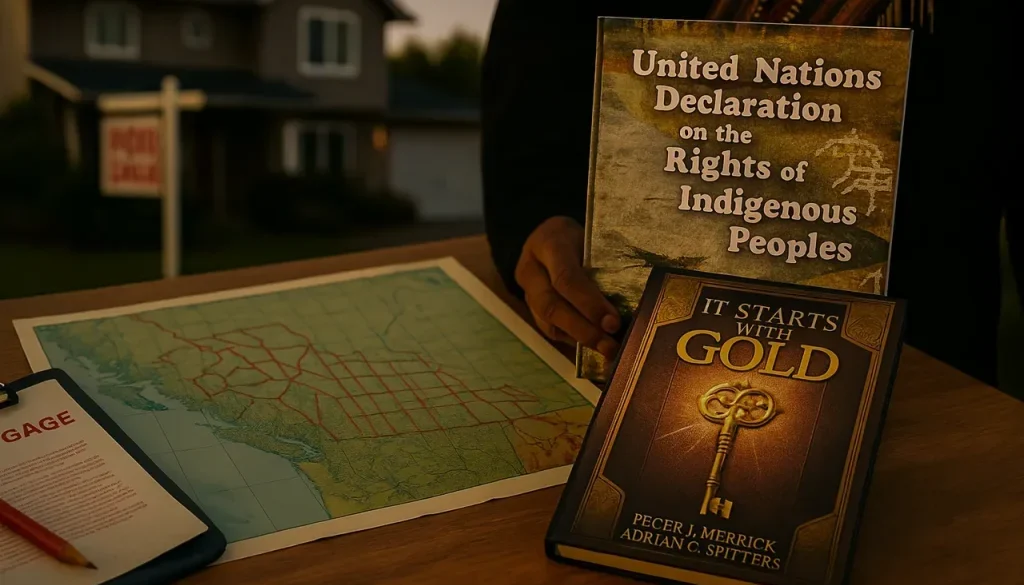
Canadian Property Rights Under Attack
By Peter J. Merrick, TEP® and Adrian C. Spitters, CFP®, co-authors of the international bestseller It Starts With Gold™ and the forthcoming book Guns, Gold & Land™
This analysis continues a series of long-form investigations published in The Merrick Spitters Reset Report™
This article explores a growing debate about the legal foundations of Canadian property rights and how global frameworks are reshaping ownership, sovereignty and financial security. It is presented as an opinion and is intended to inform and invite dialogue.
Some argue that Canada’s property system is stable and secure. Others believe the legal ground beneath Canadians is now shifting in ways few understand.
A British Columbia Court Ruling Exposed a Harsh Truth: Canadians May Not Fully Own Their Land
A new era of uncertainty has taken hold in Canada. Individuals across the country grew up believing that property ownership provided stability and freedom. The deed to a home meant more than shelter. It represented autonomy. It represented independence. It represented the idea that an individual could build a life that governments could not easily disrupt. Canadians trusted that idea because it shaped their financial planning, their family expectations and their sense of national identity. They believed that property rights in Canada were secure. They believed the ground beneath them belonged to them. None of this felt questionable until a court decision in British Columbia revealed how fragile those beliefs had become.
On August 7, 2025, the British Columbia Supreme Court ruled that the Cowichan Tribes had established Aboriginal title over several hundred acres of land in Richmond. That ruling startled the nation because it changed what many Canadians thought was settled law. The decision stated clearly that Aboriginal title is a senior and prior right. Those words carried consequences far beyond Richmond. They signalled that fee simple ownership, which millions of Canadians believed was the most secure form of private property, may no longer stand at the top of the hierarchy. The ruling forced individuals to confront a reality they were never warned about. Ownership is not absolute. Ownership sits inside a legal framework that can shift without consultation, without democratic debate and without public consent.
This moment intensified when journalist and host David Leis sat down with legal scholar Bruce Pardy, the executive director of Rights Probe and a respected professor of law at Queen’s University. Their conversation cut through political messaging and exposed the seriousness of the ruling with a clarity Canadians were not receiving from their institutions. Leis pushed for the answers that mattered to Canadian individuals. Pardy explained the legal structure that made the ruling possible, the contradictions built into modern land policy and the consequences that will follow if nothing changes. Their interview stands as one of the most important journalistic discussions of 2025 because it forces individuals to see what governments and media outlets have avoided acknowledging. Property rights in Canada are not what Canadians believed them to be.
👉 Subscribe to The Merrick Spitters Reset Report™ and receive a digital copy of our international bestseller, It Starts With Gold™, along with our white paper, Last Asset Standing™ and early updates on our forthcoming book, Killing Crypto™.
The Cowichan decision did not simply place a claim over a few parcels of land. It placed a claim over the assumptions Canadians hold about their country. The ruling revealed, in plain language, that Aboriginal title supersedes fee simple. This means a homeowner’s title, even if registered in good faith, will be treated as secondary if Aboriginal title is proven underneath it. For many individuals, this was the first time they understood that title systems can overlap, and that the legal order places one title above the other. This realization shook people who had believed that the registry system, the Crown grant and their deed were the final word on ownership.
Local news in Richmond reported that some banks delayed or refused mortgage renewals on properties within the claimed territory. Homeowners found themselves unsure whether they could refinance, sell or even transfer their homes without the approval of the Cowichan Tribes. Provincial officials insisted that nothing had changed. The lived experience of residents suggested otherwise. This contradiction revealed a deeper problem. Canadians no longer know whether to trust what governments say or what they see. When legal realities conflict with political messaging, individuals are left to navigate uncertainty on their own.
The shock spread quickly because the ruling forced Canadians to confront a rising truth. Property rights in Canada are not fully protected. Ownership depends on political choices, shifting court interpretations and frameworks that have evolved quietly over decades. Canadians are discovering that they stand inside a legal structure that was never explained to them, one that can redefine their rights without warning. The Cowichan decision pulled back a curtain on something far larger than Richmond. It revealed how Canada built the conditions for this crisis.
To understand how this shift became possible, Canadians must look back at the policies and legal decisions that reshaped the system beneath them.
How Canada Built This Crisis
The roots of the current moment stretch back decades, far beyond the Richmond ruling that caught the public by surprise. The Cowichan decision feels sudden only because Canadians were never told how the legal architecture beneath their feet was evolving. The truth is that governments, courts and international frameworks built this environment slowly, piece by piece, while most individuals believed that property rights were fixed. Section 35 of the Constitution Act, 1982 marked a turning point. When it entered the constitutional order, it recognized and affirmed existing Aboriginal and treaty rights without clearly defining their boundaries. At the time, many Canadians believed this section was symbolic or cultural in nature. Few imagined that it would grow into a powerful legal tool capable of reshaping the hierarchy of land rights across the country.
Over the past four decades, the Supreme Court of Canada interpreted Section 35 in ways that expanded the meaning and scope of Aboriginal title. In the landmark Delgamuukw v. British Columbia decision, the Court established that Aboriginal title is a collective right rooted in historic occupation and that this title carries enforceable powers over land use. Later, the Tsilhqot’in Nation v. British Columbia ruling confirmed that Aboriginal title grants Indigenous groups the right to decide how the land is used, to benefit from its economic development and to control access. These decisions created a situation where Aboriginal title, once primarily theoretical, became a practical force that could override provincial grants and private ownership. The court did not frame these expansions as new rights. Instead, it described them as rights that always existed, even if they had not been recognized before. This interpretive approach meant that Aboriginal title could expand in meaning without public debate or legislative reform. The courts simply announced what they believed the law always contained.
Courts also expanded another idea that few Canadians understand. Aboriginal title does not require continuous occupation from 1846 to the present. A group can establish title even if the land was unused, abandoned or developed by others for generations. This interpretation surprised many individuals who believed long-term, good-faith possession protected their ownership. The courts have made it clear that historic occupation carries greater weight than uninterrupted modern use.
As the judiciary extended the reach of Aboriginal title, political forces added another layer of complexity. In 2016, Canada endorsed the United Nations Declaration on the Rights of Indigenous Peoples (UNDRIP). UNDRIP establishes global standards for Indigenous rights, including land ownership, self-determination, governance and resource control. It recognizes Indigenous peoples’ rights to the lands they traditionally occupied or used. Although the federal government initially described UNDRIP as aspirational and not directly binding, its language carried implications that could not be easily contained once integrated into government policy.
British Columbia moved even further. In 2019, the province passed the Declaration on the Rights of Indigenous Peoples Act (DRIPA). DRIPA requires that British Columbia align its laws with UNDRIP. Many British Columbians assumed that DRIPA was symbolic, another gesture in the spirit of reconciliation. Few understood that the act placed the province on a legal path that would eventually place Aboriginal title above fee simple. Few realized that DRIPA empowered the government to negotiate agreements recognizing Indigenous control over vast territories, even where individuals already held registered titles. DRIPA was the hinge that connected international aspirations to domestic law.
The DRIPA Action Plan, introduced between 2022 and 2024, pushed this shift even further. It committed British Columbia to shared decision-making with Indigenous governments, consent-based processes and co-management of land and resources. These commitments were made without wide public consultation. Many individuals did not realize that the Action Plan moved the province from reconciliation language into structural governance changes that directly affect land use and private ownership.
The Cowichan ruling did not emerge from nowhere. It was the logical outcome of decades of court decisions that elevated Aboriginal title and political decisions that tied British Columbia’s legal framework to UNDRIP. People now beginning to recognize the implications of this ruling are discovering that the system changed while they were busy living their lives. They supported reconciliation, believing it meant cultural respect and improved relationships. They did not expect that it would place their own rights in a vulnerable position. They did not expect that the title they purchased in good faith could be reinterpreted by courts decades after the fact.
When Two Worlds Collide
Canada is now standing at a difficult intersection. Two competing visions of ownership have collided. The first is fee simple, the foundation of private property under common law. Fee simple supports individual autonomy. It allows land to be bought, sold, mortgaged and developed. It forms the basis of real estate markets, municipal planning, lending systems and long-term financial strategies. Individuals believed that fee simple provided stability. It gave them the confidence to build homes, raise children, grow businesses and accumulate wealth over time.
The second vision is Aboriginal title, which operates under a different logic. Aboriginal title is communal, not individual. It is rooted in historic occupation, ancestral stewardship and the collective identity of Indigenous groups. It is not transferable to private individuals. It can only be surrendered to the Crown. Its purpose is long-term preservation, not market activity. These two systems do not align easily, and courts have acknowledged that they cannot coexist over the same piece of land. The Court made that incompatibility unavoidable when it declared Aboriginal title a senior right. This ranking means that fee simple, the bedrock of Canada’s private property system, is now subordinate when Aboriginal title is proven.
Many individuals do not realize that fee simple has no constitutional protection in Canada. The Constitution does not guarantee private property rights, and Canada’s Charter of Rights and Freedoms does not include property protection. Fee simple exists only through provincial legislation, which means courts and governments can redefine its scope without constitutional barriers. This lack of constitutional protection makes the current shift even more significant.
Governments have attempted to reassure Canadians by claiming these systems can work together. They say both interests can be honoured simultaneously. They insist that agreements will balance rights. But the practical reality is different. When a right is senior and prior, it carries authority over the one beneath it. When a court establishes a hierarchy, the lower right becomes conditional. The homeowner no longer stands at the top of the legal chain. Their ownership becomes vulnerable to claims, negotiations and decisions made by others.
The Cowichan ruling forced Canadians to accept what many officials avoided discussing. These two systems do not share equal weight. They represent conflicting philosophies about land. If Aboriginal title is senior, fee simple becomes dependent on political processes, judicial decisions and negotiations that homeowners cannot control. This is the fracture running through the property system in Canada. It is the fracture that individuals must now confront. This realization forces Canadians to reconsider what ownership, security and citizenship now mean.
The Shock to Canadian Individuals
When the ruling became public, individuals across British Columbia experienced a kind of collective disorientation. Some asked whether their property could be next. Others wondered whether their titles contained hidden vulnerabilities. British Columbia is largely unceded territory, meaning the province does not have treaties covering most of its land. This makes large regions open to Aboriginal title claims. Individuals who purchased land decades ago on Vancouver Island, the Lower Mainland, the Okanagan or the northern interior now question whether the titles they hold could one day face similar scrutiny.
The consequences extend far beyond homeowners. Businesses rely on stable land titles to secure financing for development projects. Municipalities rely on predictable property rights to plan infrastructure and zoning. Banks rely on clear legal frameworks to evaluate risk. Investors rely on certainty to determine whether projects are viable. When property rights become uncertain, every sector feels the impact. The confusion surrounding the Richmond ruling has already affected lending practices, insurance evaluations and municipal planning. Individuals who thought their greatest concern was market volatility are now confronting the possibility that their title itself may be contested.
Many individuals feel a rising pressure they cannot ignore. They realize that waiting for governments to clarify the situation is not a strategy. They understand that ownership can become conditional when courts reinterpret long-standing assumptions. They see that what they believed was secure can be questioned without warning. These realizations change how people think about their land, their security and their future. Many start to consider how they can protect themselves in a system that is shifting around them. They learn quickly that true stability does not come from a document but from the resilience they build through preparation and diversification.
The American Watchpoint
The crisis unfolding in British Columbia may appear uniquely Canadian, yet American individuals and international observers should pay close attention. UNDRIP is not confined to one nation’s borders. It is a document adopted by the United Nations to establish international standards for Indigenous rights across all member countries. The United States endorsed UNDRIP in 2010.
Canada’s federal government embedded UNDRIP even more directly in 2021 when it passed Bill C-15. This legislation requires the federal government to align all Canadian laws with UNDRIP over time. While British Columbia acted first, Bill C-15 means the same framework could extend nationally. Many Canadians do not realize the implications. What is happening in British Columbia today could become the policy environment for the entire country if federal alignment continues.
Although it did not incorporate the declaration into federal law in the way British Columbia did through the Declaration on the Rights of Indigenous Peoples Act, the principles of UNDRIP influence academic institutions, advocacy groups, international legal bodies and some state-level movements. This means the same pressure that reshaped British Columbia’s legal landscape can eventually reach other jurisdictions, including several regions of the United States with unresolved territorial or governance disputes involving Indigenous nations.
UNDRIP’s provisions regarding land, governance, and self-determination do not distinguish between national systems. They present a universal framework. They affirm rights to lands traditionally used or occupied. They call for the recognition of Indigenous legal orders alongside state structures. When a country decides to integrate UNDRIP into domestic law, as British Columbia did, the balance of authority shifts rapidly. If Canada’s experience becomes a model for implementation, other countries may follow the same trajectory. The Richmond ruling provides an example of how courts may interpret Indigenous land rights when UNDRIP principles are woven into domestic law. This is why American investors, policymakers and property owners with interests in Canada must reassess their assumptions. They must understand that Canadian property rights may no longer resemble the structures they believed to be stable. They must recognize that cross-border investments now operate inside a shifting legal environment.
American individuals who own Canadian real estate or participate in Canadian development projects must evaluate their exposure carefully. Property that seemed secure a few years ago may now carry unforeseen risk if located within areas subject to Indigenous claims. American businesses working with Canadian resource, infrastructure or agricultural sectors may find themselves navigating layers of Indigenous consultation, approval or jurisdictional overlap they did not anticipate. The British Columbia ruling signals that courts can reinterpret land rights abruptly, and that governments may respond inconsistently. An investor who believed they were evaluating price, market conditions or regional growth must now consider legal uncertainty that can undermine even the most promising opportunity.
Canada has become a watchpoint for countries observing how UNDRIP plays out in real time. If Aboriginal title claims continue to expand, if courts continue to elevate Indigenous jurisdiction and if governments continue to negotiate agreements that shift authority without clear public consultation, this could become a template for international adoption. Americans who see the Richmond ruling as a distant event misunderstand the reach of global governance structures. The Cowichan decision is not isolated. It reflects a global movement that is gaining momentum. Countries that adopt UNDRIP into legislation may find themselves walking the same path. The United States, while legally distinct, is not immune to international pressure, academic influence or political decisions that align with global frameworks. What happens in Canada today could influence what happens elsewhere tomorrow.
A Pressure Canadians Cannot Ignore
As the implications of the Cowichan decision spread, Canadians are now facing pressure from two opposing directions. On one side, they want to believe that their property rights remain secure because that belief has shaped their lives for generations. On the other side, they cannot escape the reality that courts have redefined those rights without consulting them. They find themselves caught between trust in a system they relied on and recognition that the system has shifted. This creates a tension that reshapes how individuals understand their country and their place within it.
If individuals simply trust that governments will restore clarity, they risk losing what they believed was untouchable. Yet if they question the system openly, they may confront authorities who dismiss those concerns as misunderstandings or overreactions. The courts and government agencies often speak in language that appears reassuring while avoiding the core issue. They insist nothing has changed, yet homeowners cannot access financing. They claim that fee simple remains valid, yet Aboriginal title is deemed senior. These contradictions create a pressure that is emotional as much as it is legal. Canadians are forced to navigate conflicting messages from institutions that no longer appear aligned with one another.
Many individuals feel this pressure rising in their daily lives. They sense that ownership is transforming into something conditional. They hear provincial leaders promise stability while watching municipalities struggle to answer simple questions from residents. They listen to banks cite legal uncertainty as a reason for withholding financing. They witness Indigenous leadership speaking confidently about jurisdiction over land that homeowners believed belonged to them. They watch as treaties and historical boundaries are reconsidered in ways that could reshape entire regions. All of this accumulates until individuals feel the need to reevaluate everything they once considered safe.
This pressure alters how Canadians think. It shifts them from dependence on institutional assurances to independence in their planning. They no longer accept the idea that a government document guarantees security. They begin to question what true ownership means. They start to consider assets that are not vulnerable to courts or political shifts. They reconsider how they allocate their savings, how they prepare for retirement and how they define stability. They learn that resilience does not come from trust alone. It comes from foresight and preparation.
Individuals who grasp this reality adapt. They shift from passive acceptance to active decision making. They examine their exposure to legal uncertainty. They consider diversification strategies that reduce reliance on land as the primary anchor of their wealth. They look toward assets that do not depend on government recognition or shifting legal interpretations. This pressure, although uncomfortable, has begun to reshape Canadian financial consciousness. People are learning to see beyond the familiar structures of property law and to prepare for a future that may not resemble the past.
Sovereignty and the Fracturing of Canadian Identity
The Cowichan ruling raises deeper questions that reach into the heart of Canada’s identity. For generations, the country promoted itself as a nation built on fairness, equality and shared citizenship. Canadians believed that laws applied uniformly to all individuals regardless of ancestry. They believed that their identity as citizens carried equal standing. This belief shaped their understanding of justice and their expectations of governance. Yet the Richmond ruling suggests that Canada is moving toward a system where rights and authority can vary based on lineage. If Aboriginal title overrides fee simple, if certain groups possess land rights that others do not and if courts elevate group-based rights above universal rights, then Canada must confront whether equality before the law still exists.
This is not a critique of Indigenous rights. It is a recognition that modern Canada must resolve a contradiction that has grown unchecked. A country cannot sustain two parallel systems of ownership without tension. One system must dominate the other. The Richmond decision makes clear which system courts prioritize. The question now is how Canada can maintain a coherent national identity if rights are allocated based on ancestry. If the legitimacy of ownership depends on historic occupation rather than present citizenship, the country will struggle to uphold the principle that rights are individual, universal and equal.
Individuals who supported reconciliation often did so believing it meant cultural recognition, better relationships and shared progress. They did not anticipate that reconciliation could redefine their own rights. They did not expect that they would be placed in a contentious position regarding the land they purchased legally. They did not imagine that courts would recognize claims that place their title beneath another. The Richmond decision forces Canadians to examine what citizenship means when different legal systems operate simultaneously over the same territory.
This moment reveals a fracture in Canada’s sense of itself. It challenges the narrative that the country operates under a single unified legal order. It exposes the tension between historical grievances and modern equality. It signals that Canada must choose whether it will remain a nation defined by universal rights or evolve into one defined by ancestral entitlements. This choice carries consequences for sovereignty, unity and the future of the country.
A Future Shaped By Uncertainty
The consequences of the Cowichan ruling continue to expand outward, reaching far beyond the borders of Richmond and unsettling the foundational assumptions Canadians once relied on. The legal environment now unfolding is not a temporary disruption. It is the beginning of a systemic shift. Courts across British Columbia and potentially across Canada may view the Cowichan decision as a precedent that demonstrates how Aboriginal title can be recognized, applied and enforced in contemporary settings. This means that individuals holding property in areas with unresolved Indigenous claims could face similar uncertainty. The legal system that once protected titles through predictability and precedent now feels fluid, driven by evolving interpretations rather than stable principles.
Municipalities are already feeling the strain. Planning departments cannot confidently predict whether new developments will remain viable if overlapping title claims surface. Zoning decisions, infrastructure projects and long-term urban strategies depend on clear, unambiguous ownership structures. When those structures become unstable, municipal leaders lose the ability to guarantee that taxpayer-funded projects will proceed without legal conflict. This uncertainty slows economic development and creates hesitation among investors who once considered British Columbia one of the most desirable regions for real estate in North America.
Developers face even greater challenges. They rely on secure land titles to obtain financing, to negotiate contracts and to ensure that construction timelines remain intact. When a court recognizes Indigenous title retroactively, developers face risks that cannot be insured or easily mitigated. Some may avoid British Columbia entirely until clarity returns, which could take years. Others may continue building but increase prices to offset legal risk, pushing housing even further out of reach for many individuals already struggling with affordability.
Financial institutions are also reconsidering their positions. Banks depend on stable legal frameworks to evaluate collateral. When land titles become uncertain, lending becomes a gamble. Some institutions have already paused mortgage renewals in areas affected by the Cowichan claim. Others may tighten requirements, demand additional security or withdraw from high-risk regions altogether. These actions could ripple through the housing market, affecting prices, refinancing options and generational wealth planning. Individuals who once believed their homes were their strongest assets must now contend with risks they could not have anticipated.
This uncertainty affects the entire Canadian economy. Property is not just a private asset. It underpins municipal taxation, wealth distribution, business expansion and retirement planning. When the foundation weakens, the pillars above it tremble. The legal system that Canadians believed would safeguard ownership has begun to reveal fractures, and individuals must now navigate a landscape where certainty is no longer assured. Canada stands at a turning point, and the path ahead will determine how stable property rights remain for decades to come.
What Canadians Can Do Now
In this environment, individuals cannot depend on federal or provincial governments to restore clarity quickly. The political response to the Cowichan ruling suggests that officials are more focused on managing public perception than clarifying the legal structure. This leaves Canadians responsible for protecting their own stability. The first step is awareness. Individuals must understand that their exposure to Indigenous land claims varies depending on geography, history and regional legal precedents. Reviewing one’s property holdings is no longer optional. It is essential.
Individuals should examine whether their lands fall within areas of unresolved claims or regions identified as historically occupied by Indigenous groups. While this alone does not determine legal outcomes, it provides insight into potential vulnerabilities. Those who discover they may be in contested areas must consider strategies that reduce overreliance on real estate for long-term security. Diversification becomes not only wise but necessary. Real estate has long been viewed as a cornerstone of Canadian wealth, yet the current legal shifts reveal that land-based wealth can be reinterpreted by courts in ways individuals cannot control.
This does not mean abandoning property ownership. It means strengthening one’s position by adding assets that lie outside the reach of shifting political and legal frameworks. Physical gold remains one of the most reliable options for individuals seeking stability outside institutional systems. Gold does not rely on government recognition. It does not require courts to affirm its value. It does not depend on treaties, legislation or judicial interpretation. Gold remains a tangible store of wealth that cannot be devalued by legal rulings or policy changes. In uncertain times, individuals who hold real assets are less vulnerable to changes they did not choose.
Diversification also involves reevaluating long-term plans. Individuals must consider how much of their wealth is tied to property that could be affected by future claims. They must rethink generational planning strategies that assume real estate will remain a stable foundation for their children or grandchildren. They must prepare for an environment where legal interpretations continue evolving, where governments negotiate agreements behind closed doors and where courts elevate rights based on historic occupancy. Canadians who take proactive steps now will stand in a stronger position as this legal landscape continues to shift.
Moving Toward Strength
Despite the uncertainty that now surrounds property rights in British Columbia and potentially across Canada, individuals are not powerless. They can take action that protects their autonomy and strengthens their future. This begins with demanding clarity. Citizens have the right to expect transparent communication from their governments regarding the status of land rights and the implications of DRIPA, UNDRIP and modern Aboriginal title rulings. They can call for legislative reforms that protect fee simple ownership and ensure that all individuals are treated equally under the law.
Strength also comes from personal responsibility. Individuals who accept the reality before them gain the ability to respond intelligently. They can diversify their assets, build financial strategies that are not dependent on institutions and structure their affairs to withstand potential shocks. They can shift their thinking from reliance on government stability to reliance on the principles that have protected wealth for centuries, including the ownership of tangible assets.
This moment demands awareness, courage and discipline. It requires Canadians to face uncomfortable truths about the fragility of systems they once trusted. It requires individuals to evaluate their exposure, adapt their strategies and prepare their families for a future that may unfold differently than expected. Those who take action will not only protect themselves but also contribute to a national conversation that Canada can no longer postpone.
This turning point is exactly what we warned about in our broader work on systemic fragility and asset security.
The themes in this analysis reflect the deeper warnings explored in the international best-selling book It Starts With Gold™, co-authored by Peter J. Merrick, TEP® and Adrian C. Spitters, CFP®. In the book, we explain how fragile financial and legal systems expose individuals to hidden risks, and how real assets offer stability during periods of uncertainty. Readers can learn strategies aligned with the principles of resilience and independence and explore how gold plays a central role in safeguarding wealth across shifting legal and economic landscapes. Visit www.ItStartsWithGold.com.
A Country at a Crossroads
Canada now stands at a point in history where the structure of property rights is being reshaped faster than most citizens can process. The Cowichan ruling did not simply reinterpret a narrow legal question. It exposed the fragility of assumptions that millions of individuals believed were unshakable. The idea that fee simple ownership formed the bedrock of Canadian property law is no longer reliable. The belief that Crown grants represent a settled and final transfer of rights has been weakened. The notion that individuals own their land outright, without competing claims from parallel legal systems, has been challenged in a way few Canadians ever imagined.
This moment is bigger than a single case. It touches on sovereignty, identity and the essence of what it means to be a citizen in a modern country. Canada is navigating two legal worlds at once. One world is the historic tradition of common law, built on individual rights, clear titles and equal standing before the law. The other is the expanding framework of Aboriginal title, rooted in collective rights, ancestral stewardship and international declarations. Courts have signalled which world will take precedence when they collide. Canadians must now decide how to respond.
Some may argue that the Cowichan decision represents progress, and in certain contexts, recognition of Aboriginal title is vital to reconciliation. Yet progress cannot come at the cost of destabilizing millions of individuals who acted in good faith under the laws they were taught to trust. If a country wishes to honour Indigenous rights while preserving equality for all citizens, it must build a transparent, predictable and unified legal system. Canada has not yet done this. Instead, it has built overlapping structures that now conflict in ways that affect homeowners, investors, First Nations communities, municipal leaders and the broader public.
If this conflict continues unmanaged, Canada risks becoming a nation where property rights differ depending on geography, ancestry or historical interpretation. That outcome would fracture the principles of equality that Canadians once believed were foundational. It would also create long-term economic consequences as investors reevaluate whether Canada is a reliable partner in development, infrastructure or resource projects. A country that cannot guarantee stable property rights cannot attract capital with the confidence it once enjoyed.
A Path Forward
The path forward requires honesty from governments, clarity from courts and engagement from citizens. Canadians must understand the legal environment they now inhabit, and they must recognize that silence or avoidance will not restore stability. Governments must clarify the relationship between Aboriginal title and fee simple. Courts must reconcile modern interpretations with the expectations of equality that define a constitutional democracy. Citizens must demand transparency rather than accepting vague reassurances that do nothing to resolve uncertainty.
For individuals, the most powerful step is preparation. Canadians cannot rely solely on land-based wealth when the legal definition of ownership is shifting. They must strengthen their financial positions by diversifying into assets that exist outside governmental and judicial volatility. Physical gold remains a central foundation for individuals seeking security in uncertain times because it is independent of legal interpretation. No court can redefine its value. No political negotiation can erase its worth. Individuals who hold gold protect themselves from the unpredictability that now surrounds land and property rights.
This does not mean abandoning real estate. It means building a resilient foundation that can withstand legal, political and economic change. Canadians who see what is happening and act accordingly will not be caught off guard. They will navigate the transition with clarity instead of confusion, intention instead of fear and strength instead of vulnerability.
The deeper lesson emerging from this moment is that true security does not come from institutions, titles or political promises. It comes from understanding that systems can change without warning, and from building a strategy that protects one’s independence regardless of those changes. Canadians who rely entirely on the stability of government systems place themselves at the mercy of forces they cannot control. Canadians who diversify into assets that hold intrinsic value create a buffer against uncertainty.
The Four Pillars We Recommend for Certainty
Our team of professionals assist clients in structuring wealth by Owning Assets in Order of Asset Security. We prioritize the most secure assets and safeguard those that are most vulnerable using the four pillars that form the foundation of long-term financial certainty.
- Gold and precious metals hold real, tangible value.
- Alternative investments that reduce systemic risk.
- Private portfolio management that lowers counterparty exposure.
- Mutual life insurance instruments that protect capital and individuals.
In It Starts With Gold™, we describe how these four pillars operate as a unified structure to protect wealth and maintain continuity through economic and political uncertainty. Each pillar plays a distinct role: precious metals preserve purchasing power, alternative investments diversify and stabilize income, private portfolio management provides professional oversight, and mutual life insurance strengthens capital protection. Together, they form a balanced foundation that helps investors remain secure when one or more areas of the economy are tested.
👉 Book Your Complimentary Review to learn how to structure your wealth around the Four Pillars of Asset Security.
Stay informed. Stay prepared. Act while choice still exists.
Canadians are now living through a period of transition. The country is redefining what ownership means. The legal landscape surrounding Aboriginal title, fee simple rights and international declarations like UNDRIP is evolving rapidly. Individuals who recognize the stakes and respond with foresight will protect their autonomy and their families. They will move through this uncertainty with a level of confidence that comes only from preparation.
Canada is at a crossroads, but Canadians are not powerless. They can demand clarity, protect their wealth and build strategies that do not depend on shifting legal foundations. They can take responsibility for their financial future instead of waiting for governments to fix a system that may never return to what it once was. Those who act now stand strongest.
The warning signs are no longer theoretical. They are here, unfolding in real time.
👉 Sign up today for The Merrick Spitters Reset Report™ to receive a digital copy of our international bestseller, It Starts With Gold™, our white paper, Last Asset Standing™, and early updates on our upcoming book, Killing Crypto™.
Prefer a hard copy? Order It Starts With Gold™ on Amazon today.
In periods like this, those who prepare early become the ones who endure.
References
- United Nations, United Nations Declaration on the Rights of Indigenous Peoples (UNDRIP)
- Government of British Columbia, Declaration on the Rights of Indigenous Peoples Act (DRIPA)
- Government of British Columbia, DRIPA Action Plan (2022–2024)
- Government of Canada, Bill C-15: United Nations Declaration on the Rights of Indigenous Peoples Act (2021)
- British Columbia Supreme Court, Cowichan Tribes v. British Columbia (Attorney General), 2025 BCSC Decision
- Supreme Court of Canada, Delgamuukw v. British Columbia, 1997 SCC
- Supreme Court of Canada, Tsilhqot’in Nation v. British Columbia, 2014 SCC 44
- UBC Indigenous Foundations, Aboriginal Title – Definition, History & Jurisprudence
- Government of New Brunswick, Reference Cases on Aboriginal Rights and Private Land
- Canadian Lawyer, Landmark BC-Haida Agreement Raises Fundamental Questions About Aboriginal Title and Private Property
- Haida Nation & Government of British Columbia, Haida Gwaii Title Recognition Agreements
- Government of British Columbia. Haida Nation Recognition Act
- BC Land Title and Survey Authority (LTSA), Fee Simple Title Definitions and Legal Framework
- Frontier Centre for Public Policy, Interview with David Leis and Professor Bruce Pardy
- Frontier Centre for Public Policy, Research Papers on Property Rights and Governance
- Global News, Richmond Mortgage Disruption Following Aboriginal Title Ruling
- Global News, Cowichan Land Title Case Leaves Richmond Property Owners With Questions
- CBC News, Cowichan title lands encompass multimillion-dollar mansions in Richmond, B.C.
- Fraser Institute, BC Indigenous Land Claims Decision Leaves British Columbians in Limbo
- JFK Law Corporation, Cowichan Tribes and Private Property: Separating Fact from Fiction
- Angus Reid Institute, Survey of Canadian Views on Property Rights and Governance
- Bank of Canada, Financial System Review – Mortgage & Collateral Risk Environment (2024)
- Wikipedia, Cowichan Tribes v. Canada
Disclaimer
This publication is for general information and educational purposes only. It is not intended to provide financial, legal, tax, investment, or real estate advice, nor should it be interpreted as a recommendation or solicitation to buy or sell any financial product, security, insurance contract, or property. The discussion of Aboriginal title, fee simple rights, UNDRIP, DRIPA, court decisions, and government policy reflects general interpretations based on publicly available information at the time of writing. These interpretations may not reflect the full legal context and may change as legislation, case law, or regulatory frameworks evolve.
Readers should not rely on this article to make decisions regarding property rights, land claims, investments, or financial strategy without consulting qualified professionals who can assess their individual circumstances. All investments involve risk, including the possible loss of principal. Real estate ownership and land title may be subject to legal complexities that require advice from licensed legal counsel. Past performance does not guarantee future results, and changes in government policy, judicial interpretation, and economic conditions can materially affect outcomes.
The authors provide professional services through their respective regulated affiliations. Nothing in this publication constitutes specific advice to any individual or entity, nor is any representation made regarding the accuracy or completeness of the information presented. For guidance tailored to your financial, legal, or real estate situation, please consult a licensed financial advisor, tax specialist, or legal professional.