Sumas Prairie: A Fight for Farmland, Legacy, and Food Security
By Peter J. Merrick, TEP® and Adrian C. Spitters, CFP®, co-authors of the international bestseller It Starts With Gold™ and the forthcoming book Guns, Gold & Land™
This analysis continues a series of long-form investigations published in The Merrick Spitters Reset Report™
Why a reclaimed lake became British Columbia’s most important agricultural battleground
By Peter J. Merrick, TEP® and Adrian C. Spitters, CFP®, co-authors of the international bestseller It Starts With Gold™ and the forthcoming book Killing Crypto™
This is Part 1 of a three-part series examining the past, present, and future of Sumas Prairie. This first installment explores the history of the land, why it became one of British Columbia’s most important agricultural regions, and what is at stake as new pressures begin to reshape a region once seen as stable. This article is written as an opinion, intended to inform and invite dialogue.
A Region Built on Determination and Memory
Sumas Prairie was not always farmland. Long before roads and barns stretched across the valley, this land was Sumas Lake, a shallow body of water that shaped the lives of Indigenous communities and defined the geography of the Fraser Valley. It carried fish, wildlife, and cultural significance. It also created a natural barrier for settlers who later saw its agricultural potential.
The decision to drain the lake in the early twentieth century was more than an engineering project. It was a declaration of belief in the land’s future. It required courage from people who saw possibility where others saw a floodplain. They carved channels, built dikes, and constructed systems strong enough to keep a lake from returning. Their work transformed a wetland into one of the most productive agricultural regions in Western Canada.
That history matters because it reveals something about the land and the people who shaped it. Sumas Prairie has always carried a dual identity. It is farmland crafted through effort, yet it remains a place where water waits for opportunity. This tension lies beneath every field and road. It influences every decision farmers make. It reminds every family that the valley’s strength is tied to infrastructure that must be maintained with the same resolve that created it.
Earlier generations understood this relationship clearly. They respected the land’s potential and acknowledged its limitations. They invested in systems that kept the soil dry, crops healthy, and communities protected. Their leadership gave the province a secure foundation for food production.
That foundation was never permanent. It relied on systems that required constant attention to remain effective. A former lakebed can function as farmland only when its drainage network is maintained with precision, its pumps remain dependable, and its dikes stay strong enough to control the water that surrounds it. The region’s stability has always depended on the discipline of active stewardship, not the assumption that the land would manage itself.
That foundation is now beginning to shift.
👉 Subscribe to The Merrick Spitters Reset Report™ and receive a digital copy of our international bestseller, It Starts With Gold™, along with our white paper, Last Asset Standing™ and early updates on our forthcoming book, Killing Crypto™.
The Prairie Became the Agricultural Heart of a Growing Province
Once the lake was drained, Sumas Prairie quickly revealed its value. The soil was fertile. The climate was favourable. Proximity to population centres allowed the region to become a core supplier for dairy, poultry, vegetables, berries, nursery crops, and livestock feed. Its output supported families across the province. It shaped economies. It built communities.
The success of the prairie was not accidental. It came from coordinated stewardship. Farmers worked the land with skills passed down through generations. Municipal and provincial officials recognized the area’s strategic importance. Investments kept drainage systems functioning. Water channels remained clear. Pump stations stayed responsive. The agricultural sector thrived because infrastructure matched the land’s demands.
Families relied on the prairie because it demonstrated reliability even in difficult seasons. It produced food with consistency. It absorbed population growth. It provided stability when other regions struggled. Sumas Prairie became a symbol of what coordinated action can achieve when people share a common purpose.
Yet land engineered through discipline must be protected through discipline. When oversight weakens, the balance shifts. When attention drifts, the land reflects it. When infrastructure ages, the soil responds. These changes do not begin loudly. They begin quietly, often unnoticed at first. They appear in patterns farmers observe long before policymakers do.
These patterns are now emerging across the valley.
The Early Signs of Weakening Land
Families who work Sumas Prairie understand its behaviour with a precision that cannot be learned from charts or reports. They notice subtle changes that reveal deeper stress within the landscape. They see water linger in fields that once drained quickly. They observe soil staying saturated longer than it should. They track how ditches fill faster after even modest rainfall. These observations come from experience, not speculation. They form the early warning system of a region built on the discipline of close attention.
These shifts signal more than temporary inconvenience. They reflect the natural tendency of a former lakebed to behave like a lake when the systems holding it back weaken. Water follows memory. Soil follows a pattern. Hydrology follows opportunity.
A field that once welcomed planting now hesitates. A network of ditches that once carried water away now fights to keep up. A drainage pump that once managed risk with ease now bears a heavier strain each season.
The land remembers what it was.
This memory matters because it reveals how fragile the relationship between farmland and water can become when infrastructure does not evolve as quickly as the pressures acting upon it. These early signals set the stage for the challenges explored in Parts 2 and 3 of this trilogy.
How Weakness Begins: Infrastructure Built for Yesterday’s Demands
Every engineered landscape comes with a lifespan. Systems designed to control water must be maintained long before failure becomes visible. That principle guided earlier generations who protected Sumas Prairie.
Modern pressures have made this principle harder to uphold.
Dikes built decades ago now require reinforcement. Drainage channels need expansion. Pump stations must be upgraded to reflect increased population, development, and climatic variability. None of these needs emerged suddenly. They developed over the years. Yet many upgrades have moved slowly, trapped in cycles of planning and limited investment.
This is where the first cracks appear. Not in dramatic storms, but in everyday conditions that reveal systems wearing down. Water that once moved freely now encounters resistance. Pumps that once ran briefly now run persistently. Soil that once dried predictably now remains unpredictable.
Infrastructure begins to struggle long before it breaks. That struggle is becoming visible across Sumas Prairie.
The Role of Community: Farmers as Guardians of the Land
Communities in the Fraser Valley have always acted as stewards of the land they depend on. Their leadership comes from necessity. When systems slow, they adapt. When seasons shift, they adjust. When risk approaches, they prepare. This is the culture that defines the prairie.
Farmers are not passive observers. They are the first responders to environmental stress. They take responsibility for patterns that institutions often recognize too late. Their observations today echo the knowledge of earlier generations who understood that in regions shaped by water, vigilance is not optional.
Their voices now carry urgency. Their concerns reflect trends visible across fields, pastures, and drainage routes. They see the early signals of a land beginning to shift back toward its natural state. Their experiences form the foundation of the arguments explored in this trilogy.
A province that listens to farmers builds strength. A province that overlooks them loses clarity.
When Food Security Depends on a Single Region
British Columbia faces a difficult reality. Its agricultural base has been shrinking for years. Urban expansion, affordability pressures, and changing land use have reduced the amount of productive farmland available to support a growing population. Against this backdrop, Sumas Prairie remains irreplaceable.
The region provides dairy, eggs, poultry, vegetables, berries, and feed that supply communities across the province. It acts as a buffer against disruptions in global supply chains. It anchors local economies. It stabilizes food prices. Its ability to remain productive affects every household.
When the prairie begins to weaken, the consequences ripple outward. Reduced yields increase dependence on imports. Supply chains tighten. Costs rise. Affordability declines. These effects reveal how closely tied food stability is to the strength of a single region.
This link is not a vulnerability created by farmers. It is the outcome of decades of policy choices and geographic constraints. The province depends on Sumas Prairie because it holds qualities other regions cannot easily match. Its soil, climate, and proximity to major markets make it a cornerstone of food security.
That cornerstone now shows cracks.
The Drift Toward Instability
The prairie is not collapsing. It is shifting. The signs are subtle but consistent. They reflect a landscape under strain rather than a landscape in failure. This distinction matters because it reveals the nature of risk facing the region.
Instability does not begin with catastrophe. It begins with drift. It begins with the absence of decisive action. It begins when systems meant to protect farmland move more slowly than the pressures acting on them.
The drift becomes visible when:
- water drains more slowly
- pumps run more frequently
- fields absorb moisture unevenly
- planting windows tighten
- small storms produce outsized impacts
These indicators reflect a system losing its margin of safety.
This trilogy explores how that margin eroded. Part 1 provides the historical foundation. Part 2 examines the structural forces that began reshaping the region. Part 3 analyzes how these forces emerged into visible conditions as of early 2026.
Understanding the drift is essential for understanding the consequences.
Why This Trilogy Matters Now
British Columbia stands at a turning point. The province faces pressures on its food system, its infrastructure, and its governance structures. Sumas Prairie reflects these pressures more clearly than almost anywhere else in the province. It is a region built through determination and maintained through discipline. It is also a region shaped by water that waits for opportunity.
This trilogy exists because ignoring early signals has consequences. Families risk losing the stability that earlier generations fought to create. Communities risk losing the farmland that feeds them. The province risks losing a foundation it cannot easily replace.
Awareness is the first step toward protection. Understanding the forces at work allows individuals to prepare, respond, and lead during periods of uncertainty.
A Path Forward
The land is not lost. The region is not beyond repair. The story of Sumas Prairie has always been a story of determination. Families built strength once. They can build it again. What matters now is awareness, unity, and the refusal to assume that the systems built generations ago will protect the future without renewed commitment.
This is Part 1 of the trilogy. Part 2 expands on the forces now reshaping British Columbia’s governance structure and how those forces affect the land. Part 3 examines whether Sumas Lake is being positioned to return through government neglect.
The Four Pillars We Recommend for Certainty
Families who understand the pressures facing regions like Sumas Prairie often ask how they can build stability when institutional systems drift. Our team of professionals helps clients structure wealth by Owning Assets in Order of Asset Security. This approach strengthens what is most stable and safeguards what is most vulnerable. It is built on four pillars that work together to create long-term certainty.
- Gold and precious metals that hold real, tangible value: These assets exist outside the financial system. They act as the anchor when currencies weaken and when confidence in institutions fades. Physical metals preserve purchasing power when other sectors shift.
- Alternative investments that reduce systemic risk: Private real estate, private credit, and other non-public assets offer income and stability without relying on public markets alone. These assets help families maintain control during periods of market or policy disruption.
- Private portfolio management that lowers counterparty exposure: Professional discretionary managers provide oversight, structure, and discipline. They help families navigate uncertainty while reducing reliance on mass-market institutions that often move slowly during periods of stress.
- Mutual life insurance instruments that protect capital and individuals: These contracts preserve value, create stability, and provide tax-advantaged growth and estate support. They offer families a secure base when markets or governments shift course.
In It Starts With Gold™, we describe how these pillars form a unified structure that protects wealth and maintains continuity during economic and political uncertainty. Each pillar has a distinct strength. Precious metals preserve purchasing power. Alternative investments stabilize income. Discretionary management provides discipline. Mutual life insurance safeguards capital. Together, they create a balanced foundation that allows families to remain steady when one or more areas of the economy are tested.
Stay informed. Stay prepared. Act while choice still exists.
Why We Wrote It Starts With Gold™
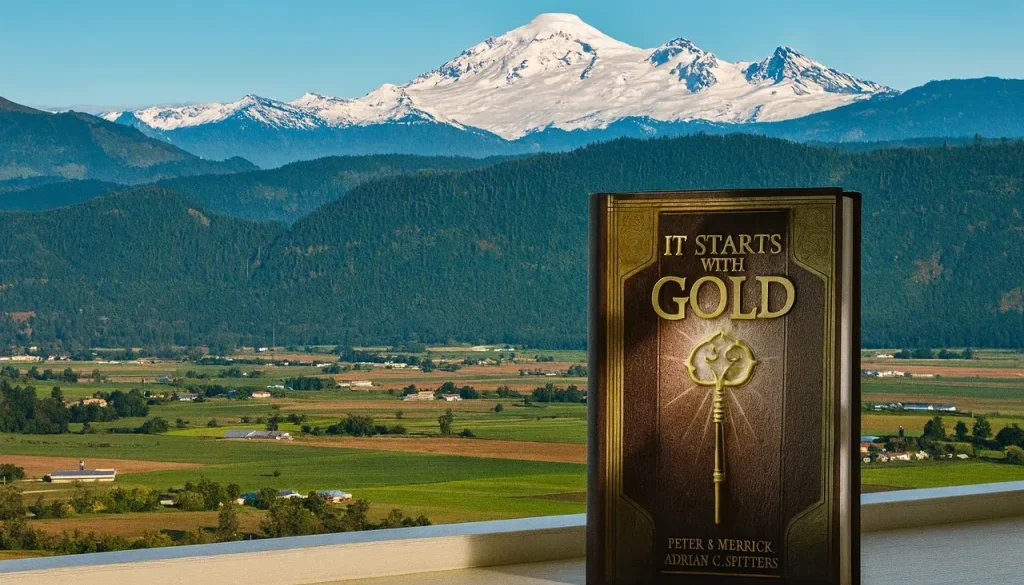
The uncertainty facing Sumas Prairie reflects a broader pattern across Canada. Systems once believed to be stable now reveal weaknesses. Institutions move slowly. Promises drift. Risks emerge quietly. These themes form the foundation of our number one international best-selling book, It Starts With Gold™, co-authored by Peter J. Merrick, TEP® and Adrian C. Spitters, CFP®.
In the book, we reveal how declining systems can catch families unprepared, how resilience begins with individual leadership, and how protective strategies can secure a family’s future when institutional certainty fades. These lessons apply directly to regions like the Fraser Valley, where long-term stability now depends on clarity and preparation. Visit www.ItStartsWithGold.com to explore these ideas further.
👉 Sign up today for The Merrick Spitters Reset Report™ to receive a digital copy of our international bestseller, It Starts With Gold™, our white paper, Last Asset Standing™, and early updates on our upcoming book, Killing Crypto™.
Prefer a hard copy? Order It Starts With Gold™ on Amazon today.
References
- Statistics Canada. “Agricultural Production and Moisture Reports.” Government of Canada. Accessed December 2025
- Government of British Columbia, Ministry of Environment and Climate Change Strategy. “Environmental Monitoring and Hydrology Resources.” Accessed December 2025
- Government of British Columbia, Ministry of Agriculture and Food. “Industry and Agricultural Land Use Information.” Accessed December 2025
- Fraser Basin Council. “Lower Mainland Flood Management Strategy.” Accessed December 2025
- Agriculture and Agri-Food Canada. “Weather and Climate Resources.” Accessed December 2025
- Environment and Climate Change Canada. “National Hydrometric Program: Real-Time Water Data.” Accessed December 2025.
Disclaimer
This publication is for general information and educational purposes only. It reflects broad observations about land use, agriculture, infrastructure, governance, and economic conditions in British Columbia. It is not financial, legal, tax, investment, or real estate advice, and it should not be relied upon to make decisions about personal finances, property, or business operations.
The views expressed are general in nature and based on publicly available information at the time of writing. Circumstances can change as legislation, economic conditions, environmental factors, or policy frameworks evolve. Readers should consult qualified professionals who can assess their individual situation before acting on any information discussed in this article.
All references to financial concepts, asset structures, or risk-management approaches are presented for educational purposes only. They do not constitute a recommendation or solicitation to buy or sell any product, security, investment, or insurance contract. No guarantee is made regarding the accuracy or completeness of the information provided.
For guidance specific to your personal circumstances, please seek advice from a licensed financial advisor, tax specialist, legal professional, or other appropriately regulated expert.