What If the Buyers Don’t Come Back?
How the Retreat of Chinese Capital Is Changing the Foundation Beneath Parts of Canadian Real Estate, and Why It Matters Across North America
By Adrian C. Spitters, Co-Author, It Starts With Gold™
Co-Creator, The Merrick Spitters Reset Report™
Every Market Begins with an Assumption
One of the lessons I have learned since entering the financial-services industry in 1987 is that the greatest risks rarely emerge without warning. They begin when we continue making decisions based on assumptions that are no longer true. Rising real estate values feel normal. Falling interest rates feel permanent. Strong demand appears certain. Over time, assumptions harden into facts, and few people stop to ask whether the foundations beneath them still exist.
That is the question I keep asking today. History does not repeat exactly, but major turning points often begin before they reach the headlines. By the time the change becomes obvious, the forces behind it have usually been building for years.
Lessons from the Farm
Long before I entered the investment industry, I learned this lesson growing up on a Dutch dairy farm. Farming teaches patience because the visible results always lag behind the work that produces them. A productive harvest depends upon decisions made months earlier. The soil must be prepared, the seed planted, the weather observed, and the inevitable surprises managed as the season unfolds. By the time neighbours admire a healthy crop, most of the important decisions have already been made.
Financial markets have always reminded me of those seasons on the farm. The headlines report what has already happened, but they rarely explain what has been quietly developing beneath the surface. Investors naturally focus on the harvest because it is visible. The underlying changes that produced it often receive far less attention, even though they are far more important.
That perspective has shaped the way I have viewed every major market cycle throughout my career. Whether it was the crash of 1987, the technology bubble, the Global Financial Crisis, the extraordinary policy responses during COVID-19, or today’s inflationary environment, I found myself returning to the same question:
What changed beneath the surface before everyone else noticed?
Why I Study History
People often say that history repeats itself. I have never believed that to be literally true. Circumstances, technologies, governments and markets change. What changes far more slowly is human nature. Fear, optimism, greed and complacency continue to influence financial decisions much as they always have.
History does not predict the future with certainty, but it helps us recognize recurring patterns of human behaviour and question assumptions that others have accepted as permanent. That philosophy eventually became the foundation of It Starts With Gold™. Despite its title, the book was never intended to be only about precious metals. Gold became the starting point because the history of money taught me to ask a question that is often overshadowed by the pursuit of returns:
How secure are the assets upon which my family’s future depends?
That question ultimately led to Owning Assets in Order of Asset Security™, a framework that organizes wealth according to how resilient each asset may be across a wide range of future outcomes. Protecting wealth begins by understanding the risks before pursuing the potential returns. Over the years, Peter and I approached that question from different professional disciplines.
My work focused on markets, monetary history and Asset Security. Peter’s centred on taxation, estate planning and the long-term transfer of wealth between generations. Although we began from different perspectives, we repeatedly arrived at the same conclusion: preserving wealth requires more than selecting investments alone. It requires organizing wealth so it can endure changing economic, legal and family circumstances.
The Assumption Almost Nobody Questioned
For decades, many North Americans came to regard rising real estate values as almost inevitable. Different explanations were offered over the years, including population growth, immigration, limited housing supply, declining interest rates and strong investor demand. Each of those factors contributed to the story, but together they also reinforced a much larger assumption that few people questioned.
The assumption was simple: no matter what happened, the buyers would always come back.
Over the past several months, I have been studying a structural change that has materially weakened one of the supports beneath parts of the Canadian real estate market. Bill Coughlin’s long historical record shows a sharp break in Lower Mainland sales activity across periods he associates with capital from mainland China and Hong Kong.
His chart does not identify the nationality of each buyer or the source of every dollar. But when it is read alongside the destruction of property wealth inside China, tighter capital controls and Canadian policy changes, it supports a difficult conclusion: purchasing power that once helped propel these markets is no longer arriving with its former strength.
In this article, “Chinese capital” refers to cross-border funds originating from mainland China and Hong Kong. It does not refer to Chinese Canadians, immigration generally or buyers based on ethnicity.
Follow the Capital
Several months ago, my colleague and friend Bill Coughlin asked me a question that has stayed with me ever since:
What happens when one of the largest sources of demand disappears?
Bill has tracked Greater Vancouver and Fraser Valley real estate markets since 1982. Through VancouverMarketReports.com, he has developed a long historical record of sales, prices and market activity. That record allows him to compare current conditions with earlier market cycles rather than relying only on monthly sales reports.
That question matters because real estate markets are influenced not only by the number of available buyers, but also by the amount and direction of the capital those buyers bring with them. For many years, Chinese investment represented an important source of demand in several Canadian housing markets. Whether through direct purchases or family and business structures, that money became part of the demand supporting prices and shaping expectations about who would buy Canadian real estate next.
Bill’s sales record shows a sharp and lasting break in activity following the periods he associates with Hong Kong and mainland Chinese capital. The chart does not establish cause and effect or identify the funding source of individual purchases. What it does reveal is a timing pattern that deserves serious attention. The evidence from China and the policy changes that follow help explain why this change may be structural rather than temporary.
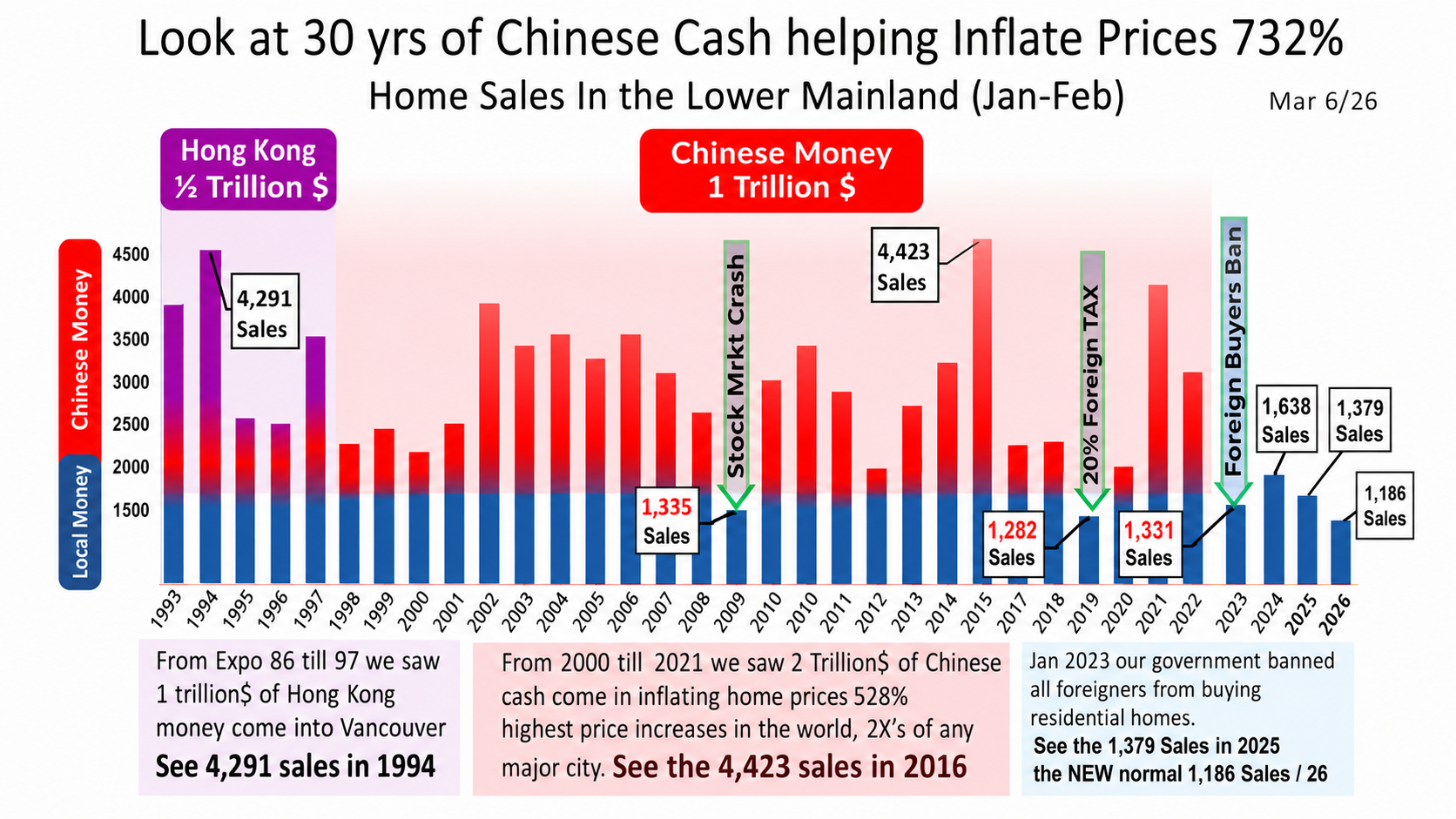
Figure: Bill Coughlin’s interpretation of Lower Mainland home-sales cycles and periods associated with Hong Kong and mainland Chinese capital, 1993–2026.
January 2023: The federal government prohibited many non-Canadians from purchasing residential property, subject to statutory exceptions.
Calculation methodology: Coughlin’s analysis is based on Greater Vancouver and Fraser Valley market data that he has tracked since 1982 using his proprietary home-price index. The annual bars display January-February Lower Mainland home-sales counts from 1993 onward. Coughlin identifies 1993 as the point when the measurable market effect of the post-Expo 86 Hong Kong capital cycle began. The price-change percentages are his calculations from historical values in that proprietary index. The colour assignments, capital periods and capital-flow estimates represent Coughlin’s interpretation of the historical market record and are not transaction-level measures of buyer nationality or source of funds.
Source: Bill Coughlin, “Look at 30 yrs of Chinese Cash Helping Inflate Prices 732%,” chart dated March 6, 2026, emailed to Adrian C. Spitters on July 20, 2026. Reproduced with permission. Coughlin also presented the chart in “How To Lawfully Preserve Asset Wealth Before The Canadian Gov Takes It. Interview With Experts,” Liberty Talk with Odessa, YouTube video, 57:14, June 24, 2026. View the interview.
Bill’s historical analysis points to a material retreat in this source of demand. The destruction of household property wealth inside China, combined with tighter capital controls and Canadian restrictions, makes a rapid return unlikely.
Policy Also Changed the Flow
China tightened important channels for moving money abroad years before the property downturn reached its current scale, including rules governing large overseas cash withdrawals with bank cards.
British Columbia introduced taxes on foreign residential purchases, while Canada prohibited many non-Canadians from purchasing residential property beginning in 2023. That federal prohibition has been extended through January 1, 2027.
These factors reinforce Bill’s thesis. The retreat developed through several forces working together: the destruction of household property wealth inside China, tighter controls on outbound capital and Canadian restrictions on foreign purchasing. Together, they have fundamentally changed the flow of capital into Canadian real estate.
The Wealth Destruction Behind the Retreat
The retreat of Chinese capital from Canadian real estate did not occur in isolation. It coincided with a decline in Chinese household property wealth estimated in the trillions of dollars.
A Barclays estimate reported by the South China Morning Post placed the decline in Chinese household property wealth since 2021 at approximately US$18 trillion. The estimate depends upon the methodology used and should not be treated as an audited total, but it illustrates the extraordinary scale of the adjustment. The loss did not arrive through one dramatic Lehman Brothers moment. It accumulated across households, developers, local governments, banks and foreign creditors.
The decline is no longer a forecast. Adjusted for inflation, China’s residential property price index has fallen below levels recorded in 2005 and 2006. Real prices have been lower than a year earlier for 17 consecutive quarters. The BIS series changes coverage across time, so comparisons with 2005 and 2006 should be read as evidence of direction and scale rather than as a perfectly like-for-like measure.
A June 2026 China Index Academy survey found resale prices approximately 6.95 percent lower than a year earlier in first-tier cities and 8.21 percent lower in second-tier cities. Among the ten major cities in its survey, Nanjing declined 11.45 percent, and Wuhan declined 10.89 percent.
Those losses matter far beyond the price of Chinese real estate because housing remains the largest component of Chinese household wealth. Estimates vary significantly by dataset and definition. A 2023 New York Fed analysis placed property at roughly two-thirds of household assets, while the World Bank’s December 2025 balance-sheet data put housing at 47.4 percent in 2022. Regardless of the measure used, falling housing values weaken household balance sheets and reduce the ability and willingness to send capital abroad.
China’s pre-sale model left buyers exposed when developers ran out of money and construction stalled. By July 2022, protests and mortgage-boycott threats had affected more than 200 projects involving at least 80 developers.
Beijing responded through guaranteed-delivery programs and a property-financing “white list.” By September 2025, Chinese authorities reported that approved white-list loans had exceeded 7 trillion yuan and were supporting the construction and delivery of nearly 20 million housing units. These programs helped complete homes, but they did not restore the equity families had lost.
The losses also reached Chinese local governments. Land-sale revenue had become a major source of local financing, although its share varied by year and by the measure used. When property development and demand for land weakened, local government financing vehicles were left carrying heavy debts.
The IMF uses an “augmented debt” measure that includes government-guided funds and the activities of local government financing vehicles. It estimated that debt at 126.6 percent of GDP in 2025 and projected it to reach 135.3 percent in 2026.
China’s banks were also asked to absorb and postpone part of the loss. In January 2026, Reuters reported, citing two sources familiar with the matter, that authorities were allowing banks to extend loans for certain white-list projects by up to five years. The measure may delay loss recognition; it does not eliminate the underlying credit risk.
Evergrande illustrates the scale of what went wrong. The company collapsed with more than US$300 billion in liabilities. By August 2025, its liquidators reported that approximately US$255 million of assets had been sold. Only a small portion came from assets held directly by the parent company, and not all proceeds were necessarily available for distribution to creditors.
Most of Evergrande’s assets and operations were inside mainland China, beyond the direct control of its Hong Kong liquidators. Chinese regulators also found that its main onshore unit had overstated revenue by approximately US$78 billion across 2019 and 2020.
Evergrande’s losses also reached offshore creditors and investment funds through the international bond market. Recovery on those bonds remains highly uncertain. The broader lesson is that property losses originating inside China did not remain entirely within China. They were transmitted through global credit markets, even where individual fund exposures represented only a small portion of total assets.
A Balance Sheet Recession
The pattern resembles what happened in Japan after 1990. Japanese land and commercial-property prices fell sharply over many years following the collapse of the country’s asset bubble. The country did not experience one dramatic weekend of financial collapse. Banks carried impaired loans for years, households concentrated on repaying debt instead of spending, and economic growth stagnated for a generation.
Economist Richard Koo used the term “balance sheet recession” to describe what happens after an asset-price collapse leaves borrowers focused on repairing their finances rather than spending and investing. His classic work examined Japan’s corporate sector. China’s circumstances are not identical, but the balance-sheet mechanism is now visible across the economy. Households, developers, local governments and banks are all concentrating on repairing financial damage rather than expanding spending, borrowing and investment.
China is now more than five years into this adjustment, and continued weakness remains likely. S&P Global Ratings expects China’s primary property sales to fall another 10 to 14 percent in 2026. A May 2026 Reuters poll projected home prices to fall 3.5 percent in 2026. Prices continue to decline despite repeated interest-rate reductions, housing-conversion programs, financing extensions and government stabilization measures.
These conditions make a rapid return of large cross-border household flows unlikely. Any recovery is likely to be slow, uneven and weaker than before. Chinese households have lost trillions of dollars of property wealth. Developers remain burdened by debt. Local governments have lost a major source of revenue. Banks are extending repayment periods rather than recognizing the full losses, while families are rebuilding their financial security.
The Story Goes Beyond Interest Rates
Public discussion of Canadian housing remains focused on interest rates, affordability, immigration, housing supply and government policy. Those factors matter, but none of them restores the trillions of dollars of property wealth erased inside China. None repairs the balance sheets of Chinese families, developers, local governments or banks. None reverses the capital controls or financial pressures keeping money inside China.
Bill’s analysis exposes the part of the Canadian real estate story that monthly sales reports cannot fully explain. When his historical work is read alongside the evidence from China and the policy changes on both sides of the Pacific, it points to a material retreat in this source of demand. Lower interest rates or improved affordability may influence domestic buyers, but they do not automatically replace cross-border purchasing power that has already weakened.
For North American families and investors, the consequences extend beyond Canadian housing and Chinese property bonds. A prolonged balance-sheet contraction can affect commodity demand, tourism, education, luxury spending, international real estate, businesses dependent on Chinese consumers and portfolios exposed to Chinese credit. The effects will not be uniform, but they will not stop at Canada’s border.
What Should Families Ask?
The practical question is not whether every Canadian home will decline or whether Chinese capital will disappear completely. The question is whether a family’s financial security depends upon an assumption that may no longer be true.
Every family should ask:
- How much of our wealth depends upon one property, market or source of demand?
- Which assumptions must remain true for that asset to hold its value?
- What happens to our family plan if those assumptions do not return for five or ten years?
These questions do not require families to abandon real estate. They require families to understand what their future depends upon.
Looking Through the Lens of Asset Security
This is precisely why I continue returning to the principles of Asset Security.
Asset Security is not about predicting the next movement in a market. It is about organizing wealth, so a family’s future is not dependent on any single economic outcome. Whether we are discussing real estate, equities, precious metals, private investments or any other asset, the first question remains the same:
Has anything fundamentally changed that affects the long-term security of this asset?
Only after answering that question should we begin discussing expected returns.
The destruction of Chinese household property wealth and the retreat of Chinese capital from Canadian real estate demonstrate how quickly an assumption supporting an asset can become obsolete. Bill’s historical analysis indicates that this structural change is already underway. The question is no longer whether this source of purchasing power has weakened. The question is how deeply these markets will adjust if it does not return with its former strength.
That is why I chose the name Owning Assets in Order of Asset Security™. It shifts the conversation from performance to resilience. An asset that performs exceptionally well under one set of conditions may become more vulnerable when those conditions change.
It is also why diversification must extend beyond owning more securities. This broader view reflects the combined perspective that Peter and I have developed over decades of working with families. Markets matter, but so do ownership structures, taxation, insurance, succession planning and governance. Wealth is preserved not by any single strategy, but by how those strategies work together.
One Question Changes Everything
Every family has worked hard to build the life it enjoys today. For some, that wealth is concentrated in a business. For others, it may be real estate, investment portfolios, farmland or a lifetime of savings. Whatever form it takes, one question remains:
How secure are the assets supporting the life you have worked so hard to build?
We do not need to predict the price of every Canadian home to recognize what has changed. Taken together, the evidence supports a clear conclusion: cross-border purchasing power from mainland China and Hong Kong is no longer supporting parts of Canadian real estate with its former strength. Conditions inside China make a rapid return unlikely. If this capital returns, it may not return in the same form or with the same force.
My purpose is not to suggest that families abandon real estate or long-term investing. It is to help them recognize when the assumptions beneath an asset have changed and prepare their wealth for a range of plausible futures.
The families that preserve wealth most successfully are rarely those that predict every event correctly. More often, they are the ones who recognize structural change before preparation becomes a necessity rather than a choice.
The greatest threats to wealth rarely arrive as surprises. They emerge quietly as yesterday’s assumptions become tomorrow’s vulnerabilities. History reminds us that markets evolve, societies adapt, and new opportunities continue to emerge for those prepared to recognize them early.
Continue Your Asset Security Journey™
Every week, The Merrick Spitters Reset Report™ examines a structural economic, monetary or financial development through the lens of history and Asset Security.
If this article caused you to question how much of your family’s future depends upon one market, one asset or one assumption, I invite you to subscribe. You will receive each new Weekly Editorial, ongoing research, historical perspective, and a complimentary digital copy of It Starts With Gold™, co-authored by Peter J. Merrick and Adrian C. Spitters.
Subscribe to The Merrick Spitters Reset Report™
If you would like to examine your own assets through the four tests of control, access, independence and continuity, I invite you to schedule a private Asset Security Conversation™. Together, we can identify the assumptions supporting your wealth and consider where greater resilience may be needed.
Schedule Your Asset Security Conversation™
Merrick Spitters Wealth™ combines the complementary experience of Peter J. Merrick and Adrian C. Spitters to help families think differently about Asset Security, wealth preservation, succession planning and long-term financial resilience.

Disclosure
This article is provided by Adrian C. Spitters as author of The Merrick Spitters Reset Report™ for general educational and informational purposes. It reflects the author’s opinions as of the date of publication and is not individualized financial, investment, legal, tax, accounting, insurance or real estate advice. Nothing in this article constitutes an offer or solicitation to buy, sell or hold any security, investment or property.
Information and estimates are drawn from third-party sources identified in the article and believed to be reliable, but they may not have been independently verified. Accuracy, completeness and continuing currency cannot be guaranteed. Opinions, estimates, historical comparisons and forward-looking statements involve uncertainty and may change. Historical experience does not predict or guarantee future results. Readers should obtain advice appropriate to their individual circumstances before acting.
The author does not provide discretionary private portfolio management through this article or The Merrick Spitters Reset Report™. If a reader later chooses to explore discretionary private portfolio management, the author may introduce the reader to an independent, appropriately registered portfolio-management firm. That firm is responsible for any portfolio recommendations, suitability assessment, account documentation, fees and required regulatory disclosures.
About Adrian C. Spitters and Peter J. Merrick
Adrian C. Spitters, CFP®, FCSI®, CEA®
Adrian C. Spitters is a Canadian private wealth advisor with nearly four decades of experience advising business owners, professionals, farmers, retirees and multi-generational families. Raised on a dairy farm in British Columbia’s Fraser Valley, he focuses on Asset Security, wealth preservation and coordinating specialized professionals around one complete family plan. Adrian is co-author of the international bestseller It Starts With Gold™ and publisher of The Merrick Spitters Reset Report™. Read Adrian C. Spitters’ full biography here.
Peter J. Merrick is an international speaker, educator, and estate-planning specialist with more than three decades of experience advising business owners, professionals, and family enterprises across Canada and the United States. His work focuses on succession planning, long-term wealth preservation, and helping families structure and transition wealth across generations. Peter is the co-author of the international bestseller It Starts With Gold™ and publisher of The Merrick Spitters Reset Report™. Read Peter J. Merrick’s full biography here.
References
- Bank for International Settlements. “Real Residential Property Prices for China.” Selected Property Price Series, series QCNR628BIS. FRED, Federal Reserve Bank of St. Louis. Updated June 25, 2026.
- British Columbia, Ministry of Finance. “Additional Property Transfer Tax for Foreign Entities and Taxable Trustees.” Last updated June 20, 2025.
- Canada, Department of Finance. “Government Announces Two-Year Extension to Ban on Foreign Ownership of Canadian Housing.” News release, February 4, 2024.
- China Evergrande Group (In Liquidation). “Decision of the Listing Committee; Liquidators’ Progress Report; and Continued Suspension of Trading.” August 12, 2025.
- China Index Academy. “June Existing-Home Price Declines Widened across 100 Cities; Shanghai and Shenzhen Rose Month over Month.” July 1, 2026.
- China Index Academy. “Map of Existing-Home Prices in Ten Major Cities, June 2026.” July 7, 2026.
- China Securities Regulatory Commission. “Administrative Penalty Decision Concerning Hengda Real Estate and Responsible Personnel.” Decision no. 49 [2024], May 21, 2024.
- Coughlin, Bill. “Look at 30 yrs of Chinese Cash Helping Inflate Prices 732%.” Chart dated March 6, 2026. Emailed to Adrian C. Spitters, July 20, 2026. Reproduced with permission. Also presented in “How To Lawfully Preserve Asset Wealth Before The Canadian Gov Takes It. Interview With Experts.” Liberty Talk with Odessa. YouTube video, 57:14. June 24, 2026.
- Dawson, Jeff. “Why Are China’s Households in the Doldrums?” Liberty Street Economics, Federal Reserve Bank of New York, September 27, 2023.
- Gao, Liangping, and Ryan Woo. “China Home Prices Likely to Fall at Slower Pace This Year; Seen Rising in 2027: Reuters Poll.” Reuters, May 29, 2026.
- International Monetary Fund. “IMF Executive Board Concludes 2025 Article IV Consultation with China.” Press Release no. 26/053, February 18, 2026.
- Jim, Clare. “China’s Mortgage Boycott Spurs Shakeout among Strapped Developers.” Reuters, July 20, 2022.
- Jim, Clare. “China Reportedly Drops Rules That Sparked Property Crisis, Developer Shares Surge.” Reuters, January 29, 2026.
- Jim, Clare, and Scott Murdoch. “China Evergrande Liquidators Say $255 Million of Assets Have Been Sold.” Reuters, August 12, 2025.
- Koo, Richard C. The Holy Grail of Macroeconomics: Lessons from Japan’s Great Recession. Revised and updated ed. Singapore: John Wiley & Sons (Asia), 2009.
- National Financial Regulatory Administration. “Achievements Made in the Financial Sector during the 14th Five-Year Plan Period.” September 22, 2025.
- Ren, Daniel. “Home Prices in China’s Biggest Cities Stabilise under Beijing’s Stimulus Measures.” South China Morning Post, January 17, 2025.
- S&P Global Ratings. China Property Watch: Supply Glut to Impede Recovery. February 8, 2026.
- State Administration of Foreign Exchange. “Official of the State Administration of Foreign Exchange Answers Media Questions on Regulating Large-Sum Overseas Cash Withdrawals with Bank Cards.” December 30, 2017.
- World Bank. China Economic Update, June 2022. Washington, DC: World Bank, June 2022. Focus chapter, “Real Estate Vulnerabilities and Financial Stability in China,” 46–65.
- World Bank. China Economic Update: Advancing Reforms, Enhancing Prospects. Washington, DC: World Bank, December 2025.