
What Happens When No Currency Passes the Test?
How the U.S. dollar can remain dominant while losing purchasing power, and why family Asset Security starts with gold but does not end there
By Adrian C. Spitters, CFP®, FCSI®, CEA® and Peter J. Merrick, TEP® Co-Authors, It Starts With Gold™, Co-Creators, The Merrick Spitters Reset Report™
Adrian’s First Lesson in Financial Security
When I entered the securities business in 1987, my first lesson arrived during one of the most violent market breaks in modern financial history.
On Friday, October 16, the Dow Jones Industrial Average fell 108 points in what was then its first triple-digit daily loss. On Saturday, October 17, I wrote the Canadian Securities Course examination. On Monday, October 19, known as Black Monday, the Dow fell another 508 points, or 22.6%. I began my career between the first triple-digit daily decline in the Dow and the largest one-day percentage decline in its history.
That experience taught me that market value and financial security are not the same thing. Prices that appear dependable can change with extraordinary speed when liquidity and confidence disappear. It established a question that has remained central throughout my career: what protects a family when the assumptions supporting the financial system are tested? Over the following decades, Peter and I developed that inquiry through It Starts With Gold™ and our 2025 white paper, Last Asset Standing™.
The U.S. dollar already occupied the central position in the global monetary system when I entered the business. Nearly four decades later, it remains dominant, but monetary dominance and the preservation of family wealth are not the same measure.
Families did not need to witness the formal collapse of a currency to experience the gradual erosion of its value. They experienced it through the rising cost of food, housing, education, healthcare and retirement. They saw investment accounts rise in nominal terms while the cost of maintaining their standard of living rose with them. They paid tax on gains measured in dollars even when part of those gains merely reflected the declining purchasing power of the currency itself.
Business owners and farmers experience the same monetary erosion through higher payroll, energy, equipment, financing and replacement costs. A property or productive asset may sell for far more nominal dollars than its original cost, even as taxes and replacement costs rise with it.
This distinction reframes the question of monetary succession. A proposed successor must be measured according to what it can do, while a family must decide what it can continue to own, control and access while the outcome remains unresolved.
For U.S. families, the dollar is the unit in which income, taxes and most obligations are measured. Canadian families use a different domestic currency but remain exposed to the dollar through trade, investment markets, imported costs and cross-border holdings. Both therefore face the same central question: not simply which currency may eventually prevail, but what the family will continue to own, control and access if purchasing power, confidence or monetary relationships change.
Defining the Succession Problem
Monetary debates often treat weakening confidence in the dollar as evidence that the euro, Chinese renminbi, a proposed BRICS currency, Bitcoin or stablecoins are moving closer to replacing it. Dissatisfaction with the incumbent, however, does not establish the qualifications of a successor.
The International Monetary Fund (IMF) reported that the U.S. dollar represented 57.13% of official global foreign-exchange reserves in the first quarter of 2026. The euro accounted for 20.03%, while the Chinese renminbi accounted for 1.99%.
These figures do not establish that the dollar is financially sound or capable of preserving purchasing power. They show only that no rival has yet displaced it. The dollar may therefore retain its dominant position even as its weaknesses become more visible.
The Monetary Succession Test™
We developed The Monetary Succession Test™ to separate a credible monetary successor from a popular narrative. Its purpose is to compare the demonstrated structure of a proposed successor with the complete operating structure of the incumbent dollar system.
The dollar is the benchmark because it is the system a successor would have to replace. That means replacing more than a familiar unit of account or payment method. A credible successor would need to support global trade, savings, credit, collateral and financial settlement through markets, institutions and legal relationships capable of operating at international scale. A candidate may perform one of these functions without being capable of carrying the entire system.
The test is structural rather than predictive. It does not evaluate investment merit, forecast price appreciation or deny that a candidate may serve a useful supporting role. It asks whether governments, institutions, businesses and individuals could rely on that candidate as the primary operating currency of global commerce and finance.
The test examines four conditions simultaneously: convertibility, capacity, circulation and continuity. No single factor, including economic size, technological speed, political ambition, scarcity or current popularity, can establish a credible successor. The following sections apply each condition to the leading candidates.
Convertibility: Wealth Must Be Able to Move
A reserve currency must be more than widely recognized. Governments, institutions, businesses and individuals must be able to acquire, hold, transfer and redeem it across borders without depending on discretionary permission from the issuing state.
The renminbi’s principal limitation is convertibility. China possesses enormous industrial and trading power, but it continues to administer the movement of capital. China’s State Administration of Foreign Exchange maintains an annual individual foreign-exchange purchase quota equivalent to US$50,000. Transactions beyond the quota may require supporting documentation and remain subject to the country’s foreign-exchange rules.
Digital assets present a different form of dependency. Bitcoin can be held directly and transferred without a commercial bank authorizing each transaction, but conversion into wages, taxes, business expenses and conventional investments commonly requires exchanges, banks or regulated gateways. Dollar-backed stablecoins can move quickly, but their issuers may restrict addresses or freeze tokens under their terms or when required by law. A CBDC would remain a digital form of an existing sovereign currency and would remain subject to the issuing state.
Family implication: an account balance does not establish access if moving or using the proceeds still depends on discretionary permission from an institution, government or intermediary.
Capacity: The World Needs Somewhere to Place Its Savings
Reserve currencies require financial markets capable of receiving trillions of dollars in government reserves, pension assets, collateral and international savings.
The U.S. Treasury market gives the dollar an unmatched advantage. It provides a large pool of government debt across many maturities and is integrated into global banking, collateral and settlement systems. The euro is the closest existing alternative, but the euro area’s sovereign debt remains divided among twenty-one countries with different fiscal positions and political risks.
China has large financial markets, but access, governance and state direction remain different from the open-market structure used by global reserve managers. Bitcoin lacks the stable collateral, credit markets and price stability required for reserve-scale capacity. A proposed BRICS currency has no common issuer, treasury, central bank or unified capital market.
Family implication: the larger the family balance sheet, the more important the strength, liquidity and custody capacity of the institutions holding it become.
Circulation: A Reserve System Must Supply What the World Needs
A currency cannot become globally dominant unless the world can obtain enough of it. International circulation requires a continuing supply of currency, credit and liquidity at the scale global commerce demands.
Robert Triffin identified the tension now known as the Triffin dilemma. The world needs the reserve issuer to supply liquidity, but doing so can eventually weaken confidence in the currency. The United States has supplied dollars through external deficits, overseas investment, bank credit and large dollar-denominated debt markets.
China faces the opposite problem. Its State Administration of Foreign Exchange reported a current-account surplus of approximately US$735 billion for 2025. China can increase international renminbi use through lending, swap lines and trade settlement, but becoming the primary reserve issuer would require it to make far more of its currency and financial assets available outside the country.
Stablecoins can extend the movement of dollars without replacing them. Bitcoin’s fixed base-layer supply cannot itself expand to provide the elastic credit required by a modern economy. Gold also cannot process payrolls or finance global trade, but that is not the job assigned to gold within the Last Asset Standing™ framework.
Family implication: a reserve asset and operating liquidity perform different jobs. Families still need cash flow for payroll, taxes, debt, living costs and estate obligations.
Continuity: Confidence Must Survive a Generation
Families build retirement, estate and succession plans across decades. A credible monetary system must therefore survive political cycles, demographic change, fiscal pressure and technological disruption.
The dollar benefits from established legal institutions, open capital markets and decades of integration into world trade. The euro depends on continued political and fiscal cooperation among twenty-one countries. China possesses significant state capacity, but its controlled capital system, aging population and concentration of political authority create different continuity risks. BRICS cooperation has not produced the common rules, shared liabilities or dispute-resolution structure required for monetary union.
Digital protocols may continue operating even when exchanges fail, issuers restrict access or governments change the laws governing conversion, taxation and ownership. Technical survival is not the same as legal and financial continuity.
Family implication: ownership is not complete unless legal title, authority and access can survive incapacity, death and generational change.
Findings of The Monetary Succession Test™
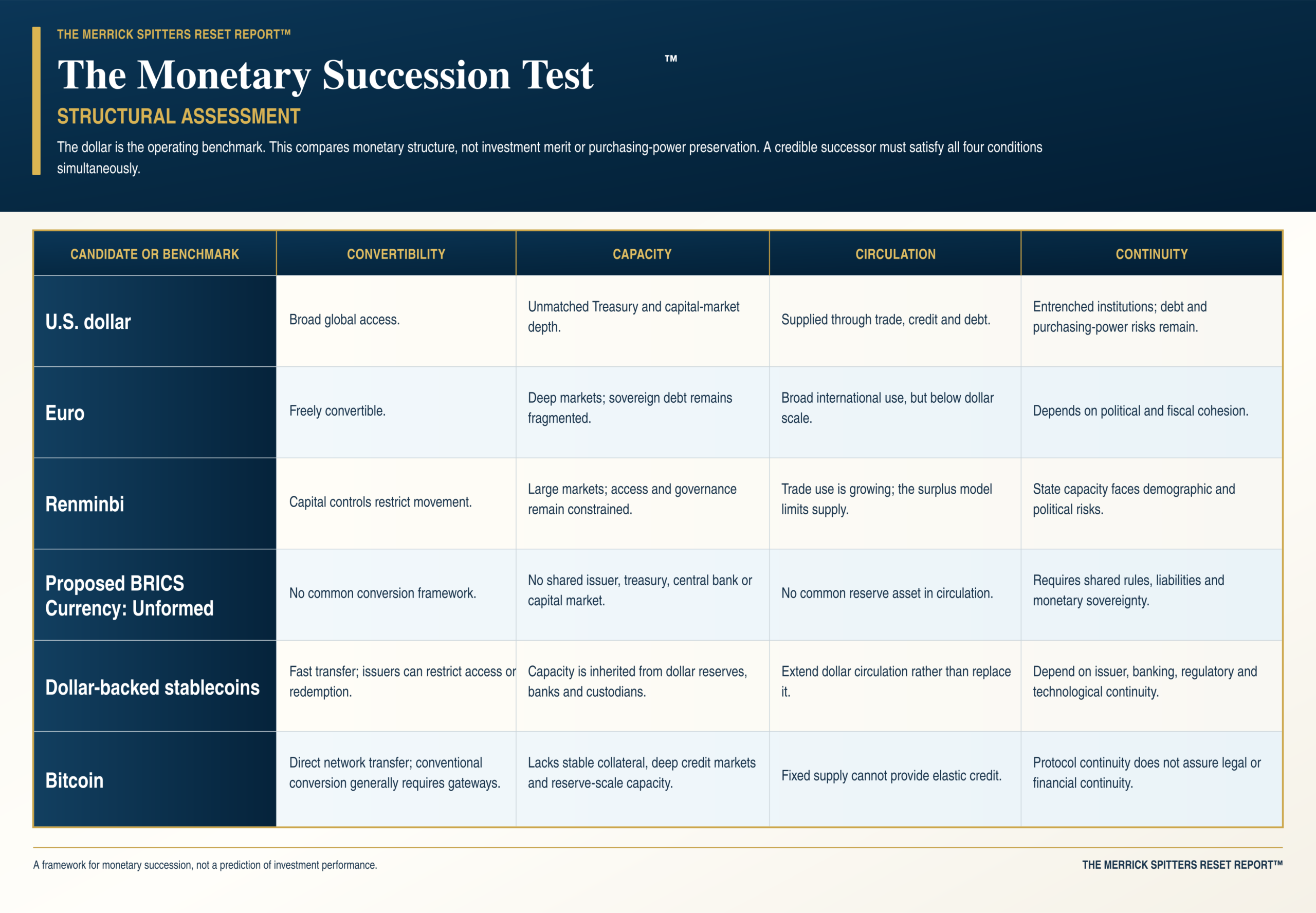
No proposed successor currently matches the dollar’s combination of convertibility, capacity, circulation and continuity. The euro comes closest but lacks a fully unified sovereign-debt market. The renminbi has economic scale but not unrestricted convertibility. BRICS has no common monetary balance sheet. Stablecoins extend the dollar, while Bitcoin lacks the stable credit and capital-market capacity required of a reserve system.
The dollar can therefore remain dominant by default while continuing to lose purchasing power. Its position within the global operating system and its ability to preserve a family’s wealth are separate measures.
What the Test Does, and Does Not, Mean for a Family Balance Sheet
The Monetary Succession Test™ is not a household asset-ranking or allocation model. It answers a narrower question: does any proposed monetary system possess the structure required to replace the dollar? It does not determine how a family should divide its assets.
Consider a family that has sold a business, farm or property. The sale creates liquidity, but it also removes the productive asset that previously generated income, provided control or served a practical purpose. The proceeds are now held through deposits, securities, custodians and other financial claims.
Taken together, the family implications of the test show why directly owned reserves, productive assets, operating liquidity, professionally governed capital, tax planning and legal continuity must be coordinated.
This is where The Monetary Succession Test™ hands the question to the companion ownership frameworks. The test evaluates monetary systems. Last Asset Standing™ evaluates ownership dependencies. Owning Assets in Order of Asset Security™ establishes the sequence of priorities. The Five Pillars of Asset Security™ turn that sequence into a coordinated family strategy.
Gold: The Last Asset Standing™
The Last Asset Standing™ white paper distinguishes beneficial ownership through a nominee or intermediary from direct ownership under which the owner holds documented legal title and control. Its assessment identifies the issuer, legal owner, custodian and governing jurisdiction; the parties able to freeze, dilute, restrict or change the asset; and the institutions required for continued access. The question is not only what the asset is worth, but which promises, permissions and operating systems must continue functioning before the owner can use or transfer it.
Bonds depend on their issuers, deposits on banks and depositor law, and brokerage securities on nominees, custodians and clearing systems. Stablecoins add an issuer, reserves and legal authorities, while cryptocurrency held through an exchange depends on that exchange. Directly owned, identifiable physical gold held outside the banking system has no issuing institution or software protocol.
The immobilization of an estimated US$300 billion in Russian central-bank reserves held across the Group of Seven (G7) countries and the European Union following Russia’s invasion of Ukraine demonstrated the power of jurisdiction. Central banks also purchased a net 863 tonnes of gold in 2025 after three consecutive years above 1,000 tonnes. The IMF reported that gold surpassed U.S. Treasuries as a share of official reserves in 2025, largely because of the rising market price of gold.
The word gold on an account statement does not establish Asset Security. A fund, pooled account or certificate may track the price without conveying legal title to identifiable metal. Properly documented, fully allocated gold can remain directly owned in a non-bank vault when the records identify specific metal under the family’s title. Acquisition, authentication, insurance, storage, estate-planning and price risks remain, but they differ from relying on an issuer’s promise.
Last Asset Standing™ therefore establishes an ownership principle: retain productive investments, but do not allow every part of family wealth to depend on an issuer, intermediary or single jurisdiction.
Owning Assets in Order of Asset Security™
In It Starts With Gold™, we described Owning Assets in Order of Asset Confiscation as a proprietary strategy for prioritizing assets according to their resilience during systemic stress and financial confiscation. Owning Assets in Order of Asset Security™ develops that principle into a broader order of responsibility.
Most financial planning begins with return. This framework begins with more fundamental questions: What do you actually own? How securely do you own it? What must continue functioning for you to retain control?
The framework applies four ownership tests. These are distinct from the four monetary conditions in The Monetary Succession Test™:
Control. Can the owner direct the asset without requiring another party’s approval or continued performance?
Access. Can the owner reach the asset when it is needed, including during market disruption, institutional stress or digital interruption?
Independence. How many banks, brokers, custodians, governments, legal systems or technologies must continue functioning for ownership to remain effective?
Continuity. Can the asset remain intact through taxation, incapacity, death, succession and changing jurisdictional rules?
The ordering is not a public ranking of products from best to worst. It is a sequence of financial dependencies. Secure what must endure first, then build the remaining structure around it.
From Ownership Order to the Five Pillars of Asset Security™
The four ownership tests lead to five levels of responsibility. The Five Pillars of Asset Security™ provide the corresponding implementation structure within The Merrick Spitters Asset Security Framework™.
- Foundational assets. Pillar One, Physical Gold and Silver, addresses this level. Properly held physical gold establishes a directly owned monetary reserve outside conventional counterparty chains. Gold generally serves as the primary monetary reserve. Silver adds monetary characteristics and industrial demand but may experience greater price volatility. Their role is monetary independence, not income.
- Essential productive assets. Pillar Two, Alternative Investments and Productive Private Assets, addresses this level. Assets connected to shelter, land, infrastructure, storage, private businesses, private credit, royalties and other contractual cash flow can add income, growth and return drivers beyond public markets. Their security depends on asset quality, manageable debt, capable management and durable demand. Private ownership changes the source of return, but it does not eliminate investment risk.
- Professionally governed investment capital. Pillar Three, Discretionary Private Portfolio Management, addresses this level. Some wealth should remain liquid and invested in financial markets. A documented discretionary mandate establishes who makes investment decisions, while an independent custodian holds and reports the assets. Account segregation, diversification and clear authority strengthen governance and custody discipline.
- Tax-advantaged strategies for repositioning assets. Pillar Four, Tax-Advantaged Strategies for Repositioning Assets, addresses this level. Planning before a business, farm, portfolio or real estate asset is sold or transferred may reduce tax friction and preserve more capital for suitable reinvestment, liquidity, debt reduction or other family priorities. Tax savings are not guaranteed. The investment, tax and legal consequences must be reviewed together before the transaction creates a deadline.
- Comprehensive wealth and continuity planning. Pillar Five, Comprehensive Wealth and Continuity Planning, addresses this level. This pillar connects financial planning, permanent insurance, estate and tax planning, business or farm continuity, succession, legal authority and cross-border needs. Its purpose is to keep wealth useful to the family and allow ownership, liquidity and authority to pass as intended.
The appropriate balance among these responsibilities depends on the family’s circumstances. The framework does not prescribe fixed allocations or require every family to use the same assets.
No pillar is sufficient by itself. Gold provides a monetary anchor but not a complete income or family plan. Productive assets, portfolio management, tax coordination and continuity planning perform different jobs. When no currency passes The Monetary Succession Test™, the answer is not to choose the least incomplete candidate. It is to reduce how much of the family’s future depends on predicting one monetary outcome. Asset Security starts with gold, but it does not end there.
Continue Your Asset Security Journey
Every week, The Merrick Spitters Reset Report™ examines a structural economic, monetary or financial development through the lens of history and Asset Security. The purpose is to connect large structural changes to the practical questions of ownership, control and continuity.
If this article caused you to question how much of your family’s future depends on one currency, one institution or one chain of custody, subscribe to The Merrick Spitters Reset Report™. You will receive each new Weekly Editorial, independent research, historical perspective, and a complimentary digital copy of It Starts With Gold™, co-authored by Peter J. Merrick and Adrian C. Spitters.
Subscribe to The Merrick Spitters Reset Report™
To identify what your family owns, what it depends on and which questions require qualified professional review, schedule a private Asset Security Conversation™.
About Adrian C. Spitters and Peter J. Merrick
Adrian C. Spitters, CFP®, FCSI®, CEA®
Adrian C. Spitters is a Canadian private wealth advisor with nearly four decades of experience advising business owners, professionals, farmers, retirees and multi-generational families. Raised on a dairy farm in British Columbia’s Fraser Valley, he focuses on Asset Security, wealth preservation and coordinating specialized professionals around one complete family plan. Adrian is co-author of the international bestseller It Starts With Gold™ and publisher of The Merrick Spitters Reset Report™. Read Adrian C. Spitters’ full biography here.
Peter J. Merrick is an international speaker, educator, and estate-planning specialist with more than three decades of experience advising business owners, professionals, and family enterprises across Canada and the United States. His work focuses on succession planning, long-term wealth preservation, and helping families structure and transition wealth across generations. Peter is the co-author of the international bestseller It Starts With Gold™ and publisher of The Merrick Spitters Reset Report™. Read Peter J. Merrick’s full biography here.
Important Disclosure
This article is presented for informational and educational purposes only. The views expressed are those of the authors as of the publication date and are subject to change without notice. This article is not individualized financial, investment, legal, tax, accounting, insurance or real estate advice and should not be relied upon as the sole basis for any decision. Readers should obtain advice from appropriately qualified, registered or licensed professionals who can consider their individual circumstances.
References to multifamily housing, real estate investments, resource investments, private placements, exempt market securities, precious metals, insurance strategies, portfolio management and alternative investments are provided for educational and illustrative purposes only. They are not recommendations, solicitations or offers to buy or sell any security, insurance product, precious metal or other investment. All investments and strategies involve risk. Values may fluctuate, and no result is guaranteed. Past performance is not indicative of future results, and forward-looking statements are subject to uncertainty.
Peter J. Merrick and Adrian C. Spitters contribute to The Merrick Spitters Reset Report™ as authors. Where appropriate in his separate advisory work, Adrian C. Spitters may introduce clients to independent, appropriately registered or licensed professionals, including an independent discretionary portfolio-management firm. Any recommendations, suitability assessment, documentation, fees and required disclosures are provided separately by the relevant professional or firm before a client proceeds.
Research Note
Jay Martin’s June 27, 2026 essay, “The Empty Throne,” helped prompt the monetary-succession question examined in this report. The Monetary Succession Test™ and the conclusions drawn from it were developed independently through the proprietary Merrick Spitters framework.
The ownership analysis extends concepts developed by Peter J. Merrick and Adrian C. Spitters in their 2025 white paper Last Asset Standing™, particularly its distinction between beneficial and direct ownership and its examination of custody, access and institutional control. Statistics used in this report were reviewed against the underlying primary or first-party sources.
This article applies Version 1.0 of The Monetary Succession Test™, using evidence reviewed through July 19, 2026. The euro and renminbi are classified as Eligible Monetary Systems; the proposed BRICS currency as an Unformed Proposal; dollar-backed stablecoins as Derivative Payment Instruments; and Bitcoin as an Eligible Monetary System in its current protocol-based form.
India’s Ministry of External Affairs stated in February 2026 that, although local-currency trade settlement was being discussed, there was “no discussion for a BRICS currency.” The proposed BRICS currency is therefore classified as Unformed because no common issuer, central bank, treasury, monetary balance sheet or conversion framework currently exists.
The condition-level findings, stated in the order convertibility, capacity, circulation and continuity, are: euro, Pass, Partial, Partial and Partial; renminbi, Fail, Partial, Partial and Partial; proposed BRICS currency, Unformed across all four conditions; dollar-backed stablecoins, Partial, Inherited, Partial and Partial; and Bitcoin, Partial, Fail, Fail and Partial. Evidence confidence is High for the euro, renminbi and Bitcoin, High for the BRICS proposal’s current Unformed classification, and Moderate for dollar-backed stablecoins because issuer terms and regulations differ.
References
- Bernhardt, Donald, and Marshall Eckblad. “Stock Market Crash of 1987.” Federal Reserve History. Accessed July 19, 2026.
- Circle Internet Financial, LLC. “USDC Terms.” Last updated December 12, 2025.
- European Central Bank. “Bulgaria Introduces the Euro.” Press release, January 1, 2026.
- European Commission. Options Paper by the European Commission on the Use of Frozen Assets to Support Ukraine’s Reconstruction. Council of the European Union, document 15534/22, November 30, 2022.
- India. Ministry of External Affairs. “Transcript of Special Briefing by MEA on the State Visit of the President of Brazil to India.” February 21, 2026.
- International Monetary Fund. “World Official Foreign Currency Reserves Largely Unchanged in the First Quarter of 2026.” IMF Data Brief, July 1, 2026.
- Martin, Jay. “The Empty Throne.” Jay’s Letter, June 27, 2026.
- Merrick, Peter J., and Adrian C. Spitters. Last Asset Standing™. Foundational ownership white paper. The Merrick Spitters Reset Report™, 2025.
- Merrick, Peter J., and Adrian C. Spitters. The Monetary Succession Test™: A Foundational Analytical Framework for Evaluating Claims to Global Reserve-Currency Succession. Version 1.0. The Merrick Spitters Reset Report™, August 2026.
- Merrick, Peter J., and Adrian C. Spitters. Owning Assets in Order of Asset Security™. The Asset Security Reference Series. The Merrick Spitters Reset Report™, 2026.
- Merrick, Peter J., and Adrian C. Spitters. The Five Pillars of Asset Security™. The Asset Security Reference Series. The Merrick Spitters Reset Report™, 2026.
- Ruder, David S. “Remarks Before the Conference Board.” U.S. Securities and Exchange Commission, February 23, 1988.
- State Administration of Foreign Exchange. “Official of the State Administration of Foreign Exchange Answers Media Questions on Regulating Large-Sum Overseas Cash Withdrawals with Bank Cards.” December 30, 2017.
- State Administration of Foreign Exchange. “SAFE Releases China’s Balance of Payments for the Fourth Quarter and for the Annual of 2025.” March 27, 2026.
- State Administration of Foreign Exchange. “SAFE Spokesman Addresses Press Conference on Relevant Issues Concerning the Detailed Rules on Measures for the Administration of Individual Foreign Exchange.” January 5, 2007.
- Tether International, S.A. de C.V. “Token Terms of Sale and Service.” Last updated February 26, 2026.
- Triffin, Robert. Gold and the Dollar Crisis: The Future of Convertibility. New Haven, CT: Yale University Press, 1960.
- World Gold Council. “Central Banks.” In Gold Demand Trends: Q4 and Full Year 2025. January 29, 2026.