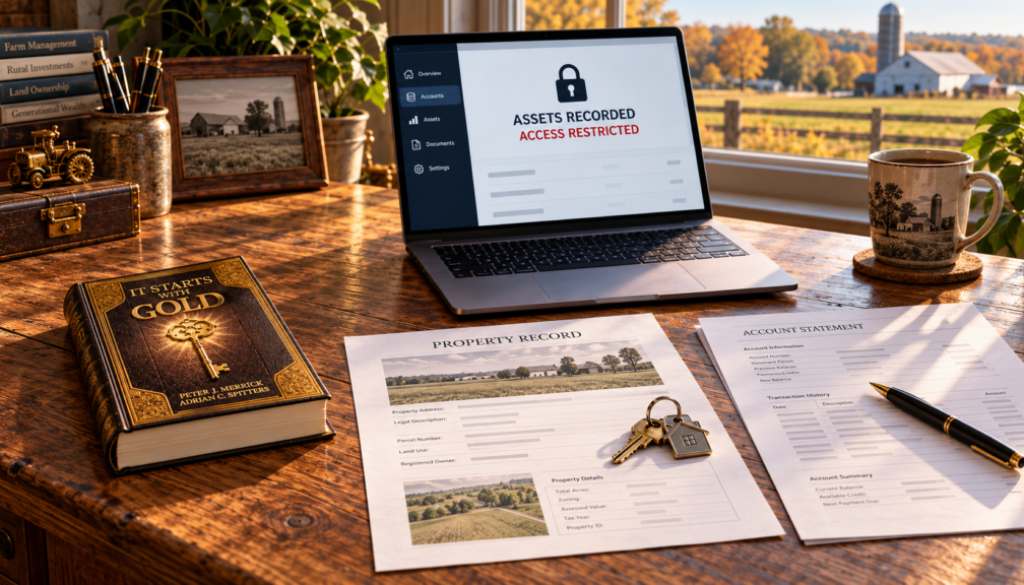
Tokenization: Who Will Control What You Own?
What Patrick Wood’s warning means for your home, savings, income and family business
By Adrian C. Spitters, CFP®, FCSI®, CEA and Peter J. Merrick, TEP®, Co-Authors, It Starts With Gold™ | Co-Creators, The Merrick Spitters Reset Report™
When You Own the Asset but Cannot Use It
We tend to assume that a new way to hold an asset leaves our rights intact. A share becomes a token. A bank balance moves to a new app. Our name still appears on the screen. We expect to use the money as we always have.
Growing up on a dairy farm in British Columbia’s Fraser Valley taught me to judge wealth by what it lets a family do. I took that lesson into the financial industry in 1987. A farm needs cash before planting. A business must meet payroll. Retirees need income they can spend. Those needs are the starting point for this article.
Picture a family about to retire and pass its business to the children. This is a hypothetical case. The family accepts a token-based investment and uses a linked service to pay bills. Then an identity check blocks withdrawals. Its savings remain on screen, but the supplier must be paid on Friday.
The owners upload their records and wait. Their cash runs out before anyone with power to release the funds acts. They take an expensive loan or sell land meant for the children. Even if access returns, the interest and forced sale remain. That is how a payment problem becomes a lasting loss.
In Crucible of Tokens, Patrick M. Wood warns that easy access is drawing people into a system that puts ownership and control in fewer hands. I regard him as the foremost authority on the link between technocracy and tokenization. His concern reaches into the home, savings, pay and credit on which a family relies. I take that warning seriously because those are the assets and choices families spend a lifetime building.
What Changes When an Asset Becomes a Token
Tokenization means recording an asset or a claim as digital units called tokens. The record often sits on a blockchain, a shared digital ledger. A smart contract is code that carries out set rules. Those rules can govern a sale, a loan payment or who may receive the token.
Wood uses a coat check to explain a token held through a custodian. You trade the claim ticket while someone else keeps the coat. Getting it back still rests on that person and the rules for release. Custody means who holds the asset and keeps records on your behalf.
Tokens take different legal forms. One can be a share issued by the company itself. Another can be a claim on shares held by someone else. A third can track a share’s price without making you a shareholder. Staff at the SEC, the U.S. securities regulator, set out these differences in January 2026. The company name on the token does not tell you which rights you have.
A property token can represent shares in a company that owns a building. You then hold shares; the company holds the land title. A gold token can be a promise from the firm that issued it. The right to receive metal rests on its terms. For a family, these details decide who receives income, who can sell and what passes to the children.
Peter J. Merrick and I address this gap in It Starts With Gold™, in “The Illusion of Ownership.” Our book brings monetary history and personal experience together with fiction. The chapter asks what stands between a claim and the asset itself.
Why This Is Moving Beyond Crypto
Money has changed its form and its promise before. The U.S. Federal Reserve was created in 1913. In 1971, foreign governments lost the right to exchange U.S. dollars for gold. Bitcoin’s 2008 paper later proposed direct digital payments. Bitcoin is a digital asset in its own right. It is different from a token tied to a farm, fund or bank deposit.
Tokens have now entered established finance. Franklin Templeton launched its blockchain-recorded money fund in 2021. BlackRock and Securitize launched BUIDL for large institutions in 2024. In 2026, DTCC, which helps complete U.S. securities trades, brought more than 50 firms into work on its token service. Trades using securities held by its DTC unit followed in July.
Wood sees two routes into this system. Assets held through brokers and funds can move onto new systems behind the account screen. Land held in the family’s own name needs a different step: a signed contract that pledges it, shares its gains or transfers title. One route comes through the firms that hold your savings. The other comes through an offer you accept.
Canada is also taking part. The Bank of Canada joined Project Agorá in 2026. The Bank for International Settlements (BIS) uses this project to test payments across borders between institutions. That September, six Canadian banks announced work on a Canadian-dollar tokenized deposit system. Their first focus is transfers between institutions, with a longer-term goal of linking other digital assets.
Keep bank deposits separate from securities custody. A bank deposit is money the bank owes you. Securities custody concerns who holds the securities and keeps records on your behalf. Each arrangement has its own ownership, transfer and access terms. Read the terms for the actual product you hold.
Who Controls the Money You Receive
Wood separates the asset being sold from the money used to pay for it. The BIS describes systems that link assets, bank deposits and central bank money. The same identity check or firm can govern both sides of a trade. A family could sell an investment and still be unable to spend the token it receives.
A stablecoin is a token designed to track a currency, usually the U.S. dollar. The U.S. GENIUS Act sets out rules for these payment tokens. Treasury identifies January 18, 2027 as its expected general effective date. The law permits reserves such as cash and short-term U.S. Treasury debt.
An issuer holds and manages the reserves under the product’s terms. Circle holds USDC reserves in separate accounts for users’ benefit. Its terms give holders no right to interest earned on those reserves. The GENIUS Act also prohibits covered issuers from paying interest or yield solely for holding, using or keeping the token.
Redemption means cashing the token in for what the issuer promises. The right depends on the product’s terms. Circle requires an eligible Circle Mint account in good standing for direct redemption. Holding USDC alone does not open that route or give you title to the Treasury bills. Treasury Secretary Scott Bessent linked stablecoin growth to demand for U.S. government debt. Our editorial What Happens When No Currency Passes the Test? examines the promise behind a currency.
These forms of money carry different claims. A bank deposit is money the commercial bank owes you. A central bank digital currency is money the central bank owes you. A stablecoin relies on its issuer and reserves. The word “digital” does not make their rights or protections the same.
How an Offer Becomes the Only Choice
Crucible of Tokens follows Wood’s The Final Betrayal, co-authored with Courtenay Turner, and The New Economics of Technocracy. His central warning is blunt: “They take the deed and leave you the key.” You receive access while another party holds the title. Patrick Wood’s introduction sets out his argument.
Wood opens with David Copperfield’s Statue of Liberty illusion. The observer sees a familiar scene without noticing the change behind it. His point is about the terms of ownership changing while life still looks normal. He traces the path from an attractive offer to a habit, then to the default choice.
Faster payments and lower costs bring people in. Employers and suppliers build around the new system. Keeping the old route becomes costly. A farmer seeking credit or a retiree drawing income then finds that refusing the new terms carries a price.
Wood calls this an ownership heist. He warns that a debt crisis will push families to accept terms they would reject in better times. They may keep living in the home or running the farm after control has shifted. The danger is signing away rights under pressure and discovering the cost when they try to leave.
What a Home Equity Offer Can Cost
Wood’s housing chapter separates a loan against a house from selling a share of its future gains or transferring it to a company. These are different legal acts. Putting them on a blockchain does not make them equal.
A U.S. consumer-finance study found large final bills, disputes over home values, problems getting new loans and risks of forced sale in home-equity contracts. An offer with no monthly payments can still require a large sum at the end. The amount due when you leave matters as much as the cash you receive today.
Wood also describes a future offer that combines debt, a share of the home’s gains and title terms with a token-based payout. This combined product is his forecast. He warns that the cash offered today can draw the family into terms that change the home’s future.
Consider a family that takes such an equity offer to support its business. Sales fall. A final payment comes due, and the family cannot get a new loan. It must sell an asset it planned to leave to the children. The sale follows a contract signed years before anyone reads the will.
For a farm, the stakes reach into the next season as well as the next generation. Before signing, establish who can claim the land or its gains, how the final bill is set and what happens at death or sale. Give the children who may take over a clear account of the terms they would inherit.
When Retirement and Pay Move to New Rules
Wood’s retirement example follows an American nurse whose employer plan offers a choice of funds. Her name appears on her account. The fund managers decide what it holds and who keeps the assets. A new fund holding or change in how the plan runs can bring tokens into it without each saver signing a new contract.
A Canadian family should examine its own plan’s rules. Who chooses the investments and uses their voting rights? What changes can be made without your consent? Which rules govern withdrawals? A couple living on monthly income needs to know whether a new default changes how that income reaches their bank account.
Wood follows the same path through payroll. A cheaper, faster service wins users until the old route is harder to obtain. Code can set rules for when wages are released and what is deducted. On a system that requires an approved wallet, a failed identity check can stop a worker from using earned pay.
For the employer, sending a token does not complete the job if staff cannot spend it. For a household already borrowing against future wages, deductions made before the pay arrives leave less for rent and food. Check the pay rules, fees and other ways to receive money before the new route becomes routine.
Who Can Block or Move Your Tokens
A verified wallet can link your identity to your assets. Shared checks can spread a mistaken freeze across services. The person affected must then challenge the decision after the money has stopped moving.
DTC’s pilot papers describe a root wallet, an account with power over token records. Under the system’s stated rules, it can move, replace or destroy tokens without the holder’s private key. Those powers include fixing errors and acting on court or regulatory orders. Its LedgerScan records also form the basis of the official token record. The public blockchain is only part of the evidence.
Other systems have controls too. ERC-3643, a technical standard, provides identity checks, freezes and forced transfers. The GENIUS Act sets out a duty for covered issuers to be able to act on lawful freeze and seizure orders. Circle’s USDC terms allow address blocking. A token held in your own wallet can still be subject to the issuer’s powers.
Canada’s 2022 emergency measures required account freezes linked to the blockades without a court order. The measures were revoked that February. The precedent shows that access can be stopped through the existing financial system. Wood’s warning extends to private firms that run digital money, even when the central bank does not issue the coin itself.
In the fictional 2050 of It Starts With Gold™, Jackie.NY2618 needs permission to leave her district. She has grown used to those limits. The story asks how people adjust to control once it becomes part of daily life.
What Theft and Lost Access Really Mean
The March 2023 USDC crisis showed how reserves and access can come apart. Circle disclosed US$3.3 billion of reserves at failed Silicon Valley Bank. Direct redemptions stopped over the weekend, and USDC lost its dollar peg. Authorities protected the deposits, and the peg recovered. During the disruption, full backing on paper had not kept the token at its promised price.
Other failures need different forms of help. QuadrigaCX owed clients about C$215 million with almost no assets to cover the debt. The FBI linked the roughly US$1.5 billion Bybit theft in February 2025 to North Korea. Solana’s February 2024 outage halted its network for about five hours. An exchange can fail, keys can be stolen and a network can stop. The whole blockchain need not be broken for a family to lose money.
A private key lets someone sign a token transfer. A thief with that key can submit a transfer the ledger accepts. That proves the system accepted the signature; it does not settle lawful ownership. Changing a login password will not erase the thief’s copy of the key or undo a completed transfer.
If you alone hold the signing keys, losing every working key and recovery route can leave the tokens out of reach for good. An identity document cannot recreate the missing secret. Some managed tokens allow recovery or forced transfers. That help exists only where the system grants the power and the person in charge can use it.
Records can fail too. The public ledger may survive while a firm loses the files that link you to assets in a shared account. An app image then tells only part of the story. A claim is harder to enforce when the evidence linking it to the owner is gone.
A stolen-token dispute can require tracing the recipient, proving your rights and finding a firm or court with power to act. The assets may move across borders before help arrives. Save the records and report the theft through verified channels promptly. Never give a private key or recovery phrase as proof of ownership.
A chatbot can collect a case without resolving it. The U.S. consumer-finance bureau has documented loops and barriers to human help. OBSI, Canada’s banking and investment complaint body, reviews eligible cases and recommends compensation. Its recommendations are not binding. Ask for a formal case number, the route to human review and the filing deadline. Then establish who can carry out the remedy you seek.
Artificial intelligence can sort evidence. It cannot replace missing reserves or use recovery powers the system never provided. Nor can it make a person return assets that have been moved beyond its reach. There is no honest single recovery rate for these different failures. The outcome rests on what survived, who has the assets and who has power to act.
Code can also force a sale while a dispute is open. IMF official Tobias Adrian has warned about demands for more collateral and failures spreading through code. Collateral is an asset pledged to secure a debt. If the contract sells it to cover the loan, a later account fix does not cancel that sale.
When Credit Pressure Reaches the Farm
Wood warns that moving bank deposits into stablecoin reserves can direct more money towards government debt and change local lending. Federal Reserve staff research examines how these flows affect bank funding and loan costs. The effect turns on where the funds come from and where the issuer keeps them.
For a farmer, the risk can arrive as a refused loan before planting. The land still has value, but fuel and feed must be paid for now. The family must pledge more land, accept harsh loan terms or sell part of the farm. Those choices reduce what the next generation can work with.
Wood also describes rising prices for scarce essentials alongside tighter credit. A business can face dearer supplies while customers spend less and lenders offer less. Families need a cash plan for that mix of pressures.
He forecasts later changes to stablecoin reserve rules once the system is widely used. His warning is that the promise behind the token can change after users have built their lives around it. Watch the backing rules as closely as the price.
What to Review Before the Next Offer
Our Merrick Spitters Asset Security Framework™ turns these concerns into a review of what you hold. Owning Assets in Order of Asset Security™ examines Control, Access, Independence and Continuity. Wood adds four questions: who chooses the assets, whose name holds title, who gets the income and uses the rights, and how you can take the holding out.
Start with the contract. Establish what you own, the fees and the terms for cashing out. Ask what rights remain if the provider fails. Compare a proposed change with the terms you already have. For a home or farm offer, have the claims on the property and the final payment explained in writing.
For shares you plan to hold, examine direct registration where the company offers it. This puts the shares on its register in your name. Review the fees, sale process and estate steps before changing how you hold them. Owning a fund gives you a stake in the fund, rather than title to each asset inside it. The SEC’s Investor Bulletin on Holding Your Securities explains the choices.
Protect cash for the bills that cannot wait. List payroll, household needs, supplier payments and farm inputs. Arrange reserves and payment routes that do not all rely on one provider or identity check. Cash in small bills helps during outages where businesses accept it. Check deposit-insurance eligibility and limits for each product.
Look for shared points of failure. Different apps can use the same issuer, bank or network. Our editorial The Risk Is Larger Than the Market examines this wider exposure. Count the firms between the family and its money, and test whether the apparent alternatives still work when one of them fails.
Last Asset Standing™ examines directly owned physical gold. Metal held under clear, documented ownership does not rest on a token issuer’s promise to pay. If someone stores it for you, check the title, storage terms and release process. Gold and silver still carry price, theft, storage and legal risks. They belong in a plan that also meets the family’s income and spending needs.
Keep a secure copy of the evidence. Save contracts, purchase records, bank transfers and statements. For tokens, include the network, token details, wallet addresses and transaction records. Store signing keys and recovery phrases separately from ordinary evidence files and support messages.
Join the access plan to powers of attorney and estate documents. An executor needs lawful authority as well as a way to reach the assets. A working password does not grant that authority. Test withdrawals and recovery steps while help is available, and record how to reach a person who can act.
Wood also counts tools, skills and local relationships as wealth. A generator, a stocked workshop and someone who can repair a pump keep a farm working during a payment outage. They buy time and reduce the need to accept a bad financial offer just to keep operating.
The existing Tokenization Preparedness and Dispute Guide sets out checks for outages, lost or stolen keys, proof of ownership and disputes. Use it with the professionals who help manage your affairs to prepare the records and steps your family would need.
Begin With What Your Family Relies On
This week, review your five largest holdings and the bills your household or business cannot miss. Write down the rights you hold, who can block access and how you would meet those bills during a freeze. Resolve the gaps while you still have time and choices.
Continue Your Asset Security Journey™
Every week, The Merrick Spitters Reset Report™ examines changes in money and finance and what they mean for the assets your family relies on.
Not yet a subscriber?
Subscribe free for each new Weekly Editorial and a complimentary PDF copy of It Starts With Gold™.
Subscribe Free + Receive It Starts With Gold™
Already a subscriber?
Book a conversation with Adrian through PFC Wealth Solutions™ to review who owns your assets, who controls access and how your family would pay essential bills during a disruption.
About Adrian C. Spitters and Peter J. Merrick
Adrian C. Spitters, CFP®, FCSI®, CEA
Adrian C. Spitters is a Canadian private wealth advisor with nearly four decades of experience advising business owners, professionals, farmers, retirees and multigenerational families. Raised on a dairy farm in British Columbia’s Fraser Valley, he focuses on Asset Security, wealth preservation and coordinating specialised professionals around one complete family plan. Adrian is co-author of the international bestseller It Starts With Gold™ and publisher of The Merrick Spitters Reset Report™. Read Adrian C. Spitters’ full biography here.
Peter J. Merrick, TEP®
Peter J. Merrick is an international speaker, educator and estate-planning specialist with more than three decades of experience advising business owners, professionals and family enterprises across Canada and the United States. His work focuses on succession planning, long-term wealth preservation and helping families structure and transition wealth across generations. Peter is co-author of the international bestseller It Starts With Gold™ and publisher of The Merrick Spitters Reset Report™. Read Peter J. Merrick’s full biography here.
Important Disclosure
The Merrick Spitters Reset Report™ publishes general education, research, commentary and opinion. It does not provide individualised financial, investment, insurance, legal, tax or accounting advice. Any individual advisory engagement is separate and should be undertaken with an appropriately licensed adviser. Reading or subscribing does not create a professional or client relationship.
References
- Wood, Patrick M. “Excerpt: Introduction to Crucible of Tokens.” Patrick Wood’s Technocracy News, October 6, 2026.
- Wood, Patrick M. Crucible of Tokens. 2026. Reviewed using the supplied time-stamped transcript, 00:00:07 to 07:35:16. See the introduction and chapters on tokenization, investments, retirement accounts, housing, payroll, inflation and credit, gold and silver, the system’s architects, and practical preparation. Canadian edition purchase link.
- Merrick, Peter J., and Adrian C. Spitters. It Starts With Gold™. 2025. Chapters 31, “The Illusion of Ownership,” and 35, “2050: The Spider’s Utopia,” especially pages 405–411 and 457–463. Book details and complimentary digital edition.
- Merrick, Peter J., and Adrian C. Spitters. The Final Firewall: How to Survive a Financial Reset. 2025.
- Merrick, Peter J., and Adrian C. Spitters. While Ownership Remains, Control Weakens. 2025.
- Chiu, Jonathan, Mohammad Davoodalhosseini, Cam Donohoe, Thorsten Koeppl, and Diego Zúñiga. “Tokenization: What It Is and How to Think About It.” Bank of Canada, June 2026.
- U.S. Securities and Exchange Commission staff. “Statement on Tokenized Securities.” January 28, 2026.
- Nakamoto, Satoshi. “Bitcoin: A Peer-to-Peer Electronic Cash System.” 2008.
- Franklin Templeton and Stellar Development Foundation. “Franklin Templeton, Stellar Development Foundation Mark Five Years of BENJI, the First U.S.-Registered Tokenized Money Market Fund.” April 30, 2026.
- Securitize. “BlackRock and Securitize Debut New BUIDL Share Class on Solana Network.” March 25, 2025.
- Bank for International Settlements. “BIS Builds Out Game-Changing Blueprint for the Future Monetary and Financial System.” June 20, 2023.
- Bank for International Settlements. “The Next-Generation Monetary and Financial System.” Annual Economic Report 2025, chapter 3. June 24, 2025.
- Bank of Canada. “Bank of Canada Joins BIS Project Agorá to Test Improvements in Wholesale Cross-Border Payments.” May 27, 2026.
- National Bank of Canada. “Six Canadian Banks Explore Development of a Secure CAD Tokenized Deposit Solution.” September 22, 2026.
- Bank of Canada. “Digital Canadian Dollar.” Accessed October 7, 2026.
- Wood, Patrick M. “Energy Currency: Your Money Won’t Help You.” Technocracy News, March 12, 2015.
- Federal Reserve History. “Federal Reserve Act Signed into Law.” Event dated December 23, 1913. Accessed October 7, 2026.
- Ghizoni, Sandra Kollen. “Nixon Ends Convertibility of U.S. Dollars to Gold and Announces Wage/Price Controls.” Federal Reserve History. Event dated August 1971. Accessed October 7, 2026.
- United States. GENIUS Act. Public Law 119–27, July 18, 2025, sections 2(16) and 2(22), 4(a)(1), 4(a)(6)(B), 4(a)(11) and 20.
- Bessent, Scott. “Statement from U.S. Secretary of the Treasury Scott Bessent on Enactment of the GENIUS Act.” U.S. Department of the Treasury, July 18, 2025.
- U.S. Department of the Treasury. “Treasury Seeks Public Comment on GENIUS Act Proposed Rulemaking.” August 17, 2026.
- Wood, Patrick M. “Tokenization of Real-World Assets Is a Tool of Conquest, Not Liberation.” Technocracy News, April 14, 2026. Public opening commentary.
- Turner, Courtenay. “The Tokenization Chokepoint.” Courtenay Turner’s Substack, May 5, 2026. Public opening commentary.
- U.S. Securities and Exchange Commission, Division of Trading and Markets. No-action letter to The Depository Trust Company and attached request. December 11, 2025, especially pages 3, 14 and 19 of the PDF.
- Depository Trust & Clearing Corporation. “DTCC Advances Development of New Tokenization Service, Convenes 50+ Firms to Drive Digital Assets Adoption.” May 4, 2026.
- Depository Trust & Clearing Corporation. “DTCC Turns Tokenization into Reality: U.S. Trades Successfully Processed Using DTC-Tokenized Assets.” July 15, 2026.
- Department of Finance Canada. “Remarks by the Deputy Prime Minister and Minister of Finance: Special Joint Committee on the Declaration of Emergency.” June 16, 2022.
- Bank for International Settlements. “Project Mandala.” Updated November 2025. Accessed October 7, 2026.
- ERC-3643 documentation. Permissioned token recovery and forced transfers. Accessed October 6, 2026.
- Circle. USDC Terms. Accessed October 6, 2026.
- Ontario Securities Commission. Downfall of Quadriga (2018). 2020.
- Federal Bureau of Investigation. North Korea Responsible for $1.5 Billion Bybit Hack. 2025.
- Anza. 02-06-24 Solana Mainnet Beta Outage Report. 2024.
- Adrian, Tobias. “Tokenization Can Change the World’s Financial Architecture.” IMF Blog, July 2, 2026.
- CFPB. Chatbots in consumer finance. June 6, 2023.
- OBSI. How the complaint process works. Accessed October 6, 2026.
- Merrick, Peter J., and Adrian C. Spitters. Owning Assets in Order of Asset Security™. Accessed October 6, 2026.
- Province of British Columbia. Build an Emergency Kit and Grab-and-Go Bag. Updated August 11, 2026. Accessed October 6, 2026.
- U.S. Securities and Exchange Commission, Office of Investor Education and Assistance. Crypto Asset Custody Basics for Retail Investors. 2025.
- Canadian Centre for Cyber Security. Back Up and Encrypt Data. 2019.
- Consumer Financial Protection Bureau, Office of Mortgage Markets. Issue Spotlight: Home Equity Contracts: Market Overview. 2025.
- National Bank Independent Network. “What Is a Custodian?” May 30, 2023.
- Canada Deposit Insurance Corporation. Resolution of Large Banks. Accessed October 6, 2026.
- Merrick, Peter J., and Adrian C. Spitters. Last Asset Standing™. White paper, 2025, especially pages 16–18, 29 and 36–37. Download through the white paper landing page. Accessed October 7, 2026.
- Spitters, Adrian C., and Peter J. Merrick. “What Happens When No Currency Passes the Test?” The Merrick Spitters Reset Report™, August 10, 2026.
- Spitters, Adrian C. “The Risk Is Larger Than the Market.” The Merrick Spitters Reset Report™, August 17, 2026.
- Merrick, Peter J., and Adrian C. Spitters. “Your Business Is Not Your Legacy: What You Pass On Is.” The Merrick Spitters Reset Report™, September 7, 2026.
- U.S. Securities and Exchange Commission, Office of Investor Education and Advocacy. Investor Bulletin on Holding Your Securities. July 12, 2023.
- Federal Reserve Board staff. In the Shadow of Bank Runs: Lessons from the Silicon Valley Bank Failure and Its Impact on Stablecoins. FEDS Notes, December 17, 2025.
- Circle. $3.3 Billion of USDC Reserve Risk Removed, Dollar De-peg Closes. Statement dated March 12, 2023; webpage dated March 13, 2023.
- Wang, Jessie Jiaxu. Banks in the Age of Stablecoins: Some Possible Implications for Deposits, Credit, and Financial Intermediation. Federal Reserve Board staff, FEDS Notes, December 17, 2025.