The Final Firewall: How to Survive a Financial Reset
By Peter J. Merrick, TEP® and Adrian C. Spitters, CFP®, co-authors of the international bestseller It Starts With Gold™ and the forthcoming book Guns, Gold & Land™
This analysis continues a series of long-form investigations published in The Merrick Spitters Reset Report™
A proven asset hierarchy and action plan for Canadians who want to keep what they have built
This is Part 3 of a three-part series on the likelihood of a Global Financial Reset. Part 2 detailed the five phases of the reset. In this final part, we present the most actionable wealth protection roadmap available to Canadians.
The global financial system is being dismantled and restructured. Those who act early will retain control. Those who do not will be redefined as users, not owners. This final article outlines a practical roadmap for Canadians to survive and thrive during a financial reset. This article is presented as an opinion and is intended to inform and invite dialogue.
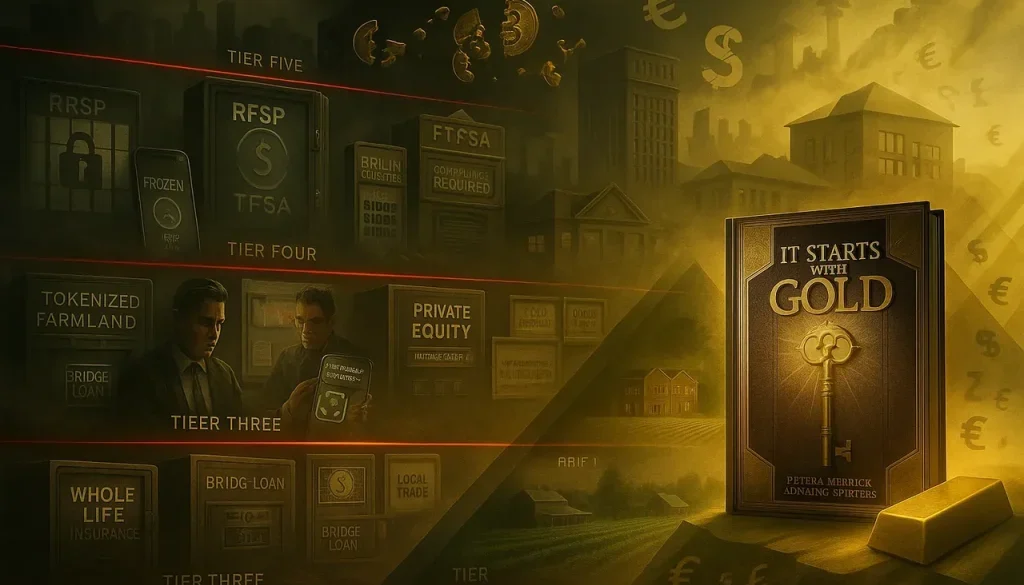
The Risk Pyramid: From Control to Confiscation
Every asset class is not created equal. In a financial reset, what matters most is control. The further removed you are from direct ownership and legal title, the higher your exposure to seizure, restriction, or devaluation. To navigate this transition, it is essential to understand which assets offer real protection and which merely offer the illusion of security.
At the top of the hierarchy are Tier One assets. These include physical gold and silver held in private, audited, non-bank vaults. This means not tokenized, not pooled, and not stored within a bank custodian system. Also included are parcels of farmland held with clear legal title, ideally in regions that produce essential food supplies and lie outside major urban development zones. Private rental real estate, particularly multi-family units built for long-term tenant demand, also fits into this top tier, provided it is owned outright and not entangled in ESG mandates.
Tier Two includes resilient, cash-flowing assets that provide both income and legal shielding. Participating whole life insurance policies from mutual companies stand out. These contracts offer long-term capital preservation, creditor protection, and tax-sheltered growth while remaining off the grid of government benefit testing and market volatility. Private equity in essential industries such as infrastructure, food systems, and tangible goods also falls into this category, particularly when structured through holding companies or intellectual property trusts designed to protect against creditor and regulatory interference.
Tier Three consists of moderately secure holdings. These include portfolios managed by independent, discretionary portfolio managers who are not aligned with major banks or mutual fund distributors. Some exposure to diversified private debt or bridge lending may be acceptable at this level. These assets may still be liquid and income-generating, but they are closer to the regulated system and could be vulnerable in a liquidity crisis.
Tier Four marks the danger zone. These are assets most Canadians are still holding, unaware of their exposure. This includes cash held in major banks, Canada Savings Bonds, Guaranteed Investment Certificates, and publicly traded Real Estate Investment Trusts. Stocks, Exchange Traded Funds, and mutual funds held inside registered accounts like the Registered Retirement Savings Plan, Registered Retirement Income Fund, or Tax-Free Savings Account fall into this group. Crypto assets held on exchanges or tokenized platforms also belong here, particularly when they are centrally custodied or subject to government disclosure.
Tier Five carries the greatest risk in a reset. These are assets with maximum custodial, regulatory, and political exposure. Pensions, annuities, and employer-sponsored savings plans may be frozen, revalued, or redirected under public purpose mandates. Real estate or business assets tied to government subsidies, Net Zero compliance, or ESG rules may become unusable or financially unsustainable. Anything centrally custodied by institutions bound to the state should be considered vulnerable.
What Canadians Should Do Right Now
The most urgent priority is to identify the weak links in your financial structure. Replace mutual funds and passive ETFs with discretionary mandates managed by independent professionals who are not aligned with the banks. Move physical gold and silver into vaults that are outside the traditional banking system, in jurisdictions that respect private property and do not participate in global financial coordination agreements. Begin reducing exposure to pension plans or government-aligned investment vehicles that could be restructured or seized.
Next, build cash flow off the grid. This does not mean off-the-books, but rather out of reach of centralized policy levers. Focus on private rental properties that serve real housing needs, farmland that feeds people, and private businesses in essential goods and services. Consider income-producing private debt strategies or long-term insurance solutions that are structured for control, not market chasing.
Lock in intergenerational reserves with whole life insurance policies offered by mutual insurers. These policies provide permanent capital that is tax-deferred, creditor-protected, and outside of the registered plan regime. Policies can be structured to support future lending, tax planning, or estate equalization without losing control or visibility.
Canadians should also consider jurisdictional diversification. This means diversifying not only asset types but also geography. Offshore physical gold storage in places like Liechtenstein or Singapore offers additional protection. Second residency or citizenship-by-investment programs can provide valuable legal and financial exit options if domestic access to capital becomes limited.
Avoid tokenization traps. Do not be misled by offers to digitally register or tokenize your metals, real estate, or equity shares unless you retain legal title, private keys, and full platform control. If the offering is hosted on a third-party exchange or blockchain governed by ESG compliance rules, you may become a user, not an owner. In a reset, tokenized assets often carry restrictions that physical or paper title assets do not.
Finally, rebuild your local wealth ecosystem. Build alliances with independent food producers, tradespeople, and non-institutional professionals. These are the people and networks that will matter most in a time when national systems are disrupted or repurposed. Being able to secure goods and services through personal trust relationships may become more reliable than any financial app or digital interface.
Protect your Wealth. Contact New World Precious Metals

ou Are Your Own Central Bank Now
The Canadian government may speak of stability, access, and inclusion. But history teaches that financial resets are rarely implemented to protect individual freedom. Instead, they centralize control. They repurpose capital. And they redefine ownership.
When money becomes programmable, only unprogrammable assets retain value. When transactions become traceable, only private interactions remain sovereign. When asset platforms are governed by ESG and compliance thresholds, only those who hold assets directly can bypass the gatekeepers.
When systems are frozen, whether for security, climate, or equality, only what lies outside those systems will remain accessible.
There Is Still Time to Prepare
This is not about fear. It is about readiness. Canadians still have access to the legal tools, jurisdictional options, and private assets that can form a firewall against the next phase of this transition.
We explore this in greater depth in our #1 international best-selling book, It Starts With Gold™, co-authored by Peter J. Merrick and Adrian C. Spitters. In the book, we reveal how the global financial system is being restructured to limit ownership and how tangible, private, and income-generating assets can be used to protect and transfer wealth. Visit www.ItStartsWithGold.com.
To find out more, order your own copy of It Starts With Gold™ from Amazon today. CLICK HERE
References
- World Gold Council – Central Bank Gold Demand Report
- Office of the Superintendent of Financial Institutions – Canadian Bank Bail-In Regime
- Atlantic Council – CBDC Tracker
- Canadian Pension Plan Investment Board – ESG Mandates
- Bank for International Settlements – Derivatives Statistics
- Canadian Life and Health Insurance Association – Participating Whole Life Overview
- International Monetary Fund – Real Asset Inflation Hedge Report