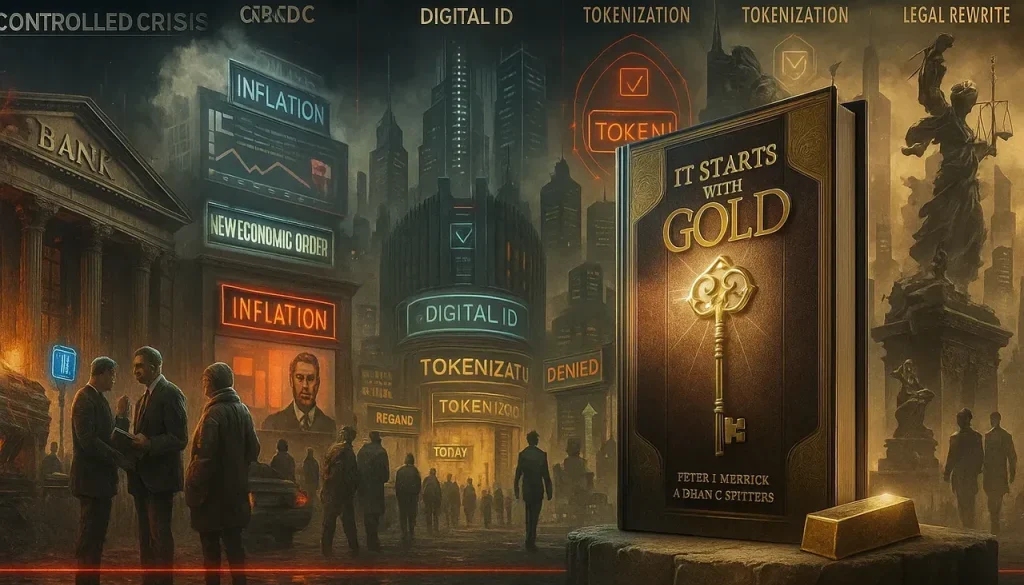
The Reset Is Not Coming, It Has Begun
By Peter J. Merrick, TEP® and Adrian C. Spitters, CFP®, co-authors of the international bestseller It Starts With Gold™ and the forthcoming book Guns, Gold & Land™
This analysis continues a series of long-form investigations published in The Merrick Spitters Reset Report™
A Step-By-Step Breakdown of How The Global Financial System is Being Dismantled and Restructured in Real Time
This is Part 2 of a three-part series on the likelihood of a Global Financial Reset. In Part 1, we outlined the structural drivers of the global financial reset. Now, we explore how those drivers are unfolding in real time.
Some still believe we will get a warning. But as outlined in It Starts With Gold™, financial resets do not start with sirens. They unfold in calculated phases. This article presents a practical, phased overview of the ongoing reset and what to expect next. This article is presented as an opinion and is intended to inform and invite dialogue.
Phase One: Controlled Crisis and Media Reframing
The first phase begins with the orchestration or exploitation of large-scale trigger events. These include the default of a sovereign debt issuer such as Italy or Japan, a collapse triggered by overleveraged derivative exposure in commercial real estate, or a cyberattack on financial infrastructure that disables payment systems. In response, central banks inject massive amounts of emergency liquidity into the markets, while institutions like the Group of Seven or BRICS convene emergency summits. Governments act swiftly, but their coordinated language signals something more permanent than a simple patch.
In the media, we see the language shift rapidly. What once would be called a financial crisis is reframed as a necessary transition. Phrases like “green transformation,” “inclusive financial access,” or “new economic order” begin to appear in headlines. In Canada, a key signal to watch for is a sudden alignment between the Bank of Canada, the Office of the Superintendent of Financial Institutions, and provincial governments. This could be accompanied by the rollout of new emergency powers, similar to what was passed in British Columbia under Bill 7. Although presented as temporary, these changes quietly reset the public’s expectations.
Phase Two: Debt Monetization and Currency Devaluation
In the second phase, governments release massive new spending packages, which are promoted as solutions for inequality, climate action, or post-crisis recovery. Universal basic income trials or carbon dividend programs begin to circulate in mainstream political conversations. Behind the scenes, central banks absorb this new debt by expanding their balance sheets and keeping interest rates artificially low.
This monetary expansion, however, comes at a cost. Inflation begins to rise, but official statistics understate its true impact. Adjusted consumer price indexes hide the purchasing power erosion, even as real-world costs of housing, fuel, and food continue climbing. Public discourse adapts once again. Terms like “helicopter money,” “debt forgiveness,” and “stakeholder equity” become normalized. Social benefits are increasingly linked to ESG metrics, making access dependent on alignment with environmental or social goals. During this time, gold begins breaking new highs. Governments may start to impose restrictions on the size and frequency of cash transactions, under the justification of stopping fraud or preventing capital flight.
Phase Three: Central Bank Digital Currency Rollout and Identity Integration
By the third phase, physical cash begins to disappear under the official rollout of Central Bank Digital Currencies. These digital currencies are introduced as more efficient, secure, and inclusive than traditional money. However, they do more than replace physical banknotes. Each citizen’s CBDC wallet is linked to a central Digital ID platform. Together, these systems form a programmable money structure tied to identity and social compliance.
CBDCs may come with built-in features that limit how much can be spent in a certain period or place expiration dates on balances to encourage spending. Transactions could be restricted based on climate compliance, medical status, or social credit metrics. These are not distant possibilities. In Canada, pilots for Digital ID systems are already underway. Programs like CleanBC are laying the groundwork for climate-based behavioural scoring, and major Canadian banks are already required to disclose climate-related financial risks as part of federal reporting mandates. Still, these new tools are presented as safeguards for technological innovations that increase inclusion and fight crime. Few realize they also redefine control.
Phase Four: Tokenization and Property Reclassification
Next comes the gradual digitization and reclassification of private property. Land, real estate, businesses, and even physical assets, such as gold, are recorded on permissioned blockchains. At first, this is promoted as an efficiency upgrade. In reality, it enables a shift from ownership by title to ownership by conditional access. Tax policy, financing availability, and usage rights are now determined by ESG scores and regulatory compliance.
Non-compliant properties, such as farmland that does not meet Net Zero benchmarks, become less valuable. Owners face higher taxes or are excluded from refinancing options. Gold may be increasingly reclassified, restricted, or limited to institutional holders in tokenized form. In this framework, possession is not control. The user’s ability to sell, borrow against, or improve their property is based on permissions set by public-private partnerships.
In Canada, we are already seeing signals of this transition. Provincial governments are reassessing land rights and property usage through environmental frameworks. What was once protected under common law is now contingent upon political alignment.
Phase Five: Legal and Financial Rewriting
In the final phase of the reset, emergency tools are solidified into permanent systems. Coordination between global financial institutions, such as the International Monetary Fund and the Bank for International Settlements, becomes codified. National sovereignty over fiscal and monetary decisions erodes under the guise of “stability” and “global resilience.”
New laws are introduced to redirect wealth. These include formal bail-in regimes, wealth taxes, and mandates that require portfolio allocations into ESG-compliant funds. Pensions are absorbed into “social wealth pools” that serve policy rather than performance. The tax system itself changes in language. The word “tax” is replaced by terms like “solidarity contribution” or “planetary responsibility.”
Most importantly, ownership is no longer defined by legal title but by access rights. Platforms and contracts, not constitutions or courts, determine who controls assets. Behaviour, not law, becomes the gatekeeper to participation in the economy.
Canadians Cannot Afford to Ignore This
British Columbia’s Bill 7 is not an isolated policy. It is a template for centralized control. Under the guise of “disaster preparedness,” it allows unelected officials to expropriate land or restrict its use without due process. Similar shifts are emerging in Ontario’s Greenbelt and Alberta’s municipal zoning, where climate and social justice goals are driving top-down land-use decisions.
At the same time, Digital ID systems are being fast-tracked. What began as pandemic-era health passports is evolving into permanent infrastructure linking financial data, carbon footprints, and access to services. Backed by major banks and global partners, these systems are forming the foundation of a programmable financial regime.
All of this is happening as Canada’s national debt exceeds $1.3 trillion, with interest payments now among the federal government’s largest expenses. Rather than risk default, Ottawa appears to be pursuing a strategy of indirect control, limiting access to wealth based on compliance, not law.
Canadians holding RRSPs, TFSAs, and RESPs may believe their assets are safe, but these registered accounts are subject to federal regulation. In 2022, we saw accounts frozen under emergency powers. That event was not an exception. It was a test.
Traditional investment platforms are also shifting. ESG mandates are redefining performance standards, while access to funding and favourable tax treatment may soon depend on political alignment. Residential real estate is increasingly evaluated by climate metrics, putting homeowners at risk of higher costs or restricted refinancing if their properties fail to meet government standards.
The pattern is clear. Through Bill 7, Digital ID integration, and ESG-linked compliance, control over money and property is quietly being transferred from individuals to institutions aligned with global frameworks.
The question every Canadian should ask is this: Will I still have access to my money, my home, or my investments if I disagree with future mandates?
Protect your Wealth. Contact New World Precious Metals

There Is Still a Window, Use It Wisely
This financial reset is not coming. It has already begun. Each phase unfolds not through chaos, but through bureaucracy. The terminology softens the reality. But for those who pay attention, the signs are visible and urgent.
There is still time to take action. By exiting permissioned systems, reducing reliance on tokenized assets, and investing in tangible, income-generating holdings, individuals can create a buffer between their wealth and the emerging control grid. We explore these urgent themes in detail in our #1 international best-selling book, It Starts With Gold™, co-authored by Peter J. Merrick and Adrian C. Spitters.
In the book, we reveal how the global financial system is being reconstructed from the top down, and how Canadians and others around the world can protect their wealth before access, privacy, and ownership are redefined. Visit www.ItStartsWithGold.com.
To find out more, order your own copy of It Starts With Gold™ from Amazon today. CLICK HERE
References
- Atlantic Council – CBDC Tracker
- Bank of Canada – Digital Currency Research
- Government of British Columbia – Bill 7
- World Economic Forum – Stakeholder Capitalism Metrics
- Bank for International Settlements – Derivatives Statistics
- International Monetary Fund – Digital Currency Readiness
- CleanBC Climate Plan