Bitcoin Mirage: Why Six Figures Marks the Start of the Collapse
By Peter J. Merrick, TEP® and Adrian C. Spitters, CFP®, co-authors of the international bestseller It Starts With Gold™ and the forthcoming book Guns, Gold & Land™
This analysis continues a series of long-form investigations published in The Merrick Spitters Reset Report™
Bitcoin’s Record Highs Are Not Proof of Strength but Symptoms of Speculative Exhaustion. Real Wealth Still Lives Where It Always Has, in Tangible, Productive Assets That Endure.
The Illusion of Endless Wealth
When Bitcoin crossed the $100,000 mark, the world erupted with excitement. For many, it seemed to confirm that this new form of money had finally conquered the old system. News headlines celebrated record prices. Influencers preached that the digital age had defeated traditional finance. Friends and family began sharing stories of windfall profits. Some claimed they had made millions in a year. Others regretted not buying sooner.
The stories spread like wildfire, and soon investors were calling their advisors asking if they should mortgage their homes to buy ten bitcoins before the next big run. The tone was almost religious, filled with urgency and envy. People pointed to early adopters who now lived lives of luxury. What they could not see was that this moment, this collective euphoria, was not the beginning of a revolution. It was the late stage of a mania.
The question worth asking was not whether Bitcoin could reach a million dollars. It was whether investors would still have their money when the party ended. History teaches that when every investor begins to believe they are a genius, collapse is already in motion. The Dutch believed tulips would make them rich in 1637. Tech investors believed the internet would make every company worth billions in 1999. Homebuyers believed real estate would only rise in 2006. Each time, prices soared on faith and crashed on fear. The Bitcoin era has become the modern echo of that same story.
👉 Subscribe to The Merrick Spitters Reset Report™ and receive a digital copy of our international bestseller, It Starts With Gold™, along with our white paper, Last Asset Standing™ and early updates on our forthcoming book, Killing Crypto™.
Buffett’s Warning on Faith-Based Finance
Warren Buffett, the chairman and chief executive officer of Berkshire Hathaway, has lived through almost every financial mania of the past century. His view of Bitcoin is simple and precise. “If you offered me all the Bitcoin in the world for $25 I wouldn’t take it,” he once told an interviewer. He went further, saying, “When you buy Bitcoin today for $100,000, you’re hoping that tomorrow someone pays more than you did.”
Buffett’s words are not those of an out-of-touch traditionalist. They reflect an understanding of value that has endured for more than seven decades. His point is not about technology. It is about the difference between owning something that produces and something that depends solely on the next buyer’s enthusiasm.
Bitcoin has become the purest expression of faith-based finance. It is a system that promises liberation from government control while relying entirely on the belief that its digital code has value. It offers the illusion of scarcity, the appearance of freedom, and the comfort of belonging to a movement. In reality, it demands complete dependence on technology, electricity, and market psychology.
The Scarcity Myth
The core of Bitcoin’s narrative rests on a simple number: twenty-one million. The software limits the total supply of coins to that figure. Supporters argue that because no central bank can print more, Bitcoin is immune to inflation. With roughly 19.9 million coins already mined, the supply is nearly fixed. The logic seems unbreakable. Scarcity equals safety.
But scarcity alone does not create value. If it did, every rare object in the world would be worth a fortune. Scarcity only matters when combined with utility. Gold is valuable because it is rare and useful. It has physical properties that make it ideal for jewelry, electronics, and as a store of value. Bitcoin’s scarcity is mathematical, not physical. Its usefulness depends entirely on market acceptance. Remove that acceptance and the scarcity becomes meaningless.
Supporters call Bitcoin “digital gold,” arguing that it is a superior version of the metal because it can be transferred instantly across borders. The comparison fails at a fundamental level. Gold has served as money for thousands of years. It requires no internet connection, no password, no electricity, and no counterparties. Its value is intrinsic, recognized across cultures and centuries. Bitcoin is a recent invention, existing only as lines of code. Its worth depends on belief and infrastructure. That is not intrinsic value. It is a collective agreement that can change overnight.
The Difference Between Price and Value
In every bubble, price becomes mistaken for value. Investors convince themselves that rising prices prove they are right. They forget that value is created by productivity, not popularity. When you buy a business, you own something tangible. That business has employees, equipment, products, and customers. It generates cash flow. It pays dividends. Its worth grows through real activity.
Bitcoin produces nothing. It generates no income, hires no workers, and adds nothing to the real economy. Its value exists only when another buyer appears, willing to pay more. It does not create; it transfers. Buffett once framed this perfectly by asking, “Would you rather own a goose that lays golden eggs, or something you hope to sell to someone else for more than you paid?” The goose produces value. The speculative asset demands constant belief. When belief falters, the illusion ends.
This distinction is not academic. It is the difference between building wealth and gambling with it. Productive assets reward patience. Speculative ones punish complacency. The investor who holds a business or a farm can wake up knowing value was created overnight through effort and demand. The Bitcoin holder wakes up hoping that sentiment has not shifted.
When Innovation Becomes Idolatry
Bitcoin’s defenders insist that this time is different. They claim that blockchain technology will change everything, from banking to record-keeping. They point to institutional adoption and call it validation. They quote analysts predicting six- or seven-figure price targets.
There is truth in their argument. Blockchain may indeed transform industries. Early Bitcoin investors did make life-changing fortunes. Major institutions are participating, lending credibility. But those same ingredients have appeared in every speculative bubble. A grain of truth attracts serious money, then optimism turns into obsession.
Investors often confuse technological innovation with financial value. Owning Bitcoin does not grant ownership of the blockchain any more than owning a domain name in 1999 granted ownership of the internet. The companies that survived the dot-com collapse, such as Amazon, Apple, and Google, created real value by serving human needs. The thousands that vanished were built on excitement alone. Bitcoin’s technology may endure, but its price cannot defy gravity forever.
The Scale of the Illusion
At $100,000 per coin, Bitcoin’s total market capitalization exceeds two trillion dollars. If it ever reached one million per coin, the combined value would surpass twenty trillion. That figure rivals the total output of the global economy. Yet Bitcoin performs a fraction of the transactions that traditional payment networks handle in seconds. The imbalance between expectation and reality is staggering.
Institutional participation is often presented as evidence of stability. It is not. Institutions amplify both opportunity and risk. They bring leverage, derivatives, and complex products that can multiply volatility. The same forces that made the mortgage market appear safe before 2008 now operate in digital form. Institutional adoption does not protect investors. It often magnifies the eventual collapse.
The Psychology of the Crowd
The most powerful fuel in any mania is emotion. Fear of missing out drives rational people to irrational choices. The moment they see friends and strangers making money, their discipline dissolves. They convince themselves that if everyone else is buying, it must be safe.
This collective psychology has repeated for centuries. It creates a cycle of euphoria, followed by panic. In the early stages, the profits seem effortless. In the middle, people borrow to buy more. In the final stage, those who entered last begin to panic as prices stall. The smart money sells quietly. The crowd holds on, believing recovery is near. Then the collapse accelerates.
Bitcoin has already experienced two major cycles of boom and bust. In 2017, it climbed from $1,000 to $20,000 and fell 84 percent. In 2021, it rose to $69,000 before plunging 77 percent. Both times, believers said the same thing: “This time is different.” Both times, the result was identical.
The Missing Margin of Safety
Benjamin Graham, known as the father of value investing, once said that the three most important words in finance are “margin of safety.” This principle protects investors from their own optimism. It is the buffer between what something is worth and what you pay for it. Without it, a single mistake can erase a lifetime of effort.
Bitcoin at $100,000 offers no margin of safety. Its valuation assumes perfect execution, infinite demand, and zero competition. There is no room for error. Every buyer today is betting on continued belief. The risk is absolute, and the protection is nonexistent. If faith weakens, there is no underlying asset to fall back on. The only cushion is hope, and hope has no resale value.
The Trap of Digital Dependence
Bitcoin’s popularity stems from a genuine desire for independence. Many investors feel betrayed by inflation, overregulation, and the erosion of privacy. They long for a financial system outside government control. Bitcoin promises that escape. But the irony is that it depends on the same structures it claims to replace. It requires power grids, internet access, and cooperation among miners and exchanges. If those systems falter, so does Bitcoin.
True independence does not come from algorithms. It comes from ownership. It comes from holding assets that exist in the real world, assets that you can control without permission or passwords. It comes from self-reliance, not self-delusion.
The Power of Real Ownership
Property that provides shelter and precious metals that have held value through centuries of war and inflation remain essential pillars of real wealth. Gold and silver remain the most reliable forms of tangible wealth. Their physical properties, universal acceptance, and independence from financial intermediaries make them a foundation for long-term security and purchasing-power preservation. These assets exist whether the internet works or not. They do not vanish when markets panic. They continue to generate value regardless of opinion.
For investors seeking to preserve both liquidity and sovereignty, physical precious metals serve as the first and most enduring layer of protection, anchoring portfolios against inflation, currency debasement, and systemic risk.
At our firm, we help clients structure their portfolios according to the principle of Owning Assets in Order of Asset Security. This framework prioritizes the safest, most tangible assets first and places speculative investments at the outer edge, where they belong. The foundation of real wealth is security. Tangible assets protect against uncertainty. Productive assets provide income. Private investments add diversity. Speculative assets should only occupy what one can afford to lose.
Private Real Estate: Income Rooted in Necessity
Among productive assets, Private Real Estate Investment Trusts (Private REITs) have become one of the most stable and resilient forms of income-producing ownership. These vehicles combine the income potential of real estate with the professional management and transparency of institutional-grade assets, providing investors with exposure to housing demand without the burdens of direct ownership.
By focusing on multifamily communities, they deliver stability rooted in necessity because people will always need places to live, regardless of market cycles. These trusts pool investor capital into professionally managed apartment communities, generating steady rental income and long-term value through a range of market conditions.
Because housing remains a basic necessity, multifamily real estate offers both cash flow and long-term inflation protection. When held privately rather than through publicly traded REITs, these structures also reduce exposure to stock-market volatility and short-term sentiment, aligning with the principles of real ownership and asset security.
This approach has guided wise investors through every major crisis. It ensures that when the speculative towers fall, the foundation still stands. It is not about fear. It is about sovereignty.
From Speculation to Sovereignty
The purpose of wealth is not merely accumulation. It is freedom. The ability to make decisions without dependence on unstable systems or emotional markets. Speculative assets promise liberation but often deliver captivity. They chain investors to price movements and emotional cycles. Real ownership liberates them by grounding wealth in the physical and the productive.
When speculation ends, only what is real remains. The farmland still yields crops. The factory still runs. The building still houses families. The gold still holds its weight. Wealth built on these foundations survives crises and transfers across generations. Wealth built on illusions vanishes when belief fades.
There is still time to choose. The financial world is undergoing rapid transformation. Technology is rewriting the rules of commerce, money, and ownership. But the timeless laws of value remain unchanged. Price is temporary. Value is permanent. Speculation destroys. Productivity endures. Those who remember that distinction will navigate the storm and emerge with strength.
A Path Forward
At our firm, we assist clients in structuring wealth by Owning Assets in Order of Asset Security. For many investors, that begins with establishing a core allocation to physical gold and silver, assets that can be owned directly, stored safely, and held outside the reach of market or system failures.
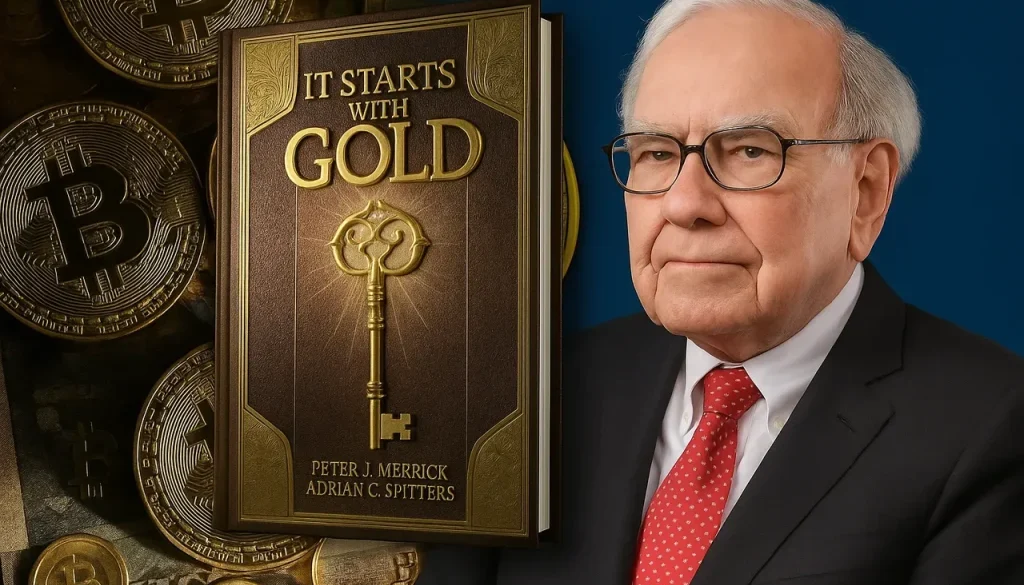
These insights connect directly to the themes explored in It Starts With Gold™, co-authored by Peter J. Merrick, TEP® and Adrian C. Spitters, CFP®. Inside the book, we show how to establish a tangible-asset foundation, measure security across asset classes, and safeguard against systemic shocks while maintaining control of your future. Visit www.ItStartsWithGold.com.
👉 Sign up today for The Merrick Spitters Reset Report™ to receive a digital copy of our international bestseller, It Starts With Gold™, our white paper, Last Asset Standing™, and early updates on our upcoming book, Killing Crypto™.
Prefer a hard copy? Order It Starts With Gold™ on Amazon today.
References
- Buffett, W. (2022). “I Wouldn’t Pay $25 for All the Bitcoin in the World.” CNBC Interview.
- Buffett, W. (2024). “Buying Bitcoin Is Not Investing.” Yahoo Finance.
- Bloomberg Markets (2025). Bitcoin Holds Firm Above $100,000 as Institutional Momentum Builds.”
- Reuters (2025). “Crypto Funds Attract Record Inflow Amid Bitcoin’s Six-Figure Surge.”
- Coindesk (2025). “Public Companies Buy More Bitcoin Than ETFs for Third Consecutive.”
Disclaimer
This publication is for educational and informational purposes only and is not intended to promote or recommend any specific investment, strategy, or security. It is not intended as personalized financial, legal, or tax advice, and it should not be relied upon as a recommendation to buy or sell any investment or product. Market conditions, economic policies, and asset valuations can change without notice, and all investments carry risk, including possible loss of principal. Readers should consider their individual circumstances and consult with a qualified financial or legal professional before making decisions based on this material.
Peter J. Merrick, TEP®, and Adrian C. Spitters, CFP®, provide professional advisory services through independent affiliations with regulated financial firms in their respective jurisdictions. The views expressed reflect the authors’ independent opinions and may not represent those of any affiliated institution.