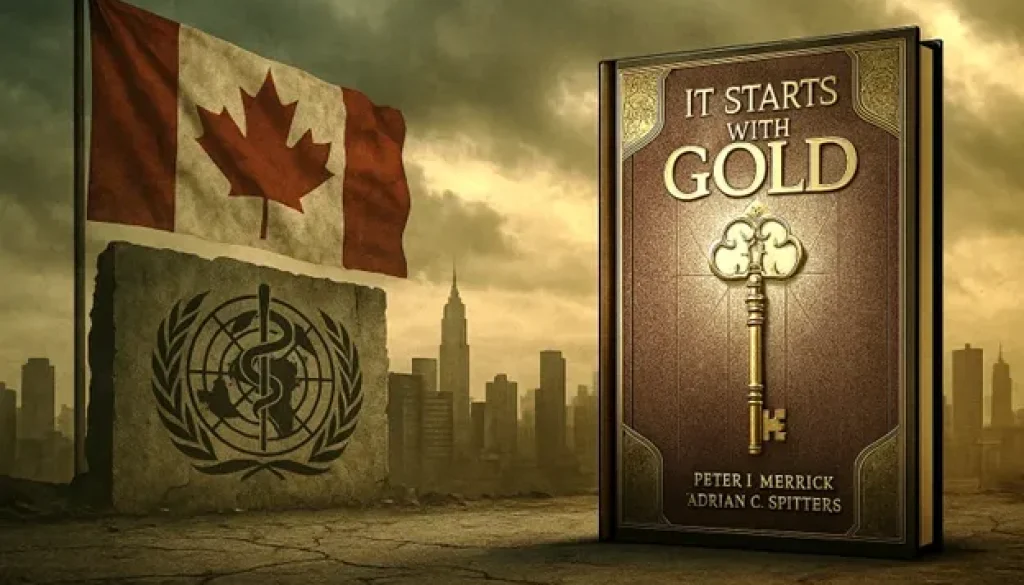
Canada at the Brink: WHO Treaty and Debt Agenda Threaten Freedom
By Peter J. Merrick, TEP® and Adrian C. Spitters, CFP®, co-authors of the international bestseller It Starts With Gold™ and the forthcoming book Guns, Gold & Land™
This analysis continues a series of long-form investigations published in The Merrick Spitters Reset Report™
How the WHO Pandemic Treaty and Mark Carney’s Economic Plan Could End Canadian Sovereignty
The urgent themes discussed in this article are expanded upon in our #1 international best-selling book, It Starts With Gold™, co-authored by Peter J. Merrick and Adrian C. Spitters. In the book, we reveal how global agreements, economic policies, and leadership decisions can quietly erode national sovereignty, democratic rights, and individual freedoms. Visit www.ItStartsWithGold.com.
Canada recently signed onto the World Health Organization’s Pandemic Treaty, a global agreement committing member states to coordinated pandemic responses. While presented as a safeguard for public health, the deeper implications reveal a dangerous convergence of international governance, centralized control, and debt-fuelled economic restructuring. When viewed alongside Prime Minister Mark Carney’s sweeping plan to rebuild Canada, the treaty becomes part of a much broader strategy to realign the nation under transnational oversight.
Sovereignty at Stake: Canada’s Independence Compromised
The WHO Pandemic Treaty obligates Canada to implement health policies directed by the WHO, a body headquartered in Geneva and composed of unelected international representatives. While marketed as a cooperative effort for global equity, the agreement raises serious concerns about sovereignty and democratic accountability.
Canadian MPs such as Leslyn Lewis have warned that the treaty could open the door to externally imposed lockdowns, vaccine mandates, and surveillance protocols, all triggered by ambiguous definitions of future “public health emergencies.” These policies could be enforced without meaningful parliamentary debate or provincial consent.
WHO Treaty Enforcement: How Mandates Become Reality
The treaty’s power lies not in its immediate force of law but in how it can be domesticated. Canada’s federal government has the authority to ratify international agreements and adopt implementing legislation. While not self-executing, the treaty’s influence increases dramatically once integrated into national law or emergency frameworks.
Federal adoption can trigger harmonized regulations across provinces, especially under national emergencies, which may override local authority. The WHO has also proposed new financial instruments tied to compliance, increasing the pressure to conform. This paves the way for global health directives to shape domestic policy beyond public scrutiny.
Mark Carney’s Vision: Debt-Driven Economic Transformation
Mark Carney, former central banker turned Prime Minister, is spearheading a comprehensive restructuring of Canada’s economy using state-led borrowing and global integration. His plan calls for billions in new infrastructure projects, climate-oriented investments, and technology upgrades, with a significant portion of funding sourced through ESG-aligned global capital.
This debt-fuelled model, while branded as innovative and sustainable, increases Canada’s reliance on international lenders. Critics point out that debt-to-GDP levels are projected to exceed 80 percent by 2027, with a growing share of this debt held by foreign institutions. Once tied to global financial expectations, Canadian policy may no longer serve national interests but rather those of transnational creditors.
ESG and Net Zero: Health Mandates Meet Climate Governance
Carney’s role as a global champion of ESG finance is well established. His economic plan links pandemic resilience to climate targets and carbon neutrality, echoing language found throughout the WHO treaty. The treaty itself contains provisions for “climate-sensitive disease surveillance” and environmental health protections.
This opens the door for future public health emergencies to be declared based on climate factors such as wildfire smoke, extreme heat, or zoonotic spillover. In such a framework, Canadians could face permanent emergency measures not only for pandemics but for ongoing environmental risks, implemented through the same treaty that bypasses direct democratic oversight.
Surveillance and Digital Control: Privacy in Peril
The treaty’s Pathogen Access and Benefit-Sharing System (PABS) introduces mechanisms for global monitoring and compliance. Canada would be required to share biological data, medical countermeasures, and adhere to protocols shaped abroad.
Paired with Carney’s digital modernization push, this system could institutionalize global surveillance under the banner of health. Health passes, digital IDs, and biometric tracking would shift privacy from a right to a privilege, authorized or revoked based on adherence to global standards. These systems, once embedded, rarely disappear.
Democracy Undermined: Transparency Lost
Canada’s participation in the WHO treaty was negotiated with minimal public engagement. The process avoided parliamentary debate, lacked provincial consultation, and bypassed public input. Researchers at York University criticized the treaty as one of the most consequential yet least transparent policy shifts in Canadian history.
Carney’s broader reforms follow a similar pattern. Sweeping changes to spending, infrastructure, and resource allocation have been announced without full debate or federal-provincial alignment. The Canadian public is left watching decisions made behind closed doors, often in collaboration with international entities whose priorities are not always aligned with domestic interests.
Global Precedents: This Is Not Hypothetical
Other nations have already experienced the consequences of surrendering authority during health and financial crises. During the Ebola outbreak, West African nations were pressured into accepting WHO-led governance structures and foreign medical teams, often without local consent. Argentina, following pandemic-related debt renegotiations, saw IMF-driven policy changes in health and energy.
Canada risks following this pattern. By embedding itself into the WHO treaty and Carney’s globally tethered economic vision, it becomes increasingly difficult to exercise independent governance in future emergencies.
Equity or Dependency: Canada’s Resources at Risk
Advocates claim the treaty ensures equitable access to vaccines and treatments. In practice, this may require Canada to export key technologies and innovations, such as mRNA intellectual property or medical supply chains, without reciprocal benefit.
Doctors Without Borders has already raised concerns that Canada’s support for voluntary, not mandatory, tech sharing shields pharmaceutical companies but undermines global access. If pressure mounts to align with WHO redistribution mandates, Canada may be forced to comply or face diplomatic and financial isolation.
Carney’s economic model reinforces this risk. As Canada relies more heavily on global finance and foreign capital, the ability to retain sovereign control over critical assets, including health, data, and natural resources, fades.
Lessons from COVID-19 Ignored: The Risk of Permanent Overreach
The COVID-19 response showed how quickly governments can implement extraordinary restrictions when operating under emergency powers. Canadians endured lockdowns, school closures, forced isolation, and digital health tracking that was once unimaginable but is now normalized.
Institutionalizing emergency governance through the WHO treaty could make these powers permanent. Future “public health risks,” real or theoretical, may be used to trigger global directives enforced domestically with little public input. Canadians would find themselves governed not by elected representatives, but by international technocrats accountable to no voter base.
Provincial Pushback: A Constitutional Firewall?
Health care falls under provincial jurisdiction in Canada. Alberta Premier Danielle Smith has signalled strong resistance to federally adopted international treaties that affect provincial autonomy. Section 92 of the Constitution Act gives provinces the right to administer their own public health policies.
Legal experts suggest provinces could use this constitutional firewall to resist WHO-aligned mandates. Saskatchewan and other provinces may follow, leveraging the courts to challenge federally imposed obligations and preserve regional governance.
A Dangerous Precedent: Global Impact Beyond Canada
Canada’s compliance sets a precedent. If one of the world’s largest, wealthiest, and most resource-rich nations can be coaxed into surrendering core elements of its sovereignty under the banner of health equity and sustainable finance, others will follow. The treaty becomes a template. Carney’s economic model becomes a blueprint. What is now Canadian policy could soon become a global standard.
Hope and Solutions: Taking Back Control
Despite the seriousness of the risks, Canadians are not powerless. Now is the time to demand transparency, debate, and accountability. In It Starts With Gold™, we outline practical solutions to resist this convergence of supranational governance and centralized control:
-
-
- Reassert provincial authority over health and emergency mandates
- Require full parliamentary ratification for any treaty affecting civil liberties
- Secure national ownership of infrastructure, health supply chains, and IP
- Protect wealth through tangible, independent assets like gold and farmland
- Shift capital to private alternative investments outside institutional influence
-
We can make a difference, but only if we act.
To find out more, order your own copy of It Starts With Gold™ on Amazon today. CLICK HERE
References:
- WHO Pandemic Agreement Announcement
- Canada’s Role in the WHO Pandemic Treaty
- Doctors Without Borders on Canada’s Pandemic Treaty Stance
- Mark Carney’s Economic Plan
- Mark Carney’s Strategic Vision for Canada
- Concerns Over Sovereignty by Canadian MPs
- Transparency Concerns in Canadian Negotiations
- Concerns over WHO’s Authority