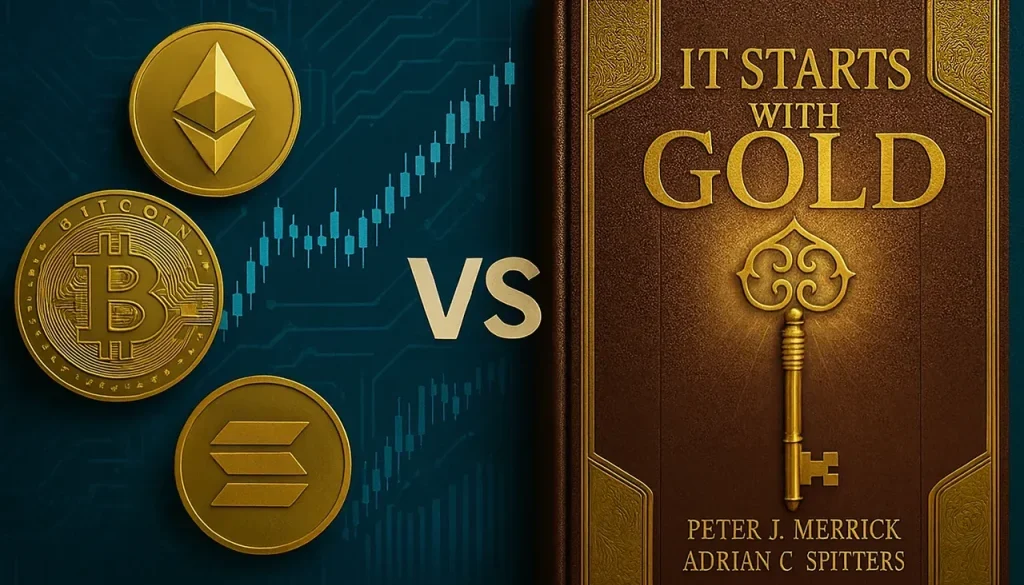
Crypto ETFs: The Digital Cage Disguised as Innovation
By Peter J. Merrick, TEP® and Adrian C. Spitters, CFP®, co-authors of the international bestseller It Starts With Gold™ and the forthcoming book Guns, Gold & Land™
This analysis continues a series of long-form investigations published in The Merrick Spitters Reset Report™
The floodgates have opened. In 2025, U.S. regulators approved a wave of new spot crypto ETFs, prompting Canadian institutions to quietly prepare their own versions. Beneath the excitement lies a deeper risk few advisors recognize.
The Crypto ETF Trap: How Advisors Are Being Groomed to Sell the Digital Cage
A silent campaign is conditioning advisors to see crypto ETFs as innovation. In reality, they serve as the gateway to tokenized financial control.
This article examines how global financial institutions are conditioning advisors to promote the next phase of digital control through crypto ETFs. It is presented as an opinion to inform and awaken critical thinking.
The Grooming Begins
A quiet transformation is underway across the financial world. Advisors are being taught to celebrate it, clients are being trained to trust it, and institutions are positioning it as the next great breakthrough.
The new frontier, they are told, is the crypto exchange-traded fund (ETF), a product that blends the illusion of digital innovation with the structure of traditional finance. To many, it sounds modern, efficient, and safe. In reality, it is the next layer of financial control disguised as opportunity.
In training sessions, webinars, and dealer conferences, advisors are hearing the same language repeated by industry trainers, product wholesalers, and compliance officers: “Client demand is growing.” “Digital diversification is essential.” “ETFs are the future.”
This repetition is not education. It is conditioning. Advisors are being prepared to become the sales force for a financial architecture they do not control.
👉 Subscribe to The Merrick Spitters Reset Report™ and receive a digital copy of our international bestseller, It Starts With Gold™, along with our white paper, Last Asset Standing™ and early updates on our forthcoming book, Killing Crypto™.
The Manufactured Illusion of Innovation
Every generation of advisors has been taught that new products equal progress. Once, it was mutual funds. Then it was managed accounts. Then came ESG mandates, private credit, and structured notes. Now, it’s crypto ETFs.
The message is always the same: evolve or be left behind. The emotional undertone is powerful because no professional wants to appear outdated. The result is a pattern of psychological compliance rather than intellectual conviction.
By framing crypto ETFs as “innovation,” institutions bypass critical thought. Advisors stop asking who benefits most and start asking how to participate. In that shift, control is lost.
The Script Behind the Curtain
What appears spontaneous across firms and publications is, in truth, coordinated. Media outlets glorify the “mainstreaming of digital assets.” Industry educators emphasize the importance of “client relevance.” Dealers push “approved lists.”
None of this is organic. It is the Financial Industrial Complex, a web of custodians, fund manufacturers, data vendors, and central institutions, quietly scripting a new narrative. Advisors are the actors. Investors are the audience. And the ending has already been written.
This machinery rewards obedience with recognition. Advisors who embrace the new narrative are praised as visionaries. Those who hesitate are labelled outdated. In subtle ways, reputational pressure replaces regulatory pressure.
The grooming is nearly perfect because it doesn’t feel forced. It feels earned.
The Buffett Warning
Two decades ago, Warren Buffett, the Sage of Omaha, warned the world that derivatives were “financial weapons of mass destruction.” Most advisors nodded respectfully and went back to selling mutual funds.
Today, that prophecy echoes louder than ever. The ETF structure, often praised as transparent and liquid, now functions as the delivery system for the same synthetic leverage Buffett condemned.
Each new layer of ETF innovation adds complexity that few fully grasp. Behind the simplicity of a ticker symbol lies a chain of derivatives, swaps, and counterparties linked to the $4 quadrillion global derivatives web, a system so vast that it dwarfs global GDP many times over.
The modern ETF, particularly those tied to digital assets, is not a tool of empowerment. It is a soft weapon of wealth extraction. A perfectly engineered siphon designed to transfer capital from individuals to the institutions that control both the custody and the collateral.
As Buffett foresaw, financial engineering has replaced financial stewardship. The modern ETF is not the democratization of investing. It is the mechanization of dependency.
The Hidden Architecture of Control
Behind every ETF lies a hierarchy few retail investors ever see. Custodians hold the underlying assets. Prime brokers extend credit. Market makers execute liquidity operations that mask volatility until it’s too late.
Crypto ETFs extend this model into the digital realm. Instead of holding tokens directly, investors own units in a fund that holds positions in custodial wallets controlled by institutions. Ownership becomes abstract.
What investors gain in convenience, they lose in sovereignty. The further wealth drifts from direct possession, the easier it becomes to control, freeze, or reprice. The investor becomes a renter in a digital property system that feels secure, but only because it’s invisible.
The Tokenization Trap
The flood of crypto ETFs is not the destination. It is the bridge.
The real goal is tokenization, the conversion of all real-world assets into programmable, traceable digital tokens. The promise will be irresistible: instant settlement, endless liquidity, fractional ownership.
But the price of participation is submission. Once assets are tokenized, they live inside a programmable ecosystem that can be taxed, tracked, or limited at will.
Crypto ETFs normalize the concept of digitized ownership long before the public realizes what’s being built. They train investors to trust digital custody, to accept centralized control of decentralized assets, and to feel “innovative” while surrendering freedom.
The ETF is the psychological on-ramp. Tokenization is the final destination.
The Canadian Perspective
Canadian investors and advisors should pay close attention. The marketing materials arriving from U.S. firms will soon flood Canadian inboxes, rebranded with maple leaves and bilingual disclaimers.
Our regulatory culture rarely leads; it follows. Once the United States Securities and Exchange Commission (SEC) set the precedent for generic crypto ETF listings, Canadian institutions began positioning themselves to replicate the model.
Advisors across Canada will soon face a new wave of “educational” content encouraging digital diversification, backed by white papers, dealer guidance, and compliance scripts. The persuasion will not come from regulators. It will come from peers, supervisors, and marketing departments.
The objective is not to educate advisors. It is to align them.
Canada’s regulatory bodies, including the Canadian Securities Administrators (CSA) and the Canadian Investment Regulatory Organization (CIRO), have already begun reviewing ETF frameworks that mirror recent U.S. approvals.
The Emotional Hook
The most effective grooming tool is emotion. Advisors are not being pressured with fear of punishment. They are being seduced with the promise of belonging.
They are told they are pioneers. They are told they are modern. They are told they are helping clients adapt to the future.
Behind every advisor drawn into this digital wave stands a family whose security depends on their guidance. When advisors are conditioned, so are the households that trust them.
In truth, they are being conditioned to abandon the discipline of stewardship for the excitement of novelty. The industry’s great psychological trick is that it replaces purpose with participation.
When advisors start chasing relevance instead of resilience, the industry has already won.
The Financial Industrial Complex at Work
This is not a conspiracy. It is coordination. It operates through influence, not force, shaping markets through incentives, policy alignment, and advisor education rather than overt regulation. The same global institutions that shaped the ESG agenda, the same central banks that advocate for digital currencies, are guiding the next financial migration.
The Financial Industrial Complex does not need to confiscate wealth directly. It only needs to convince investors to store it inside systems it controls. ETFs, mutual funds, and tokenized platforms achieve this without resistance.
Every layer between the investor and the asset is another layer of control. Every digitized product erodes personal custody. Every ETF marketed as progress extends the reach of the machine.
This is not innovation. It is containment.
The Path to Freedom
The antidote is not rejection. It is reorientation.
We teach clients to Own Assets in Order of Asset Security, to anchor wealth in tangible, direct forms of ownership that cannot be diluted or deactivated by the system.
Gold remains the foundation. It is the last universally recognized asset that requires no counterparty, no blockchain, and no institution to validate its worth. It cannot be tokenized without consent, and it cannot be digitally erased.
Silver, productive land, income-producing multifamily real estate, and essential commodities follow closely behind. These are assets that exist beyond permissioned systems.
We are not anti-technology. We are pro-sovereignty. Advisors and investors alike must rediscover the difference.
When wealth is grounded in real assets, financial engineering loses its power. The digital cage has no walls for those who stand outside it.
The Moral Call
History will not remember those who complied. It will remember those who stood up for what was right. The role of a true advisor is not to chase the next product. It is to shield clients from the consequences of systemic manipulation.
The path forward is simple but not easy. Build wealth that stands on its own. Measure every investment by how much control it grants or how much it takes away.
The Financial Industrial Complex is betting that most people will trade freedom for convenience. Those who don’t will inherit the future.
If this trend continues unchecked, the next generation may inherit a financial system where ownership itself becomes a licensed privilege rather than a natural right.
At our firm, we assist clients in structuring wealth by Owning Assets in Order of Asset Security. We prioritize the most secure assets and safeguard those that are most vulnerable.
👉 Subscribe to The Merrick Spitters Reset Report™ to receive a digital copy of our international bestseller, It Starts With Gold™, our white paper Last Asset Standing™, and early updates on our forthcoming book, Killing Crypto™.
Stay informed. Stay prepared. Act while choice still exists.
The system is evolving faster than most advisors realize. Those who protect their clients from digital dependency today will be remembered as the ones who preserved true financial freedom tomorrow.
These insights directly connect to the themes explored in It Starts With Gold™, co-authored by Peter J. Merrick, TEP® and Adrian C. Spitters, CFP®. Inside the book, we show how to establish a tangible-asset foundation, measure security across asset classes, and safeguard against systemic shocks while maintaining control of your future. Visit www.ItStartsWithGold.com.
Prefer a hard copy? Order It Starts With Gold™ on Amazon today.
Disclaimer:
This publication is intended for informational and educational purposes only as of October 4, 2025. It does not constitute financial, investment, legal, accounting, or tax advice, and should not be interpreted as a recommendation or solicitation to buy, sell, or hold any security, investment fund, or financial product. The views and opinions expressed are those of the authors, Peter J. Merrick, TEP®, and Adrian C. Spitters, CFP®, and do not necessarily represent those of any affiliated organization, regulated entity, or professional body.
All information is believed to be accurate at the time of writing, but is subject to change without notice. The authors make no representation or warranty, express or implied, regarding the completeness or accuracy of the information contained herein. Readers are encouraged to seek personalized advice from a qualified, licensed financial professional before acting on any information or ideas discussed in this article. Past performance is not indicative of future results. Market conditions, legislation, and regulatory frameworks may change, potentially impacting the relevance or accuracy of the material presented.
The authors and their affiliates expressly disclaim any liability for losses or damages arising from reliance on this publication or its contents, whether in whole or in part. This article is published for the purpose of stimulating informed discussion and independent thought among financial professionals and investors.
References:
- U.S. Securities and Exchange Commission: Approval of Generic Listing Standards for Commodity-Based Trust Shares (2025)
- Reuters: SEC Paves Way for Crypto Spot ETFs with New Listing Rules (September 2025)
- CoinDesk: SEC Makes Spot Crypto ETF Listing Process Easier, Approves Grayscale’s Large-Cap Crypto Fund (Sep 17, 2025)
- CoinDesk analysis: Crypto ETF ‘Floodgates’ Open With SEC Listing Standards (Sep 19, 2025)
- Investopedia: SEC Approves Standards That Could Lead to a Flurry of New Crypto ETFs (2025)
- Berkshire Hathaway: Warren Buffett’s 2002 Letter to Shareholders
- Wealth Professional: What Canadian Advisors Need to Know About the Influx of New U.S. Crypto ETFs
- Canadian Securities Administrators: Investor Alert: Risks of Crypto Asset Trading Platforms and ETFs (2023)
- CIRO’s “Learn about the Risk of Crypto Assets”
- CIRO’s bulletin “Crypto Asset Trading Platforms – Applying for CIRO Membership” (Feb 28, 2025)
- CSA/CIRO news release: “CSA and CIRO expect crypto trading platforms to prioritize applications for investment dealer registration and CIRO membership” (Aug 6, 2024)
- Bank for International Settlements: Blueprint for the Future Monetary System – Improving the Old, Enabling the New (June 2023)
- World Economic Forum: The Tokenization of Assets and the Future of Capital Markets (2023)
- Investment Executive: Advisors Divided Over Crypto ETFs as Client Interest Grows (2024)
- Crypto-curious investors test a cautious industry: Investment Executive (March 11, 2025)
- Advisors divided ahead of SEC bitcoin ETF decision: InvestmentNews (Jan 8, 2024)