Gold Fell Apart. The Monetary Story Did Not.
What the 2026 collapse revealed about paper leverage, physical metal and the alternative perspective on gold, silver and platinum.
By Adrian C. Spitters, CFP®, FCSI®, CEA and Peter J. Merrick, TEP® Co-Authors, It Starts With Gold™; Co-Creators and Publishers, The Merrick Spitters Reset Report™
The Crash Was a Purge of Leverage, Not the End of the Monetary Case
Gold, silver and platinum did not merely correct in 2026. They were hit by a liquidation event powerful enough to erase months of gains and expose how much quoted metal prices still depend on the credit system that alternative-market experts have warned about for years.
The official account explains the spark. A hawkish Federal Reserve surprise hit a crowded, parabolic trade. The dollar rose, expected rate cuts faded, real-rate expectations hardened and leveraged positions were forced out. That sequence appeared across precious metals, mining shares, rates and the dollar.
The alternative perspective explains why the event matters beyond the headline. Paper leverage, dealer positioning, exchange margins, inventory location and confidence in settlement turned a change in expectations into a historic cascade. In our opinion, that is the deeper story. The crash changed the price. It did not settle the monetary argument.

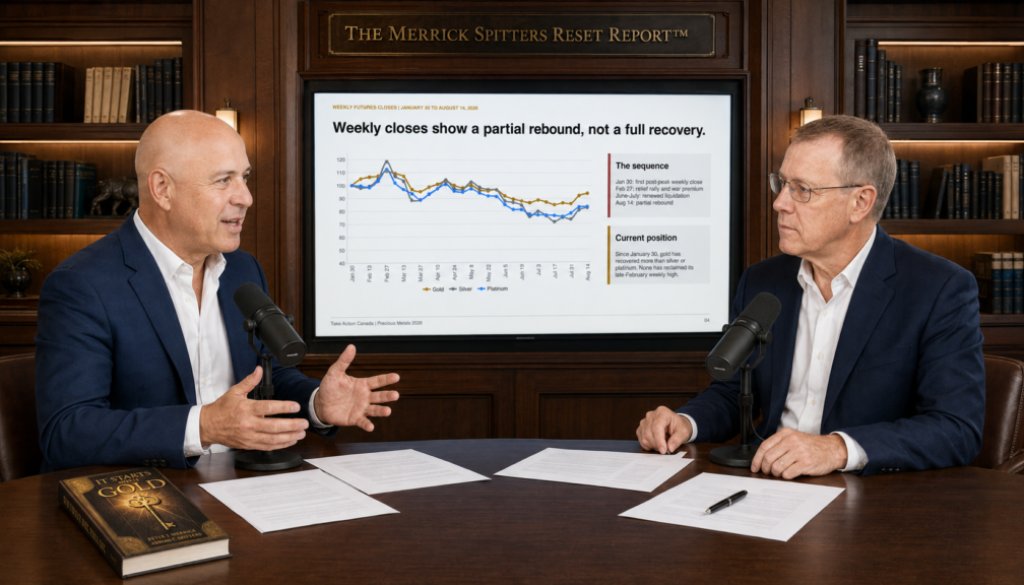
Chart note: Indexed weekly futures closes, January 30, 2026 = 100. Futures series may reflect contract rollover and are not identical to spot-market quotations. Sources: Yahoo Finance, GC=F, SI=F and PL=F.
Adrian: The Lesson I Learned in 1987
When I entered the securities business in 1987, my first lesson arrived between two historic market breaks. On Friday, October 16, the Dow Jones Industrial Average fell sharply. On Monday, October 19, it fell 22.6 percent in one session. Sound assets were sold because somebody, somewhere, needed liquidity immediately.
I have never forgotten the distinction. Market value and financial security are not the same thing. A fundamentally sound asset can collapse when leveraged financial flows set the marginal price. The owner of an unleveraged physical reserve is in a different position from a trader whose futures account is being liquidated, even though both see the same quotation.
That is the frame Peter and I bring to precious metals. We are asking what happened, what the alternative perspectives correctly identified, and what role each metal can perform if monetary trust keeps eroding.
The Official Trigger Was the Spark, Not the Whole Fire
On January 29, 2026, spot gold reached US$5,594.82 an ounce. Silver reached US$121.64. Platinum had already touched US$2,918.80 earlier that week. The advance had become parabolic and positioning was crowded.
The next day, President Donald Trump named Kevin Warsh as his choice to lead the Federal Reserve. Markets interpreted the nomination as more protective of central-bank independence, less tolerant of balance-sheet expansion and more hawkish than the debasement trade had assumed. The dollar strengthened, yields moved higher, rate-cut expectations faded and the trade reversed.
That is the official trigger, and it is credible. The cross-market timing is too clear to ignore. It also explains why the first crash was not caused by Turkey or oil. Turkey and oil mattered later, during the second act. They deepened a break that had already begun.
Turkey and Oil Were the Second Act
The late-February Iran war changed the inflation and liquidity picture. Oil surged, inflation expectations rose and the market moved from expecting easier policy toward fearing more tightening. Gold can be insurance against geopolitical disorder, but it can still fall first if the immediate reaction is a stronger dollar and higher real-rate expectations.
Turkey then mobilized part of its official gold holdings as pressure on energy imports, foreign-exchange liquidity and domestic markets intensified. That selling did not create the January collapse. It added supply and reinforced the second leg down. The sequence matters because it prevents two errors: blaming Turkey for a crash that began earlier, or assuming that official-sector gold demand moves only in one direction.
During the weekend of August 15 and 16, 2026, the oil channel became even more important. Reuters reported that only five commodity vessels transited the Strait of Hormuz on Saturday and none on Sunday, compared with 31 during the preceding weekend, after the UAE said three ADNOC-operated vessels had been attacked. A drone attack also halted loadings at Russia’s Sheskharis terminal, while Turkey reduced Russian Black Sea oil imports amid supply disruptions. The alternative concern is straightforward: an oil shock can cause liquidation first, then monetary support later.
What Happened From the Crash Through August 14, 2026
For the week ending August 14, 2026, the accompanying chart compares indexed weekly futures closes, with each metal rebased to 100 at the January 30 reference point. During the final trading session of that week, Reuters reported spot gold at US$4,379.95, or about US$4,380; silver at US$64.88; and platinum at US$1,746.97, or about US$1,747. These were intraday spot quotations, not an official closing-price fixing. Against their January intraday peaks, the approximate drawdowns remained 22 percent for gold, 47 percent for silver and 40 percent for platinum.
Gold rebuilt more than silver or platinum because a weaker dollar and lower odds of an immediate rate increase improved the monetary backdrop. The rebound is real, but incomplete. Silver and platinum still carry the deeper scars of leverage, smaller-market liquidity and industrial-cycle exposure.
The path from January to August had three major legs down: the Warsh and leverage shock, the oil and Turkey shock, and the June washout that carried gold below US$4,000. The August recovery followed softer data, renewed buying and a less hostile dollar. That sequence supports a structural bull case while warning against straight-line thinking.
Market Mechanics Turned a Selloff Into a Cascade
A small change in expectations can cause a very large price move when positioning is crowded and financing is unstable. The first sellers do not need to believe that gold has lost its monetary role. They only need to reduce risk. Their selling moves price, triggers stops, forces dealer hedging and raises margin pressure on the next group of holders.

This is where the alternative perspective is strongest. A paper-dominated market can transmit financial stress into the price of a physical asset. Margin policy, options hedging and risk limits can amplify a decline. A tight physical market can therefore fall violently if the marginal price is set by leveraged financial claims.
That conclusion does not require proof of a centrally coordinated suppression operation. It requires only the observable interaction of leverage, liquidity and rules. The question of intent is separate from the mechanism.
What the Alternative Perspective Adds
The sources Peter and I reviewed do not form a single movement. Armstrong Economics emphasizes capital flows and warns that war can drive capital into the dollar before it drives gold higher. Peter Schiff, GoldSilver, Sprott Money, Miles Franklin, ITM Trading and many Kitco guests emphasize debt, currency debasement and direct ownership. Monetary Metals focuses on competition for savings and market basis. Commodity Culture, Bullion News, The Morgan Report, Liberty and Finance, Wall Street Silver Official, Silver Slayer, Real John F. Perez, Capital Cosm, Default Finance, ZeroHedge, Gerald Celente, Gregory Mannarino, Doug Casey and Cambridge House give more space to paper-market stress, retail stacking, financial repression and monetary-reset scenarios.
Their methods and commercial interests differ, but the shared theme is clear. Rising sovereign debt and reserve weaponization are making central banks reconsider dependence on the U.S. dollar. Financial repression becomes more likely when governments cannot afford market rates, while paper leverage can temporarily hide physical tightness. Gold generally leads the monetary response, silver magnifies it, and platinum depends more heavily on supply disruption.
Our opinion is that this shared structural diagnosis deserves more attention than it receives in mainstream commentary. The alternative sources are strongest on the fragility of the system, ownership, custody, jurisdiction and the political incentives surrounding debt. They are weakest when a sound direction of travel is converted into an exact price and date.
What the Reviewed Sources Agree On
Across the supplied sources, the dominant view is that the precious-metals cycle is not over. Daily Reckoning sees gold as a warning from a debt system approaching a tipping point. Peter Schiff treats the collapse as a liquidity event inside a larger inflation and deficit cycle. GoldBroker calls the correction a breather before a secular blowoff phase. Sprott Money, GoldSilver, Miles Franklin and many Commodity Culture guests expect physical scarcity and monetary demand to rebuild prices.
The consensus is strongest on gold. Sovereign debt, central-bank diversification, sanctions risk and pressure to cap borrowing costs form the common foundation. The sources disagree about the immediate dollar path. Armstrong’s framework allows a stronger dollar and weaker gold first, especially during war or a liquidity scramble. That changes the route, not the longer concern about monetary trust.
The consensus is more explosive and less reliable on silver. Its documented deficit and regional tightness support higher prices, while its small market and monetary history encourage extreme targets. The same small market, leverage and industrial exposure also make another deep liquidation plausible. The alternative-source range is not a forecast band. It shows unusually wide disagreement about timing and magnitude.
Platinum receives far less attention from the reviewed alternative-market experts. Its bullish case rests mainly on concentrated mine supply, low stock cover and the possibility of disruption, not on a widely shared monetary-reset thesis. That makes platinum a potentially powerful scarcity trade, but the weakest consensus holding of the three.
Where the Alternative Consensus Breaks
Monetary Metals offers the most useful counterweight, framing 2026 as competition for savings and trust rather than automatic systemic collapse. Kitco’s reporting on ING allows a slower, volatile recovery under a stronger dollar and higher yields. Miles Franklin has carried both crash warnings and bullish targets. ZeroHedge has published conventional margin explanations beside allegations of engineered paper selling. These contradictions require us to separate mechanism, evidence and marketing.
Our synthesis is that the alternative perspective has a strong direction-of-travel argument and a weak calendar. Debt, reserve diversification, supply concentration and ownership risk are durable. Precise dates for collapse, exchange failure or monetary reset are not. Our realistic conclusion is structurally higher metals with repeated air pockets, not a guaranteed vertical move.
The Severe Alternative-Perspective Sequence
The most coherent severe path begins in sovereign bonds, not at a coin shop. A failed auction, disorderly long-term yields or a leveraged credit accident creates a scramble for dollars and collateral. Gold, silver and platinum can all fall during that first liquidation because investors sell what they can, not only what they distrust.
The next stage is the policy response. Central banks provide liquidity, cap yields or tolerate inflation because the fiscal system cannot carry market rates indefinitely. Governments direct balance sheets, encourage domestic bond ownership, restrict capital or revalue official gold. Gold responds first as the reserve asset outside another government’s liability. Silver follows more violently if investment demand meets a physical deficit. Platinum participates only if industrial demand survives or supply disruption dominates.
The terminal tail scenario is a fracture between financial claims and available metal. Lease rates and regional premiums remain elevated, delivery terms change, cash settlement is imposed or good-delivery bars become unavailable at the quoted benchmark. That is the environment in which the most extreme silver and gold forecasts become mathematically conceivable. By August 14, 2026, the market had shown tightness, inventory fragmentation and violent rule-sensitive price action, but it had not shown a verified COMEX default or a durable wholesale benchmark failure.
The Predictions, In Their Own Words
James Rickards, Commodity Culture, July 3, 2026: “$10,000 Gold By Year-End ‘Still Intact’.” This is published episode-title wording. From the August 14, 2026 Reuters spot snapshot of US$4,379.95, that would require an advance of roughly 128 percent before year-end. It is a severe crisis thesis, not an ordinary recovery call.
Martin Armstrong, Armstrong Economics, January 27, 2026: “In gold, the next major resistance level is at 7600.” Armstrong did not attach a date to that resistance level. Separately, he published a 2032 model range of US$8,350 to US$10,000. His distinctive argument is that capital flow, war and the dollar determine the route.
Michael Oliver, ITM Trading, February 6, 2026: “$500 Silver by Summer, $8,000 Gold.” This is the published ITM headline wording. Silver at US$500 would require an increase of about 671 percent from the August 14, 2026 spot snapshot of US$64.88. That summer call had not occurred by August 14, 2026.
Michael Oliver, Commodity Culture, August 11, 2026: “$1,000 ‘Wouldn’t Shock Me’.” This is published episode-title wording. The episode notes place the possibility within roughly the next year. From US$64.88 silver, that implies a rise of about 1,441 percent. It is a regime-change call and remains untested.
Francis Hunt, Commodity Culture, August 13, 2026: “Silver To ‘Super Surge’ After Debt-Based Collapse.” This is published episode-title wording. Hunt’s framing is severe because the metal advance follows a broader debt and liquidity failure. The title gives no fixed price or date, which makes it a tail scenario rather than a testable short-term target.
Gianni Kovacevic, Commodity Culture, August 7, 2026: “$200 a ‘When, Not If’ Question.” This is published episode-title wording. A US$200 silver price would be about 208 percent above US$64.88. The direction is bullish, but the wording does not supply a firm deadline.
Gerald Celente, Trends Journal, 2026 Top Trends: “GOLD, SILVER SPIKE OF A LIFETIME.” Celente ties the metals thesis to war, debt, depression risk, civil unrest and an increasingly militarized economy. It is a social and geopolitical scenario, not a numerical metals model.
What Those Predictions Get Right, Get Wrong and Have Not Yet Proved
Verified fact. Central-bank gold buying rebounded sharply in the second quarter. The World Gold Council reported 289 tonnes of net buying in Q2, a second-quarter record, while total gold demand across all categories reached 2,522 tonnes in the first half. The Silver Institute still forecasts a 46.3-million-troy-ounce deficit for 2026, the sixth consecutive annual deficit. The World Platinum Investment Council forecasts a 297,000-troy-ounce platinum deficit and year-end above-ground stocks of 1.747 million troy ounces, representing less than three months of demand.
Credible inference. The collapse was amplified by leverage, stop-loss selling, options hedging, margin pressure and thin liquidity. Reserve diversification and concern about weaponized finance are providing a patient source of gold demand. These mechanisms support the alternative thesis without proving every allegation attached to it.
Unverified rumor. No public evidence identified in the research completed for this article established that a named bullion bank engineered the crash, that the COMEX defaulted, that forced cash settlement occurred, or that China imposed a total silver-export ban. Those claims should be monitored because the consequences would be important, but they should not be repeated as established fact.
Alternative-perspective tail scenario. A formal gold revaluation, capital controls, yield caps, forced domestic bond ownership, persistent wholesale physical premiums or failed exchange delivery could produce prices far outside ordinary institutional ranges. Extreme targets are mathematically possible under a monetary regime change. The part most likely to fail is the timetable.
Gold: Our Highest-Conviction Monetary Metal
Gold is the clearest monetary asset of the three. Its structural support is not simply the belief that inflation exists. It is the observable decision by reserve managers to diversify away from concentrated sovereign-credit exposure. The World Gold Council reported that 74 percent of surveyed central banks expect the U.S. dollar’s share of global reserves to decline over five years, while 84 percent expect gold’s share to rise.
Our opinion is that gold is most likely to lead the next durable metals advance. That opinion can survive a temporary stronger dollar, another liquidation or even official selling because gold’s liquidity makes it useful during stress. What would weaken our view is sustained official-sector selling combined with durable fiscal repair and persistently positive real yields. That combination is possible, but it is not the direction the debt and reserve data currently suggest.
Silver: The Greatest Upside and the Greatest Leverage Risk
Silver offers the greatest upside potential and the worst liquidation risk. The 2026 deficit is real, coin and net-bar demand is expected to rise 18 percent, and AI infrastructure, data centres, vehicles and electrification support industrial use. Regional inventory shortages can create powerful squeezes, especially if monetary investment returns at the same time.
The restraint is equally real. Total demand is forecast down 2 percent and industrial demand down 3 percent. Solar manufacturers are using less silver and finding substitutes, while recycling rises at high prices. Existing stocks can fill a yearly deficit, and recession can weaken industrial demand. Silver can outperform gold dramatically, but it can also fall almost twice as far when leverage unwinds.
Platinum: A Scarcity Option, Not a Monetary Core
Platinum remains the most concentrated physical supply risk. Mine supply is forecast to be flat, above-ground stocks are expected to fall below three months of demand, and supply is heavily exposed to South African power, labour and logistics conditions as well as Russian sanctions and transport constraints.
We view platinum as a scarcity option, not a substitute for gold. Its case improves if a supply interruption occurs while industrial demand holds. Its case weakens if recession reduces automotive and jewelry demand, recycling rises and above-ground stocks rebuild. Platinum may lead in a physical squeeze, but it does not have gold’s central-bank monetary floor.
Peter: Gold Is Money Before It Is an Investment
I come to this question from decades of examining cross-border risk, monetary sovereignty and the legal structure surrounding wealth. Gold matters because it can sit outside the promise of a bank, government or corporate issuer. Its purpose is not to outperform every quarter. Its purpose is to remain money when confidence in other claims is being repriced.
That does not make every form of gold equivalent. Allocated title is different from an unallocated claim. A coin in direct custody is different from a leveraged futures position. Jurisdiction, access, authenticity, insurance and the right to take delivery matter. The alternative sources earn credibility when they force those ownership questions into the open.
The error is to turn monetary insurance into a casino chip. If leverage can force the sale, the owner may be right about the long-term direction and still lose control at the worst possible moment. We start with gold because it is money before it is an investment. We then decide how much, in what form, in which jurisdiction and for what purpose.
Our Opinion on the Direction of Travel
Our joint opinion is that the monetary case survived and the structural bias remains upward. That is also the broad consensus across the alternative perspectives and expert opinions reviewed. We attach neither a price target nor a date. These sources make their strongest case on debt, reserve diversification, market plumbing and ownership risk, and their weakest through false precision.
The path is likely to remain violent. Gold is our highest-conviction monetary metal and likely leader. Silver offers the greatest catch-up potential and the greatest leverage risk. Platinum is a concentrated supply option whose outcome depends more heavily on industry and disruption. A liquidity event can push all three lower before a policy response sends them higher.
The most plausible severe path is not an overnight exchange default. It is gradual financial repression: capped yields, tolerated inflation, directed bank balance sheets, tighter capital movement and continuing official gold accumulation. A paper-and-physical fracture is the more extreme outcome. We would take it seriously only if delivery fails, cash settlement is forced, wholesale premiums persist or available good-delivery bars become demonstrably unavailable.
The Better Question
The better question is not whether gold, silver or platinum will recover from the next headline. It is what each metal is expected to do when liquidity, inflation, policy and confidence move in different directions. Which holdings are monetary insurance? Which are exposed to industrial demand? Which can be accessed without relying on a leveraged financial claim? Which can be held through a forced liquidation without becoming a forced seller?
The 2026 collapse did not prove that gold failed. It proved that monetary insurance and leveraged speculation are not the same thing, that a physical deficit does not prevent financial liquidation, and that a screen price can move faster than the underlying monetary case. Our conclusion is calm but firm: hear the alternative perspective, verify the facts and treat rumours as rumours.
The appropriate response is not panic, prediction or indiscriminate buying. It is deliberate ownership. Know why each metal is held, avoid leverage that can force the wrong sale, and understand title, custody, jurisdiction, liquidity and access. Gold is the monetary core. Silver is the volatile monetary-industrial accelerator. Platinum is the concentrated supply option. It starts with gold.
Where Precious Metals Fit Within Asset Security
Owning Assets in Order of Asset Security™ begins with a different question. It does not ask which asset might produce the highest return. It asks which assets can remain under the owner’s Control, Access, Independence and Continuity when markets or institutions are under pressure. Directly owned physical gold ranks first because it has no corporate issuer, earnings statement or bank promise behind it. The form still matters. Allocated title, authenticity, custody, jurisdiction and practical access determine whether gold functions as an owned reserve or merely another financial claim.
That is why precious metals form Pillar One of The Five Pillars of Asset Security™. The remaining pillars perform different jobs: alternative and productive assets can provide income outside conventional public markets; private portfolio management and custody discipline govern capital intentionally kept inside markets; participating whole life insurance with a mutual insurer can provide contractual stability and liquidity, subject to the insurer’s claims-paying ability; and legal control, succession and jurisdictional resilience help preserve authority and continuity when ownership must pass or conditions change.
The pillars are not competing products, and gold is not expected to do every job. It does not replace productive income, professional portfolio governance, insurance liquidity or legal continuity. It reduces a specific dependency by placing part of family wealth outside another institution’s promise. It starts with gold, but it does not end there. The Asset Security Conversation begins by deciding what each part of the structure is expected to protect and whether its form of ownership can perform that role under stress.
Continue Your Asset Security Journey™
Every week, The Merrick Spitters Reset Report™ examines structural economic, monetary, geopolitical and financial developments through one central question: what do they change about an owner’s Control, Access, Independence or Continuity? This week’s question is what the precious-metals collapse revealed about paper leverage, physical ownership and the role of gold, silver and platinum when monetary trust is being repriced.
If this article caused you to reconsider whether your precious-metals exposure is designed for monetary insurance, liquidity, speculation or a physical supply event, we invite you to subscribe. You will receive each new Weekly Editorial, ongoing research, historical perspective and access to a complimentary digital copy of It Starts With Gold™, co-authored by Peter J. Merrick and Adrian C. Spitters.
Subscribe to The Merrick Spitters Reset Report™
If you would like to examine how precious metals fit within your broader asset-security structure, we invite you to schedule a private Asset Security Conversation™. Together, we can examine which holdings are intended for liquidity, monetary insurance, market participation or physical supply protection, and how their title, custody, jurisdiction and access conditions differ. The purpose is not to sell a predetermined solution. It is to clarify what each holding is expected to do before changing conditions test it.
Schedule Your Asset Security Conversation™
The Merrick Spitters Reset Report™ combines the complementary experience of Peter J. Merrick and Adrian C. Spitters to help families build resilience before uncertainty, liquidity pressure or monetary disruption limits their options. That is how families preserve financial choice before changing conditions narrow what remains possible.
About The Authors
Adrian C. Spitters, CFP®, FCSI®, CEA
Adrian C. Spitters is President and Private Wealth Advisor of PFC Wealth Solutions™ through Performance Financial Consultants Ltd. A Canadian private wealth advisor with nearly four decades of experience, Adrian advises business owners, professionals, farmers, retirees and multi-generational families. Raised on a dairy farm in British Columbia’s Fraser Valley, he learned early that productive assets and financial security cannot be reduced to a number on a statement.
Adrian began his financial career in 1987 during the week of Black Monday. That experience, followed by later market and liquidity crises, shaped his belief that history supports preparation, not market timing. He focuses on the difference between price exposure and durable ownership, including the control, access, independence and continuity of important holdings.
With Peter J. Merrick, Adrian co-authored the international bestseller It Starts With Gold™. He is also co-creator and publisher of The Merrick Spitters Reset Report™, where he writes weekly commentary on structural economic, monetary and financial change through the lens of history and Asset Security.
Read Adrian C. Spitters’ full biography here.
Peter J. Merrick, TEP®
Peter J. Merrick, often referred to as The King of Main Street, is an internationally recognized author, writer, commentator, educator and keynote speaker specializing in monetary sovereignty, cross-border risk mitigation and financial de-risking. With more than three decades of experience, he helps business owners, professionals, families and their advisors navigate complex financial, tax and estate-planning challenges.
Peter holds the Trust and Estate Practitioner designation through the Society of Trust and Estate Practitioners. He has written three LexisNexis textbooks, the international bestseller The King of Main Street and hundreds of articles. His commentary has appeared in Bloomberg, The Wall Street Journal, Dow Jones and other professional publications. Peter is co-author of It Starts With Gold™ and co-creator and publisher of The Merrick Spitters Reset Report™.
Read Peter J. Merrick’s full biography here.
Important Disclosure
This article is presented for informational and educational purposes only. The views expressed are those of the authors at the time of publication and are subject to change without notice. Market prices and conditions change continuously. It is not individualized financial, investment, legal, tax, accounting, insurance, real-estate or precious-metals advice and should not be relied upon as the sole basis for any decision.
Quoted forecasts and extreme price levels are the opinions of the named third parties, not predictions by Peter J. Merrick or Adrian C. Spitters. They may depend on assumptions about interest rates, currencies, policy, demand, supply, liquidity, market structure and geopolitics, and they may never occur. An interview statement, model output, options strike or commercial headline is not evidence that a stated price will occur.
Precious metals can be highly volatile and may experience substantial losses. Physical ownership may involve premiums, storage, insurance, liquidity, authenticity, legal-title, jurisdictional and access risks. Futures, options, exchange-traded funds, unallocated accounts and other financial claims involve additional leverage, tracking, liquidity and counterparty risks. Past performance is not indicative of future results, no result is guaranteed and actual outcomes may differ materially from forward-looking statements.
The World Gold Council, Silver Institute and World Platinum Investment Council are industry organizations. Several alternative-market commentators, interview guests and publishers sell bullion, research, subscriptions, securities or related services. Commercial interest does not make a claim false, but readers should consider incentives and verify material facts against current primary sources.
Peter J. Merrick and Adrian C. Spitters contribute to The Merrick Spitters Reset Report™ as authors and joint publishers. The Reset Report is an educational publishing platform and does not provide regulated advisory services. Where appropriate in separate advisory work, Adrian may introduce clients to independent, appropriately registered or licensed professionals. Any recommendation, suitability assessment, documentation, fees and required disclosures are provided separately by the responsible organization.
New World Precious Metals may pay qualifying direct-referral compensation to Performance Financial Consultants Ltd. under the governing referral arrangement. Adrian may share resulting referral revenue with Peter under their separate agreement. Adrian does not currently receive the New World payment directly in his personal capacity. Applicable disclosures are provided before a client engages with the relevant organization. The authors do not act as portfolio managers or securities sellers through the Reset Report.
A subscription, download, link, contact request or meeting booking does not create a client or professional relationship. Any regulated or professional engagement begins only after the responsible person or organization accepts the engagement and completes the required agreements and disclosures. Readers should obtain advice from appropriately qualified professionals for their circumstances.
Read the complete Regulatory, Relationship and Editorial Disclosure
References and Further Reading
- Armstrong Economics. “Gold, Silver Glut & Geopolitics.” January 27, 2026.
- Bullion News. “Videos.” YouTube channel. Accessed August 14, 2026.
- Cambridge House International. “Videos.” YouTube channel. Accessed August 14, 2026.
- Capital Cosm. “Videos.” YouTube channel. Accessed August 14, 2026.
- Commodity Culture. “Francis Hunt: Silver to Super Surge after Debt-Based Collapse.” August 13, 2026.
- Commodity Culture. “Gianni Kovacevic: $200 Silver a When, Not If Question.” August 7, 2026.
- Commodity Culture. “James Rickards: $10,000 Gold by Year-End Still Intact.” July 3, 2026.
- Commodity Culture. “Michael Oliver: $1,000 Silver Wouldn’t Shock Me.” August 11, 2026.
- Daily Reckoning. “Gold and Silver: Something’s Wrong.” January 23, 2026.
- Daily Reckoning. “Rickards: Buy the Dip.” Accessed August 14, 2026.
- Default Finance. “Videos.” YouTube channel. Accessed August 14, 2026.
- Doug Casey’s Take. “Videos.” YouTube channel. Accessed August 14, 2026.
- Financial Times. “Turkey’s Gold Sales Deepen Bullion Slump.” April 7, 2026.
- GoldBroker. “Gold and Silver Take a Breather before a Secular Bull Blowoff Phase.” June 16, 2026.
- GoldSilver. “Gold and Silver Correction: Why the Structural Bull Market Survives.” July 21, 2026.
- Gregory Mannarino. “Streams.” YouTube channel. Accessed August 14, 2026.
- International Monetary Fund. “Fiscal Monitor.” April 2026.
- ITM Trading. “Michael Oliver: Silver’s Rebirth after Smackdown.” February 6, 2026.
- Kitco. “ING Cuts Gold and Silver Forecasts as Yields and the Dollar Weigh.” June 24, 2026.
- Liberty and Finance. “Videos.” YouTube channel. Accessed August 14, 2026.
- Merrick Spitters. “It Starts With Gold™.” Accessed August 14, 2026.
- Merrick Spitters. “Owning Assets in Order of Asset Security™.” Accessed August 14, 2026.
- Merrick Spitters. “The Five Pillars of Asset Security™.” Accessed August 14, 2026.
- Miles Franklin Media. “Video Search Results.” Accessed August 14, 2026.
- Monetary Metals. “Gold Outlook 2026: Competition for Savings, Not a Simple Collapse Thesis.” 2026.
- Peter Schiff. “War, Oil, and Inflation Are Setting Up Gold’s Next Surge.” March 13, 2026.
- Real John F. Perez. “Alternative Precious-Metals Commentary.” Accessed August 14, 2026.
- Reuters. “Shipping Slows Through Strait of Hormuz After Tanker Attacks, Data Shows.” August 16, 2026.
- Reuters. “Gold Rises on Weaker Dollar as Inflation Data Cements Rate-Hold Bets.” August 14, 2026.
- Reuters. “Gold Set for Steepest Daily Drop since 1983; Silver Eyes Worst Day Ever.” January 30, 2026.
- Reuters. “Specter of Warsh Fed Sparks Precious-Metals ‘Debasement’ Crash.” February 2, 2026.
- Reuters. “Russia’s Sheskharis Terminal Halts Loadings after Drone Attack.” August 14, 2026.
- Reuters. “Turkey Cuts Russian Oil Imports as Black Sea Disruptions Curb Supply.” August 14, 2026.
- Reuters. “U.S. Warns Iran as Two More Ships Are Attacked and Hormuz Traffic Slows.” August 14, 2026.
- Silver Institute. “World Silver Survey 2026 Outlook.” 2026.
- Silver Slayer. “Videos.” YouTube channel. Accessed August 14, 2026.
- Sprott Money. “Silver to $106 and Gold’s Wild Rally: 2026 Price Predictions.” 2026.
- The Morgan Report. “Videos.” YouTube channel. Accessed August 14, 2026.
- Trends Journal. “Gerald Celente’s 2026 Top Trend Forecasts.” Accessed August 14, 2026.
- Wall Street Silver Official. “Videos.” YouTube channel. Accessed August 14, 2026.
- World Gold Council. “Perspectives on Gold Reserves.” Central Bank Gold Reserves Survey 2026. June 16, 2026.
- World Gold Council. “Gold Demand Trends Q2 2026: Central Banks.” 2026.
- World Platinum Investment Council. “Platinum Quarterly and 2026 Forecast.” 2026.
- Yahoo Finance. “Gold Futures Historical Data (GC=F).” Accessed August 14, 2026.
- Yahoo Finance. “Platinum Futures Historical Data (PL=F).” Accessed August 14, 2026.
- Yahoo Finance. “Silver Futures Historical Data (SI=F).” Accessed August 14, 2026.
- ZeroHedge. “Rock Now Beats Paper.” Contributor commentary on the January crash. Accessed August 14, 2026.
- ZeroHedge. “Silver Institute: Silver Enters a Squeeze Regime.” April 17, 2026.