No Succession Plan? You Could Lose Your Farm and Legacy
By Peter J. Merrick, TEP® and Adrian C. Spitters, CFP®, co-authors of the international bestseller It Starts With Gold™ and the forthcoming book Guns, Gold & Land™
This analysis continues a series of long-form investigations published in The Merrick Spitters Reset Report™
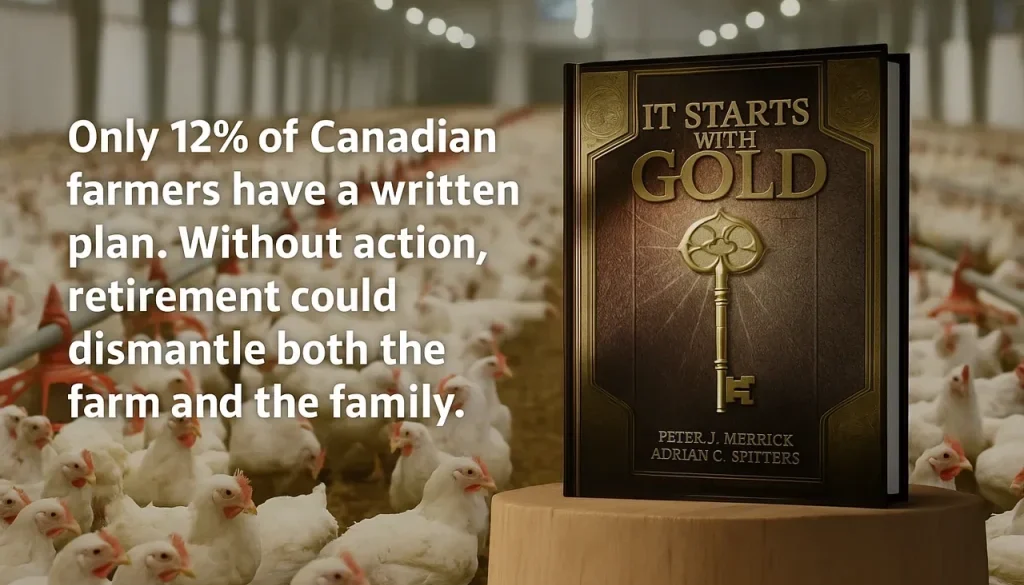
Only 12% of Canadian farmers have a written plan. Without action, retirement could dismantle both the farm and the family.
Canada is facing a looming succession crisis in agriculture. According to the 2021 Census of Agriculture, two-thirds of Canadian farmers do not have any form of succession plan. Only 12 percent have a written plan in place. This lack of preparation poses a direct threat to the continuity of farming operations, the preservation of intergenerational wealth, and national food security.
The urgency is clear. Nearly 40 percent of Canadian farmers are expected to retire within the next eight years. With the average age of farm operators exceeding 56 and fewer young people entering the sector, the absence of proper planning will leave a vacuum that policy cannot fill and markets cannot resolve.
This article examines the hard realities of farm succession in Canada, the legal and tax structures that make or break transitions, and the operational steps needed now to avoid liquidation and conflict later.
1. The Decline of the Canadian Farm Operator
Since 1991, the number of Canadian farmers under age 35 has dropped from 20 percent to just 8 percent. During the same period, the share of farmers aged 55 and older has steadily increased, now representing nearly 60 percent of all operators.
This demographic shift is not just a statistical concern. Farming in Canada is becoming concentrated in the hands of aging owners with insufficient transition plans. The lack of successors is partly due to economic factors such as high land prices, volatile markets, and the rising cost of equipment and inputs. It is also a cultural shift. Many farm children choose urban careers, leaving parents uncertain about whom to pass the land to.
Without a plan, farms risk being sold off piece by piece, converted to non-agricultural use, or absorbed by institutional investors, severing the link between the land and the family that worked it.
2. The Cost of Doing Nothing
Farm succession is not just about legacy. It is about liquidity, legal clarity, and tax efficiency. When a farmer dies without a clear plan, their estate may face:
· Immediate capital gains taxes on deemed dispositions
· Probate delays and legal disputes between heirs
· Liquidity issues, forcing the sale of land or equipment to pay taxes or equalize inheritances
· Unfair distributions, particularly if only one child wants to farm but must buy out siblings
These problems are not hypothetical. Every year, family farms are lost because succession was delayed or left to a generic Will.
Planning is not expensive compared to the cost of inaction. The cost of doing nothing is often the forced dismantling of an entire family operation.
3. Two Succession Models: Lifetime Transfer vs Estate Transfer
There are two primary paths for transferring a family farm: during the owner’s lifetime or through the estate after death. Each option has advantages, risks, and distinct tax and legal consequences. The right choice depends on timing, family dynamics, financial readiness, and long-term goals.
Understanding the mechanics of both models is critical to ensuring a smooth and sustainable transition.
A. Lifetime Transfers
Transferring farm assets during the owner’s lifetime has several advantages:
· It allows for training and mentoring of the successor
· Parents can gradually reduce involvement while maintaining control
· Gifts or sales with repayment terms can be used to preserve cash flow
· Taxes may be deferred using Section 73 rollover provisions
Lifetime transfers also allow use of the Lifetime Capital Gains Exemption (LCGE), currently up to $1,250,000 per individual for Qualified Farm Property.
Key risks include:
· If a child sells the transferred farm within three years, capital gains may be attributed back to the parent
· Gifting assets may create fairness issues with other children
· Improperly documented transfers may be recharacterized by tax authorities
B. Estate Transfers
Passing the farm through a Will may be appropriate when parents wish to retain full control until death. However, this approach requires precision:
· Multiple Wills may be needed for different asset classes
· Executor instructions must be clear to prevent intra-family conflict
· The estate must have enough liquidity to cover taxes and provide fairness to non-farming heirs
· Insurance planning is often necessary to provide non-farming heirs with cash rather than land
Farm assets that qualify for the LCGE can reduce or eliminate capital gains tax at death. Other assets, such as inventory, equipment, or non-qualifying land, are fully taxable.
Without proper structuring, the estate may be forced to sell land to pay the tax.
4. Estate Equalization Is the Greatest Challenge
Most Canadian farms are asset-rich but cash-poor. This creates a dilemma when parents want one child to take over the farm but also want to treat their other children fairly.
Options include:
· Hotchpot Clauses in the Will, which account for lifetime gifts when equalizing inheritances
· Life insurance to provide cash to non-farming heirs
· Use of trusts to provide farming heirs control without full ownership
· Share freezes and corporate reorganization to split value between voting control and growth
Equal does not always mean fair. A five million dollar farm split equally between five children, when only one is operating it, can destroy both the business and the family.
Fairness may require inequality, with transparency and planning to back it up.
5. The Role of Insurance in Succession
Insurance can:
· Fund buyouts between siblings
· Provide liquidity to pay taxes
· Protect loans or promissory notes owed to retiring parents
· Offer disability or critical illness coverage to key operators
Permanent insurance, such as participating whole life, is especially useful due to its tax-sheltered growth, guaranteed death benefit, and ability to fund shareholder agreements.
Its cost is modest compared to the tax liabilities it can offset.
6. Legal Structuring and Documentation
Common legal oversights include:
· Land held personally rather than in a corporation or trust
· Absence of shareholder or partnership agreements
· Lack of documentation for gifts or promissory notes
· No Power of Attorney or incapacity planning
Essential documents to maintain:
· Wills
· Power of Attorney
· Shareholder or partnership agreements
· Land titles and purchase history
· Corporate financial statements and tax filings
· Lease or rental agreements
· Trust deeds and insurance policies
7. Alternatives to Family Succession
When no family successor is available, consider:
· Employee buyouts
· Vendor-financed sales to neighbours
· Stewardship transfers through land trusts or co-ops
· Corporate acquisition with long-term leaseback agreements
These alternatives can preserve the farm’s purpose and productivity, even without family involvement.
8. The Corporate Threat: When Government Policy Fails
Succession planning also guards against government-enabled corporate consolidation. In provinces like Saskatchewan and B.C., institutional investors have acquired hundreds of thousands of acres. B.C. currently has no restrictions on foreign or corporate ownership.
Many farms, absent a clear succession plan, are sold under pressure through tax reassessments, death, or regulatory burden to corporations that view the land as a commodity, not heritage.
Policies like carbon restrictions, nutrient application limits, and provincial emergency powers have already eroded decision-making freedom for many small producers.
If farmers delay, they may not get to choose who ends up owning their land. Bureaucracy will do it for them.
9. Capital Barriers for the Next Generation
Even when there is interest, farmland prices remain a massive barrier.
With average land values exceeding $3,500/acre nationally, and far higher in southern Ontario and parts of B.C., many young Canadians are priced out of continuing the family farm.
10. Trigger Events: Act Before It’s Too Late
Succession planning should begin long beforethese events:
· Unexpected death
· Sudden illness
· Land sale offers
· Tax reassessments
· Family disputes
Waiting for these moments leaves families without time or options.
11. Use What Is Available
The Canadian Agricultural Partnership (CAP)offers cost-shared advisory services for farm succession planning. Yet uptake remains low.
Support exists. But it only helps those who act early.
Every Farm Has a Future, But Only If You Start Today
Succession planning is not a document. It is a process.
We touch on these critical themes in our #1 international bestseller, It Starts With Gold™, co-authored by Peter J. Merrick and Adrian C. Spitters. In the book, we reveal how tangible assets, intergenerational trust, and professional strategies combine to protect family wealth across generations.
📘 To request a complimentary copy of our white paper on farm succession planning, visit www.ItStartsWithGold.com.
📧 Email: adrian@itstartswithgold.com
🛒 To purchase the full book, order It Starts With Gold™on Amazon.
We want to hear from you!
🌾 Are you facing succession challenges in your family farm?
🤝 What tools or resources would help you make the transition easier?
References
1. Farmers Wanted – RBC Climate Action Institute
2. The Future of Canadian Farmland is “In Doubt” – Storeys
3. Understanding Farmers’ Readiness to Develop a Succession Plan – MDPI
4. Capital Gains and Losses – Farmers and Fishers (CRA)
5. Labour and Skills Shortages in the Agro-Food Sector – OECD
6. Succession Plan for the Agricultural Operation – Statistics Canada
7. Characteristics of Farm Operators – Statistics Canada
8. Why Farmland Protection is Not Enough
9. Supporting Farmland Access and Use by Farmers
10. Growing farmland inequality in the Prairies poses problems for all Canadians