One Policy, Zero Estate Taxes, Full Legacy
By Peter J. Merrick, TEP® and Adrian C. Spitters, CFP®, co-authors of the international bestseller It Starts With Gold™ and the forthcoming book Guns, Gold & Land™
This analysis continues a series of long-form investigations published in The Merrick Spitters Reset Report™
The ONE Thing Canadian Farmers Need to Know: How 20M of Tax Became 40M of Charity
The ONE Thing™ Farm-Legacy Strategy
Canadian farmers know what it means to dedicate a lifetime to something real. Yet few realize that on the day they are gone, the government treats every acre, quota, and piece of equipment as if it were sold at that exact moment. For many families, this creates significant tax consequences during an already difficult time.
This educational article outlines a hypothetical scenario showing how a Canadian farm family might use planning tools within the Income Tax Act to support charitable goals and help offset taxes payable at death. The example is illustrative. Farmers should seek personalized tax, legal, and financial advice before acting.
👉 Subscribe to The Merrick Spitters Reset Report™ and receive a digital copy of our international bestseller, It Starts With Gold™.
Bridge Over Troubled Waters
For decades, we have worked alongside Canadian farm families across the country. These individuals rise before sunrise, meet each season with discipline, and build their lives around the demands of their land and livestock.
Adrian understands this world personally. Raised as the son of a Dutch farmer who came to Canada in the 1950s with determination and faith in the land, he carries a deep respect for those who build something lasting from the soil.
Peter brings deep expertise as a Trust and Estate Practitioner, with decades spent designing succession strategies for complex family enterprises across Canada. His work has helped countless families navigate the responsibilities, risks, and emotional weight that come with transferring a lifetime’s labour to the next generation.
Together, we form a formidable team. After nearly forty years advising farmers, we share more than seventy years of combined experience within the Canadian financial system. We have seen the benefits of early preparation and the strain caused by delayed planning. This is why we created The ONE Thing™ Farm Legacy Strategy. A single well-timed decision can reshape how a family approaches its future.
Your Future Protected
Most families are surprised to learn how the Income Tax Act treats their life’s work at death. When an individual passes away, they are deemed to have disposed of all assets at fair market value unless the intergenerational farm rollover applies.
If no children are willing or able to continue farming, the rollover cannot be used. The deemed disposition then applies in full. The rules cover farmland, buildings, quota, equipment, and shares in a family farm corporation. The difference between adjusted cost base and fair market value becomes a capital gain, and half of that gain is currently taxable.
This is also where many families misunderstand the role of the Lifetime Capital Gains Exemption. The exemption may help when children continue farming and meet the qualification tests, but it rarely offsets more than a small portion of total accumulated gains for large or multigenerational farms. Most families discover that the LCGE cannot neutralize the full tax burden they face at death.
How the Rollover Rules Really Work
The capital gains inclusion rate is currently at fifty percent. Future governments may revisit this issue, and if the inclusion rate increases, the tax burden will rise accordingly. The spousal rollover normally applies first. When the first spouse passes away, the farm may be transferred to the surviving spouse on a tax-deferred basis if the requirements of the Act are met.
An intergenerational rollover may then allow the farm to pass to the next generation at the parents’ adjusted cost base rather than fair market value. This defers the gain. It does not eliminate it. Unrealized gains accumulated over decades transfer to the children if they meet the farming activity requirements.
To qualify for the rollover, the next generation must meet the farming activity test outlined in the Income Tax Act. Many families are surprised to learn that the requirements can be strict and are not automatically satisfied by part-time farming or land rental arrangements.
If the children cannot or choose not to farm, the rollover cannot be used. The deferred gains crystallize when the property is eventually sold or farming ceases. For many families, this represents millions of dollars in multigenerational deferred gains.
Why Advance Planning Becomes Essential
Deferred gains across generations create a large embedded tax liability that eventually surfaces when farming stops or when the second spouse passes. Many families explore planning options long before that moment.
One approach is a charitable giving strategy designed to generate donation tax credits at death. Paired with a properly structured insurance strategy, the charitable gift may be replaced for the family, creating philanthropic impact while helping offset taxable income triggered at death.
This strategy is effective because the donation receipt is created at the moment of death through a personally owned life insurance policy. Lifetime charitable gifts do not produce the same level of tax relief. Trusts and corporations also cannot claim these donation credits. Only personally triggered donations under Section 118.1 provide the offset required to neutralize capital gains at death.
What Happens When Families Do Not Plan
Many families assume the rollover, the Lifetime Capital Gains Exemption, or future flexibility will “take care of things.” It rarely works that way. When planning is delayed, the tax bill arrives in a single moment, often at the worst possible time. The estate may need to sell land quickly, usually at a discount, just to generate cash. Operating lines can be called by lenders who need certainty. Children may face a tax bill they cannot pay, forcing the sale of equipment, quota, or acreage that took generations to build. Some families lose control of the farm entirely because taxes become larger than liquidity. These outcomes are preventable, but only with early, coordinated planning.
How Trusts and Prior Planning May Affect This Strategy
Some farm families hold land, quota, or farm corporation shares inside a discretionary family trust. These structures may help with income splitting, creditor protection, or freezing the value of the parents’ estate, but they can limit this charitable strategy.
A trust does not qualify for the donation credit rules that apply when an individual makes a charitable gift at death. Insurance owned by a trust does not create donation receipts that can offset taxable capital gains triggered at death. Families with existing trusts should review whether the trust should be maintained, amended, or paired with a parallel structure.
When Farms Are Held Inside a Corporation
Many Canadian farms operate through a family farm corporation. In this case, capital gains at death generally apply to the shares of the corporation. Donation receipts cannot be issued to a corporation when a shareholder dies. Corporate-owned insurance does not generate the credits needed to offset gains at death.
Some families rely on the Capital Dividend Account inside a private corporation to distribute life insurance proceeds tax-free. This helps liquidity but does not eliminate capital gains on shares triggered at death. The Charitable Estate By Pass Plan addresses tax at the estate level.
What Must Be Done When Farms Are Held in Trusts or Corporations
When land, quota, buildings, or farm shares are owned inside a family trust or corporation, additional planning steps are required. Donation tax credits at death arise only when the life insurance policy is owned personally or within a structure that qualifies under Section 118.1 of the Income Tax Act.
To benefit from the plan, ownership of the policy must align with the person who will generate the taxable capital gain. This may require transferring ownership of the policy out of the trust or corporation while the parents are alive. Legal and tax advice is essential.
Why Many Advisors Miss This Opportunity
Most advisors focus on tools like rollovers, freezes, and the Lifetime Capital Gains Exemption, but few understand how charitable donation credits interact with deemed disposition at death. The rules under Section 118.1 are highly specific. Corporate-owned policies cannot generate personal donation credits. Trust-owned policies do not qualify. And donation credits must arise in the hands of the person who triggers the taxable gain. These nuances require specialized planning. Families often discover too late that their existing advisors never integrated this strategy simply because they were not trained in how these provisions work together.
The Farm Rollover Trap Most Families Do Not See Coming
Many families rely on the intergenerational rollover without realizing it only delays tax. Children who continue farming may use their Lifetime Capital Gains Exemption within their limits, but gains beyond this exemption continue to accumulate.
Over several generations, this can create enormous unrealized gains. The challenge emerges when a generation cannot or does not wish to continue farming. When the rollover chain breaks, decades of appreciation crystallize in one event.
This is also where many families with multiple children face difficulty. One or more children may continue farming while others do not. Without planning, equalization often requires selling land or shares to raise cash. A charitable estate strategy provides liquidity that allows equalization without forced sales or family conflict.
Triggering Gains Intentionally to Give the Next Generation a Clean Slate
Families can intentionally crystallize accumulated gains at death by choosing not to apply the intergenerational rollover. Families who qualify for the intergenerational rollover may choose not to apply it. By intentionally allowing the deemed disposition to occur at fair market value at death, donation credits can be matched directly against taxable capital gains.
When the second spouse passes, the deemed disposition occurs at fair market value, and the capital gain arises in the parents’ estate. The life insurance policy pays to the chosen charity, and the estate receives a donation receipt. Donation credits may offset the taxable capital gains in the year of death and the preceding year.
This approach also creates a clean adjusted cost base for the next generation. Children inherit the farm at a fair market value cost base rather than the parents’ deeply discounted historical cost. This reset can prevent future tax traps, simplify long-term planning, and make future financing or corporate reorganizations more manageable.
This allows parents to retain ownership and control during their lifetime while giving the next generation a new adjusted cost base equal to fair market value. The children begin with a clean tax foundation, and the planning avoids the timing mismatch that occurs when gains are triggered during life. Accurate valuation and coordinated tax and legal advice are essential.
The Importance of Defensible Valuation
Valuation must be defensible. The Canada Revenue Agency may review valuations that appear aggressive or incomplete. An accredited valuation ensures planning remains effective and reduces the risk of reassessment.
A Story of What Can Go Wrong Without a Plan
Not every family receives a favourable outcome. One Alberta family inherited a grain operation that had spanned more than sixty years. Their parents relied on the intergenerational rollover but never revisited the plan. When the second spouse passed, none of the children were actively farming. The rollover chain broke, triggering millions of dollars in deferred gains. The estate lacked liquidity, financing was tight, and land prices were soft. To cover tax, the family had to sell more than four thousand acres, and much of that land went to an outside buyer. A farm that took three generations to build disappeared in less than one year because planning was delayed.
A Story That Speaks to the Heart
Bill and Margaret are third-generation Saskatchewan farmers. Their farm is valued at one hundred fifty million dollars. They relied on the intergenerational rollover when they took over the farm, and they now carry accumulated deferred gains.
A planning review showed their estate could face a twenty-million-dollar tax bill if the second spouse passes and their children do not continue farming.
With tax and legal advice, they explore a Charitable Estate By Pass Plan and purchase a forty-million-dollar joint last-to-die insurance policy with their foundation named as the beneficiary.
When the second spouse dies, the foundation receives the proceeds. The estate receives a donation receipt that may offset taxable capital gains.
How Their Estate Benefits
This example is one possible structure. Without planning, Bill and Margaret’s estate could face a twenty-million-dollar tax bill. Their children may be forced to sell assets.
With planning, donation tax credits may offset the taxable capital gains. Their estate remains intact, and their community receives a meaningful legacy.
Insurance premiums often represent less than one percent of estate value. Premiums vary based on age, health, and product design.
Before and After: Tax Illustration
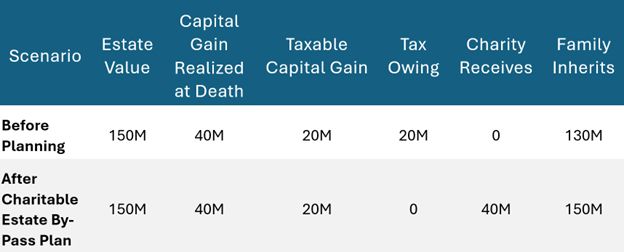
The twenty-million-dollar tax bill is fully offset by a forty-million-dollar charitable receipt issued under Section 118.1 of the Income Tax Act. Actual outcomes require personalized tax analysis.
How Debt and Leverage Affect the Outcome
Debt does not reduce taxable gains. The deemed disposition applies to the full fair market value. The charitable estate plan ensures liquidity remains available to offset tax regardless of leverage.
Life insurance proceeds paid to a named beneficiary typically bypass probate and may receive creditor protection in many provinces. This allows liquidity to arrive quickly and privately, which can be essential for farms carrying debt or operating lines of credit.
How the Plan Protects the Legacy
When structured properly, the Charitable Estate By Pass Plan may provide tax efficiency, charitable impact, and long-term legacy benefits. Some policies build cash value that may be accessed through loans or collateral arrangements. The intent is to align charitable goals with responsible multigenerational planning.
This strategy also supports estate equalization when siblings have different roles in the farm. Liquidity prevents disputes and reduces reliance on forced sales. This is often the difference between a family that remains unified and a family that faces conflict during succession.
Owning Assets in Order of Asset Security
In It Starts With Gold, we introduce the framework called Owning Assets in Order of Asset Security. It helps families understand where each asset sits on the spectrum of stability and vulnerability. Tangible assets such as farmland, physical precious metals, and participating whole life insurance often provide resilience across economic cycles.
What We Have Learned
Time never waits. Families who plan early gain confidence and peace of mind. Those who delay often face preventable difficulties. Every family’s situation is unique, yet the principles remain consistent.
Provincial Differences Do Not Change the Core Strategy
Probate procedures vary across provinces, but the Income Tax Act governs capital gains, intergenerational rollovers, and charitable donation credits nationwide. The charitable strategy works within this federal framework for all Canadian farm families.
A Practical Step Toward Protecting Your Legacy
If this message resonates, we welcome a conversation. We offer a confidential Charitable Estate Review for Canadian farm families seeking direction. We will review your structure, outline potential strategies, and provide guidance in plain language.
Visit www.ItStartsWithGold.com to learn more.
The Four Pillars We Recommend for Certainty
Our team of professionals assist clients in structuring wealth by Owning Assets in Order of Asset Security. We prioritize the most secure assets and safeguard those that are most vulnerable using the four pillars that form the foundation of long-term financial certainty.
- Gold and precious metals that hold real, tangible value.
- Alternative investments that reduce systemic risk.
- Private portfolio management that lowers counterparty exposure.
- Mutual life insurance instruments that protect capital and individuals.
In It Starts With Gold™, we describe how these pillars work as a unified structure to protect wealth and maintain continuity through economic and political uncertainty. Together, they help investors remain grounded when one or more areas of the economy are tested.
Stay informed. Stay prepared. Act while choice still exists.
Sign up today for The Merrick Spitters Reset Report™ to receive a digital copy of our international bestseller, It Starts With Gold™.
Prefer a hard copy? Order It Starts With Gold™ on Amazon today.
You spent a lifetime building something real. You endured long seasons, difficult markets, and uncertainty with the same determination your parents brought to the land. Now you have the opportunity to protect what you built and pass it forward with intention. Your legacy should not be decided by tax rules, liquidity shortages, or rushed decisions made under pressure. With the right strategy, your life’s work can continue into the hands of the next generation with dignity, assurance, and peace.
Disclaimer
This article is provided for general educational purposes only and is not intended to provide financial, legal, tax, or investment advice. The concepts and examples discussed, including the hypothetical scenario, are illustrations only and may not be appropriate for every individual or family. The information is based on current rules within the Income Tax Act and related legislation as of the date of publication. These rules may change, and their application can vary depending on individual circumstances.
Readers should not rely on this material to make decisions without consulting qualified professionals who can consider their specific situation. All financial planning strategies involve risks, including market risk, legislative changes, and variations in tax interpretation. Results will differ based on personal factors such as asset structure, residency, valuation, and timing.
Insurance strategies should be evaluated with a licensed insurance professional to ensure suitability and compliance with provincial and federal regulatory requirements.
The authors provide professional services through their respective regulated affiliations. Nothing in this publication should be interpreted as a recommendation, solicitation, or endorsement of any particular strategy, product, or transaction. No representation or warranty is made regarding the accuracy or completeness of the information provided. For advice tailored to your needs, please consult a licensed financial advisor, tax specialist, or legal professional.