Ostrich Cull in BC: The Fight for Immunity Is Not Over
By Peter J. Merrick, TEP® and Adrian C. Spitters, CFP®, co-authors of the international bestseller It Starts With Gold™ and the forthcoming book Guns, Gold & Land™
This analysis continues a series of long-form investigations published in The Merrick Spitters Reset Report™
The CFIA’s Plan to Cull 400 Ostriches Sparks Urgent Questions About Food Freedom, Science, and Immunity
A quiet farm in Edgewood, British Columbia, now sits at the centre of a national controversy. After two ostriches tested positive for avian flu, the CFIA ordered the destruction of an entire flock, despite signs of survival and scientific interest in their immune response. This article examines the legal battle, the scientific potential of ostrich-derived antibodies, and what this case reveals about the future of decentralized food and health systems in Canada.
Broader Implications for the United States and the World
This is not just a Canadian issue. The attempted eradication of a naturally resilient flock has captured global attention because it touches on a much larger debate: Who controls the definition of health, safety, and acceptable farming practice? The United States, like Canada, faces growing pressures to digitize and centralize food systems, standardize animal tracking, and align disease control policies with global biosecurity frameworks. The actions taken by the CFIA today could influence similar decisions tomorrow in the USDA, the European Food Safety Authority, and international health bodies.
If immune-rich ostrich eggs and regenerative farming models are discarded in favour of regulatory compliance, nations risk forfeiting their last links to organic, decentralized systems that protect both biological diversity and medical sovereignty.
This case stands as a global inflection point. It raises urgent questions for scientists, farmers, regulators, and citizens alike. What does sovereignty mean when natural immunity is viewed as a liability? Who decides whether innovation outside centralized control is preserved or erased from the landscape? The answers may shape not only Canada’s agricultural future but also the global trajectory of food rights, medical research, and the survival of truly independent health economies.
A Small Farm with Big Implications
Nestled in Edgewood, British Columbia, Universal Ostrich Farms Inc. has become a symbol of resistance against a rising tide of centralized authority. After 69 ostriches died during a harsh winter in late 2024, two tested positive for highly pathogenic avian influenza (HPAI), subtype H5N1. In response, the Canadian Food Inspection Agency (CFIA) ordered the destruction of nearly 400 remaining birds, along with their eggs, embryos, and cryogenically preserved genetics.
What began as a routine enforcement of biosecurity protocol has become something far more sinister: a test case in the suppression of decentralized resilience. As of now, the birds live. But the sword still hangs. Time is running out.
Timeline of Events
• Late 2024: 69 ostriches die during extreme cold.
• January 2025: H5N1 confirmed in two carcasses.
• March 2025: CFIA issues eradication order.
• May 2025: Universal Ostrich Farms files for judicial review.
• Present: Flock remains alive. Cull order pending.
The Court Ruling That Raised New Questions
In May 2025, Universal Ostrich Farms sought a judicial review in Federal Court. Their argument was simple: let science, not bureaucracy, determine the path forward. But the court refused to examine the core questions. It confirmed only that the CFIA followed its procedural obligations under Section 48 of the Health of Animals Act. It did not consider whether the virus remained active, whether the flock had developed natural immunity, or whether their biological data held value for future research.
The decision signalled more than deference to law. It marked a chilling affirmation that emerging science can be legally ignored when it contradicts bureaucratic mandates.
Ostrich Eggs and a Parallel Health Economy
Ostrich eggs are not just a nutritional novelty. They are a biochemical treasure. Rich in immunoglobulin Y (IgY), a powerful antiviral antibody, these eggs may hold answers to viral resistance outside conventional pharmaceutical pipelines.
Universal Ostrich Farms had been in exploratory discussions with scientists developing IgY-based antivirals untethered from patented drug platforms. Their model was simple and dangerous to the system: generate immune solutions from nature, free of dependency.
According to a Canadian veterinary immunologist, “The potential of IgY antibodies is significant, and ostrich-derived variants could be an untapped resource for future virology research.”
If the cull proceeds, an entire parallel model of biologically derived health resilience could be erased. This is not merely the loss of animals. It is the destruction of non-compliant knowledge.
When Compromise Is Taken Off the Table
The CFIA was given options. High-profile figures in the United States, including Dr. Mehmet Oz and U.S. presidential candidate Robert F. Kennedy Jr., offered to fund the relocation of the flock to Florida for study. The proposal included secure research partnerships that would prevent further spread.
The CFIA refused. Not because they had irrefutable scientific grounds, but because their rigid protocol left no room for deviation. The precautionary principle, once a tool to assess risk, has become a bludgeon used to silence alternative approaches.
This rejection illustrates a growing pattern: institutional frameworks are not designed to adapt. They are designed to eliminate outliers.
Traceability, Compliance, and Exclusion
Universal Ostrich Farms had no barcodes, no genetic registration, no digital traceability tags. They did not subscribe to United Nations food systems, nor did they embrace Canada’s digitized livestock identification infrastructure. They opted out.
In doing so, they became a threat. Because in a system built on digital compliance, non-participation is now a punishable offense. In an increasingly technocratic society, exclusion is the new enforcement.
Biosecurity, Trade, and Market Sensitivity
Behind the veneer of public health lies the economic engine. Canada exports over $1.75 billion in poultry products annually. The CFIA’s defence of culling was never just about containing disease. It was about preserving appearances for global trade partners.
A single ostrich farm that survives without vaccines, without slaughter, and without centralized control could upend decades of international trade norms. And that, more than any virus, may be the true contagion authorities seek to eliminate.
Global Precedents for Preservation
Elsewhere, in countries like Japan, Brazil, and South Africa, farms with immune flocks have occasionally been granted conditional research exemptions. These nations acknowledged that real-world immunity, even in small pockets, holds critical value.
But Canada, it seems, would rather erase the anomaly than explore its possibilities.
What the Legal Process Confirmed and Omitted
The Federal Court confirmed only that the CFIA acted within its legal rights. It offered no consideration of the moral or scientific cost. The court, like the agency it upheld, chose compliance over curiosity.
As confidence in institutional science erodes post-pandemic, this omission sends a clear message. Even documented biological resilience is irrelevant if it challenges the official script.
A Rare Opportunity to Study Natural Resilience
The ostriches at Universal Ostrich Farms are not just livestock. They may be survivors of a viral event now feared worldwide. Their bodies, their eggs, and their preserved embryos could hold answers that synthetic labs have failed to deliver.
And yet, they stand on the edge of eradication. Not for being diseased, but for proving that nature can heal itself without intervention. In a world increasingly hostile to natural systems, that is a dangerous truth.
Public Response and Support Growing
Support for the farm is growing. Independent scientists, integrative health advocates, and grassroots organizations have called for a scientific moratorium. A petition now circulates, calling not only for the preservation of the flock, but for the preservation of a future where nature’s data is not systematically deleted.
This is not merely about a farm. It is about a fork in the road. One path leads toward programmable food, sterilized health systems, and state-approved biology. The other leads to discovery, resilience, and choice.
The Global Policy Landscape Is Shifting
From the World Health Organization to the UN Food Systems Summit, a web of global initiatives is transforming food into a digitized commodity. Livestock IDs, carbon scores, and biosecurity passports are no longer theoretical. They are operational.
What happens to this ostrich farm is no longer a local issue. It is a preview of the algorithmic agriculture regime now emerging worldwide.
Universal Ostrich Farms operates outside of that regime. And for that reason, it may not be allowed to exist.
Time Remains, But Not Much
The CFIA’s order has not yet been enforced. The birds are still alive. But the window is closing.
This is the moment for Canadians, and for the world, to decide: Do we allow centralized mandates to erase natural resilience? Or do we demand a new conversation, one grounded in transparency, openness, and a willingness to learn from nature, not dominate it?
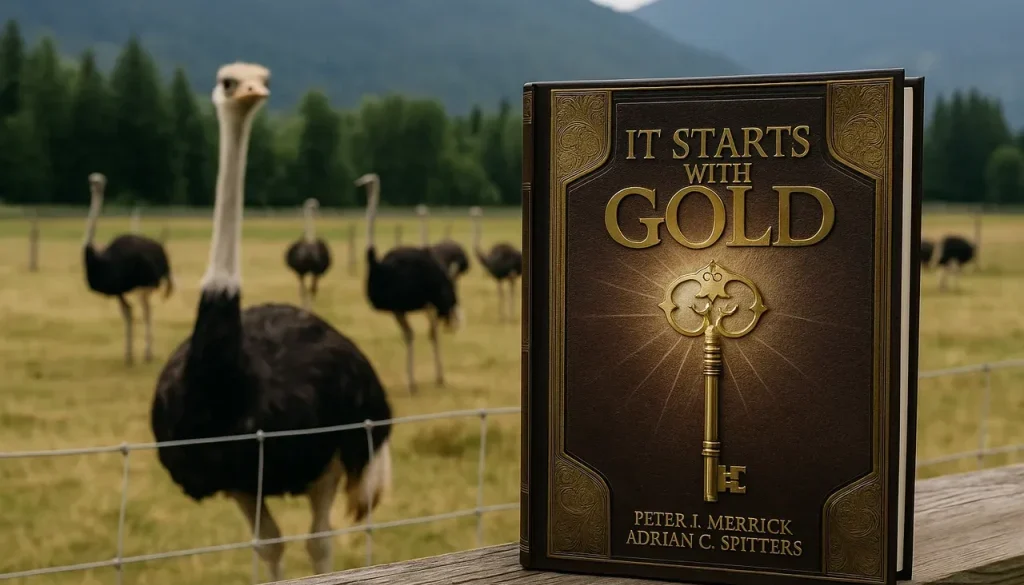
These themes are explored in detail in our number one international best-selling book, It Starts With Gold, co-authored by Peter J. Merrick and Adrian C. Spitters. In it, we examine why decentralization is no longer optional. It is essential. Not as a protest, but as a strategy for survival.
Visit www.ItStartsWithGold.com
Order your copy of It Starts With Gold from Amazon today. CLICK HERE
If this matters to you, now is the time to speak up. Share this story. Write to your MP. And do not let this flock, or what it represents, vanish without resistance.
References:
1. Federal Court Decision: Universal Ostrich Farms Inc. v. CFIA – May 28, 2025
2. Canadian Food Inspection Agency – Avian Influenza Guidelines
3. Universal Ostrich Farms Inc. v. CFIA – Judicial Review Ruling (Federal Court)
4. Facts about avian influenza
5. The Guardian – RFK Jr offers to save Canadian ostriches
6. Burnaby Now – CFIA defends process in ostrich cull case
7. The Times – Dr. Oz and RFK campaign to preserve Edgewood ostriches
8. CAPI: The Complexities of Net Zero in Canadian Agriculture (June 2024)
9. RFK Jr. and Dr. Oz Offer to Relocate Ostriches