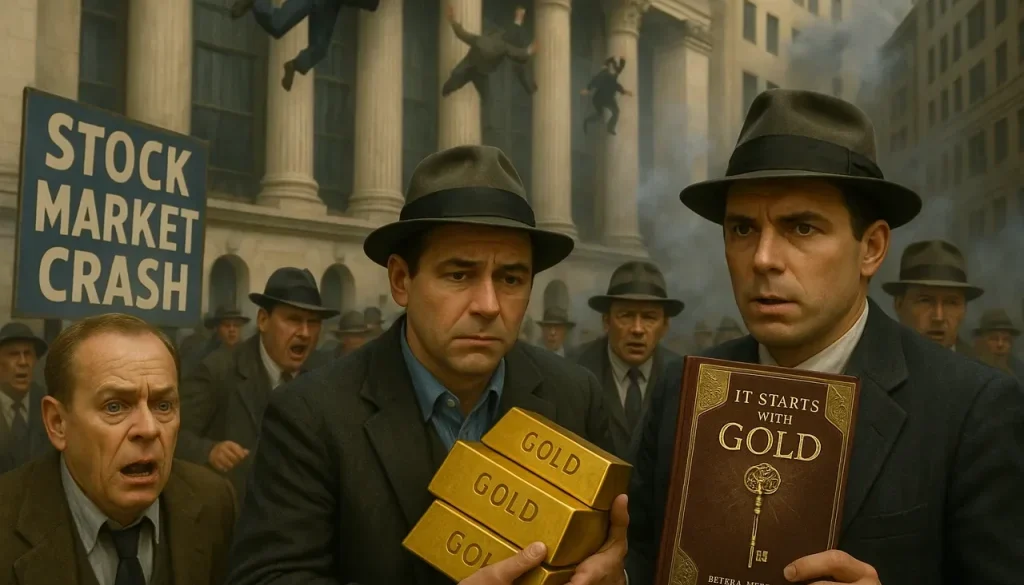
System-Wide Warning: The Crash Has Started. Buy Gold Now!
By Peter J. Merrick, TEP® and Adrian C. Spitters, CFP®, co-authors of the international bestseller It Starts With Gold™ and the forthcoming book Guns, Gold & Land™
This analysis continues a series of long-form investigations published in The Merrick Spitters Reset Report™
Why the Financial Industrial Complex Is Entering Its Most Dangerous Phase
If you take nothing else from this article, let it be this. Get a complimentary digital copy of our international bestseller, It Starts With Gold, and read it slowly. It was written to prepare individuals for the moment we have now entered. The crash is not somewhere far off in the distance. The first stage of it is already here, and the individuals who understand what is happening will have a very different future than those who do not.
For more than seven decades between, we have worked inside what we call the Financial Industrial Complex. That is the global system of central banks, governments, commercial banks, large asset managers, pension funds, and insurance companies that creates, sells, and manages almost all financial products on earth. We have seen how this machine works from the inside. We have helped individuals grow and protect their wealth within it. Now, as we near the end of our careers, we feel a duty to step forward and ring the bell. We want you to understand what the smart money is already doing and how you can protect yourself and your family.
👉 Subscribe to The Merrick Spitters Reset Report™ and receive a digital copy of our international bestseller, It Starts With Gold™, along with our white paper, Last Asset Standing™ and early updates on our forthcoming book, Killing Crypto™.
The Quiet Move That Changed Everything
In the third quarter of 2025, something happened that almost nobody noticed. Chinese billionaires moved about forty-seven billion dollars out of United States stocks. They did not move it into Chinese shares, European markets, real estate, bonds, or cryptocurrencies. They moved it into physical gold stored in vaults in Hong Kong, Singapore, and Switzerland. On the surface, it looked like a simple shift in portfolios, the type of thing that financial television often dismisses as rebalancing.
However, this pattern should deeply concern any individual whose savings are heavily invested in stocks, especially in retirement plans. This is the same pattern that appeared before the great financial crisis in 2008. Back then, Chinese elites quietly reduced their United States exposure months before the housing market collapsed and the banking system seized. The S&P 500 index fell about fifty-seven percent in eighteen months. Lehman Brothers disappeared. Bear Stearns was sold for pennies. Trillions in wealth were wiped out. It began with the quiet selling that almost no one took seriously.
In Q3 2025, Chinese investors sold a net forty-seven point two billion dollars in United States stocks. That is the largest quarterly selloff by Chinese nationals since data began in the late 1990s. In the same quarter, World Gold Council data show that Chinese individuals, institutions, and family offices bought almost the same amount of gold. Individuals bought bars and coins. Institutions bought gold exchange-traded funds and allocated bullion. Family offices paid for private vault storage. Dollar for dollar, they sold American stocks and bought gold.
Why This Is Not Normal “Rebalancing”
Chinese billionaires have been building positions in United States assets for about forty years. Since China opened its economy in the late 1970s, capital has flowed steadily into America. Even during major crises such as the dot-com crash, the 2008 meltdown, and the pandemic, Chinese investors continued to buy. They saw those crises as opportunities to acquire more assets at lower prices. That made sense while they still believed the system would recover.
Q3 2025 is different. It marks the first sustained reversal of that long trend. They are not just trimming exposure. They are exiting and shifting into gold. When individuals who have been net buyers for four decades suddenly reverse course, that is not a small adjustment. That is a major alarm. In simple terms, the individuals who are closest to the real economic data and the deepest financial intelligence are moving away from United States risk and toward the oldest safe haven in human history.
To understand why this matters, we need to look back at the last time they behaved this way. Between late 2006 and mid-2007, Chinese investors sold around thirty-one billion dollars of United States equities. Western financial media barely noticed. Analysts called it normal rebalancing. Most individuals ignored it. Yet that quiet selling marked the beginning of the slide that led to the worst financial crisis since the Great Depression.
How They Saw 2008 Before Everyone Else
In 2007, everything in the United States seemed strong on the surface. The housing market was hot. Banks were packaging risky mortgages into complex products and calling them safe. The S&P 500 reached a record high in October. Many individuals believed that real estate could never fall nationwide. Very few wanted to hear warnings.
Chinese investors saw something very different, and they saw it earlier than almost everyone else. They had three large advantages. The first was manufacturing data. China produces a huge share of the goods that American retailers sell. When companies like Walmart, Target, and Amazon cut their orders, Chinese factories see it months before those changes show up in official statistics. In late 2006, Chinese factory owners saw orders starting to slow. They immediately told the wealthy families who owned those factories. That was when the first wave of selling began.
The second advantage was their banking relationships. Chinese banks were on the other side of many subprime mortgage trades. They saw detailed loan data that showed how weak many of these mortgages really were. They knew that many loans would not be repaid. They also knew that the “AAA” ratings stamped on those securities were misleading. While pension funds in the West were still buying these products, Chinese banks were quietly exiting and warning their richest clients.
The third advantage was government intelligence. China runs an extensive system that tracks global trade flows, shipping activity, credit, and capital movements. Its analysts saw the housing bubble and the growing stress in real time. They did not wait for slow quarterly reports. When Chinese billionaires started selling in late 2006, they were not guessing. They were acting on information that retail investors did not have.
From the start of that selling to the bottom of the market in March 2009, about twenty-eight months passed. Individuals who prepared early were hurt less and often came through stronger. Individuals who ignored the signals were caught in the center of the storm.
Why They Are Selling Again Now
Today, the pattern is repeating, but the reasons are even larger and more global. Chinese manufacturers are on the front line of the artificial intelligence buildout. They produce servers, chips, power systems, and cooling technology. In Q3 2025, orders for AI-related chips fell more than twenty percent from the previous quarter. That was the first decline since the AI boom began. Factories in China felt it immediately. Corporate earnings in the West will only show it months later.
At the same time, the United States’ debt position has moved into a danger zone. The national debt is well above thirty-five trillion dollars. The debt to gross domestic product ratio is around one hundred and thirty percent and rising. When Japan had its major crisis in the 1990s, its debt-to-GDP ratio was lower than that. When Greece collapsed, its ratio was higher, but the pattern was similar. Chinese investors, who study sovereign debt crises carefully, see the same warning signs.
There is also the new risk of asset seizure. Since 2022, the United States and its allies have frozen hundreds of billions in Russian assets. They have imposed strict limits on Chinese companies and have used financial tools as weapons in geopolitical disputes. If you are a Chinese billionaire with billions in United States stocks, bonds, and real estate, you must consider the possibility that those assets might be frozen in a future conflict. Physical gold held in a neutral vault cannot be frozen as easily.
Finally, the dollar is slowly losing its share of global reserves. It still dominates, but its share has been sliding as central banks add more gold and more alternative currencies. Nations in the BRICS group are exploring new ways to trade without relying on the dollar. Chinese billionaires see this shift from the inside and are moving ahead of it. Once again, they are stepping away from a system they believe is becoming unstable.
Why Gold Is Their Chosen Lifeboat
These individuals are not moving to gold by accident. Gold has three key features that make it uniquely valuable in times of crisis. First, it has no counterparty risk. When you own a stock, you rely on managers, markets, regulators, and the wider economy. When any of those fail, your stock can become worth far less, or even nothing. When you own physical gold outright, you do not rely on any promise. You own a piece of metal that human beings have valued for thousands of years.
Second, gold is accepted everywhere. It is not tied to any one country or banking system. A bar of gold in Singapore will be recognized in Zurich, New York, Dubai, or Toronto. That makes it especially valuable for wealthy individuals who fear that their financial assets may be seized or frozen. If their stocks can be blocked in a computer system, their gold can still sit quietly in a vault.
Third, gold has preserved purchasing power through every major currency crisis in modern history. During the hyperinflation in Weimar Germany, individuals who held gold were able to protect their savings while paper money collapsed. In Zimbabwe, Venezuela, and Argentina, individuals who owned gold shielded themselves from the worst effects of currency destruction. Gold is not perfect, and its price can be volatile, but over long periods, it has a record that no paper currency can match.
History also shows how gold behaves when stock markets crash. During the 2008 crisis, gold finished the crash period roughly flat, then surged more than one hundred percent in the following years while stocks were still recovering. During the 2020 pandemic crash, gold dipped briefly, then reached new highs while many sectors of the market struggled. That is why Chinese billionaires are not only selling United States stocks. They are using those funds to buy gold on a very large scale.
Why 2025 Is Different From Past Cycles
What makes this period more extreme than 2008 or 2020 is that central banks are now some of the largest buyers of gold. In recent years, central banks around the world have accumulated hundreds of tons of gold each quarter. China, India, Poland, Singapore, and others have all increased their holdings. This steady buying creates a strong base of demand.
At the same time, global gold mine production has been almost flat for several years. Large new deposits are rare. Many older mines are producing less. So we have a simple but powerful setup. Demand from central banks, wealthy individuals, and eventually the wider public is rising. Supply is not keeping up. Over time, that dynamic puts upward pressure on prices.
This is why we believe that the move into gold by Chinese billionaires and by central banks is not a short-term trade. It is part of a longer shift away from a debt-based system that has been stretched past its safe limits. They are building lifeboats while the ship still looks steady to most individuals on deck.
The Three Waves of a Crash
Capital does not flee all at once. It moves in waves. The first wave is what we are seeing now. Quiet selling by billionaires, sovereign wealth funds, and family offices. They reduce risk while prices are still high. Their sales put gentle pressure on markets, but do not create panic. This stage rewards individuals who notice and act early.
The second wave comes when institutions begin to feel stress. Hedge funds, pension plans, and mutual funds start to face redemptions and margin calls. Investors pull money from funds that are losing value. Those funds are forced to sell assets to raise cash. Selling leads to more losses, which leads to more withdrawals, which leads to more selling. This feedback loop creates sharp declines.
The third wave is the public panic. This is when ordinary individuals finally realize that a real crash is happening. They see large daily drops in their retirement accounts. They receive frightened calls from friends. They watch frightening headlines. Many decide to sell everything to stop the pain. Sadly, this often happens near the bottom, after most of the damage has already occurred.
Right now, in late 2025, we are in the early part of wave one. The window to prepare is open, but it will not stay open forever. By the time we are deep into wave two, prices will already be much lower and emotions much higher. Preparation is easiest before the storm reaches full strength.
How an Unsophisticated Investor Can Prepare
We know that not every reader is a professional investor. Many individuals feel overwhelmed by financial jargon. That is exactly why we are writing this in simple language. Preparation does not require complex formulas. It requires basic steps, taken calmly.
The first step is to understand how much exposure you have to United States stocks. This includes individual shares, index funds that track broad markets, and mutual funds in your retirement accounts. Add all of these together. If more than half your assets are in these equities, you carry a high level of risk in a system that the smart money is exiting. Reducing that risk is not about fear. It is about prudence.
The second step is to build a position in gold, and for many individuals, in silver as well. A common target for protection is between fifteen and twenty-five percent of a portfolio in precious metals. That does not mean speculation in risky mining shares. It means a foundation in assets that do not depend on the health of the Financial Industrial Complex.
There are three main ways to own gold.
Physical gold means bars or coins that you store yourself or in a secure vault. This option removes most counterparty risk, but it introduces practical questions about storage, insurance, and safekeeping. For individuals seeking real protection, this remains the strongest foundation because it does not rely on financial intermediaries.
Gold exchange-traded funds are easy to buy in standard brokerage accounts, but they are paper contracts rather than direct ownership of gold. In many cases, the total number of ETF claims is larger than the amount of physical metal held in reserve. This creates dependence on custodians and sub-custodians who may not have enough gold to satisfy every claim during a crisis. These structures can be convenient for trading, but they should not be viewed as a safe substitute for physical gold.
Gold mining stocks represent ownership in companies that extract gold from the ground. They can rise quickly during strong markets, but they can also fall sharply because their value depends on operating costs, debt levels, business performance, and overall market conditions. Most individuals should treat these stocks as a small and speculative position only. For Canadians in higher tax brackets, certain exploration companies offer flow-through shares, which pass exploration expenses to investors who can deduct them from taxable income. This can improve after-tax returns, but these investments remain volatile. Physical gold should remain the core of any precious metals strategy, with mining shares used sparingly and with care.
Once your precious metals position is in place, the next step is to reduce exposure to concentrated risks elsewhere.
The third step is to reduce concentrated positions in highly valued technology stocks that depend heavily on the artificial intelligence narrative. When orders for AI hardware begin to slow, earnings expectations can fall quickly. Stocks that were priced for perfection can drop very fast. We are not saying that every technology company will fail. We are saying that it is wiser to have a smaller, more selective position than to be heavily concentrated in the most crowded names, just as smart money is leaving.
The fourth step is to increase cash reserves. Cash may feel boring, but it has two powerful advantages in a crash. First, it reduces the anxiety that comes from watching every asset you own move up and down violently. Second, it becomes a source of strength when markets finally bottom. Individuals who hold cash can buy high-quality assets at discount prices when others are forced to sell.
A simple defensive framework for the next few years might look like this for an average investor. This is not personal advice, because every situation is different. It is a picture of how a more resilient structure can look.
Owning Assets in Order of Asset Security
For years, we have taught the principle of Owning Assets in Order of Asset Security. This means you build your financial life starting with the assets that are hardest to destroy. At the top are physical assets that do not rely on any single institution or promise, such as gold and, for some individuals, well-chosen real assets. Below that are claims that depend on more layers of trust, such as bank deposits, insurance policies, and certain bonds. Below that again are equities and speculative investments that can disappear if confidence fails.
Most individuals have been encouraged by the Financial Industrial Complex to invert this order. They are told to load up on stocks, mutual funds, and complex products, often with very little in hard, independent assets. That structure works as long as the system appears strong. When the system shakes, it reveals how fragile that approach really is.
The reason we stress this now is that the house of cards has grown very tall. United States debt and global debt have reached historic levels. On top of this sits a vast tower of derivatives, which are contracts whose value depends on other contracts. The total notional size of these derivative positions runs into the quadrillions of dollars. Much of this will never be settled in full, but the network of obligations is so complex that failures in one corner can trigger failures elsewhere. When a structure like this begins to crumble, the safest place to stand is on assets that do not rely on it.
What the Financial Industrial Complex Really Is
We do not use the term Financial Industrial Complex to sound dramatic. We use it because it captures a real structure. It is the web of central banks that create money, governments that borrow and spend, commercial banks that extend credit, investment banks that build complex products, asset managers that sell those products, and media that often encourage individuals to stay fully invested in the system. It is not a single conspiracy. It is a system with its own logic and incentives.
This machine grows through debt. New money is created mostly when banks make loans. Those loans create deposits, which feed more activity. However, the loan itself never creates the interest that must be paid on it. That interest must come from somewhere else in the system. The only way to keep the system going is to create more and more debt. Over time, this leads to larger and larger bubbles. History shows that every such bubble eventually reaches a size that cannot be supported and then contracts sharply.
We are now living in a time when that contraction is becoming more likely. The system has promised more than it can deliver without a significant loss of purchasing power for savers. Central banks can delay the reckoning by printing money or holding interest rates low, but they cannot repeal the laws of arithmetic. At some point, promises that cannot be kept will not be kept. Individuals who have prepared will feel the shock less. Individuals who have not prepared will feel it most.
Why We Are Ringing the Bell Now
We are not writing as gurus who think we are smarter than everyone else. We are two men who have spent most of our lives inside this machine, helping individuals navigate it as best we could with the information we had at each stage. We have both seen plans work well and plans fail badly. We have both sat across the table from individuals who were in tears because a lifetime of savings was suddenly at risk. Experiences like that stay with you.
As we move into the later chapters of our careers, we do not feel right staying silent when we see the same pattern that led to past crises forming again, only larger. We cannot force anyone to act. We would not wish to. What we can do is explain what we see in plain language. We can share the principles that we believe offer protection. We can invite individuals to think differently about their relationship with the Financial Industrial Complex.
Knowledge without action is worth very little. At the same time, action without understanding can be reckless. Our hope is that this article gives you a foundation of understanding that leads you to thoughtful action. Not fear-based action. Thoughtful action. The smart money has already started to move. You do not need to be a billionaire to learn from what they are doing.
This is why preparation matters, and why it must begin before the panic stage sets in.
A Practical Next Step
If this article has given you a new way of looking at what is happening, your next step should be simple and calm. Begin by getting your complimentary digital copy of It Starts With Gold through The Merrick Spitters Reset Report™. We wrote that book to take the ideas in this article much further and to lay out, in plain language, how to build a life that is less dependent on a fragile system.
As you read, notice where your own situation may be vulnerable. Notice how much of your wealth sits inside the Financial Industrial Complex and how much stands outside it. Notice how you feel when you imagine another large market decline. Those feelings are signals. They are telling you where some adjustments might be needed.
We are not here to frighten you. We are here to offer you a way to see clearly, to prepare, and to move through what is coming with more confidence and less shock. The crash has begun, even if it is not yet fully visible on every screen. The individuals who act during this first wave will look back with quiet gratitude. The individuals who wait for the headlines will have a much harder road.
The Four Pillars We Recommend for Certainty
Once individuals understand the order of asset security, the next step is learning how to structure their own holdings with stability in mind.
Our team of professionals assist clients in structuring wealth by Owning Assets in Order of Asset Security. We begin with the most secure assets and then protect those that are most vulnerable. This framework is built on four pillars that create long-term certainty, especially when trust in the broader system begins to fade.
-
-
- Gold and precious metals hold real, tangible value. These assets stand on their own, regardless of what happens to banks, currencies, or governments.
- Alternative investments that reduce systemic risk. Private real estate and private credit create stability and income beyond public-market volatility.
- Private portfolio management that lowers counterparty exposure. Professional oversight ensures discipline, clarity, and protection through rapid market shifts.
- Mutual life insurance instruments that protect capital and individuals. These tools provide liquidity, strengthen estate continuity, and support long-term security.
-
In It Starts With Gold, we show how these pillars work together as a unified structure that protects wealth during economic and political strain. Precious metals preserve purchasing power, alternative investments provide diversification and income, private portfolio management adds institutional discipline, and mutual life insurance strengthens capital protection. Together, they create a foundation that stays steady even when the system around you does not.
This is what preparation looks like. This is how individuals stay ahead of a financial order built on belief.
Stay informed. Stay prepared. Act while choice still exists.
Everything discussed here is a direct extension of what we outlined in our book.
The themes in this article connect directly to It Starts With Gold, co-authored by Peter J. Merrick, TEP® and Adrian C. Spitters, CFP®. Within the book, we explain how to establish a tangible-asset foundation, measure risk across various asset classes, and safeguard yourself against systemic shocks while maintaining control over your future. Visit www.ItStartsWithGold.com.
👉 Sign up today for The Merrick Spitters Reset Report™ to receive a digital copy of our international bestseller, It Starts With Gold™, our white paper, Last Asset Standing™, and early updates on our upcoming book, Killing Crypto™.
Prefer a hard copy? Order It Starts With Gold™ on Amazon today.
References
- Merrick, P. J., & Spitters, A. C. It Starts With Gold
- International Monetary Fund (IMF) “Global Debt Remains Above 235 Percent of World GDP.”
- International Monetary Fund (IMF) “Global Debt Database Overview.”
- Bank for International Settlements (BIS) “OTC Derivatives Statistics.”
- Bank for International Settlements (BIS) “Global Debt: Current Issues and Trends.”
- U.S. Department of the Treasury “U.S. National Debt Clock: Official Treasury Data.”
- World Bank “Global Debt and Fiscal Risks.”
- World Gold Council “Quarterly Gold Demand Trends Report.”
- World Gold Council “The relevance of gold as a strategic asset (2023)”
- World Gold Council – Goldhub “What makes gold a strategic asset?”
- International Monetary Fund (IMF) “Gold as International Reserves: A Barbarous Relic No More?” January 27, 2023)
- Congressional Research Service (CRS) “Fractional Banking-Definition, how it Works, History”
- Federal Reserve, “Money creation in the modern economy”
- Bank of England “Creation of Money Through Bank Lending.”
- OECD “Who Saw Sovereign Debt Crises Coming?”
- OECD “Sovereign Debt Crises and Early Warning Indicators”
- U.S. Securities and Exchange Commission (SEC) “Understanding Risks of Derivatives.”
Disclaimer
This publication is for general information and educational purposes only. It discusses broad economic themes, historical patterns, and the structure of the global financial system. Nothing in this article is financial, legal, tax, or investment advice, and it should not be interpreted as a recommendation or solicitation to buy or sell any financial product, security, or real estate.
The views expressed reflect professional observations and opinions based on publicly available information at the time of writing. These views may change as market conditions, government policy, financial regulations, or economic circumstances evolve. The scenarios described are illustrative and are not predictions of future events.
Readers should not act on the information in this publication without seeking advice from qualified professionals who can consider their personal situation, goals, and risk tolerance. All investments carry risk, including the potential loss of principal. Past performance does not guarantee future results. Changes in monetary policy, interest rates, or global markets can materially affect outcomes.
The authors provide professional services only through their regulated affiliations. Nothing in this publication constitutes personalized guidance to any individual or entity. While reasonable efforts have been made to ensure accuracy and completeness, no guarantee is given. For recommendations tailored to your circumstances, please consult a licensed financial advisor, tax specialist, or legal professional.