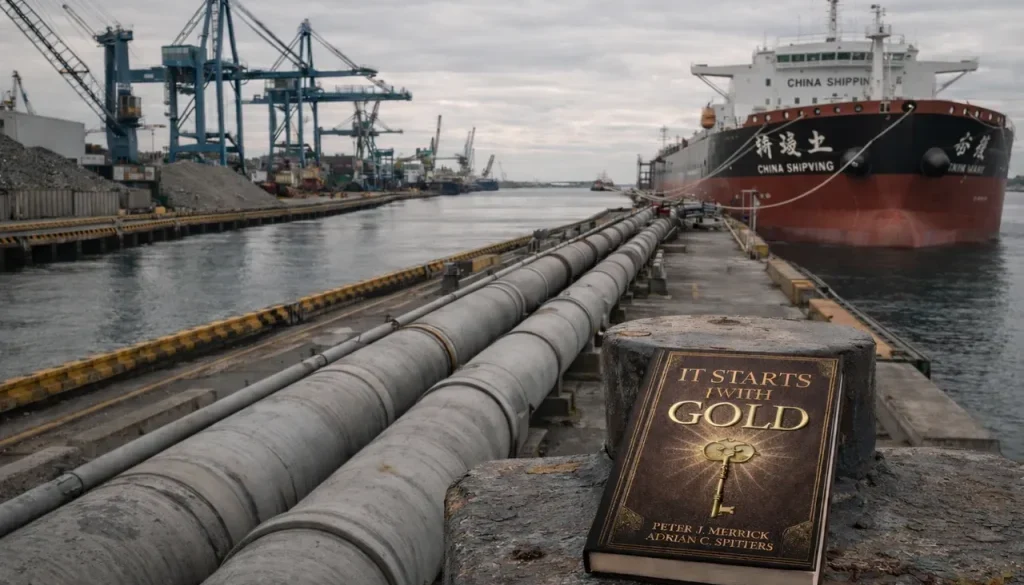
The $3 Trillion Asset Capture That Quietly Reset the Global Order
By Peter J. Merrick, TEP® and Adrian C. Spitters, CFP®, co-authors of the international bestseller It Starts With Gold™ and the forthcoming book Guns, Gold & Land™
This analysis continues a series of long-form investigations published in The Merrick Spitters Reset Report™

Venezuela Was Not Rescued. It Was Acquired. Canada Is Far Closer Than It Thinks
This article explores a growing debate about how power now moves through financial systems, infrastructure control, and resource monetization rather than through open conflict. It is presented as an opinion and is intended to inform and invite dialogue.
As the calendar turned and celebrations filled city streets, a far more consequential event unfolded beyond public attention. News coverage focused on leadership change, while political language framed the moment as justice and renewal. What remained largely unexamined was the financial reality beneath those headlines and the scale of what had just occurred.
On January 3, 2026, Venezuela’s political leadership collapsed, and with it the final barrier separating the world’s largest stranded energy asset from global balance sheets. Control over more than 303 billion barrels of proven oil reserves shifted in practical terms, even if not yet reflected in ceremonial ownership. Trillions of dollars in mineral wealth moved from inaccessible to monetizable. Tens of billions of dollars in foreign debt were marked down, restructured, or written off. What appeared to be a political event functioned as a sovereign-scale asset transfer.
The mechanics and sequencing outlined in this analysis draw from a detailed public examination of Venezuela’s collapse and subsequent asset realignment. The implications do not remain confined to South America. They extend into the structure of the global financial system and directly into Canada’s economic, resource, and sovereignty landscape.
It is important to acknowledge that this transition did not occur in a vacuum. The collapse of Venezuela’s political leadership was accompanied by direct intervention, the arrest of senior officials, and the rapid dismantling of the existing governing structure. These events dominated headlines and framed the moment as a political reckoning.
Yet those visible actions functioned as confirmation, not causation. By the time leadership was removed, the financial, logistical, and operational constraints that rendered Venezuela’s assets unusable without external authorization were already firmly in place. The invasion and arrests marked the conclusion of a process that had been unfolding for years, not its beginning.
👉 Want to read more articles like this? Subscribe to The Merrick Spitters Reset Report™.
Venezuela’s Value Was Never Political
Venezuela did not lack resources. It lacked access. With more proven oil reserves than Saudi Arabia, Iran, or any Middle Eastern nation, Venezuela controls roughly eighteen percent of the world’s proven oil supply. By comparison, the United States holds a fraction of that amount despite its reputation for energy dominance.
This reality dismantles the long-standing portrayal of Venezuela as a failed state with little to offer. The country sat atop the largest stranded energy asset on Earth, not because extraction was impossible, but because the pathways required to convert oil into cash flow were systematically restricted.
Most of these reserves are concentrated in the Orinoco Belt, a vast geological formation containing more than five hundred billion barrels of technically recoverable heavy crude. Heavy oil is difficult to extract, expensive to upgrade, and unusable without specialized refining capacity. Only a limited number of refineries can process it, most of them located along the United States Gulf Coast.
That imbalance shaped the outcome. Venezuela held the resource, while the United States controlled the monetization infrastructure. Once sanctions targeted financing, shipping, and critical inputs such as diluent, production collapsed in a predictable sequence. By the time political leadership fell, the asset had been transformed into a distressed, debt-laden opportunity ready for external management.
This trajectory unfolded over nearly two decades across multiple administrations. The consistency matters. The asset remained the objective, and the timeline remained long.
Oil Was Only the Surface Layer
Beneath Venezuelan territory lies one of the largest undeveloped mineral deposits in the Western Hemisphere. Gold reserves measured in the thousands of tonnes. Coltan essential for semiconductor manufacturing. Rare earth elements required for electric vehicles, military systems, and advanced electronics.
China dominates global rare earth processing, and Venezuela represented one of the few alternative supply chains with meaningful scale. That alternative has now shifted under new control structures.
As Venezuelan gold reserves held abroad began moving toward liquidation to fund restructuring and reconstruction, central banks worldwide paid attention. Gold prices did not collapse. They reflected a deeper recalibration. When a sovereign nation’s reserves can be seized, redirected, or monetized by external authorities, confidence in custodial systems weakens. That response does not produce panic. It produces quiet repositioning.
Gold moved steadily, reflecting long-term distrust rather than speculation. The message was clear. If sovereign reserves are vulnerable, security must be redefined.
A Different Model of Control
What unfolded in Venezuela did not resemble historical imperialism. There were no occupying forces, no extended military campaigns, and no televised invasions. Control emerged through financial systems rather than force.
The process followed a recognizable pattern. Asset identification came first. Financial pressure through sanctions and market exclusion followed. Logistics and operational inputs were constrained. Liquidity dried up. Collapse arrived not as a surprise, but as an endpoint. External parties then stepped in as creditors, managers, and technical partners during restructuring, with control transferring through legal agreements, concessions, and joint ventures.
This approach mirrors private equity strategy applied at the national level. Venezuela did not represent an anomaly. It represented a working template.
Why Canada Is Not Removed From This Pattern
Canada shares more structural similarities with Venezuela than many are prepared to acknowledge. Canada holds the third-largest proven oil reserves in the world, largely concentrated in Alberta’s oil sands. Like Venezuela’s heavy crude, Canadian oil requires significant capital, specialized infrastructure, and political approval to reach market.
Pipeline access forms the first constraint. Refining capacity forms the second. Financing forms the third.
Venezuela’s experience demonstrates that land ownership alone does not guarantee control over monetization. Control rests with those who govern the pathways through which assets are financed, processed, insured, and sold. When those pathways are external or conditional, ownership becomes symbolic rather than decisive.
Canada’s banking system is among the most concentrated globally and deeply integrated into United States dollar settlement systems. Changes in compliance standards, environmental financing criteria, or cross-border capital rules flow directly through Canadian institutions. Pressure does not require sanctions. Regulatory friction and capital withdrawal produce similar outcomes without public alarm.
In this environment, energy policy cannot be separated from national security. The distinction no longer holds.
Market Consequences Canada Must Face
As Venezuelan production gradually returns over the next eighteen to thirty-six months, pricing pressure will not be distributed evenly. Low-cost producers benefit. High-cost producers operating under layered regulatory frameworks face compression. Canadian oil does not vanish under this scenario, but leverage shifts.
Capital moves faster than policy. Infrastructure follows capital. Control follows infrastructure. This pattern already appears in foreign participation across mining, energy, agriculture, and real assets throughout Canada.
Canada’s reputation for stability attracts capital. That same stability weakens domestic leverage when ownership and control diverge. Stability alone does not preserve sovereignty.
China’s Loss Alters Global Capital Behaviour
China absorbed tens of billions of dollars in losses in Venezuela because its exposure was tied to production rather than financial system control. That loss reshapes capital behavior. Investment seeks jurisdictions where contracts are enforceable and claims are secure. Canada fits that description.
As China recalibrates after Venezuela, capital does not retreat. It repositions. The result is deeper entanglement rather than disengagement, particularly in resource-rich, legally stable jurisdictions.
Canada’s Gold Absence Matters
Many nations responding to this shift are increasing physical gold holdings. Canada stands apart. Canada has effectively divested its sovereign gold reserves, leaving no neutral settlement asset outside the currency system.
This absence carries consequences. When gold is seized or redirected elsewhere, distrust spreads. Distrust drives accumulation. Canada has chosen trust over redundancy, a position that becomes costly during systemic stress.
The Illusion of Ownership
The Venezuelan case reveals a structural reality. Title does not ensure access. Access does not ensure control. Control does not ensure security when it depends on uninterrupted policy alignment.
This reality applies across scales. Nations experience it first. Institutions follow. Families and business owners experience it last. Assets inside centralized systems behave differently under strain than assets positioned beyond them. This pattern appears repeatedly throughout history.
Asset location matters as much as asset value. Financing terms often carry more influence than deeds. Regulatory alignment increasingly determines who retains agency during disruption.
The Choice Canadians Face
Canadians now face a quiet tension. Participation in centralized systems brings convenience and access, but carries exposure. Resistance limits access but preserves autonomy. Avoiding the choice does not remove it.
Structure remains the only durable response. Assets positioned deliberately across different layers of control, custody, and accessibility reduce dependence on any single system. This approach does not rely on fear. It relies on precedent.
At This Stage, the Discussion Moves From Diagnosis to Positioning
What has been described so far is not theoretical. It is observable and structural. The Venezuelan asset capture exposed how control now moves through finance, infrastructure, and jurisdiction rather than through force. Once that reality is understood, the question is no longer whether disruption will occur, but how individuals and families position themselves while choice still exists.
Owning Assets in Order of Asset Security™
When systems become unstable, survival does not depend on optimism. It depends on structure. History shows that during periods of monetary stress, political intervention, and institutional failure, outcomes are determined less by how much wealth someone has and more by where that wealth sits within the system and how exposed it is to external control.
The most common mistake investors make is assuming all assets carry equal security. They do not. Some assets exist outside the financial system, while others exist entirely within it. Some are bearer assets that require no intermediary, while others are promises dependent on counterparties, enforcement, and uninterrupted market function. Some preserve purchasing power during currency erosion, while others rely on confidence, liquidity, and institutional stability to retain value.
This distinction is why our work centers on Owning Assets in Order of Asset Security™.
Rather than chasing returns, this framework prioritizes certainty. It reframes decision-making by asking different questions. Which assets remain accessible when markets close? Which assets retain value when currencies weaken? Which assets remain under the owner’s direct control rather than subject to intermediaries? Which assets endure changes in law, policy, regulation, or financial plumbing?
Once this hierarchy is understood, diversification takes on a different meaning. The objective is no longer to own everything. It is to own the right assets, in the right order, and to protect what is most exposed before stress reveals weaknesses that cannot be corrected.
From this principle emerge the Five Pillars of Asset Security™.
The Five Pillars of Asset Security™
The Five Pillars of Asset Security™ are not independent strategies pursued in isolation. They operate as a layered system designed to preserve control, access, and continuity when financial, legal, and institutional conditions deteriorate. Each pillar addresses a different failure point revealed during periods of systemic stress, establishing a hierarchy that places certainty ahead of performance and resilience ahead of speculation.
- Gold and Precious Metals as Foundational Security: Gold and precious metals form the base layer of asset security because they carry no counterparty risk, no default risk, and no reliance on digital or financial infrastructure. They exist outside the financial system and have preserved purchasing power across currency debasement, monetary resets, and institutional failures for centuries. This pillar is not designed to generate yield. Its purpose is certainty.
- Alternative Investments That Reduce Systemic Exposure: Private real estate, private credit, and other non-public assets reduce dependence on public markets distorted by leverage, derivatives, and policy intervention. These assets are valued by cash flow, utility, and long-term demand rather than daily sentiment, providing stability when liquidity disappears and correlations converge.
- Private Portfolio Management and Counterparty Discipline: Most financial assets are held through custodial chains that expose investors to counterparty risk, asset commingling, rehypothecation, and institutional failure. Private discretionary portfolio management strengthens governance, improves transparency, and reduces exposure to firm-level leverage, increasing the likelihood that assets remain accessible under stress.
- Mutual Life Insurance as Capital Protection Infrastructure: Participating whole life insurance issued by mutual companies provides long-term capital stability, tax-efficient growth, and estate continuity. These contracts operate as financial infrastructure designed to smooth volatility, protect capital, and preserve flexibility across fiscal and generational transitions.
- Jurisdictional, Legal, and Structural Control of Assets: Even well-chosen assets can fail if held within fragile legal or regulatory structures. This pillar focuses on where and how assets are owned, including title integrity, creditor exposure, regulatory reach, and enforceability of ownership rights, ensuring durability across shifting political conditions.
How the Five Pillars Work Together
The Five Pillars of Asset Security™ function as a unified system designed to preserve control, access, and continuity across market cycles and institutional stress. Together, they shift focus away from maximizing returns and toward preserving ownership that endures.
In It Starts With Gold™, we explain how these pillars operate as a single structure, not to eliminate risk, which is impossible, but to prioritize certainty in a world where access, ownership, and control are increasingly conditional. This framework is not designed for best-case scenarios. It is built for stress.
Acting While Choice Still Exists
This article is not intended to provoke panic or paralysis. Its purpose is to restore agency.
Systems built on narrative eventually confront reality. When that occurs, the window for voluntary positioning narrows rapidly. Actions that can be taken quietly today often become restricted tomorrow. History shows that by the time change is widely acknowledged, flexibility has already been lost.
This is why structure matters more than prediction.
👉 Use our Calendly Link to Schedule a Complimentary Review.
These principles are explored in depth in It Starts With Gold™, co-authored by Peter J. Merrick, TEP® and Adrian C. Spitters, CFP®. To learn more, visit www.ItStartsWithGold.com.
👉 Sign up for The Merrick Spitters Reset Report™ to receive a digital copy of It Starts With Gold™, our white paper Last Asset Standing™, and early updates on our forthcoming book Killing Crypto™.
Prefer a hard copy? Order It Starts With Gold™ on Amazon today.