The Asset Nobody Sees
By Adrian C. Spitters, CFP® and Peter J. Merrick, TEP®
This analysis is part of an ongoing series of long-form investigations published through The Merrick Spitters Reset Report™, examining long-duration wealth stewardship, financial organization, governance continuity, and the broader structural forces increasingly shaping modern financial planning discussions.
The Invisible Foundation Of Ownership
Most families believe they understand the nature of wealth because its most visible forms can be readily observed, measured, valued, bought, and sold. As a result, bank accounts, investment portfolios, businesses, farms, real estate, and retirement accounts dominate discussions about wealth while less visible drivers of ownership and capital formation often receive far less attention.
However, the ability to acquire, preserve, and benefit from those assets depends upon a less visible form of capital. Confidence functions as an economic asset in its own right because it influences virtually every ownership decision made by households, businesses, investors, and lenders.
Every ownership system depends upon confidence. Families purchase homes, business owners hire employees, farmers plant crops, and investors commit capital because they believe future conditions will justify present commitments. Confidence therefore influences virtually every decision involving ownership, investment, and long-term planning.
Major economic shifts rarely begin with collapsing asset prices. More often, they begin with a gradual deterioration in confidence that alters behaviour before it alters market statistics. Buyers become more cautious, entrepreneurs postpone expansion plans, investors favour liquidity, and families delay significant financial commitments. Individually, these decisions may appear inconsequential, but collectively they begin reshaping the economic landscape.
When Confidence Begins To Erode
Housing markets illustrate this process particularly well. For years, public discussion focused primarily on affordability as prices rose, governments announced housing initiatives, and economists debated interest rates. Beneath those discussions, however, confidence in the ownership journey itself appears to have weakened.
Many younger families are no longer focused solely on whether they can afford a home today. Increasingly, they are questioning whether ownership itself remains realistically attainable, reflecting a much deeper concern than short-term affordability.
Ownership extends beyond shelter because it functions as one of the primary mechanisms through which families transform productive effort into opportunity, opportunity into security, and security into enduring legacy. When ownership becomes more difficult to achieve, the consequences extend far beyond housing. They affect family formation, retirement planning, business succession, and the transfer of opportunity from one generation to the next.
Consequently, some of the most important economic questions are structural rather than cyclical. The long-term health of an ownership economy depends upon whether ordinary families can continue accumulating productive assets, preserving them across time, transferring them efficiently to future generations, and participating broadly enough in ownership to prevent excessive concentration of wealth and opportunity.
These questions rarely appear in daily financial news despite their potential significance for long-term economic mobility, wealth formation, and ownership participation. In many respects, they may prove more consequential than the next interest-rate announcement or quarterly earnings report.
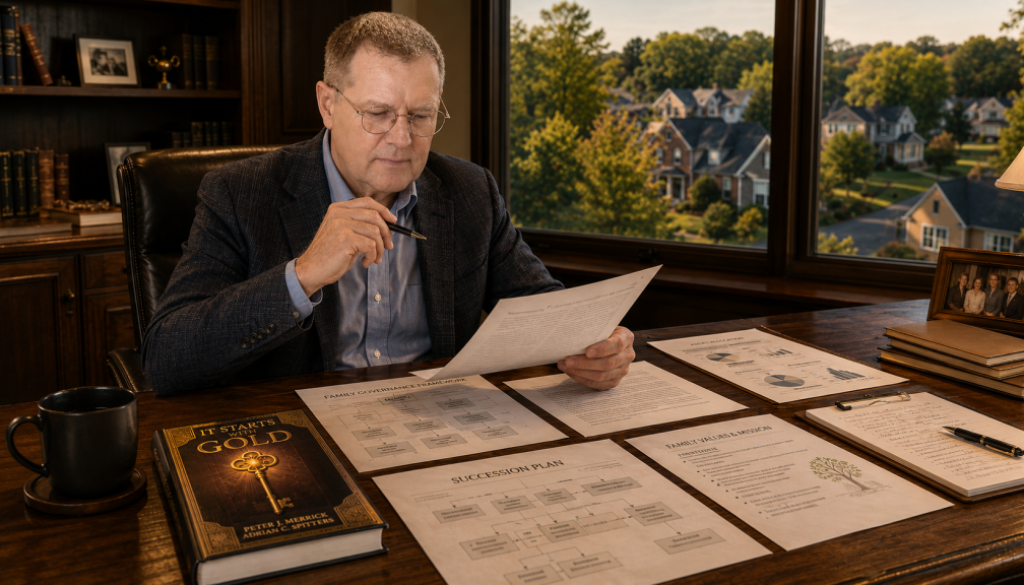
Families responsible for businesses, farms, investment portfolios, real estate holdings, or other forms of productive capital often discover that preserving ownership requires a different set of skills than accumulating it. Building wealth typically rewards concentration, effort, expertise, and risk-taking. Preserving wealth requires governance, succession planning, tax efficiency, asset protection, liquidity management, and thoughtful capital allocation. The transition from wealth creation to wealth stewardship represents one of the most important shifts many successful families will ever navigate.
The Structure Behind Enduring Wealth
Throughout history, families that successfully preserved wealth recognized that long-term success depends less upon maximizing returns and more upon maintaining resilient ownership structures. Assets rise and fall, markets expand and contract, and public policies evolve, but the ability to preserve ownership through those changes often determines whether wealth survives across generations.
Family farms, operating businesses, and investment portfolios frequently survive droughts, recessions, wars, inflationary periods, political shifts, and multiple market cycles. What determines long-term success is often not the asset itself but the structure surrounding it. Governance, stewardship, succession planning, liquidity, taxation, and risk management frequently matter more than the next year’s return.
One of the recurring lessons of history is that wealth is rarely lost solely because families fail to generate sufficient returns. More often, wealth is diminished when ownership structures fail. Assets become fragmented, taxes consume capital, successors are inadequately prepared, and changing economic conditions expose weaknesses that accumulated over time. Under those circumstances, assets that required decades to build can deteriorate far more quickly than expected.
The practical implications are becoming increasingly visible. Families face growing complexity in taxation, succession planning, business transitions, retirement income design, estate administration, regulatory change, and intergenerational wealth transfer. The challenge is no longer simply accumulating assets. The challenge increasingly involves preserving ownership through a growing number of forces capable of fragmenting, diluting, or impairing family capital over time. As ownership becomes more valuable and more difficult to replace, the structures used to protect it become increasingly important.
Wealth Versus Stewardship
The defining challenge facing many families today is not predicting economic outcomes, outperforming benchmarks, or successfully timing market cycles. The more significant challenge involves preserving ownership in an environment where productive assets appear to be becoming increasingly valuable and increasingly difficult to acquire.
Rebuilding ownership after it has been lost is often substantially more difficult than preserving it before deterioration occurs. This reality also illustrates the difference between wealth and stewardship. Wealth measures what a family possesses at a specific point in time, whereas stewardship determines whether those assets, opportunities, and capabilities remain available to future generations.
Families that successfully preserve wealth across multiple generations tend to evaluate assets differently. Rather than focusing exclusively on present value or growth potential, they also consider durability, continuity, succession, and the asset’s ability to preserve opportunities for future generations. Their perspective reflects an understanding that ownership serves purposes extending beyond consumption and short-term appreciation.
This perspective often leads to a different set of planning questions. Rather than focusing exclusively on investment performance, families begin evaluating the structures that support ownership itself. Questions surrounding governance, succession planning, tax efficiency, asset protection, retirement income design, business continuity, and intergenerational wealth transfer become increasingly important because each has the potential to strengthen or weaken long-term ownership outcomes. Stewardship therefore becomes less about managing individual assets and more about preserving the framework that allows ownership to endure.
Ownership, Freedom, And Continuity
Ultimately, ownership derives much of its importance from the freedom it provides. Ownership expands a family’s ability to make independent decisions, withstand periods of uncertainty, create opportunities for future generations, and maintain a degree of autonomy within an economic system that increasingly rewards control of productive capital.
For that reason, preserving ownership may become one of the most important responsibilities facing families during the decades ahead, particularly for those seeking to transform current wealth into enduring opportunity across generations.
From Ownership To Stewardship
Families who wish to explore these ideas in greater depth may wish to begin with two resources.
The first is It Starts With Gold™, which examines ownership, stewardship, financial resilience, and the changing nature of wealth preservation in an increasingly uncertain world. While the book begins with gold, its broader focus is the protection and preservation of productive capital across generations.
The second is The Merrick Spitters Reset Report™, which provides ongoing analysis of the economic, financial, and structural forces affecting ownership, stewardship, family enterprises, and long-term wealth preservation. Subscribers receive regular insights designed to help families think beyond short-term market events and focus on the long-term preservation of opportunity.
If these issues resonate with you and your family, business, farm, or investment portfolio, consider subscribing to The Merrick Spitters Reset Report™ and reading It Starts With Gold™ as part of your ongoing stewardship education.
If you are seeking guidance on wealth preservation, succession planning, ownership structures, retirement planning, asset protection, or long-term stewardship, you are invited to schedule a confidential conversation.
The future cannot be predicted with certainty. Ownership, however, can be strengthened, protected, and positioned to endure. Families that approach stewardship intentionally often discover that preserving opportunity across generations is every bit as important as creating it. In many cases, the ability to preserve ownership ultimately determines whether wealth becomes a temporary achievement or a lasting legacy.
Disclaimer:
This article is provided for educational and informational purposes only and should not be construed as investment, tax, legal, or financial advice. Individual circumstances vary, and readers should consult their professional advisors before making financial, tax, legal, or investment decisions. The views expressed are those of the authors as of the publication date and are subject to change without notice.
About the Authors
Adrian C. Spitters is a Canadian private wealth advisor with more than thirty-eight years of experience helping business owners, professionals, retirees, and farm families navigate long-term wealth preservation, liquidity events, and financial uncertainty. Raised on a dairy farm in British Columbia’s Fraser Valley, Adrian brings a practical understanding of stewardship, asset protection, and the pressures facing multi-generational families in changing economic environments. He is the co-author of It Starts With Gold™ and publisher of The Merrick Spitters Reset Report™. Read Adrian C. Spitters’ full biography here.
Peter J. Merrick is an international speaker, educator, and estate-planning specialist with more than three decades of experience advising business owners, professionals, and family enterprises across Canada and the United States. His work focuses on succession planning, long-term wealth preservation, and helping families structure and transition wealth across generations. Peter is the co-author of It Starts With Gold™ and continues contributing to conversations surrounding financial resilience, continuity, and stewardship. Read Peter J. Merrick’s full biography here.