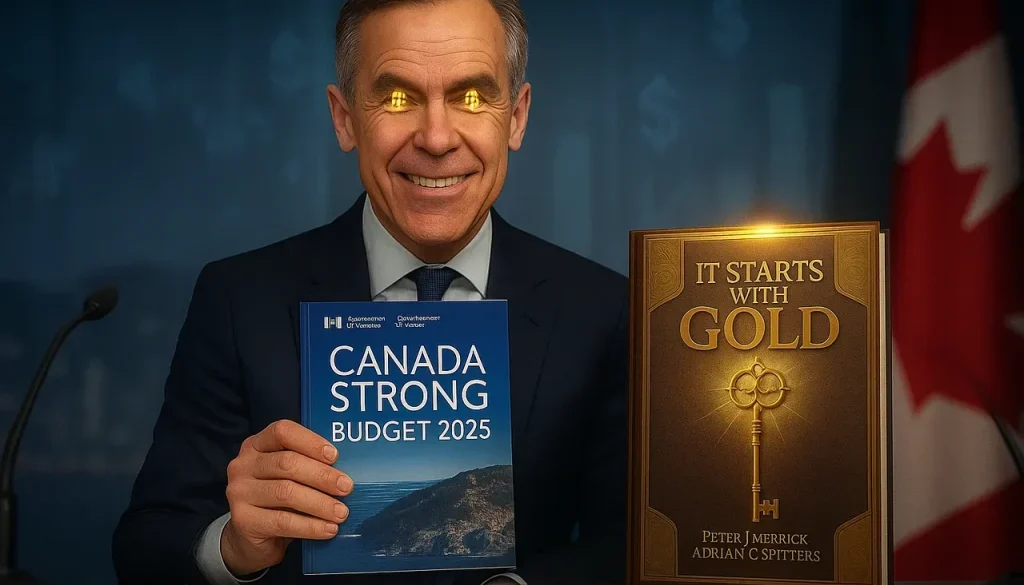
The Carney Budget: A Handout to Elites, A Setback for Freedom
By Peter J. Merrick, TEP® and Adrian C. Spitters, CFP®, co-authors of the international bestseller It Starts With Gold™ and the forthcoming book Guns, Gold & Land™
This analysis continues a series of long-form investigations published in The Merrick Spitters Reset Report™
How Retail Investors Can Still Protect Their Wealth as Canada’s New Economic Order Takes Shape
The Illusion of Renewal
Mark Carney’s first federal budget was presented to Canadians as a grand national project, a promise to build a stronger, more self-sufficient country. The numbers, on their face, suggest confidence: a trillion-dollar investment plan stretched across five years, an ambitious promise of growth, and a carefully framed deficit that government officials described as manageable. Yet behind this presentation lies a stark truth. What has been branded as a generational investment in Canada’s future is, in reality, a generational transfer of control, from citizens to institutions, from individuals to the state, and from small investors to financial elites.
The budget is not a neutral instrument. It is a blueprint for how wealth will be created, taxed, distributed, and controlled. And for ordinary Canadians trying to preserve independence through their savings, property, or investments, this new framework represents not liberation but limitation. The hand that promises to build Canada stronger is the same hand tightening its grip on the nation’s financial freedom.
👉 Subscribe to The Merrick Spitters Reset Report™ and receive a digital copy of our international bestseller, It Starts With Gold™, along with our white paper, Last Asset Standing™ and early updates on our forthcoming book, Killing Crypto™.
The Rise of the Managed Economy
Canada’s 2025 budget marks a clear pivot toward what bureaucrats describe as an investment-led economy. The language may sound harmless, but the implications are profound. When a government defines its purpose as directing national investment, it also defines who controls capital allocation, who gains access to it, and who is excluded.
For decades, Canada’s markets were shaped by private enterprise. Families built wealth through small business ownership, property investment, and prudent savings. The latest budget reorders that tradition. Public spending is no longer a tool to stimulate the economy. It has become the economy. By expanding the government’s reach into infrastructure, housing, and resources, Ottawa positions itself as both investor and regulator. This double role gives the federal apparatus enormous influence over the flow of money.
The stated goal of this approach is sovereign resilience, but the subtext is unmistakable. The new model of economic nationalism is not designed to empower individuals. It is structured to consolidate influence among corporate and bureaucratic elites who already have proximity to government power.
A Budget of Record Deficits and Record Ambitions
The government’s financial projections tell a story few are willing to read aloud. Ottawa’s own documents anticipate deficits climbing toward eighty billion dollars for the coming fiscal year, accompanied by a surge of new program spending in infrastructure and industrial development.
Independent fiscal analysts who examined the budget data confirm that federal expenditures have climbed to approximately five hundred and eighty-one billion dollars this year, an increase of nearly thirty-eight billion compared to the previous fiscal year. Interest charges on the national debt are now approaching fifty-six billion annually, which is more than the federal government transfers to the provinces for healthcare. These figures are consistent with the warnings of the Parliamentary Budget Officer, who has already described the government’s fiscal path as unsustainable and deeply concerning. Despite claims of restraint, spending continues to rise faster than revenue, leaving Ottawa dependent on perpetual borrowing.
The magnitude of this ambition is staggering. Over the next half-decade, the federal government plans to inject roughly a trillion dollars into the economy through public investment, tax incentives, and loans to strategically selected industries.
To fund this, the government quietly announced that efficiencies within federal departments would generate about sixty billion in savings. In practice, that means cuts to public services, job reductions in the civil service, and increased reliance on digital automation. The combination of high deficits, state-led investments, and internal cost reductions signals a shift toward centralized financial engineering, a controlled economy dressed in the language of innovation.
While Canadians were told this spending would create opportunity, the structure reveals something else. Most of the benefits are captured at the top, where institutional players, large banks, pension funds, and government-aligned corporations gain preferential access to capital. Ordinary investors are left to compete for the scraps.
Tax Relief or Tax Mirage
The Carney government touted a reduction in the lowest personal income tax bracket as evidence of its commitment to working Canadians. The rate cut appears generous on paper but is negligible in effect, especially once inflation and bracket creep are considered. The savings amount to a few hundred dollars a year for the average household. Meanwhile, the wealthiest corporations and institutional investors receive accelerated write-offs for capital expenditures and long-term deductions for industrial investment.
This asymmetric structure is not accidental. The modern Canadian tax code has become an instrument of behavioural control, rewarding activities aligned with federal objectives and punishing those outside them. The introduction of super-deductions for manufacturing and processing may sound like progress, yet they are accessible only to entities with massive balance sheets and the capacity to navigate complex compliance frameworks.
Small investors, entrepreneurs, and landlords do not have access to these mechanisms. For them, the budget’s signal is clear: taxes will rise indirectly through inflation, property costs, and reduced after-tax yields, while elites continue to compound their advantage through institutional privilege.
The Myth of Affordable Housing
Nowhere is the distortion more visible than in the government’s approach to housing. The Carney budget promises a surge in construction to address affordability. Yet the policies surrounding that construction channel funding and incentives toward large-scale developers and institutional landlords. The elimination of the Underused Housing Tax, framed as a simplification measure, has the practical effect of easing costs for large property owners while doing little to improve access for individual buyers.
The creation of new federal agencies to build or finance affordable housing reinforces this dynamic. It is not a decentralization of opportunity. It is a centralization of ownership. Real estate trusts, pension funds, and corporate developers now stand at the heart of Ottawa’s strategy. Retail investors who built wealth one rental property at a time are being squeezed by rising interest rates, new municipal levies, and higher maintenance costs.
The so-called national housing revival risks becoming an institutional land grab. Multifamily properties, once the refuge of the prudent investor, are being absorbed into portfolios managed by giant firms with government connections. The rules of ownership are changing, and the small investor is no longer the preferred participant.
The Concentration of Capital in Real Estate Trusts
Canada’s evolving housing and infrastructure strategy increasingly rewards size, structure, and sophistication. For investors aligned with large institutional multifamily real estate platforms such as Centurion and Avenue Living, this shift represents a unique tailwind. These trusts operate with deep financial reserves, diversified portfolios, and privileged access to institutional debt markets. Their management teams negotiate directly with lenders, municipalities, and federal agencies, allowing them to secure financing and project approvals on terms unavailable to ordinary investors.
As Ottawa channels billions of dollars into community development, transit systems, and urban renewal projects, these large platforms stand in prime position to capture the benefits. Government-backed programs often prioritize scale and compliance, which means institutional landlords can expand portfolios at reduced borrowing costs while leveraging economies of scale. Their ability to absorb short-term volatility in interest rates and construction costs makes them natural beneficiaries of the current policy environment. For investors seeking stable income and long-term capital preservation, participation in professionally managed private trusts can offer access to institutional-quality assets that would otherwise remain out of reach.
In contrast, small retail investors or do-it-yourself landlords, those owning one or two rental homes, are increasingly disadvantaged. Rising mortgage rates, stricter lending standards, and municipal bylaws targeting small property owners have eroded profitability. Maintenance expenses, insurance premiums, and compliance costs continue to climb, while government intervention in rent controls and tenant protections restricts flexibility. What was once a pathway to wealth creation through hands-on real estate ownership has become a high-risk endeavour with shrinking margins.
The new system does not favour independence. It rewards alignment. Institutional landlords benefit from policy certainty and access to capital markets. Individual investors face exposure to every policy shift, tax change, and economic downturn without the protection of scale. Over time, this dynamic will drive consolidation across the housing sector. Ownership will migrate upward, from private hands to professional managers, and from professional managers to institutional funds that operate in direct partnership with the state.
For Canadians determined to maintain real estate exposure, the conclusion is unavoidable. In an era of financial centralization, participating through well-capitalized private multifamily real estate trusts offers stability, scale, and insulation from the risks now crushing small independent landlords. Yet investors should view participation in these trusts as a tactical decision, not an endorsement of the system itself. They offer a measure of stability within the current framework, but true independence still depends on diversification beyond institutional control. The age of the do-it-yourself property investor is fading. The age of institutional real estate has arrived.
Resources, Sovereignty, and the Illusion of Independence
The budget’s second pillar, economic sovereignty, centres on critical minerals, clean technology, and industrial production. The stated goal is to make Canada less dependent on the United States and foreign supply chains. On its surface, that appears patriotic. In practice, it is a state-managed industrial policy that selects corporate winners and subsidizes their operations under the banner of national interest.
Accelerated write-offs for manufacturing and processing are being introduced to attract large capital investments. These provisions effectively transfer risk from corporations to taxpayers. While resource nationalism can sound noble, the real effect is to entrench government-aligned conglomerates deeper into Canada’s economic foundation.
Yet within this environment, a narrow opening remains for retail investors seeking to participate in Canada’s resource revival through compliant, tax-advantaged structures. Flow-through share offerings, such as those facilitated by long-standing Canadian issuers like Pavilion Flow-Through LP, enable investors to finance domestic exploration projects while deducting the associated expenses from taxable income. These vehicles have existed for decades under federal legislation and continue to support the mining, energy, and clean-technology sectors that underpin Ottawa’s industrial policy.
For high-income investors, flow-through investing can reduce overall taxes owed while aligning private capital with strategic national development. However, these investments carry concentrated sector risk, limited liquidity, and are suitable only for those who fully understand their structure and time horizon. As with all specialized vehicles, due diligence and professional guidance remain essential.
Retail investors may still find opportunity in this shift. Publicly traded mining firms, energy infrastructure companies, and specialty manufacturers could benefit from the increased flow of capital. Yet the barriers to entry are steep. Most of the tax credits and super-deductions will bypass ordinary investors entirely. The promise of sovereignty is thus paradoxical. Canada may become more independent as a nation, but less free as a marketplace.
The Corporate State Emerges
Every budget reveals a philosophy. The Carney budget’s philosophy is one of technocratic management, a belief that data, central planning, and digital infrastructure can outperform the free decisions of individuals. The government’s increasing reliance on artificial intelligence to improve productivity within departments is not a gesture of efficiency. It is a prototype of control.
By digitizing financial oversight and automating compliance, the state expands its ability to monitor and influence economic behaviour. In the short term, this manifests as streamlined taxation, automated reporting, and faster program delivery. In the long term, it lays the groundwork for programmable money and conditional access to financial services.
For ordinary Canadians, the shift toward a digital control grid wrapped in fiscal policy is not a distant theory. It is the logical outcome of budgets that consolidate power at the top while promising equality from below. As citizens become data points within the machinery of governance, their economic freedom is quietly replaced by managed participation.
The Retail Investor’s Dilemma
Within this controlled ecosystem, the retail investor faces a dilemma. The traditional strategies of wealth building, buying real estate, investing in dividend-paying equities, and contributing to registered plans are increasingly subject to forces beyond the individual’s control. Interest rates, taxation, and regulation are now instruments of social and economic engineering.
The small investor is trapped between two narratives. The first tells them to trust the system, to believe that government investment will lift all boats. The second whispers that the system itself is changing in ways that make upward mobility harder to achieve. Both can be true at once. The contradiction creates paralysis. And paralysis, in this environment, is the most dangerous position of all.
Retail investors cannot rely on old assumptions. They must accept that the landscape has shifted and act accordingly. The key is not to escape the system entirely but to position wealth in ways that minimize exposure to its weakest points, currency debasement, institutional capture, and regulatory overreach.
Yet within this tightening system, strategic investors still possess agency. While governments consolidate power, individuals who understand the rules of this new order can still operate profitably within it, provided they do so consciously and defensively
Strategic Positioning for Protection and Participation
Investors who understand this transformation can still find opportunity within it. Multifamily real estate can remain a viable asset class, but selection is critical. Properties near major infrastructure projects, hospitals, or educational hubs are more likely to maintain value. Trusts that manage debt conservatively and focus on stable rental markets can still deliver sustainable returns.
In the resource sector, investors can participate through exposure to critical minerals and clean energy infrastructure, but they must choose wisely. Firms with proven management, low leverage, and transparent governance are better positioned to benefit from government incentives without succumbing to dependency.
Yet the most vital element of any protective strategy remains diversification beyond the reach of the financial system itself. Physical gold and other tangible assets continue to serve as the ultimate hedge against systemic risk. In an era where digital finance, central planning, and surveillance intertwine, holding real assets outside institutional control preserves autonomy.
The Moral of the Reset
Budgets are moral documents. They reveal who a nation serves and what it values. The Carney budget serves the institutions that helped create it. It values efficiency over independence and centralization over diversity. It rewards proximity to power rather than personal discipline or entrepreneurial risk.
But the story is not yet finished. Every cycle of consolidation eventually meets its counterforce. Across Canada, independent investors, small business owners, and families are beginning to see through the illusion. They understand that the path to freedom begins not with government programs but with reclaiming control over their own capital.
This awakening is the beginning of a new counter-movement, a quiet financial rebellion grounded in prudence, diversification, and moral clarity. It does not require slogans or protests. It requires discipline and understanding.
The Path Forward
For those who see what is coming, the path forward is both simple and urgent. Re-examine your holdings. Prioritize assets with intrinsic value and low counterparty risk. Reduce dependency on state-controlled systems that can be altered overnight. Strengthen connections with trusted partners who share your principles. And most importantly, educate yourself and others about the mechanisms of this new financial order.
We have studied this pattern for years. It is not theoretical. It is happening in plain sight. The modern state, allied with corporate power, seeks to reshape the financial foundation of society. Yet within this transformation lies a narrow window of opportunity for those who understand the sequence.
Closing Reflections
Canada’s new economic order is not being built for ordinary people. It is being constructed for efficiency, control, and global alignment. But within every system of control, there remains a space for freedom, if one has the foresight to occupy it early.
We have outlined these patterns in our international bestseller, It Starts With Gold™, co-authored by Peter J. Merrick, TEP® and Adrian C. Spitters, CFP®. Inside the book, we reveal how physical gold ownership becomes the final store of value in an era of digital dependency, and how disciplined participation in private markets such as multifamily real estate and income-producing private assets can preserve wealth and independence when public markets no longer protect the individual.
The Carney budget is not the end of freedom. It is the wake-up call that freedom requires new guardians. We can make a difference. We can rebuild a foundation of wealth that no technocrat can confiscate. It begins by understanding the system, positioning ahead of it, and owning what cannot be replicated.
At our firm, we assist clients in structuring wealth by Owning Assets in Order of Asset Security. We prioritize the most secure assets and safeguard those that are most vulnerable.
Stay informed. Stay prepared. Act while choice still exists. Visit www.ItStartsWithGold.com.
👉 Sign up today for The Merrick Spitters Reset Report™ to receive a digital copy of It Starts With Gold™, our white paper Last Asset Standing™, and early updates on our upcoming book Killing Crypto™.
Prefer a hard copy? Order It Starts With Gold™ on Amazon today.
References
- Government of Canada – Budget 2025: Canada Strong
- Government of Canada – “Government of Canada releases Budget 2025” (News Release)
- Canada Mortgage and Housing Corporation (CMHC) – Housing Market Outlook February 2025
- Canada Mortgage and Housing Corporation (CMHC) – “Update on Canada’s Largest Rental Markets”
- Canada Revenue Agency (CRA) – Flow-Through Shares (FTSs)
- Natural Resources Canada (NRCan) – Backgrounder on Critical Minerals Investments and Partnerships
- TD Economics – Canadian Rental Market Outlook 2025
- CBRE Canada – 2025 Canada Real Estate Market Outlook
- Bank of Canada – Monetary Policy Report October 2025
- Parliamentary Budget Officer – Reducing the Lowest Federal Personal Income Tax Rate to 14 Percent
- International Monetary Fund (IMF) – World Economic Outlook: Fiscal Resilience or Fragility?
- Bank for International Settlements (BIS) – Fiscal Dominance and Central Bank Independence
Disclaimer
This publication is intended for informational and educational purposes only. It does not constitute financial, legal, tax, or investment advice and should not be relied upon as a recommendation to buy or sell any security, investment fund, or financial product. The views expressed are those of the authors and do not necessarily represent those of any affiliated organization or regulated firm.
While every effort has been made to ensure accuracy, completeness, and reliability, no representation or warranty, express or implied, is made as to the accuracy or timeliness of the information contained herein. Market conditions, government policies, and economic environments are subject to change without notice, and such changes may materially affect the opinions or projections discussed.
All investments carry risk, including the potential loss of principal. Real estate values, interest rates, and government regulations can fluctuate significantly, impacting the outcomes of any financial or investment decision. Past performance is not indicative of future results. Readers are encouraged to consult directly with a qualified financial advisor, tax professional, or legal expert before taking action based on the content of this article.
The discussion of laws, markets, and asset classes is presented for general insight only and should not be interpreted as personalized advice. The authors, Peter J. Merrick, TEP®, and Adrian C. Spitters, CFP®, provide professional advisory services through independent affiliations with regulated financial firms. Neither the authors nor any related entity accepts liability for any losses or damages arising from reliance on this publication or the information contained herein.
By reading this article, you acknowledge and agree that the authors shall not be held responsible for any actions taken based on the information presented. For personalized advice tailored to your financial situation, please consult with a licensed financial professional.