The Fraser Valley Poultry Land Rush
By Peter J. Merrick, TEP® and Adrian C. Spitters, CFP®, co-authors of the international bestseller It Starts With Gold™ and the forthcoming book Guns, Gold & Land™
This analysis continues a series of long-form investigations published in The Merrick Spitters Reset Report™
Why Institutional Capital Is Targeting Poultry Production Land
By Peter J. Merric, TEP®, and Adrian C. Spitters, CFP®
Private wealth advisors and independent researchers focused on land, capital, and multi-generational asset de-risking
👉 This analysis continues a series of long-form investigations published in The Merrick Spitters Reset Report™
Executive Summary
This article examines a growing shift in how poultry production land is being valued and acquired in British Columbia’s Fraser Valley. The analysis began with a single, unusual land inquiry involving an approximately 85-acre agricultural parcel and interest from a private investor group seeking to construct poultry barns at a scale that does not align with current quota availability, disease pressure, or typical farm expansion patterns.
While no transaction occurred, the inquiry raised a broader question: why would capital pursue large, concentrated poultry developments under conditions that have made expansion increasingly difficult for independent producers?
By examining disease dynamics, regulatory escalation, supply management structures, automation, and land scarcity, this article argues that poultry production is being reclassified from a family-farm activity into a form of managed infrastructure. This shift favours scale, capital resilience, and centralized control while quietly eroding the economic viability of smaller, independent operations.
For farmers and landowners, the issue is not competence or effort. It is timing and structure. Decisions about land, succession, partnerships, and exit are increasingly being shaped by forces that operate above the farm gate. Understanding those forces early preserves options that disappear later.
What It Signals for Farmers, Landowners, and Food Security
Over the past several years, a consistent pattern has emerged in agricultural land transactions, poultry development, and regulatory pressure, particularly in British Columbia’s Fraser Valley. What appears on the surface as isolated investment decisions, disease events, or policy responses begins to look different when examined together. The same signals repeat across land markets, production models, and regulatory frameworks, forming a direction that is difficult to ignore.
What is unfolding is not a single event. It is a structural shift. Land ownership, production control, and economic viability are being reshaped by forces that extend beyond individual farms. For producers whose livelihoods depend on land access, regulatory stability, and long-term continuity, understanding this shift is no longer optional. The environment is changing whether farmers consent to it or not.
A Local Inquiry That Did Not Add Up
No agreement, contract, or transfer resulted from this inquiry, and it is referenced here solely as an illustrative signal rather than a completed transaction.
This analysis did not begin as a theory or a predetermined conclusion. It began with a practical question raised by a local realtor involved in the sale of a large agricultural parcel in the Fraser Valley. An investor group had expressed interest in purchasing the land at a premium, with the stated intention of constructing poultry barns.
The group requested anonymity, a common condition in preliminary land inquiries involving institutional or private capital, particularly prior to regulatory review or public disclosure.
The parcel under discussion measured approximately 85 acres. In the Fraser Valley context, this size is material. It exceeds what is typically available or brought forward for new poultry development under current quota availability, disease pressure, and regulatory conditions. The scale alone placed the transaction outside normal expansion patterns.
The inquiry was notable for its scale. Large, single-site poultry developments are rare in the Fraser Valley. Disease pressure, regulatory complexity, capital intensity, and land scarcity have made expansion difficult even for established producers. Under current conditions, most operators focus on maintaining existing facilities or acquiring multiple properties to spread the risk of avian influenza outbreaks, rather than undertaking major new construction.
The question became more pronounced when a well-established large-scale poultry farmer stated that insufficient new quota was being issued to support a build-out of poultry production at this scale. Under standard market logic, limited quota availability should suppress investor interest in new barns, not encourage it. Yet the investor interest remained strong, and the willingness to pay a premium persisted.
That contradiction warranted closer examination. When capital behaves in ways that appear disconnected from stated constraints, it often signals that the economic model being used by investors differs from the one being experienced by producers on the ground.
Farmland Is No Longer Treated as a Farm Asset
Across Canada and globally, farmland is increasingly being acquired by institutional investors and large corporate entities. Private equity, pension-linked capital, and multinational agribusiness firms are purchasing land as a long-duration strategic asset rather than as the foundation for family farming. This trend has accelerated consolidation and reduced local control over production decisions.
Poultry production illustrates this shift clearly. The sector has moved toward vertically integrated models where land ownership anchors control over feed supply, genetics, grow-out facilities, processing, and distribution. Ownership of land is no longer about stewardship alone. It is about securing a fixed position inside a controlled production chain.
Across the global food system, a relatively small number of multinational corporations now dominate agricultural inputs, livestock production, processing, and logistics. Poultry is not an outlier. It is one of the most advanced expressions of this structure.
Vertical integration is deliberate. Control of land enables control of supply, margins, and production timing. Poultry operations increasingly resemble infrastructure assets rather than independent farms. Once viewed through this lens, the premium paid for land begins to make more sense.
Canada’s supply management system quietly reinforces this shift. By stabilizing pricing and limiting supply, it reduces volatility and alters how poultry operations are valued, particularly by capital that prioritizes predictability over independence.
Food Security Has Been Reclassified
Food security is increasingly treated in the same category as energy infrastructure and critical manufacturing. Recent supply chain disruptions exposed how fragile decentralized food systems can be under stress. In response, governments and institutions have begun to prioritize domestic protein capacity as a strategic objective rather than a purely agricultural concern.
This shift alters how food production is governed. When food is framed as infrastructure, it is evaluated through the same lens applied to electricity, transportation, or fuel supply. Reliability matters more than independence. Predictability matters more than diversity. Oversight matters more than discretion. Production systems are assessed not by who owns them or how long they have operated, but by whether they can deliver consistent output under adverse conditions.
Poultry sits at the centre of this reclassification because it scales quickly, converts feed efficiently, and remains one of the most affordable animal proteins. Control over poultry capacity, therefore, becomes leverage during periods of scarcity, inflation, or disruption. Farming is no longer assessed primarily by stewardship or community resilience. It is assessed by throughput, continuity, and compliance within a managed system.
When food is treated as infrastructure, ownership patterns change accordingly. Capital flows toward assets that can be standardized, monitored, and controlled at scale. The farmer’s role shifts from owner-operator to system participant. The logic does not require intent or ideology. It follows automatically from the way infrastructure is financed, regulated, and insured.
The Rise of Automated Protein Production
Modern poultry production is no longer low-tech. It is automated, monitored, and increasingly data-driven. Sensor networks, climate control systems, algorithmic optimization, and centralized analytics now govern production environments. Decisions once made through experience and observation are increasingly guided by dashboards, thresholds, and system alerts.
These technologies do more than improve efficiency. They reshape control. Once installed, automated systems establish new operating baselines that are difficult to reverse. Capital is sunk. Compliance expectations rise. Operating outside the system becomes increasingly impractical, even for capable producers. Over time, participation requires alignment with the technology stack itself.
Data compounds this effect. Modern production generates continuous operational data that feeds benchmarking, insurance underwriting, regulatory oversight, and financing models. The value of this data grows over time, favouring entities capable of aggregating, analyzing, and acting on it across multiple sites. Control shifts away from the individual operation toward centralized management structures that sit above the land.
Land capable of supporting this scale of operation becomes more valuable because it enables repeatable, high-output, tightly controlled systems. The farm becomes a managed node within a broader production network rather than an independent enterprise. This evolution favours scale. It favours capital. It favours those who can absorb compliance costs and technology investment without jeopardizing cash flow.
Climate Risk and Land Scarcity
Climate volatility reinforces this logic. Investors are paying premiums for land with reliable water access, reduced exposure to floods or wildfires, and suitability for controlled-environment agriculture. As instability increases, reliable production zones become scarce.
Land is no longer valued only for what it grows today. It is valued for what it can reliably produce under stress tomorrow. In regions like the Fraser Valley, where geography, infrastructure, and climate converge, scarcity amplifies strategic value.
Why Disease Pressure Changes Investment Behaviour
The Fraser Valley occupies a unique position within Canada’s poultry system. It lies beneath major migratory bird flyways. It contains extensive wetlands and floodplains. Its mild, wet climate allows viruses to persist in water, soil, and shared drainage systems for extended periods.
The Fraser Valley is among the most poultry-dense regions in Canada, a concentration that amplifies transmission risk, regulatory response, and the economic impact of any outbreak.
Repeated avian influenza outbreaks in the region have resulted in mass culls, emergency orders, movement restrictions, and prolonged shutdowns. These events are often framed publicly as unfortunate disruptions or isolated biological events. From a structural perspective, they function differently.
In this environment, disease is not an anomaly. It is a recurring condition. And recurring conditions change behaviour.
For independent producers, repeated outbreaks create compounding stress. Each event carries financial loss, emotional toll, compliance burden, and operational disruption. Insurance coverage is limited. Recovery timelines stretch. Capital reserves erode. Planning horizons shrink.
For large investors, disease pressure is not interpreted the same way. It becomes a variable to be managed, priced, and leveraged.
How Risk Becomes a Filter
Disease pressure does not affect all producers equally. Smaller, family-scale operations absorb shocks directly. Larger, well-capitalized entities absorb shocks systemically.
Escalating biosecurity requirements raise fixed costs. Surveillance systems, controlled access zones, upgraded ventilation, and automated monitoring require capital. Larger operators can amortize these costs across scale. Smaller producers cannot.
Over time, repeated outbreaks function as a filter. Operations that lack capital resilience exit quietly. Land is sold. Quota is transferred. Ownership consolidates.
What appears as consolidation in aggregate is experienced locally as attrition.
This is not presented as displacement. It is framed as modernization, safety, and resilience. The outcome remains the same.
Supporters of consolidation argue that larger, centralized operations improve food safety, efficiency, and affordability. From a narrow operational perspective, these claims carry weight. Scale simplifies oversight. Standardization reduces variability. Compliance becomes easier to enforce. What this framing omits is the long-term cost. Efficiency is not neutral, and safety does not necessarily translate into resilience. Systems optimized for control often sacrifice adaptability, local knowledge, and continuity, creating fragility that only becomes visible under prolonged stress.
Regulation as a Competitive Instrument
This dynamic does not arise accidentally. It emerges through the interaction of policy design, risk management, and capital capacity.
Regulatory expansion in agriculture is rarely justified as consolidation policy. It is framed as safety, resilience, or modernization. Yet the economic impact of regulation is not neutral.
Compliance costs scale unevenly. Reporting requirements, biosecurity infrastructure, monitoring systems, documentation standards, and enforcement protocols impose fixed costs that are largely independent of output. For large, well-capitalized operators, these costs are absorbed, amortized, and operationalized. For smaller family farms, they are existential.
This creates a structural advantage. Regulations do not need to prohibit small operators directly. They only need to raise the baseline cost of participation beyond what independent producers can sustainably carry. Over time, compliance becomes a competitive moat rather than a public safeguard.
Institutional capital is not required to author specific rules for this effect to occur. Its influence operates upstream through policy consultation, standard-setting bodies, insurance frameworks, and financing criteria that implicitly assume scale. Regulations emerge that are technically neutral but economically selective.
Once embedded, these requirements rarely reverse, even when the original risk subsides.
The Problem–Reaction–Solution Structure
A recognizable pattern emerges when these elements are examined together.
The problem is persistent instability. Disease outbreaks, culls, and emergency measures repeatedly frame local poultry production as fragile and risky. Independent operations are portrayed, implicitly or explicitly, as difficult to regulate and vulnerable to failure.
The reaction follows predictably. Public concern over food safety and supply reliability intensifies. Emergency powers, movement controls, surveillance, and stricter biosecurity standards are accepted as necessary. Compliance thresholds rise. Monitoring expands. The tolerance for deviation narrows.
At this stage, regulatory escalation is rarely questioned. Crisis conditions narrow the policy window. Measures introduced as temporary protections often become permanent requirements. Importantly, the feasibility of compliance is evaluated against institutional capacity rather than family-scale operations. What large operators describe as manageable upgrades are experienced by smaller farms as compounding obligations layered on already thin margins.
The solution presented is scale. Larger barns on larger parcels. Centralized operations run by entities with the capital to manage automation, biosecurity, and regulatory compliance. Scale is framed as protection. Centralization is framed as stability. Control is framed as responsibility.
Under this model, local farm production is not prohibited. It becomes uneconomic. Disease pressure, regulatory escalation, and financial strain achieve what formal bans would not.
Land changes hands. Ownership consolidates. Control migrates upward.
Why Avian Influenza Accelerates Consolidation
From this perspective, avian influenza does not deter investment in the Fraser Valley. It accelerates it.
Instability creates opportunity for those positioned to absorb it. Risk becomes leverage. Uncertainty becomes a sorting mechanism. Premiums paid for land reflect not optimism about farming as it once existed, but confidence in farming as it is being reshaped.
Investors are not betting on the absence of disease. They are betting on their ability to operate within a system designed around disease management rather than disease avoidance.
If current incentives persist, the trajectory is clear. Fewer operators will manage larger, standardized facilities. Participation will shift toward lease-based or contract arrangements rather than ownership. Decision-making will continue to move away from the land and toward centralized management structures. Production may remain stable, but independence will narrow. This outcome does not require crisis. It emerges gradually as each adjustment becomes rational within the system that produced it.
Structural Advantages of the Fraser Valley
The Fraser Valley’s appeal extends beyond disease dynamics. It sits adjacent to a major population centre, reducing transportation risk and shortening supply chains. It has mature poultry infrastructure, established feed supply, veterinary services, and processing capacity. Reliable water access supports controlled-environment production. Proximity to transportation and export corridors enhances logistical efficiency.
Canada’s supply management system adds another layer. Predictable pricing and controlled production make poultry operations resemble regulated infrastructure assets rather than open-market farms. For institutional capital, this reduces revenue volatility and improves forecasting.
Large, contiguous agricultural parcels in the region are increasingly rare. Urban expansion, generational turnover, and regulatory constraints limit availability. When a parcel suitable for intensive poultry production becomes available, competition intensifies and premiums follow.
Alignment With Global Food System Frameworks
In this context, investor behaviour in regions like the Fraser Valley aligns with broader global food system frameworks that emphasize scalability, biosecurity, and integrated control. This alignment does not require coordination or centralized instruction. It emerges naturally from shared incentives embedded in policy, financing, insurance, and regulatory design.
Across jurisdictions, food systems are being reorganized around common priorities: reliability of supply, traceability of production, and enforceable standards that can be applied consistently across operators. These priorities favour systems that are easier to monitor, easier to regulate, and easier to intervene in during periods of disruption. Scale simplifies all three.
The outcome is fewer owners, larger operators, tighter controls, and a protein supply managed through centralized systems. Food production shifts away from dispersed ownership toward consolidated platforms optimized for oversight and continuity. Local variation becomes a liability rather than a strength. Independence becomes harder to insure, finance, or defend within the system.
These land purchases are not limited to current poultry models. The same infrastructure can support future protein systems as technology and policy evolve. Land is being positioned as a long-duration asset within a controlled food production framework designed to adapt over time. From an investment perspective, this flexibility further reinforces the case for consolidation.
What This Shift Means for Farmers
For farmers operating inside this transition, the challenge is not a lack of effort or competence. It is structural.
Traditional poultry farming depended on continuity. Land passed through generations. Quota supported long-term planning. Risk existed, but it was episodic rather than permanent. The operating assumption was that stewardship, experience, and prudence would be rewarded over time.
That assumption is weakening.
When food production is treated as infrastructure, the criteria for survival change. Throughput replaces stewardship. Compliance replaces discretion. Scale replaces continuity. Farms are no longer evaluated primarily by their contribution to local communities or intergenerational stability. They are evaluated by reliability, control, and conformity within a managed system.
The most consequential decisions occur well before outcomes become visible. Choices about structure, scale, partnerships, and timing diverge long before viability is publicly questioned. Waiting for certainty often means waiting until options have narrowed. Those who recognize pressure early retain room to maneuver. Those who respond only when strain becomes undeniable inherit terms set by others.
This creates pressure that is invisible until it is overwhelming. A farm can appear solvent on paper while losing its future in practice.
The Quiet Impact on Succession
Succession planning has always been difficult in agriculture. Capital intensity, volatile margins, and regulatory complexity create barriers for younger generations. The current shift compounds these challenges.
Financing reinforces this pressure. Lenders increasingly favour scale, standardized operations, and balance sheets capable of absorbing regulatory shocks. Independent and family-scale operations face higher scrutiny, tighter terms, and reduced flexibility. These preferences are rarely framed as exclusionary, but they quietly shape which operations can refinance, expand, or transition across generations. Over time, access to capital becomes as decisive as production skill.
As compliance costs rise and disease risk becomes permanent, succession timelines compress. Heirs inherit not only land and quota, but exposure to escalating requirements and unpredictable shutdowns. Financing becomes harder. Insurance becomes more restrictive. Access to favourable terms increasingly depends on scale and consolidation.
In this environment, selling becomes framed as prudence rather than loss. Exiting is presented as rational. Consolidation advances quietly, one transaction at a time.
The result is not a dramatic collapse of family farming. It is a gradual thinning. Fewer operators. Larger footprints. Less local control.
What It Means for Landowners
Landowners who lease land into poultry production face a parallel reality. Lease terms tighten. Capital requirements shift onto property owners. Biosecurity upgrades become permanent features. Optional improvements become mandatory conditions.
Land itself changes role. It becomes less a base for independent enterprise and more a platform within a controlled production system. The value of land rises, but the autonomy attached to it declines.
For those who understand this early, land still holds leverage. For those who do not, decisions are made under pressure.
The Illusion of Stability
From the outside, the system appears stable. Grocery shelves remain stocked. Prices are managed. Supply disruptions are absorbed. This surface stability masks a deeper reconfiguration.
Control is concentrating. Decision-making is moving farther from the land. Risk is being redistributed upward and outward. The system becomes more resilient to short-term shocks while becoming less responsive to local needs.
This is not accidental. Systems designed for reliability favour centralization. Systems designed for oversight favour scale. Systems designed for compliance favour uniformity.
Where Leverage Still Exists
Despite this shift, outcomes are not predetermined.
Farmers and landowners who understand the structure early retain options that disappear later. Timing matters. Structure matters. Positioning matters.
Those who recognize how disease pressure, regulation, capital, and land values interact can make deliberate choices rather than reactive ones. Some will adapt within the system. Some will restructure holdings. Some will exit on their own terms rather than under compulsion.
For those who want to examine how land, capital, and income can be structured deliberately under these conditions, a separate analysis outlines a clear hierarchy based on durability, control, and long-term resilience rather than performance.
👉 Read: Owning Assets in Order of Asset Security™
What matters is seeing the system as it is being built, not as it once functioned.
The Cost of Silence
Silence does not preserve farms. It delays decisions until options narrow. Understanding does not guarantee protection, but ignorance guarantees vulnerability.
The transition underway in regions like the Fraser Valley is not about poultry alone. It is about who owns productive land, who controls food systems, and who absorbs risk when conditions tighten.
For farmers, landowners, and families whose livelihoods depend on long-term continuity, this moment demands attention.
The Unresolved Tension in Canada’s Food System
Canada now sits inside an unresolved tension that few are willing to name openly.
Food must remain affordable, reliable, and safe. At the same time, the systems being built to guarantee those outcomes steadily erode independence, local ownership, and long-term continuity for producers. Both realities exist at once.
The system rewards scale because scale simplifies oversight. It rewards uniformity because uniformity simplifies compliance. It rewards capital because capital absorbs volatility. These incentives do not require conspiracy or centralized instruction. They operate automatically once embedded into policy, insurance, financing, and biosecurity frameworks.
For farmers, the contradiction is stark. The same structures presented as protecting food security steadily weaken the economic viability of those closest to the land.
Where Responsibility Has Shifted
Responsibility for risk has quietly moved.
Disease risk once sat largely with nature. Today it is managed through regulation, surveillance, and enforced protocols. Financial risk once sat primarily with markets. Today it is mediated through quota, capital access, and compliance costs. Operational risk once rested with farm management. Today it is shaped by system design.
Producers are expected to absorb increasing layers of responsibility while surrendering discretion. This imbalance cannot persist indefinitely.
Regulatory burden has expanded fastest in areas where institutional operators are structurally equipped to comply, reinforcing outcomes that policy never needs to state explicitly.
When responsibility and control separate, outcomes follow predictably. Those with control set the rules. Those without it adapt or exit.
In modern agriculture, regulation increasingly determines who is allowed to remain independent rather than who is allowed to operate safely.
Why Timing Matters More Than Scale
Many assume that scale is the only path forward. That belief itself becomes a trap.
Timing often matters more than size. Understanding where pressure originates allows decisions to be made before constraints harden. Waiting for certainty usually means waiting until choice has narrowed.
Land still holds leverage. Quota still carries value. Experience still matters. What changes is how those assets are positioned within a shifting system.
The Choice Facing Farmers and Landowners
No single response fits everyone.
Some producers will integrate further, expanding scale and automation to remain viable. Some will restructure holdings to reduce exposure. Some will transition land while conditions remain favourable. Some will partner selectively. Others will exit entirely.
What matters is that these choices are made consciously, not under duress.
Ignoring the structural shift does not preserve tradition. It accelerates loss.
Why This Conversation Matters Now
This analysis did not begin as a theory. It began with a simple land purchase inquiry that did not align with prevailing conditions. From there, patterns emerged. When patterns repeat across land markets, disease responses, capital flows, and regulatory design, they deserve scrutiny.
The Fraser Valley is not unique. It is early.
What unfolds there foreshadows pressures that will surface across other agricultural regions in Canada.
Farmers have always adapted. What changes now is the speed and direction of adaptation. Understanding that trajectory is the difference between preparation and surprise.
A Closing Reflection
Food systems shape nations long before financial systems collapse. Control of land and protein supply quietly determines resilience, stability, and autonomy.
The shift underway does not announce itself loudly. It advances through incentives, risk management, and consolidation. It feels reasonable at each step. Only later does its full shape become visible.
This article offers an interpretation grounded in lived agricultural experience and structural observation. Others may see the same terrain differently. What matters is that the terrain is changing.
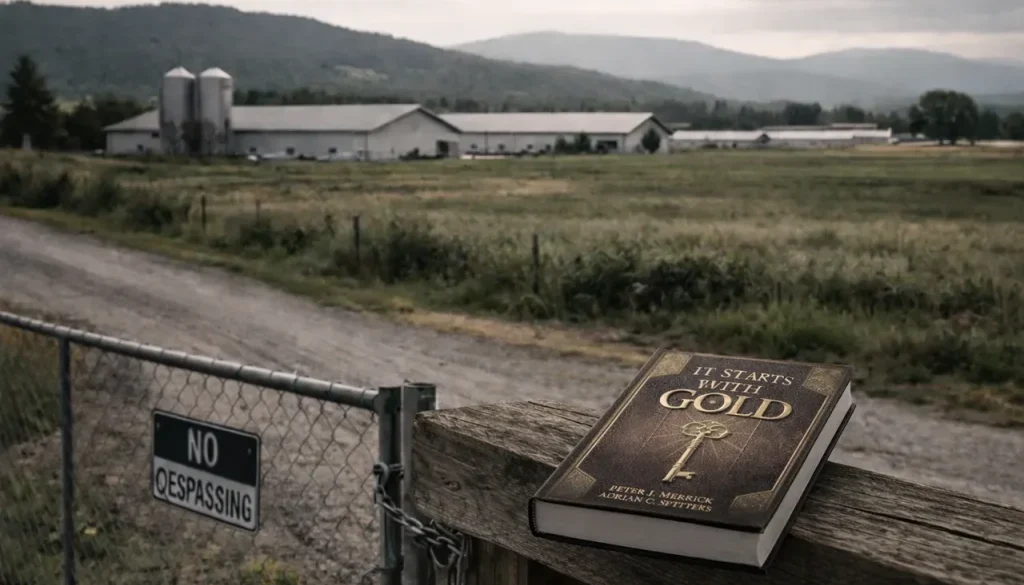
Near the end of this conversation sits a larger body of work. The themes raised here are expanded in our number one international best-selling book, It Starts With Gold™, co-authored by Peter J. Merric, TEP®, and Adrian C. Spitters, CFP®. In the book, we reveal how ownership, control, and long-duration assets quietly determine outcomes when systems tighten. Visit www.ItStartsWithGold.com.
The future of farming is not prewritten. Farmers, landowners, and families can still shape outcomes by understanding the structure early and acting deliberately. There is room to respond with strength, foresight, and resolve.
To find out more, order your own copy of It Starts With Gold from Amazon today. CLICK HERE.
References
- British Columbia Centre for Disease Control. Avian Influenza. Government of British Columbia.
- Canadian Food Inspection Agency. Latest Bird Flu Situation in Canada. Government of Canada.
- Canadian Food Inspection Agency. Fraser Valley Zoning Project. Government of Canada. Last modified December 17, 2024.
- Canadian Food Inspection Agency. Avian Influenza Disease Incidents: British Columbia (2014–Present). Government of Canada.
- Canadian Food Inspection Agency. Status of Avian Influenza Outbreaks by Province. Government of Canada.
- CityNews Vancouver. Avian Influenza Coverage in British Columbia. CityNews.
- The Progress (Chilliwack). Poultry Industry Coverage and Disease Risk Reporting. Black Press Media.
- Royal Bank of Canada Wealth Management. Supply Management Explained. RBC Wealth Management.