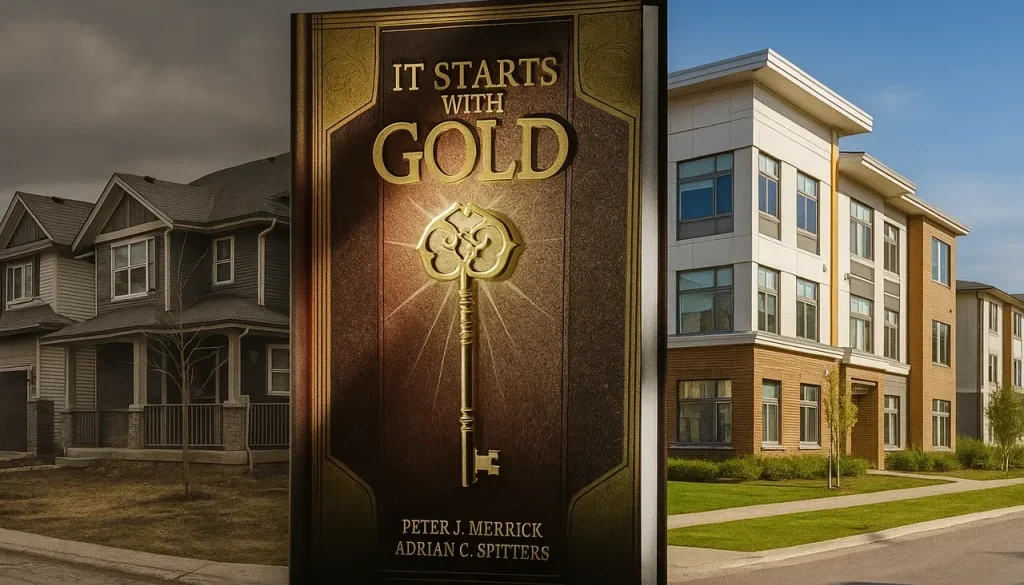
The Housing Illusion Collapses in Canada
By Peter J. Merrick, TEP® and Adrian C. Spitters, CFP®, co-authors of the international bestseller It Starts With Gold™ and the forthcoming book Guns, Gold & Land™
This analysis continues a series of long-form investigations published in The Merrick Spitters Reset Report™
As Prices Drop And Demand Weakens, Private Multifamily REITs Stand Alone
By Peter J. Merrick, TEP® and Adrian C. Spitters, CFP® Co-authors of the international bestseller It Starts With Gold™ and the forthcoming Killing Crypto™
The Contradiction That Broke the Market
For years, Canadians were told that the housing market was strong, resilient, and built on solid fundamentals. They were told that the correction would be “soft,” that inflation was under control, and that the worst had passed. Yet the cracks now stretch from coast to coast. The very institutions that promised stability are quietly preparing for decline.
Recent reports from Canada’s largest bank confirm what many have already felt. After two years of “soft landing” headlines, the nation’s biggest lender now describes the housing market as fragile and volatile. Home resales fell by 1.7 percent in September. Toronto prices are down 5.5 percent year over year, and national prices have dropped 3.4 percent.
There is no rebound. There is no recovery. There is only the slow, deliberate unwinding of an inflated illusion that can no longer sustain itself.
👉 Subscribe to The Merrick Spitters Reset Report™ and receive a digital copy of our international bestseller, It Starts With Gold™, along with our white paper, Last Asset Standing™ and early updates on our forthcoming book, Killing Crypto™.
A System Built on Delusion
The government and the banks cannot tell the truth because the truth would break confidence. They insist that home prices must fall to restore affordability, but also promise that values will remain high to protect homeowners. Both statements cannot be true. This is not confusion. It is design.
The system requires both high prices and the illusion of accessibility. It must protect the debt that fuels it while convincing citizens that ownership remains within reach. The contradiction holds the entire structure together. It is a controlled decline that transfers wealth upward while maintaining the appearance of stability.
Canadians have been taught to measure prosperity through the rising price of their homes rather than through their productivity or freedom. This shift has not only distorted the economy but also the very definition of success. A society that defines wealth through debt cannot sustain itself indefinitely.
The Leverage Behind the Illusion
The housing market’s strength was never organic. It was engineered through policy and leverage. When a mortgage is insured by the Canada Mortgage and Housing Corporation (CMHC), banks face no capital reserve requirement to issue it. That means they can lend up to one hundred times against their equity.
This regulation created a machine that rewards speculation in residential property while discouraging productive business lending. Mortgages provide leverage and insurance. Business loans require risk and diligence. Over time, the incentive structure drove banks away from enterprise toward home financing.
It was profitable. It was safe. It was also a trap.
As the public borrowed to buy homes at ever higher prices, banks enjoyed record profits, reporting returns on equity well above 25 percent, twice what their American counterparts earned. The gains were not the result of innovation or efficiency. They were the product of mathematical leverage.
For decades, Canadian monetary policy has rewarded speculation over productivity. The Basel and OSFI capital frameworks treat insured mortgages as risk-free assets, granting banks the power to expand credit almost without limit. By contrast, commercial or small business lending demands real capital backing. The result is a system that inflates property values instead of productive output, turning citizens into instruments of monetary expansion rather than participants in wealth creation.
Housing became Canada’s de facto economic engine not because it produces value, but because it produces debt.
The moment that leverage stops expanding, the illusion collapses.
The Crumbling Foundation
Recent numbers show that this process is already underway. The national sales-to-new-listing ratio now sits at 0.51, barely above a balanced market. Anything below 0.5 signals that buyers are regaining control. In other words, the balance of power has shifted.
Inventories are rising. Mortgage renewals are tightening. Affordability remains out of reach for most working families. RBC now projects volatility across all regions, with prices expected to stagnate through 2025 and decline again in 2026. This is not recovery. It is slow erosion disguised as stability.
Even immigration, once used as the political justification for endless price appreciation, is no longer providing support. Canada continues to welcome newcomers, but many cannot afford to buy. They rent, share accommodations, or delay ownership indefinitely. The demographic pressure that once drove demand is fading.
When immigration no longer sustains the market, the last pillar of the illusion disappears.
The Political Theatre of Affordability
Politicians still speak of “affordable housing” as if repeating the phrase will make it real. They announce incentives, rebates, and credits that do nothing to address the structural imbalance. When the government removed the Goods and Services Tax on new homes under one million dollars, it presented the move as relief. Yet the average new home price in Toronto and Vancouver far exceeds that threshold.
Every policy intervention injects more credit into a system already drowning in debt. It is an act of political survival, not economic repair. The truth is that no government can allow home prices to fall meaningfully without collapsing the balance sheets of banks and municipalities. Property taxes fund budgets. Mortgage interest sustains the financial sector.
Municipal and provincial budgets are addicted to rising property assessments. Every year, higher valuations generate more tax revenue without politicians ever having to raise rates. This fiscal addiction explains why even the smallest correction in home prices provokes panic among policymakers. Their survival depends on asset inflation. The phrase “housing affordability” becomes a performance, not a policy. It is designed to calm the public while protecting the very imbalance that keeps the system afloat.
The Collapse of the Soft Landing Myth
For nearly two years, the public was assured that the market would stabilize naturally. That illusion has now been shattered. RBC’s October 2025 housing report openly warns of fragile and volatile conditions. National home resales remain below pre-pandemic levels. Major urban centers continue to post year-over-year declines.
Even the largest bank in the country can no longer maintain the illusion. The language of reassurance has given way to the language of preparation. This is not honesty; it is risk management. Institutions are rewriting expectations before the market rewrites them.
Canada’s trajectory is not isolated. Similar housing contractions are unfolding in Australia, New Zealand, and the United Kingdom, where years of artificially low interest rates and foreign capital inflows inflated property values far beyond wage growth. Each of these markets is now experiencing parallel declines, revealing a synchronized correction in nations that relied too heavily on debt-fueled real estate expansion. This confirms that the downturn is not a local anomaly but part of a broader global housing reset linked to overleveraged monetary systems.
The idea of a soft landing is gone. What remains is a carefully managed descent intended to preserve the system, not the homeowner.
The Debt Machine Slows
Every modern economy depends on debt expansion to create the illusion of growth. When the flow of new credit slows, asset prices fall. Canada’s housing market, built on decades of cheap money, has reached that point.
Mortgage renewals in late 2025 and early 2026 will expose how fragile the system truly is. Thousands of households will face monthly payment increases exceeding one thousand dollars. According to the Canada Mortgage and Housing Corporation, approximately 2.2 million households, representing nearly half of all outstanding mortgages, are scheduled for renewal between 2025 and 2026. Many will encounter payment shocks of 35 to 60 percent, depending on term length and original rate.
This renewal wave will absorb disposable income, suppress consumption, and accelerate the shift from ownership to rentership as more families confront unsustainable carrying costs. The financial pressure will not appear suddenly as foreclosures. It will emerge quietly through delinquencies, distressed sales, and forced downsizing.
The decline will not be dramatic at first. It will be grinding, prolonged, and irreversible.
From Owners to Renters
The shift has already begun. Families who stretched to buy at the top of the market are discovering that they cannot refinance at today’s rates. Many will have no choice but to sell. The very asset that once symbolized freedom will become the instrument of their financial captivity.
As ownership declines, rentership rises. This transition is not simply economic; it is sociopolitical. Homeownership has long been tied to stability, autonomy, and generational wealth. The erosion of that ownership class changes the structure of society itself.
A generation that was told homeownership was the path to stability is now being quietly conditioned to view permanent rentership as flexibility. Financial media celebrates renting as the new freedom, while governments promote purpose-built rentals owned by institutions as evidence of progress. Beneath the narrative is a deeper loss: the transfer of control from individuals to corporate landlords. Each renewal shock and forced sale converts another family from owner to tenant, from participant in wealth creation to payer of it.
The marketing of this transition as modern and efficient conceals its true purpose. A nation of renters is easier to manage than a nation of owners. Ownership fosters independence. Rentership fosters dependence. The shift now unfolding is not just financial. It is political.
The Last Viable Real Estate Investment
While traditional homeowners struggle, one segment of the property market remains structurally strong: multifamily residential real estate. Unlike speculative single-family homes, apartment buildings and professionally managed rental portfolios generate essential cash flow. People may delay buying, but they cannot delay living somewhere.
As individuals are forced to liquidate and become renters, demand for rental housing will rise even as ownership falls. This is the environment in which private multifamily real estate investment trusts, or private REITs, thrive.
Private REITs operate outside the volatility of public markets. They are built on long-term cash flow, stable occupancy, and professional management rather than speculation. Their value is rooted in income, not in resale price. When capital shifts from ownership to rentership, the cash flow of these trusts strengthens.
Unlike public REITs, which trade on emotional sentiment and market volatility, private multifamily trusts operate in the real economy. Their units are not traded daily, which shields them from the fear cycles of equities. Investors receive steady monthly distributions sourced from rent, not from leveraged speculation. These structures also offer potential tax efficiency through return-of-capital and deferred gains, allowing wealth to compound quietly over time.
This is why pension funds, insurance pools, and high-net-worth families are increasing their exposure to this sector. They recognize that income, not appreciation, is the new cornerstone of real wealth.
Institutional investors have already recognized this trend. Pension funds, private equity firms, and family offices are quietly increasing their allocations to multifamily assets. The same shift that devastates homeowners fuels institutional growth.
Why Private Multifamily REITs Survive When Homeownership Fails
There are five core reasons this segment remains viable while the broader market declines.
-
-
- Essential Demand: Housing is not optional. As ownership collapses, rental demand increases. Multifamily properties meet that need directly.
- Operational Scale: Large portfolios distribute risk across hundreds or thousands of units, reducing exposure to individual defaults or vacancies.
- Cash Flow Stability: Rents adjust with inflation, preserving purchasing power even as asset prices fluctuate.
- Insulation from Speculative Cycles: Private REITs focus on yield and long-term value, not on speculative resale.
- Institutional Management and Privacy: These trusts are managed by specialized firms that operate privately, shielding investors from the emotional volatility of public market swings.
-
In short, while individual homeowners face liquidity crises, private REIT investors receive stable income. Ownership becomes rentership, and rentership becomes cash flow for those who positioned themselves correctly.
Historical performance data supports this stability. Canadian private multifamily REITs have produced annualized net yields between 4 and 7 percent over the past decade, with average occupancy rates consistently above 95 percent even during periods of market weakness. These returns are not driven by speculation or asset inflation but by recurring rental income that adjusts with inflation, providing investors with steady cash flow and real purchasing power protection.
The Death of the Ownership Illusion
This shift exposes a deeper truth. The housing market was never designed to make citizens wealthy. It was designed to make them compliant. By tying personal identity to mortgage debt, the system transformed freedom into servitude.
For decades, citizens were told that buying a home was the safest investment. In reality, it was the mechanism that locked them into the debt cycle that sustains the financial system. When the illusion of endless appreciation dies, so does the illusion of independence it provided.
The irony is that as individuals lose ownership, institutional investors gain it. Private REITs, multifamily developers, and asset managers are acquiring what individuals are forced to sell. The same properties that once symbolized middle-class prosperity are being consolidated into portfolios that generate permanent rental income for the few.
This is not coincidence. It is succession by design.
The Moral Reckoning
The erosion of ownership is not just a market event. It is a moral test of an entire economic system. A society that rewards speculation over production eventually eats its own foundation.
The deeper tragedy is not financial but moral. Canada no longer rewards those who build, produce, or serve. It rewards those who borrow. The financial industrial complex has inverted the purpose of capital itself. What once funded innovation now funds extraction. What once built communities now monetizes their decay. Until capital returns to serving the productive economy rather than consuming it, the collapse will continue not as a market event, but as a moral one.
Policymakers can continue pretending that minor reforms will restore balance, but the data says otherwise. Inflation remains persistent. Wages lag far behind asset costs. Household debt is among the highest in the developed world.
The public cannot be saved by the same institutions that created the crisis. Salvation will not come through new credit programs or interest rate cuts. It will come through individuals reclaiming control over their wealth by choosing assets that exist outside the debt system altogether.
A Path Forward: Owning Assets in Order of Asset Security
At our firm, we help clients restructure their wealth around a hierarchy we call Owning Assets in Order of Asset Security. The foundation begins with tangible assets like physical gold and silver, assets that cannot be digitally confiscated or inflated away.
From there, the second layer consists of income-producing private investments such as private multifamily real estate trusts. These provide exposure to the housing market without exposure to the fragility of individual ownership. They deliver steady cash flow from essential demand rather than speculation.
The third layer includes independent discretionary portfolios managed outside the bank-owned system, with transparent custody and true fiduciary oversight. Each layer adds diversification while maintaining control, privacy, and resilience.
This structure transforms uncertainty into strategy. It allows investors to benefit from the transition rather than be crushed by it.
The Coming Reset
History has shown that every credit cycle ends the same way. When liquidity evaporates, governments and central banks step in, not to protect citizens, but to preserve institutions.
The next phase will not arrive as panic but as policy. Relief programs will appear under the language of compassion, mortgage forbearance, emergency liquidity, and taxpayer-backed stability measures. Yet every one of these programs will serve the same end, transferring private losses to public balance sheets. When the government absorbs bad mortgages or the central bank expands its balance sheet to support financial institutions, the cycle resets, not for the citizen, but for the system. Each bailout cements dependency. Each rescue redefines control.
As rates fluctuate and currencies devalue, tangible and private assets will stand apart from the digital financial system being quietly constructed around them. Those who act before the reset retain control. Those who wait will watch control slip away.
Hope in Action
This is not a message of despair. It is a call to awareness and preparation. The collapse of the ownership illusion is not the end of opportunity; it is the beginning of clarity.
The investors who understand the transition from ownership to rentership will position themselves where value is moving. Those who see that control now lies in tangible, yield-based assets rather than speculative price appreciation will preserve and grow their wealth.
A different economy is emerging. The question is whether one will adapt to it or be consumed by it.
It Starts With Gold™
The urgent themes explored here are expanded in our #1 international best-selling book, It Starts With Gold™, co-authored by Peter J. Merrick, TEP® and Adrian C. Spitters, CFP®. In the book, we reveal how to establish a tangible-asset foundation, measure security across asset classes, and safeguard against systemic shocks while maintaining control of your future. Visit www.ItStartsWithGold.com.
👉 Sign up today for The Merrick Spitters Reset Report™ to receive a digital copy of our international bestseller, It Starts With Gold™, our white paper, Last Asset Standing™, and early updates on our upcoming book, Killing Crypto™.
Prefer a hard copy? Order It Starts With Gold™ on Amazon today.
References
- Canada Mortgage and Housing Corporation. Residential Mortgage Industry Report – Fall 2024
- Office of the Superintendent of Financial Institutions (OSFI). Capital Adequacy Requirements (CAR) – Guideline 2024
- Statistics Canada. Key Trends in Mortgage and Non-Mortgage Loans
- Canada Mortgage and Housing Corporation. CMHC Provides ‘Realistic’ Timeline for Solving Housing Crisis
- Canada Mortgage and Housing Corporation. Residential Mortgage Industry Data Dashboard
- Fasken. Financial Services Update: OSFI Guidelines and Payments Canada
- Office of the Superintendent of Financial Institutions (OSFI). Modification to the Capital Floor Transition Schedule in Chapter 1 of the Capital Adequacy Requirements (CAR) Guideline
- Skyline Wealth Management. The Benefits of Private REIT Investing
- Borden Ladner Gervais (BLG). Private REITs as a Smart Investment Alternative
- Private Pension Partners. 2025 Canadian Multifamily Outlook
- Equiton. 2025 Canadian Multifamily Investment Trends
- Royal Bank of Canada (RBC). RBC Warns: Canadian Housing Market Is Not Rebounding – Prices Still Falling
- Hilliard Macbeth. 0% Capital, 100× Leverage – Hilliard Macbeth on the Housing Crash Ahead
- Royal Bank of Canada. Trade Turbulence Shakes Canada’s Housing Market Foundations
- $300K Price Drop Needed to Restore Affordability? Average Price Must Fall, Says Housing Minister
Disclaimer
This publication is for informational and educational purposes only. It is not intended to provide financial, legal, tax, or investment advice and should not be relied upon as a recommendation to buy or sell any security, fund, or financial product. The opinions expressed are those of the authors and may differ from those of any affiliated organization or regulated firm. While every effort has been made to ensure accuracy and timeliness, no warranty or representation is made regarding the completeness or reliability of the information contained herein.
Economic conditions, market dynamics, and government policies are subject to change without notice and may materially affect the views or projections discussed. All investments involve risk, including the potential loss of principal. Past performance is not indicative of future results. Real estate values, interest rates, and regulatory frameworks can fluctuate significantly, influencing investment outcomes.
Readers should consult a qualified financial, tax, or legal professional before acting on any information contained in this publication. The discussion of laws, markets, and asset classes is general in nature and not a substitute for personalized advice.
Peter J. Merrick, TEP®, and Adrian C. Spitters, CFP®, provide professional advisory services through independent affiliations with regulated financial firms. Neither the authors nor any related entity accept liability for losses or damages arising from reliance on this publication. By reading this article, you acknowledge and agree that any actions taken based on its content are solely at your discretion.