The Ownership Crisis Nobody Wants To Talk About
By Adrian C. Spitters, FCSI® and Peter J. Merrick, TEP®
This analysis is part of an ongoing series of long-form investigations published in The Merrick Spitters Reset Report™ that examine long-term developments affecting property rights, governance systems, and financial architecture.
Something Feels Different
Over nearly four decades of working with business owners, farm families, professionals, real estate investors, and retirees, I have learned that major economic shifts rarely announce themselves clearly. They begin as subtle changes in behaviour, confidence, and expectations. Over the past several years, I have noticed a recurring theme appearing across both Canada and the United States. Regardless of age, profession, or net worth, many people sense that something fundamental is changing.
Housing prices are falling in many regions. Interest rates have stopped climbing. Inventory is returning to the market. Governments continue announcing housing initiatives and affordability programs. On the surface, these developments should be creating optimism. Yet that optimism remains surprisingly difficult to find.
Instead, many people feel increasingly uncertain. That uncertainty is showing up in conversations about retirement, business succession, family formation, real estate, and long-term financial security.
Parents wonder whether their children will ever be able to purchase a home in the communities where they were raised. Young professionals question whether years of education and career advancement will provide the opportunities previous generations enjoyed. Existing homeowners are discovering that rising property values do not necessarily translate into lasting financial security. Business owners who once viewed real estate as a dependable source of wealth creation are beginning to reassess long-held assumptions.
What makes this moment unusual is that many of the traditional relationships that governed housing markets appear to be breaking down simultaneously.
For decades, most North Americans believed they understood the formula. Work hard. Save diligently. Purchase a home. Build equity. Over time, that equity would become a cornerstone of financial security. While the process was never guaranteed, ownership generally felt attainable for those willing to make sacrifices and plan for the future.
Today, that assumption is increasingly being challenged as rising costs, affordability pressures, and changing economic realities force many families to reconsider what ownership means and whether it remains as attainable as it once appeared.
Across North America, younger families are earning incomes that would have been considered impressive only a generation ago, yet many continue struggling to access the housing market. Existing homeowners are discovering that higher valuations often come with higher taxes, higher insurance costs, higher maintenance expenses, and greater financial complexity. Developers are finding that projects approved on paper no longer make economic sense in reality. Investors are confronting markets that no longer respond predictably to the same forces that drove previous cycles.
Many people continue treating these developments as separate issues. They see housing affordability as one problem, economic growth as another, government policy as something different, and ownership as an entirely separate discussion. The deeper I examine the trends developing across Canada and the United States, the more convinced I become that these issues are connected.
Recent conversations with veteran real estate analyst Bill Coughlin reinforced that observation. While much of the public debate remains focused on housing prices, Bill believes the more important story involves confidence, participation, and the changing nature of ownership itself. The deeper I examined the data, the more I found myself reaching a similar conclusion.
What concerns me is that we may be asking the wrong question. Most discussions focus on whether housing prices will rise or fall next year. Markets have always moved in cycles. Prices rise, prices fall, corrections occur, and recoveries follow. The more important question may be whether the economic framework that allowed previous generations to build wealth through ownership is beginning to change.
If that is happening, the implications extend far beyond real estate. They affect retirement planning, succession planning, business ownership, family continuity, and ultimately the ability to transfer opportunity from one generation to the next.
That is why I believe this conversation matters. The issue may no longer be housing prices alone. Increasingly, the issue appears to be ownership itself, who can access it, who can preserve it, and who will ultimately be able to pass it to the next generation.
The Numbers Tell A Different Story
The feeling that something is changing is not simply anecdotal. The numbers emerging from housing markets across North America increasingly support what many families are already sensing.
Consider what happened in Metro Vancouver. Home sales in 2025 fell to their lowest level in more than two decades. Fewer homes sold than during the depths of the 2008 Global Financial Crisis, despite lower interest rates and despite a record number of homes being listed for sale. More than 65,000 properties entered the market during the year, yet buyers largely remained on the sidelines. That should have been a year of recovery. Instead, it became a year that forced many people to question assumptions that had guided real estate decisions for decades.
The Fraser Valley is telling a similar story. In parts of British Columbia, particularly the Fraser Valley and portions of Greater Vancouver, detached homes have fallen significantly from their recent peaks. Condominiums have experienced even larger declines. In many cases, homeowners have watched six-figure amounts of paper equity disappear within a relatively short period of time. A typical detached homeowner in parts of the Fraser Valley has seen values decline by roughly $150,000 from year-earlier levels. Yet despite lower prices, transactions remain subdued and confidence remains weak.
What makes this particularly important is that lower prices are not automatically creating affordability. That is the disconnect many people struggle to understand. For years, housing advocates argued that prices needed to come down. Today, prices are coming down in many regions, yet ownership remains out of reach for large segments of the population. If affordability were purely a pricing problem, demand should be returning much more aggressively than it is.
The same pattern is appearing elsewhere. Ontario continues grappling with slowing sales activity and projects that no longer make economic sense. Many homeowners are discovering that what appeared to be extraordinary wealth creation over the past decade looks far less impressive once inflation, carrying costs, financing expenses, and taxes are taken into account. South of the border, affordability remains near historic extremes in many American markets despite softer housing prices. In several major metropolitan areas, mortgage payments relative to income remain significantly above long-term norms.
The common thread running through all of these markets is confidence. Over the past several months, conversations with experienced real estate professionals such as Bill Coughlin have reinforced this observation. The issue is no longer simply price. The issue is whether families have confidence in their ability to commit capital, take on risk, and improve their financial position over the long term.
Housing markets ultimately depend upon confidence in the future. Families buy homes because they believe their jobs are secure, their businesses will continue growing, and their financial situation will improve over time. When confidence weakens, transactions slow. When transactions slow, developers become cautious. When developers become cautious, projects stall. When projects stall, supply constraints persist. The cycle begins feeding on itself.
This is why I believe we need to look beyond the headlines. The story is not simply that housing prices are falling. The story is that ownership remains increasingly difficult to achieve even when prices soften. That should force us to ask a much bigger question.
If lower prices are not restoring access to ownership, what exactly is preventing ownership from becoming attainable again?
The answer begins to emerge when we examine the growing gap between incomes, asset values, and economic reality. That gap is creating a disconnect that may ultimately prove far more important than the next housing cycle.
What makes this particularly interesting is that the weakness is not limited to prices.
Many people focus on what homes are worth. Far fewer pay attention to how many homes are actually changing hands.
This is where the discussion moves beyond theory. If confidence is weakening, if ownership is becoming more difficult to achieve, and if participation is declining, we should expect those realities to appear in the data. The chart below helps illustrate exactly what is happening. Across both Greater Vancouver and the Fraser Valley, inventory remains elevated while sales activity remains remarkably subdued. The result is absorption rates that continue to signal buyer-market conditions throughout much of the region.
This is important because housing markets do not stall simply because prices are high. They stall when confidence weakens, buyers hesitate, and sellers struggle to find enough qualified purchasers willing to commit capital.
The issue is no longer simply affordability. The issue is participation.
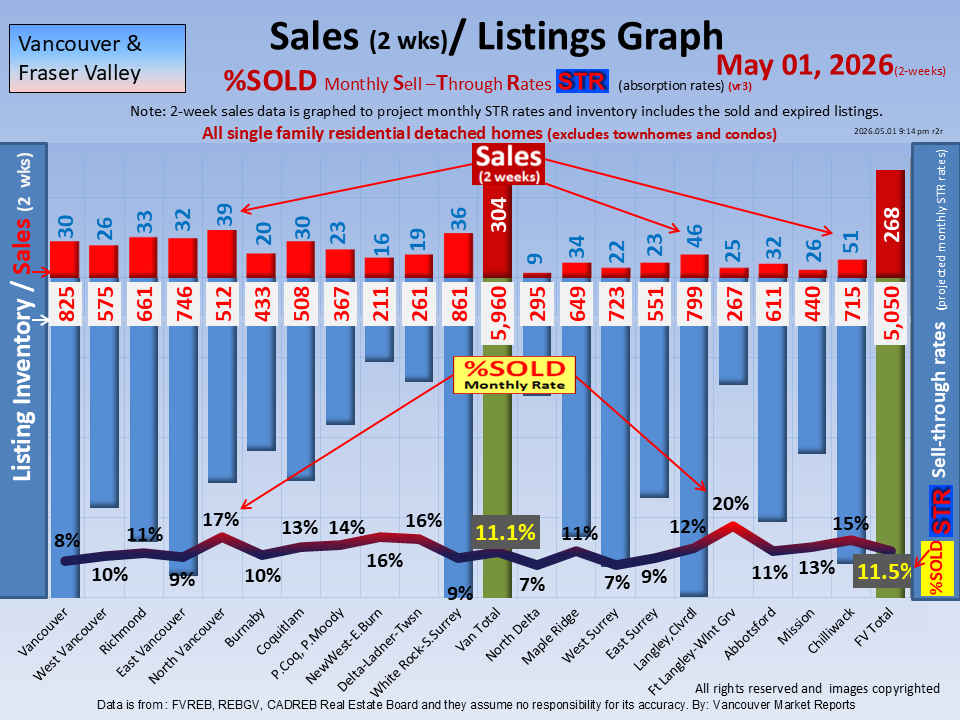
Figure 1: Greater Vancouver and Fraser Valley Detached Housing Market Inventory, Sales Activity, and Absorption Rates (May 2026)
The numbers tell a striking story.
The Fraser Valley’s projected monthly absorption rate sits at approximately 11.5%, while Greater Vancouver remains near 8%. In practical terms, both regions remain firmly within buyer-market conditions, despite interest rates moving lower and despite substantial inventory being available for purchase. Both markets remain firmly within buyer-market territory. Inventory continues to outweigh transaction activity, creating conditions that place downward pressure on pricing while increasing competition among sellers.
What stands out is not merely the number of listings. What stands out is the lack of participation.
Even as interest rates have declined from their recent highs, many buyers continue to remain on the sidelines. That suggests the challenge facing housing markets today may extend beyond borrowing costs alone. Confidence, affordability, and future economic expectations appear to be playing an increasingly important role.
That observation becomes particularly important when we begin examining the broader ownership trends unfolding across North America.
The Great Disconnect
For most of the twentieth century, there was a reasonably predictable relationship between work, income, and ownership. A family earned a living, saved money, qualified for financing, and gradually acquired assets over time. The process was not always easy, and economic downturns certainly created setbacks, but there remained a widespread belief that effort, discipline, and long-term planning could eventually lead to ownership and financial security.
Today, that relationship appears increasingly strained. Across Canada and the United States, I regularly encounter households earning incomes that would have been considered exceptional one or two generations ago. Many are professionals, tradespeople, business owners, entrepreneurs, and dual-income families. They have followed the traditional advice. They pursued education, built careers, avoided excessive debt, and worked diligently. Yet many still find themselves questioning whether ownership remains realistically attainable.
This is where the housing conversation becomes much larger than housing itself. What initially appears to be an affordability problem increasingly begins to look like an ownership problem.
The issue is not simply that homes became expensive. The issue is that asset values have risen far faster than incomes for an extended period of time. Decades of falling interest rates, expanding credit, financialization, and monetary stimulus helped drive asset prices higher across much of North America. At the same time, wage growth rarely kept pace. The result is a widening gap between what people earn and what ownership now requires.
That gap is beginning to shape major life decisions. Young adults remain in their parents’ homes longer than previous generations. Couples delay marriage and family formation. Many households postpone having children because financial stability feels increasingly difficult to achieve. Others leave the communities where they were raised because ownership has become unrealistic. These decisions are often described as lifestyle choices, but in many cases they are economic responses to changing realities.
What concerns me is that these trends are rarely viewed together. A young family struggling to purchase a home is treated as one issue. Declining birth rates are treated as another. Slowing economic mobility becomes a separate discussion. Yet all of these developments may be connected to the same underlying challenge. When ownership becomes more difficult to achieve, it changes how people plan their lives, how they allocate capital, and how they think about the future.
For much of the post-war period, parents generally believed their children would enjoy a higher standard of living than they did. That assumption became deeply embedded within North American culture. Families worked hard with the expectation that each generation would inherit greater opportunities than the one before it. Increasingly, however, many younger Canadians and Americans are beginning to question whether that assumption still holds true.
The emotional impact of this shift should not be underestimated. People can tolerate sacrifice when they believe it leads somewhere. They can endure challenges when they believe opportunities remain within reach. What becomes much more difficult is the growing perception that the traditional rewards for hard work are moving further away rather than closer. When that perception spreads, confidence begins to erode, not just in housing markets, but in the broader economic system itself.
Housing is often where this reality becomes most visible because a home represents far more than an asset. It represents security, independence, stability, and the ability to establish roots. When ownership begins feeling unattainable, the concern extends far beyond the cost of a property. It becomes a question about economic mobility, family continuity, and whether future generations will enjoy the same opportunities previous generations took for granted.
That is the great disconnect emerging across North America today. Asset values continue reflecting a world built on abundant credit and expanding wealth, while many families increasingly live in a world defined by affordability challenges, rising costs, and diminishing access to ownership. The longer that disconnect persists, the more pressure it places on confidence, opportunity, and the belief that effort alone is sufficient to build a meaningful future.
And once that belief begins to weaken, the conversation inevitably shifts from affordability to ownership itself.
The Rise Of The Permanent Renter
As the gap between incomes and asset values continues widening, another trend is quietly emerging across North America. It is a trend that receives far less attention than interest rates, housing starts, or monthly sales figures, yet it may ultimately prove far more significant. Increasingly, the question is no longer whether people can afford to buy a home today. The question is whether a growing number of people will ever be able to buy one at all.
For decades, renting was generally viewed as a temporary stage of life. People rented while saving for a down payment, establishing careers, or starting families. Ownership was considered the destination. Renting was simply one step along the journey. Today, that progression appears increasingly uncertain for many households.
Across both Canada and the United States, younger families are spending longer periods in rental accommodation than previous generations. In many major urban centres, even households with above-average incomes struggle to accumulate sufficient savings while simultaneously coping with rising rents, inflation, taxes, and day-to-day living expenses. The result is that what was once a temporary phase is beginning to look increasingly permanent.
At the same time, the buyers entering the market are changing. While many individual households remain sidelined, institutional investors continue expanding their presence in residential real estate. Pension funds, private equity firms, real estate investment trusts, and corporate landlords possess advantages that ordinary families simply do not. They can access large pools of capital, acquire properties at scale, weather market downturns, and wait patiently for opportunities that individual buyers cannot afford to pursue.
The implications of this shift extend far beyond real estate. Historically, homeownership allowed ordinary families to participate directly in wealth creation. Mortgage payments gradually became equity. Appreciation created net worth. Assets could be transferred to future generations. Ownership provided a mechanism through which millions of households accumulated wealth over time.
When ownership becomes more difficult to achieve, those benefits do not disappear. Equity continues to accumulate. Appreciation continues to occur. Assets continue generating wealth. The difference is that the benefits increasingly accrue to someone else.
This is why I believe the housing conversation often misses the larger issue. The debate frequently centres on affordability, but affordability is only part of the story. Ownership determines who ultimately benefits from the appreciation of assets, who accumulates equity, who controls productive capital, and who passes wealth to future generations. A society can have plenty of housing and still experience growing inequality if ownership becomes increasingly concentrated.
What makes this trend particularly important is that it does not require any coordinated effort or grand design. It is simply the natural consequence of capital flowing toward opportunities that become increasingly inaccessible to ordinary households. As ownership becomes more difficult for families, it often becomes more attractive for institutions. As more people remain renters, demand for rental housing increases. As rental demand increases, institutional investors become even more interested in acquiring residential assets.
Over time, the cycle begins reinforcing itself. Higher rental demand attracts additional institutional capital, which increases competition for assets and further widens the gap between ownership and access to ownership.
The concern is not that people rent. Renting will always play an important role within healthy housing markets. The concern is that a growing number of people may never have the opportunity to move beyond renting, regardless of how hard they work or how responsibly they manage their finances. When that happens, the discussion is no longer about housing policy. It becomes a discussion about economic mobility, wealth creation, and whether broad-based ownership remains achievable for future generations.
That possibility should concern anyone who cares about family continuity, long-term stewardship, and the ability of future generations to build meaningful wealth through their own efforts. Housing is simply where this shift becomes visible. The deeper issue is whether ownership itself is gradually moving further out of reach for the very people who have traditionally relied upon it as a pathway toward financial security.
A Generation Locked Out
The rise of the permanent renter is not simply a housing story. It is increasingly becoming a generational story.
For much of the last century, ownership served as one of the primary engines of economic mobility. Families worked, saved, acquired assets, and gradually improved their financial position over time. Parents generally believed their children would enjoy greater opportunities than they had. That expectation became deeply embedded within the North American experience. It shaped financial planning, career decisions, family formation, and long-term wealth creation.
Today, that expectation is being tested in ways that many families did not anticipate. The assumption that each generation would inherit greater opportunities than the one before it no longer feels as certain as it once did.
Across Canada and the United States, many younger adults find themselves facing a reality that looks very different from the one experienced by their parents and grandparents. They are entering adulthood carrying higher costs, facing elevated housing prices, dealing with rising living expenses, and navigating an economic environment where ownership increasingly feels like a moving target. Even those earning strong incomes often discover that the traditional milestones of adulthood are taking longer to achieve.
The consequences are showing up in ways that extend far beyond real estate. Family formation is occurring later in life. Marriage is often delayed. Many couples postpone having children until they feel financially secure. Others decide they cannot afford to start families at all. These trends are appearing throughout much of the developed world, and housing affordability is frequently cited as one of the contributing factors.
What concerns me most is not simply the financial impact. The deeper concern is the growing perception that the rules have changed and that following the traditional roadmap no longer guarantees access to the opportunities previous generations enjoyed.
That is what makes this issue so emotionally charged. Most people are not asking for shortcuts or special treatment. They simply want to know whether the traditional bargain still exists. For generations, families believed that studying hard, building careers, saving diligently, and making responsible decisions would eventually create opportunity and security. Increasingly, many are wondering whether that path still leads where it once did.
Increasingly, many are wondering whether that path still leads where it once did. They pursued education. They built careers. They worked hard. They avoided excessive financial risk. Yet despite following the traditional roadmap, many still find themselves struggling to access opportunities that previous generations viewed as relatively attainable.
Over time, this begins to alter how people think about the future. When ownership feels increasingly out of reach, confidence in long-term planning weakens. The incentive to save can diminish. The willingness to make long-term commitments can decline. A growing number of people begin focusing on short-term survival rather than long-term wealth creation because the larger goals appear increasingly difficult to achieve.
At the same time, another trend is emerging that receives far less attention. Inheritance is becoming increasingly important in determining who gains access to ownership.
Historically, inherited wealth often provided an advantage. Today, in many markets, it is becoming a prerequisite. Family assistance, gifts from parents, inherited property, and intergenerational transfers are playing a larger role in determining who can purchase homes and who cannot. The result is a widening divide between families that already possess meaningful assets and those attempting to build wealth entirely through current income.
This is not an argument against helping children or transferring wealth to future generations. Most parents naturally want to provide opportunities for their families. The concern arises when inheritance begins replacing economic mobility as the primary path to ownership.
A society built upon broad ownership creates opportunities for people to improve their circumstances through effort, discipline, and entrepreneurship. A society increasingly dependent upon inherited assets tends to concentrate wealth among those who already possess it. The ladder still exists, but fewer people can reach it.
This is why the housing conversation generates such strong emotions. Housing is not merely about shelter. It represents access to stability, security, and participation in the ownership economy. When people begin feeling locked out of ownership, they are not simply worried about where they will live. They are worried about whether they will be able to build a future comparable to the one enjoyed by previous generations.
That concern is spreading across North America. It is showing up in conversations around affordability, retirement, family planning, education, and wealth creation. While housing may be where the symptoms first appear, the underlying issue is much larger. It is a growing uncertainty about whether the opportunities that built the modern middle class remain accessible to the generations that follow.
And once that uncertainty takes hold, people naturally begin asking a deeper question.
If ownership is becoming harder to achieve for ordinary families, why are so many approved homes still not being built?
The Development Illusion
For years, Canadians have been told that the housing crisis is fundamentally a supply problem. Build more homes, accelerate approvals, increase density, and affordability will eventually follow. While there is certainly truth in that argument, the reality unfolding across North America is proving far more complicated than many policymakers anticipated.
One of the most revealing statistics to emerge from Metro Vancouver is the estimate that roughly 100,000 housing units already approved for construction remain stalled. These projects are not waiting for rezoning. They are not trapped in municipal approval processes. In many cases, they already possess the approvals necessary to move forward. Yet they remain dormant.
That fact alone should force a much larger conversation about whether the housing crisis is truly a supply problem or whether it has become a confidence, financing, and affordability problem as well.
If the problem is simply a lack of housing approvals, why are so many approved projects sitting idle while governments continue promising more housing? The answer reveals a reality that many political announcements fail to acknowledge. Housing is not built because governments announce targets. Housing is built when the economics make sense. Developers require financing. Lenders require confidence. Investors require acceptable returns. Buyers must be willing and able to purchase the finished product. When those conditions disappear, construction slows regardless of how ambitious the government’s goals may be.
This is where the gap between policy and reality becomes increasingly visible. Across Canada, governments continue announcing housing initiatives measured in hundreds of thousands or even millions of future homes. Yet developers on the ground are facing a very different environment. Construction costs remain elevated. Labour shortages persist. Financing has become more expensive. Insurance costs continue rising. Municipal development charges have increased. Buyers are more cautious. Every step of the development process has become more difficult than it was during the era of ultra-low interest rates.
The result is a growing number of projects that appear viable in policy announcements, feasibility studies, and government targets, but fail when confronted with the realities of financing, construction costs, and buyer demand.
This reality became particularly apparent when the Parliamentary Budget Office examined one of the federal government’s flagship housing initiatives. Canadians were promised that housing construction would accelerate dramatically, with political leaders speaking about hundreds of thousands of additional homes and transformational changes to affordability. Yet the Parliamentary Budget Office concluded that the actual impact would be far smaller than many Canadians were led to believe. The findings suggested that even if the program performs as projected, the number of additional homes produced falls dramatically short of the public expectations that were created.
The significance of that finding extends beyond any single government or political party. What it reveals is a broader challenge facing policymakers across North America. Announcing homes and building homes are not the same thing. Housing targets exist on paper. Housing units exist in reality. The distance between those two realities is measured in financing, labour, materials, infrastructure, profitability, buyer demand, and economic confidence.
Families do not live inside housing targets, government announcements, or policy documents. They live in actual homes, raise families in actual communities, and make financial decisions based on conditions that exist today rather than promises about what may be built tomorrow. Ultimately, housing supply only materializes when economic conditions support construction and buyers possess the confidence and capacity to participate in the market.
This is why I believe the housing conversation is increasingly becoming a credibility conversation. Every year that affordability worsens despite new promises, public confidence erodes a little further. Every delayed project, every missed target, and every announcement that fails to produce meaningful results reinforces a growing belief that the institutions responsible for solving the problem may no longer possess the tools necessary to achieve the outcomes they continue promising.
That is not merely a housing issue. It is a confidence issue, and confidence is one of the most difficult economic resources to rebuild once it begins to erode. Once confidence is lost, families, investors, developers, and lenders often become far more cautious, which can prolong challenges long after the original problem has emerged.
The deeper concern is that while governments continue debating future housing supply, many families are already adapting to a world where ownership feels increasingly uncertain. They are changing financial plans, delaying major life decisions, and adjusting expectations for the future. In many ways, the market is responding to this reality faster than policymakers are.
That is one reason I have become increasingly interested in the observations of people who spend their lives operating within real estate markets rather than merely studying them. Because while economists and politicians often focus on forecasts, targets, and policy frameworks, those working directly with buyers, sellers, investors, and developers are often the first to recognize when something fundamental has changed.
That brings us to Bill Coughlin and what he believes many families, investors, and business owners are still missing. While many people continue focusing on short-term price movements, Bill has spent decades watching how major shifts in confidence, financing conditions, and buyer behaviour ultimately reshape entire markets. His perspective helps connect the housing challenges we see today with the much larger ownership questions families will need to confront tomorrow.
What Bill Coughlin Sees That Many Others Miss
One of the challenges with modern economic analysis is that much of it is produced from a distance. The spreadsheets may be accurate. The forecasts may be reasonable. The models may be sophisticated. Yet markets are ultimately driven by people, and people often change their behaviour long before the data reveals what is happening.
Economists examine spreadsheets. Governments establish targets. Financial institutions publish forecasts. Analysts debate interest rates, inflation, and housing starts. All of those perspectives provide value, but they often miss something important. They do not always capture what is happening on the ground as families, investors, developers, and business owners make real-world decisions.
That is one reason I have always valued the perspective of individuals who spend decades working directly within the market itself. Bill Coughlin is one of those individuals. Having worked through multiple real estate cycles, he has seen firsthand how markets behave when confidence begins to weaken and how opportunities often emerge precisely when uncertainty is greatest.
For years, Bill has been immersed in the realities of Western Canadian real estate. He has witnessed housing booms, downturns, financing cycles, investor enthusiasm, buyer hesitation, and changing government policies. More importantly, he has spent years observing how ordinary families respond when economic conditions begin shifting beneath their feet.
What makes today’s environment different is not simply that housing prices have softened or that sales activity has slowed. Markets have experienced corrections before. What makes this period unusual is that many of the traditional relationships people relied upon no longer appear to be functioning the way they once did.
Historically, lower interest rates stimulated demand. Today, rates have declined from their recent highs, yet many buyers remain hesitant. Historically, population growth created predictable housing demand. Today, Canada’s population growth has slowed dramatically as governments reduce immigration targets and non-permanent residents leave the country in significant numbers, yet affordability remains deeply challenged. Historically, developers responded to demand by increasing construction. Today, thousands of approved projects remain stalled because the economics no longer support moving forward.
These are not normal market conditions. They are signs that deeper structural forces may be reshaping the market itself and challenging assumptions that many investors, homeowners, and policymakers have relied upon for decades.
What Bill often sees before the statistics fully reveal it is changing behaviour. Behaviour tends to shift before the data catches up. Buyers become cautious. Investors become selective. Developers delay projects. Sellers adjust expectations. Families postpone major financial decisions. These changes may appear small individually, but collectively they begin signalling that confidence is weakening.
Confidence is one of the most underappreciated forces within any economy, yet it influences almost every major financial decision families make, from purchasing a home to expanding a business or investing for the future.
Housing markets do not function simply because people need homes. They function because people believe they can commit to a mortgage, build a future, and improve their financial position over time. When confidence begins eroding, even favourable conditions can fail to generate activity. That is precisely what many housing markets across Canada and the United States appear to be experiencing today.
This is why Bill’s observations resonate far beyond real estate. What he is seeing is not merely a housing cycle. He is observing how families are adapting to an environment where ownership feels less certain, affordability feels increasingly disconnected from income, and many of the assumptions that guided financial planning for decades are being questioned.
The same conversations are taking place across North America. Business owners are questioning expansion plans. Farm families are reconsidering succession strategies. Investors are re-evaluating risk. Parents are wondering what opportunities will be available to their children. The common thread connecting all of these discussions is uncertainty about the future of ownership.
That is why I believe Bill’s perspective is particularly valuable at this moment. He is not simply analyzing real estate prices. He is observing how people behave when long-standing assumptions begin to break down. Those behavioural shifts often reveal far more than any monthly sales report ever could.
The question facing families today is not whether housing prices will rise or fall next year. The much bigger question is whether the ownership model that supported wealth creation for generations is beginning to evolve into something very different. Understanding that distinction may prove far more important than correctly predicting the next market cycle.
And once we begin asking that question, another naturally follows.
If housing can no longer be relied upon as the primary engine of wealth creation for future generations, where should families be focusing their attention instead?
The New Wealth Question
As I have worked through these housing trends, one conclusion keeps resurfacing. The most important question facing families today may not be whether housing prices rise or fall over the next few years. Markets have always moved in cycles. Prices rise, prices fall, and eventually markets find a new equilibrium.
The more important question is what families should do if some of the assumptions that drove wealth creation over the last thirty years no longer work as effectively over the next thirty.
For decades, many Canadians and Americans built substantial wealth through real estate ownership. Some accumulated rental properties. Others owned farmland. Some built businesses that included commercial real estate holdings. Many simply benefited from decades of rising property values that transformed homes into some of the largest assets on their balance sheets.
For many families, the challenge is no longer simply how to build wealth. It is how to preserve, reposition, and transfer wealth in an environment that may look very different from the one that created it.
As markets evolve, however, a different set of questions begins to emerge, questions that many affluent families, business owners, and long-term investors are now confronting for the first time in decades.
What happens if an investor decides to sell after spending decades building wealth through ownership? What happens when significant capital gains are realized? How do families preserve more of what they have spent decades building? How do they reposition capital without allowing taxes, inflation, and poor planning to consume an unnecessary portion of their wealth?
These are not theoretical questions. Across Canada and the United States, many long-term owners are quietly beginning to ask them. Some are downsizing. Some are retiring. Some are transitioning businesses or farms to the next generation. Others are simply recognizing that the environment that created extraordinary gains may not look the same going forward.
At the same time, another important question is beginning to surface. If ownership is becoming more difficult for many families, does that mean all real estate faces the same future? Or are some sectors of the market actually benefiting from the very trends creating challenges elsewhere?
The deeper I study what is happening across North America, the more convinced I become that treating all real estate as one asset class is becoming increasingly dangerous. Some segments appear vulnerable. Others may be entering periods of exceptional opportunity. Understanding the difference may prove critical for families seeking to preserve and grow wealth over the coming decade.
These are the questions I believe deserve far more attention than the latest monthly housing statistics. They are stewardship questions. They are ownership questions. They are questions that affect how families preserve opportunity across generations.
Some families will conclude that preserving capital becomes the priority. Others will focus on repositioning capital into sectors benefiting from changing demographic and housing trends. In many cases, these objectives are not competing strategies. They are complementary parts of the same stewardship conversation.
Why This Conversation Matters
That is why I am particularly interested in the perspective Bill Coughlin brings to this conversation. Many of these issues are also explored through educational events and public discussions organized by BC Research Group. Readers can find information about upcoming presentations, events, and educational resources there. The purpose of the events is not simply to discuss housing prices. It is to help families understand what may be changing beneath the surface, how those changes could affect long-term ownership and wealth creation, and what actions may be worth considering as the market continues to evolve.
For decades, Bill has worked directly within Western Canadian real estate markets, helping families, investors, business owners, and developers navigate changing conditions. His perspective extends far beyond housing prices because he understands the broader forces influencing affordability, development activity, financing conditions, investor behaviour, and long-term ownership trends.
What I find particularly valuable is that Bill does not simply focus on where the market has been. He focuses on what families should be paying attention to next.
The housing conversation unfolding across North America is no longer simply about buying and selling property. It is becoming a conversation about ownership, capital allocation, stewardship, family continuity, and understanding how economic change affects long-term wealth creation.
That is why this article is only the beginning of a larger discussion. Understanding the problem is important, but understanding how to respond may ultimately prove even more valuable.
At the Town Hall, Bill will walk attendees through what he is seeing from the front lines of the housing market, what many analysts may be missing, and why the ownership challenges facing Canada and the United States are likely to have implications that extend far beyond real estate itself. For families attempting to make major decisions involving housing, retirement, succession planning, business transitions, or long-term wealth preservation, understanding these trends may prove far more valuable than simply trying to predict the next housing cycle.
In the next article, What Happens When You Sell?, I will examine a challenge facing many long-term investors, business owners, farmers, and real estate families who have accumulated substantial gains over the years. Specifically, what happens when they decide to sell. More importantly, I will explore why some of Canada’s wealthiest families have historically utilized flow-through share structures and other tax-advantaged strategies to preserve more of what they have spent decades building.
In the article that follows, The Next Stage Of Ownership, I will explore a second reality that many investors may be overlooking. While parts of the housing market are clearly struggling, not all real estate is facing the same pressures. In fact, many of the policies contributing to declining affordability may also be strengthening long-term demand for rental housing. That creates a very different conversation around professionally managed multifamily real estate and why some investors are increasingly focusing on income-producing rental assets rather than traditional residential ownership.
These conversations are ultimately connected. Families must first understand what is changing, then determine how to protect the capital they have spent decades building, and finally decide where that capital should be positioned to benefit from the opportunities that may emerge from those changes.
That is the journey I hope to explore throughout the rest of the summer.
Because as I look across the economic landscape today, I am increasingly convinced that the most important issue facing North American families may not be housing alone.
If ownership is becoming harder to achieve, harder to preserve, and harder to transfer to future generations, then the most important economic question facing families may no longer be what housing prices will do next.
It may be whether the opportunities that built the modern middle class can still be passed to the generations that follow.
That may be the defining ownership question of our time. Not because housing matters more than everything else, but because ownership remains one of the primary ways families transform effort into opportunity, opportunity into security, and security into legacy.
It is certainly one that every family responsible for preserving assets, opportunity, and future generations should be asking.
The Ownership Crisis Nobody Wants To Talk About has focused primarily on the growing challenges associated with acquiring and preserving ownership. Yet ownership creates a different set of questions once success has already been achieved. The next article, What Happens When You Sell?, examines the stewardship challenges that emerge when highly appreciated assets are sold and families begin determining how accumulated wealth should function after the ownership phase of wealth creation has largely been completed.
The questions raised throughout this article are not limited to housing. They touch taxation, monetary policy, inflation, debt expansion, financial-system structure, and the broader challenge of preserving purchasing power across generations. Many of those themes are explored in greater detail in It Starts With Gold™, co-authored with Peter J. Merrick.
The book was written to help families better understand many of the structural forces affecting wealth preservation, monetary policy, inflation, debt expansion, financial system risk, and long-term purchasing power. While housing is one visible symptom, many of the underlying forces discussed throughout this article extend far beyond real estate and affect virtually every aspect of long-term family stewardship.
This article is also part of the ongoing long-form analysis published through The Merrick Spitters Reset Report™, where Peter and I continue examining major trends affecting taxation, ownership, capital allocation, portfolio structure, inflation resilience, succession planning, and multi-generational wealth preservation. The objective is not simply to identify emerging risks. It is to help families think more clearly about how changing economic conditions may affect their ability to preserve opportunity across generations.
Readers who wish to continue following this analysis are encouraged to subscribe to The Merrick Spitters Reset Report™ for ongoing commentary exploring long-duration wealth preservation, monetary instability, structural financial risk, stewardship coordination, inflation resilience, and the evolving relationship between global economic conditions and household balance-sheet strategy.
Use the calendar link below to book a meeting.
Families responsible for preserving significant assets often discover that the greatest risks emerge gradually rather than suddenly. A coordinated review may help identify opportunities to improve resilience, strengthen stewardship structures, and better position family capital for an increasingly uncertain economic environment.

Disclosure
This article is presented for informational and educational purposes only and reflects the author’s opinions based on publicly available data, industry reports, market commentary, and referenced sources at the time of writing. Housing markets, economic conditions, demographic trends, and government policies are subject to change.
Nothing in this article should be construed as legal, tax, real estate, or investment advice. Readers should consult qualified professional advisors before making financial, tax, investment, or real estate decisions. Any forward-looking statements represent opinions and observations rather than guarantees of future outcomes.
About the Authors
Adrian C. Spitters is a Canadian private wealth advisor with more than thirty-eight years of experience helping business owners, professionals, retirees, and farm families navigate long-term wealth preservation, liquidity events, and financial uncertainty. Raised on a dairy farm in British Columbia’s Fraser Valley, Adrian brings a practical understanding of stewardship, asset protection, and the pressures facing multi-generational families in changing economic environments. He is the co-author of It Starts With Gold™ and publisher of The Merrick Spitters Reset Report™. Read Adrian C. Spitters’ full biography here.
Peter J. Merrick is an international speaker, educator, and estate-planning specialist with more than three decades of experience advising business owners, professionals, and family enterprises across Canada and the United States. His work focuses on succession planning, long-term wealth preservation, and helping families structure and transition wealth across generations. Peter is the co-author of It Starts With Gold™ and continues contributing to conversations surrounding financial resilience, continuity, and stewardship. Read Peter J. Merrick’s full biography here.
References
- Coughlin, Bill. “Greater Vancouver and Fraser Valley Detached Housing Market Inventory, Sales Activity, and Absorption Rates (May 2026).” Vancouver Market Reports. Accessed June 2026. Available at: Greater Vancouver and Fraser Valley Detached Housing Market Inventory, Sales Activity, and Absorption Rates (May 2026).
- Hopkins, Glen. “Homeowners Lost $150,000 | Fraser Valley Market Update June 2026.” YouTube video. Available at: Homeowners Lost $150,000 | Fraser Valley Market Update June 2026.
- Julian Talks Canada. “CANADA Just Lost Its BIGGEST Housing Market – Vancouver Sales DROP Below 2008 Crisis Levels!” YouTube video. Available at: CANADA Just Lost Its BIGGEST Housing Market – Vancouver Sales DROP Below 2008 Crisis Levels!
- Juma, Hasan. “The HIDDEN Truth Behind Vancouver Real Estate.” YouTube video. Available at: The HIDDEN Truth Behind Vancouver Real Estate.
- Saretsky, Steve. “Vancouver Real Estate Prices Grinding Lower.” YouTube video. Available at: Vancouver Real Estate Prices Grinding Lower.
- Ragona Sisters: Canadian Real Estate & Market Talk. “You Bought a Home. Now Canada’s Seller Can’t Pay.” YouTube video. Available at: You Bought a Home. Now Canada’s Seller Can’t Pay.
- Galyuk, Oleg. “Buyers Are Losing $500K+ in Vancouver’s Assignment Market.” YouTube video. Available at: Buyers Are Losing $500K+ in Vancouver’s Assignment Market.
- Market Mania. “Canada’s Real Estate Situation Is A Mess.” YouTube video. Available at: Canada’s Real Estate Situation Is A Mess.
- Canada Mortgage and Housing Corporation. Housing Market Outlook and Housing Supply Reports. Ottawa: CMHC. Available at: Housing Market Outlook and Housing Supply Reports.
- Fraser Valley Real Estate Board. MLS® Market Statistics Package, May 2026. Surrey, BC: FVREB. Available at: MLS® Market Statistics Package, May 2026.
- Greater Vancouver Realtors. Monthly Market Report, May 2026. Vancouver: Greater Vancouver Realtors. Available at: Monthly Market Report, May 2026.
- Parliamentary Budget Officer (PBO). Analysis of Federal Housing Initiatives and Build Canada Homes Proposals. Ottawa: Office of the Parliamentary Budget Officer.
- Statistics Canada. Population Estimates, Canada, Provinces and Territories, 2025–2026. Ottawa: Government of Canada. Available at: Population Estimates, Canada, Provinces and Territories, 2025–2026.
Ownership Trilogy
Part 1: The Ownership Crisis Nobody Wants To Talk About
Part 2: What Happens When You Sell?
Part 3: The Next Stage Of Ownership