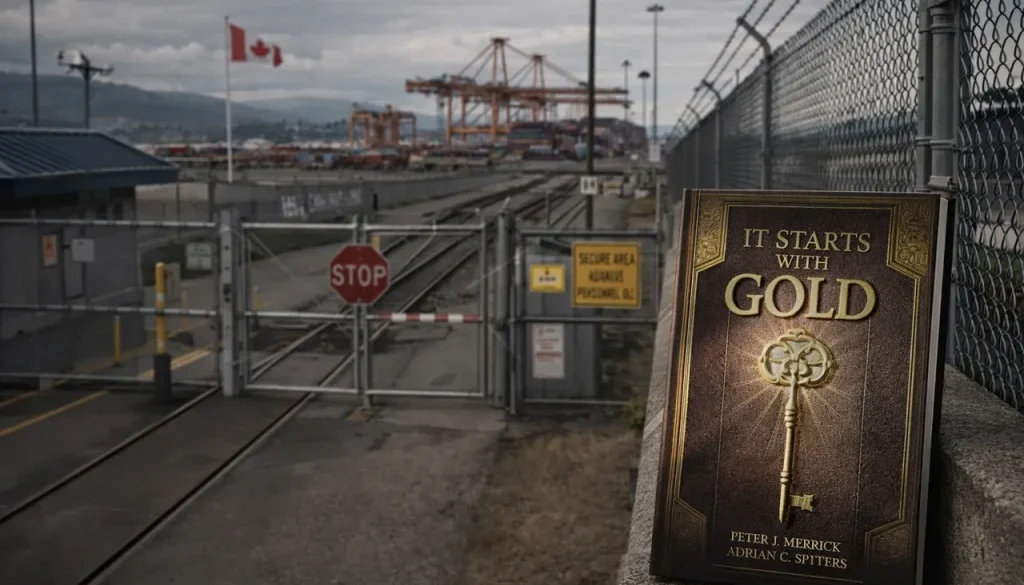
The Quiet Descent of Canada Through Managed Decline
By Peter J. Merrick, TEP® and Adrian C. Spitters, CFP®, co-authors of the international bestseller It Starts With Gold™ and the forthcoming book Guns, Gold & Land™
This analysis continues a series of long-form investigations published in The Merrick Spitters Reset Report™
Why Canada Is Not Becoming Venezuela, But Something Far Harder to Escape
Canada is not becoming Venezuela, and that comparison continues to disarm serious analysis. Venezuela collapsed through visible rupture. Shelves emptied, currency failed, institutions broke publicly, and daily life stopped working. Denial became impossible because survival itself was interrupted.
Canada’s trajectory is unfolding in the opposite way. Systems still function. Institutions still operate. Elections still occur. Money still moves. This continuity allows the population to absorb structural loss without ever experiencing a single moment that demands resistance. When daily life continues, people adapt rather than revolt. Expectations are revised downward in increments, and each revision feels rational when viewed in isolation.
Collapse shocks societies into awareness. Managed decline trains them into compliance.
This article examines how advanced economies lose autonomy without crisis, why Canada’s deep integration makes this process more durable than Venezuela’s collapse, and how populations are sorted by access rather than law. What follows is not speculation or ideology. It is pattern recognition drawn from monetary history, regulatory design, and institutional behaviour in late-cycle systems.
👉 Want to read more articles like this? Subscribe to The Merrick Spitters Reset Report™.
Venezuela Fell Fast, Canada Is Being Formatted
Venezuela collapsed through unmistakable institutional failure. Centralised power destroyed private enterprise, monetary discipline evaporated, and political legitimacy disintegrated as the state isolated itself from global capital. Shortages, hyperinflation, and mass emigration followed quickly, forcing recognition even among those who resisted it.
Canada is not failing in this way. Canada is being formatted.
Formatting is not a political event. It is a systems process. It advances through standards, frameworks, and harmonised rules that narrow discretion while preserving legality. It operates through compliance regimes, reporting requirements, and institutional alignment that appear technical rather than ideological. Each measure is defensible on its own. Taken together, they produce permanent constraint.
History shows that formatting produces more durable outcomes than collapse because it never triggers mass rejection. Populations adjust behaviour gradually while believing they are acting responsibly. That behavioural adjustment becomes the enforcement mechanism.
Phase One: When Abundance Becomes a Liability
Venezuela’s oil wealth became a tool of political control after nationalisation. Canada’s resource wealth is constrained through procedural friction rather than seizure, producing a slower but structurally similar outcome.
Canada holds oil, natural gas, uranium, timber, farmland, freshwater, and critical minerals essential to industrial economies and global supply chains. Yet the ability to develop or monetise those resources increasingly depends on regulatory clarity that rarely arrives. Approval processes stretch across political cycles. Environmental overlays expand without resolution pathways. Legal uncertainty discourages long-term capital commitment.
Capital responds predictably. Investment migrates to jurisdictions where timelines and rules are knowable. Employment contracts not through mass layoffs but through attrition and underinvestment. The public experiences stagnation rather than shock, which suppresses collective response.
The resources remain in the ground. The population remains leveraged.
This is managed scarcity. Scarcity elevates prices, concentrates authority, and increases dependence on central decision-makers. Abundance is reframed as risk, and productivity becomes conditional on permission rather than demand. A nation can appear wealthy while becoming operationally constrained.
Phase Two: Currency Without Collapse
Venezuela destroyed its currency through hyperinflation that erased savings in real time. Canada’s monetary erosion follows a different path, but the destination converges.
Canada does not experience currency panic. Instead, it experiences persistent purchasing-power loss that remains just below revolt thresholds. Inflation moderates episodically, but asset inflation, housing inflation, and cost-of-living pressure remain embedded. Household debt expands to bridge the gap between income and survival, normalising leverage as a permanent condition.
This conditions behaviour. Populations do not revolt against incremental loss. They restructure finances, delay milestones, and internalise erosion as the price of stability. Monetary discipline is replaced by monetary management, where inflation becomes a tool rather than a failure.
Once a society accepts that money no longer stores value reliably, long-term planning collapses quietly. The future is discounted, dependence increases, and political leverage consolidates upward.
Phase Three: Control Without Confiscation
Venezuela imposed capital controls overtly. Canada constructs control through administrative layering that preserves legality while narrowing discretion.
No asset is formally seized. No transaction is explicitly banned. Reporting requirements expand. Compliance costs rise. Financial institutions assume enforcement roles through internal risk frameworks rather than legislation. Access becomes conditional rather than guaranteed, and conditions shift without public debate.
Money still moves, but movement depends on interpretation. Ownership persists, but liquidity becomes reviewable. The absence of confrontation preserves legitimacy, preventing resistance from forming.
Control through friction is more effective than confiscation because it never declares itself as force.
Phase Four: The Middle Class Fades Without Vanishing
Venezuela erased its middle class violently. Canada dissolves it administratively.
Home ownership increasingly depends on inheritance rather than income. Professional wages lose relevance as housing and living costs outpace earnings. Savings erode under inflation and taxation. Dual-income households struggle to achieve stability once associated with single incomes.
The middle class does not disappear. It becomes thinner, more indebted, and more compliant. Individuals internalise failure as personal rather than systemic, fragmenting resistance. Aspirations narrow, and risk tolerance declines.
A middle class that cannot accumulate surplus cannot challenge structure. It becomes a buffer class rather than an independent one.
Phase Five: Dependence Replaces Citizenship
In Venezuela, dependence on the state emerged after private alternatives were destroyed. Nationalisation collapsed enterprise, capital fled, currency failed, and citizens relied on government distribution because markets ceased to function. Dependence was overt and coercive.
Canada’s version is quieter and more durable. Dependence is introduced gradually through programs framed as protection, equity, and care. Income supports, tax credits, subsidies, and emergency measures expand in response to stress but rarely retract. Over time, these mechanisms shift from temporary relief to permanent architecture.
This reshapes behaviour. Productive independence becomes harder to sustain because it lacks institutional insulation. Self-employed individuals and small operators face rising compliance burdens and unpredictable costs. Program participation offers predictability and administrative protection. Rational decision-making shifts from opportunity to eligibility.
Citizenship transforms from a relationship of rights and responsibilities into one of access and compliance. Freedom still exists, but exercising it carries friction, uncertainty, and personal risk. When independence feels unstable and dependence feels safe, populations choose safety. That choice feels prudent in the moment and irreversible once normalised.
Why Canada Is More Dangerous Than Venezuela Ever Was
Venezuela collapsed largely in isolation. Its failures were domestic, its currency crisis internal, and its political breakdown geographically contained. Collapse arrived quickly because institutional failure could not be hidden.
Canada operates inside an entirely different architecture. It is deeply embedded in global banking systems, regulatory harmonisation frameworks, cross-border compliance regimes, digital identity initiatives, and financial surveillance infrastructures designed for interoperability rather than sovereignty.
Pressure in this environment does not arrive through force or decree. It arrives through standards framed as best practice, risk management, and modernization. Institutions adopt these standards voluntarily because non-adoption carries penalties or exclusion. Governments implement them incrementally because they appear technical rather than political.
Once these systems align, reversal becomes impractical rather than illegal. Control migrates from law into infrastructure, from debate into software, from policy into procedure. Unlike Venezuela, where collapse exposed failure, Canada’s integration disguises consolidation as progress.
This makes Canada’s trajectory quieter, more stable, and far harder to resist.
This Is Not Chaos, It Is Order
Decline is commonly imagined as disorder because collapse is the only form most people recognize. They expect disruption, visible failure, and sudden rupture. That expectation prevents recognition of what is happening in Canada, because Canada’s transition is defined not by chaos, but by continuity and control.
Order is not incidental to managed decline. It is the strategy. Disorder unifies populations by creating shared urgency and visible failure. Order fragments them by distributing pressure across millions of private decisions. When systems remain orderly, individuals interpret stress as personal circumstance rather than structural design. This preserves legitimacy while eroding autonomy. People do not organize against systems that appear functional. They reorganize themselves inside them.
Order also removes moral clarity. In chaotic collapse, injustice is obvious and confrontation becomes inevitable. In ordered decline, every constraint arrives with a rationale, a form, and a justification. Nothing feels illegal. Everything feels reasonable. The system does not need to silence dissent when dissent never coheres into accusation.
This is why order is more effective than repression. It preserves compliance without confrontation and stability without consent.
What Comes Next: Consolidation Without Spectacle
Canada will not resemble Venezuela visually or emotionally, and that distinction matters. There will be no mass shortages, no sudden currency failure, and no dramatic moment that forces collective awareness. Canada will surpass Venezuela in efficiency, subtlety, and permanence.
Consolidation in this phase feels inevitable rather than imposed because it occurs simultaneously across domains. Municipal discretion narrows as provincial frameworks align. Professional judgment contracts as regulatory guidance expands. Financial choice diminishes as institutional risk models converge. No single authority announces this shift, which is precisely why it succeeds. When discretion disappears everywhere at once, resistance has nowhere to anchor.
Elections continue, but their relevance changes. They influence tone, not structure. Authority migrates into layers that are not contested at the ballot box because they are presented as technical, neutral, and non-political. Governance does not end. It becomes managerial. Policy debates persist, but only within boundaries already set elsewhere.
This creates a system that feels stable, yet increasingly irreversible.
Phase Six: Exit Becomes Expensive, Not Illegal
In Venezuela, exit became impossible because assets were overtly trapped. Capital controls were visible, absolute, and enforced directly. Canada’s approach achieves similar outcomes through complexity rather than prohibition.
Exit remains legal in Canada, but it becomes financially, administratively, and psychologically punitive. Tax complexity expands in ways that discourage mobility. Reporting obligations follow individuals across borders, increasing exposure and compliance risk. Withholding rules penalize capital movement. Delays, reviews, and administrative flags become routine rather than exceptional.
Financial institutions respond defensively, increasing friction pre-emptively to manage their own regulatory exposure. Individuals are not told they cannot leave. They are taught that leaving is costly, suspicious, and destabilizing. Over time, mobility shifts from being a broadly accessible right to a privilege reserved for those who planned early.
Those who recognize this phase preserve flexibility while it remains affordable. Those who delay discover that timing, not legality, was the asset they failed to protect.
Phase Seven: Ownership Without Control
Property ownership in Canada persists legally, but authority over property migrates administratively. This shift is subtle because titles remain intact, which prevents immediate resistance.
Zoning frameworks expand beyond land use into behavioural compliance. Environmental overlays impose conditionality without clear resolution pathways. Insurance availability increasingly dictates what can be done with property regardless of ownership. Capital access tightens as lending becomes contingent on alignment with external criteria unrelated to the owner’s intent.
The owner retains title but loses practical authority. Decision-making shifts to regulators, insurers, lenders, and planners whose incentives are aligned with institutional risk management rather than individual outcomes. Ownership becomes stewardship subject to evolving permissions rather than control exercised by right.
This is not confiscation. It is conditional ownership that preserves legal form while hollowing substance. Because no single moment marks the loss, resistance never coheres.
Phase Eight: Risk Is Reclassified as Dissent
In Venezuela, dissent was criminalized openly. The state named opponents, arrested them, and used force to maintain control. Repression was visible and personal, which clarified the power dynamic even as it crushed resistance.
Canada’s model operates on an entirely different logic. Dissent is not labeled as opposition. It is reclassified as risk. This shift is subtle but decisive. Once disagreement is framed as exposure rather than defiance, enforcement no longer requires ideology, law, or even intent. It requires only policy.
Financial accounts are reviewed rather than frozen. Reviews create uncertainty without triggering legal thresholds. Platforms disengage rather than censor publicly, citing terms of service or internal risk policies rather than values or politics. Employers reassess exposure rather than terminating explicitly, framing decisions as fiduciary or reputational prudence. Financial institutions de-risk relationships through opaque, automated frameworks that are largely immune to appeal.
This changes the nature of enforcement. Power no longer appears as punishment. It appears as absence. Services become unavailable. Access is delayed. Relationships dissolve quietly. The affected individual is not accused of wrongdoing, which removes the possibility of defence. There is no charge to contest, no ruling to appeal, and no authority to confront.
Enforcement migrates from law into policy, and from policy into distributed institutional behaviour. Decisions are decentralized across banks, insurers, platforms, employers, and regulators, each acting independently but within aligned risk frameworks. Accountability dissolves because no single actor claims responsibility. Every decision appears procedural, justified, and unavoidable.
This reclassification alters behaviour even among those who never intend to dissent. When risk replaces wrongdoing as the trigger for consequence, individuals begin to self-regulate pre-emptively. They avoid actions that increase scrutiny, moderate opinions that complicate categorization, and align behaviour not to law, but to perceived acceptability. Control no longer requires active enforcement. It operates through anticipation, producing compliance by habit rather than coercion.
Phase Nine: Time Compression
Managed decline depends on gradualism. Slow drift creates the illusion of time, and that illusion is its most powerful defense. People assume that because change is incremental, response can be deferred indefinitely. They believe there will be warning before the door closes.
Systems do not operate this way. They move slowly until alignment is complete. Regulatory frameworks harmonize. Data systems integrate. Identity layers converge. Reporting becomes continuous rather than episodic. Each step feels technical and manageable when viewed alone.
Time compression is not experienced equally. Those positioned inside aligned systems adapt quickly because change reinforces existing dependencies. Those outside alignment experience disruption because access shifts faster than behaviour. This asymmetry is why the transition feels sudden only to some. Others barely notice it at all.
By the time public awareness catches up, adjustment windows have closed. What remains is compliance or penalty, alignment or exclusion. The system does not announce this moment because it does not need to. Functionality continues. Choice does not.
Why Resistance Never Forms
Resistance requires three conditions. A clear enemy that can be identified. A visible injustice that can be articulated. A shared breaking point that unifies response. Canada provides none of these conditions.
Nothing visibly breaks. Stores remain stocked. Elections continue. Infrastructure functions. Institutions appear stable. Harm is distributed rather than concentrated, spread across inflation, compliance costs, delays, and opportunity loss. No single event feels decisive enough to justify revolt.
Language remains calming. Policies are framed as technical improvements, safety measures, or modernization. Costs are dispersed across time and population, which prevents solidarity. Each individual feels pressure privately and assumes others are coping better.
Resistance also fails because it requires shared language. Managed systems dilute language. Concepts become abstract. Causes become procedural. Responsibility becomes diffused. Without common words to describe harm, populations cannot coordinate a response. They sense loss but cannot articulate it collectively.
Debate fades not because it is forbidden, but because it becomes irrelevant. The structure no longer depends on persuasion. It depends on participation.
The Quiet End State
The end state does not resemble collapse because collapse would require visible failure. What emerges instead is functionality without freedom, a condition far more stable and far harder to reverse. Systems continue to operate at a level sufficient to meet basic expectations. Payments clear. Infrastructure functions. Services remain available. Governance appears orderly, predictable, and managed.
Daily life continues without interruption, which is precisely why the end state is difficult to recognize. There is no emergency broadcast, no defining crisis, and no moment that demands collective attention. Instead, there is a persistent sense of constraint that cannot be traced to a single policy, institution, or decision. Each limitation feels rational on its own. Together, they form an environment where choice narrows without ever being formally revoked.
Ambition fades not because people lose desire, but because effort no longer produces proportional reward. Advancement becomes conditional on alignment rather than merit. Risk-taking carries penalties that are asymmetric and unpredictable. Over time, people recalibrate expectations downward, not out of resignation, but out of pragmatism. Aspiration survives only where it is institutionally sanctioned.
Autonomy shrinks because independent action accumulates friction. Decisions that once required judgment now require approval. Activities that once relied on ownership now depend on permission. Ownership persists legally, but outcomes are governed by layers of authorization that sit above the individual. Control migrates upward while responsibility remains below.
The population senses that something fundamental has changed, but language fails to capture it. The past feels freer, yet few can articulate what was lost or when it disappeared. Venezuela demonstrates what happens when currency fails visibly and forces recognition. Canada demonstrates what happens when choice erodes first, followed quietly by money, land, and freedom.
This is not collapse. It is completion, the point at which the system no longer needs to expand control because it has normalized it.
Who Survives Advanced Decline
Late-cycle systems do not collapse evenly, and they do not treat populations equally. They sort people by access rather than by law, using incentives and friction instead of force. This sorting is gradual, largely invisible, and highly effective.
The first group integrates fully. These individuals and institutions comply early, remain liquid inside the system, and adopt every new framework as it appears. They align credentials, reporting, behaviour, and assets with institutional expectations. Materially, they survive and often appear successful. They feel protected because the system rewards their predictability and cooperation.
Over time, this group surrenders autonomy without noticing its absence. Choice narrows, but alternatives were never attractive to begin with. Protection replaces independence, and stability becomes indistinguishable from security. This group does not experience loss as loss. It experiences it as order.
The second group delays. They trust moderation, institutional goodwill, and historical continuity. They believe that staying reasonable will be enough. They are not punished overtly. Instead, they are priced out. Inflation erodes purchasing power. Compliance costs rise. Debt becomes permanent. Opportunities narrow while obligations expand.
This group works harder for diminishing freedom and blames itself for falling behind. The pressure feels personal rather than structural. Because there is no clear injustice to point to, frustration turns inward. This group carries the system’s weight without sharing its protections.
The third group recognizes the pattern early. They accept friction upfront to avoid captivity later. Rather than optimizing for status, yield, or institutional approval, they optimize for mobility. They reduce dependency before reducing risk, understanding that exposure without exit is not safety.
This group preserves optionality by design. It diversifies systems, not just assets. It avoids visibility where visibility creates dependency. It values control over convenience and resilience over efficiency. This group does not seek influence, validation, or recognition. It remains small because early discomfort is unattractive to most people.
Optionality becomes the rarest asset in mature systems. Those who preserve it do not announce it. They simply remain capable of moving when others cannot.
The Behaviour That Preserves Autonomy
Those who endure advanced decline do not behave like conventional investors, optimizers, or status-seekers. They do not orient their decisions around maximum return, social validation, or institutional approval. Their primary objective shifts toward preserving exit capacity long before exit becomes urgent. This distinction matters because late-stage systems reward compliance and punish optionality in subtle but consistent ways.
The first behavioural shift is a redefinition of risk. Most people define risk as volatility or loss. Those who preserve autonomy define risk as dependency. They examine every decision through a different lens: what fails if access is delayed, revoked, or conditioned. If income, shelter, liquidity, or identity depends entirely on uninterrupted system cooperation, then stability is an illusion rather than protection.
This leads to a deliberate separation of ownership from systems. Assets are no longer evaluated solely on yield, convenience, or institutional endorsement. They are evaluated on independence, durability, and control. Concentrating wealth, identity, or livelihood inside a single framework becomes unacceptable because alignment today can become restriction tomorrow. Distribution replaces optimization.
Inconvenience is embraced early because friction now is cheaper than captivity later. Additional steps, slower processes, and reduced efficiency are accepted as the price of resilience. Comfort is recognized as a trap in late-stage systems, not because it is immoral, but because it increases visibility, traceability, and dependency. The goal is not isolation, but optional disengagement.
Discipline replaces reactivity. Those who preserve autonomy do not chase narratives, trends, or emergency responses. They understand that emotional decision-making leaves a trail. Visibility increases vulnerability. Silence, patience, and consistency reduce exposure. This is not passivity. It is strategic restraint.
Visibility becomes a liability in mature systems because it creates dependency. The more legible an individual becomes to institutional frameworks, the easier it is to assess, categorize, and condition access. Those who preserve autonomy do not seek obscurity for its own sake. They seek proportionality, remaining visible where benefit exists and opaque where dependency would form.
This is not secrecy. It is selective exposure. Autonomy survives not by withdrawal from systems, but by refusing total immersion in any single one.
Why Gold Reappears Every Time
Gold does not reappear because of tradition, nostalgia, or ideology. It reappears because of what it is structurally incapable of becoming.
Gold does not rely on an issuer. It is not a promise, a contract, or a claim on future performance. It does not require a counterparty to function. There is no board, protocol, or authority that can alter its nature. This absence of dependency becomes decisive when systems consolidate and permission governs access.
Gold does not require authentication by an institution to exist. It does not need to be validated, updated, or aligned. It exists independently of digital infrastructure, regulatory frameworks, or behavioural compliance. It cannot be reprogrammed to enforce policy. It cannot be frozen through a policy change. It cannot be de-risked by an internal committee.
As systems mature, paper claims multiply. Financialization expands faster than underlying productivity. Digital representations of value proliferate because they are efficient to create, track, and control. Trust becomes abstract, centralized, and conditional. Each layer added to the system increases convenience while reducing finality.
When permission governs access, final settlement matters more than liquidity. Gold settles without appeal. It does not remember transactions. It does not record identity. It does not adjust based on behaviour or alignment. Its lack of memory is not a flaw. It is its defining feature.
Empires rise and fall. Monetary systems evolve and consolidate. Legal frameworks expand and fragment. Through each cycle, gold persists not because it competes with systems, but because it outlives them. It does not replace currency. It outlasts regimes.
Gold remains because it answers the one question advanced systems cannot tolerate being asked: what still works when permission is withdrawn.
That is why it returns at the end of every cycle.
Owning Assets in Order of Asset Security
When systems enter managed decline, survival does not depend on optimism, forecasting, or persuasion. It depends on structure. History is unambiguous on this point. During periods of monetary distortion, political intervention, and institutional consolidation, outcomes are determined less by how much wealth someone has and more by where that wealth sits within the system.
The central mistake most investors make is assuming that all assets carry equal security. They do not. Some assets exist outside institutional systems. Others exist entirely within them. Some assets are bearer instruments. Others are promises. Some preserve purchasing power through disruption. Others depend on uninterrupted confidence, liquidity, enforcement, and permission.
In advanced systems, these differences become decisive.
As access becomes conditional, ownership migrates from right to approval. Assets that once appeared equivalent diverge sharply under stress. What matters is not return, branding, or familiarity, but whether an asset remains accessible, enforceable, and under the owner’s control when systems tighten rather than fail.
This is the logic behind Owning Assets in Order of Asset Security™.
Rather than asking how to maximize performance, this framework asks how to preserve certainty. What assets remain accessible when markets close or settlement is delayed. What assets retain value when currencies weaken gradually rather than collapse. What assets remain controlled by the owner rather than intermediaries. What assets endure changes in policy, regulation, enforcement priorities, or financial plumbing.
Once this hierarchy is understood, diversification stops being cosmetic. The objective is not to own everything. It is to own the right things, in the right order, so that what is most exposed is protected first.
From this principle emerge the Five Pillars of Asset Security™.
The Five Pillars of Asset Security™
The Five Pillars of Asset Security™ are not independent strategies or product silos. They function as a layered system designed to preserve control, access, and continuity as financial, legal, and institutional conditions deteriorate. Each pillar addresses a specific failure point that appears repeatedly in late-cycle systems. Together, they form a hierarchy that prioritizes certainty over performance and resilience over optimization.
- Gold and Precious Metals as Foundational Security: Gold and precious metals sit at the base of the structure because they carry no counterparty risk, no default risk, and no reliance on financial institutions, digital infrastructure, or settlement systems. They exist outside the permissioned economy. They preserve purchasing power through currency debasement and remain functional when confidence, liquidity, or enforcement fails. This pillar is not designed to generate yield or outperform markets. It exists to remove dependence entirely. In a world where access increasingly governs outcomes, assets that require no approval to exist become foundational rather than optional.
- Alternative Investments That Reduce Systemic Exposure: Private real estate, private credit, and other non-public assets reduce reliance on public markets increasingly distorted by leverage, derivatives, and policy intervention. These assets are valued by cash flow, utility, and contract rather than daily sentiment. They generate income independent of market liquidity and retain relevance when correlations converge and volatility spikes. This pillar is not about avoiding risk. It is about reducing exposure to system-wide failure modes that emerge when public markets become instruments of policy rather than price discovery.
- Private Portfolio Management and Counterparty Discipline: Most financial assets are held through custodial chains that expose investors to counterparty risk, asset commingling, rehypothecation, and institutional leverage. In periods of stress, these risks migrate quickly from theoretical to operational. Private discretionary portfolio management introduces stronger oversight, independent custody, and clearer segregation of assets. It improves transparency, governance, and access while reducing reliance on any single institution’s balance sheet or internal risk tolerance. This pillar does not eliminate market risk, but it materially reduces structural risk when institutions themselves become points of failure.
- Mutual Life Insurance as Capital Protection Infrastructure: Participating whole life insurance issued by mutual companies functions as long-term capital infrastructure rather than a market asset. These contracts are insulated from quarterly earnings pressure, market volatility, and public market sentiment. They provide tax-efficient growth, balance-sheet stability, and estate continuity across political, fiscal, and generational transitions. In late-cycle systems, this pillar stabilizes the broader structure by preserving capital, smoothing volatility, and maintaining optionality when other assets become impaired or constrained.
- Jurisdictional, Legal, and Structural Control of Assets: Even well-chosen assets can fail if they are held within vulnerable legal, regulatory, or jurisdictional structures. This pillar addresses where and how assets are owned, not just what they are. Title integrity, corporate and trust structures, cross-border exposure, creditor risk, regulatory reach, and enforceability matter more as systems consolidate. Ownership must be durable, defensible, and respected across changing legal and political conditions. Assets must not only exist. They must be insulated from administrative overreach, emergency powers, retroactive rule changes, and silent reclassification. This pillar ensures that ownership remains real rather than nominal.
How the Five Pillars Work Together
The Five Pillars of Asset Security™ operate as a unified system rather than a checklist. Gold and precious metals anchor the structure by removing counterparty risk entirely. Alternative investments reduce dependence on fragile public markets. Private portfolio management enforces counterparty discipline and transparency. Mutual life insurance protects capital across time and volatility. Jurisdictional and legal structuring ensures that ownership itself remains enforceable.
Together, the pillars shift the objective from maximizing returns to preserving control, access, and continuity by owning assets in the order they are most likely to endure.
In It Starts With Gold™, this framework is presented not as a prediction of collapse, but as a response to conditional access, administrative control, and managed decline. The goal is not to eliminate risk, which is impossible, but to prioritize certainty in a world where ownership increasingly depends on permission.
This framework is not designed for best-case scenarios. It is designed for stress.
Acting While Choice Still Exists
This article is not intended to provoke panic or paralysis. It is intended to restore agency.
Systems built on narrative eventually collide with structure. When that collision occurs, the window for voluntary positioning closes quickly. What can be done quietly and deliberately today often becomes restricted, conditional, or costly tomorrow.
This is why structure matters more than prediction.
👉 Use our Calendly Link to Schedule a Complimentary Review.
These principles are explored in depth in It Starts With Gold™, co-authored by Peter J. Merrick, TEP® and Adrian C. Spitters, CFP®. The book explains how to establish a tangible asset foundation, evaluate security across asset classes, and protect against systemic shocks while maintaining control of your future. Learn more at www.ItStartsWithGold.com.
👉 Sign up for The Merrick Spitters Reset Report™ to receive a digital copy of It Starts With Gold™, our white paper Last Asset Standing™, and early updates on our forthcoming book Killing Crypto™.
Prefer a hard copy? Order It Starts With Gold™ on Amazon today.
Selected Institutional Sources for Context and Further Study
- Bank for International Settlements. Annual Economic Report 2023. Basel: Bank for International Settlements, June 2023.
- Bank for International Settlements. Central Bank Digital Currencies: An Opportunity for the Monetary System. Basel: Bank for International Settlements, June 2021.
- Bank for International Settlements. “Global Liquidity: Vulnerabilities and Policy Challenges.” BIS Quarterly Review, December 2022. Basel: Bank for International Settlements.
- Bank of Canada. Monetary Policy Report. Ottawa: Bank of Canada, October 29, 2025.
- Bank of Canada. “Laying Bare the Evolution of Payments in Canada.” Ottawa: Bank of Canada, May 2024.
- Bank of Canada. “Cashing in on Payments Innovation.” Ottawa: Bank of Canada, September 18, 2025.
- Government of Canada. How Canada’s Regulatory System Works. Ottawa: Government of Canada, last modified October 16, 2025.
- Government of Canada. Canada’s Digital Charter. Ottawa: Innovation, Science and Economic Development Canada, 2023.
- International Monetary Fund. Global Financial Stability Report: Safeguarding Financial Stability Amid High Inflation and Geopolitical Risks. Washington, DC: International Monetary Fund, October 2023.
- Tok, Yoke Wang, and Dyna Heng. Fintech: Financial Inclusion or Exclusion? IMF Working Paper No. 2022/080. Washington, DC: International Monetary Fund, May 6, 2022.
- Cevik, Shekhar, et al. Promise (Un)kept? Fintech and Financial Inclusion. IMF Working Paper No. 2024/131. Washington, DC: International Monetary Fund, 2024.
- Organisation for Economic Co-operation and Development. OECD Economic Surveys: Canada 2025. Paris: OECD Publishing, May 26, 2025.
- Organisation for Economic Co-operation and Development. Regulatory Policy Outlook 2023. Paris: OECD Publishing, 2023.
- Organisation for Economic Co-operation and Development. Going Digital: Shaping Policies, Improving Lives. Paris: OECD Publishing, 2019.
- World Economic Forum. Global Risks Report 2024. Geneva: World Economic Forum, January 2024.
- World Economic Forum. Shaping the Future of Financial and Monetary Systems. Geneva: World Economic Forum, ongoing initiative.
- World Economic Forum. Identity in a Digital World: A New Chapter in the Social Contract. Geneva: World Economic Forum, 2018.