The Reverse Market Crash That Will Redefine Wealth and Power
By Peter J. Merrick, TEP® and Adrian C. Spitters, CFP®, co-authors of the international bestseller It Starts With Gold™ and the forthcoming book Guns, Gold & Land™
This analysis continues a series of long-form investigations published in The Merrick Spitters Reset Report™

The Greatest Bubble Is Hidden in Plain Sight Inside the Dollar
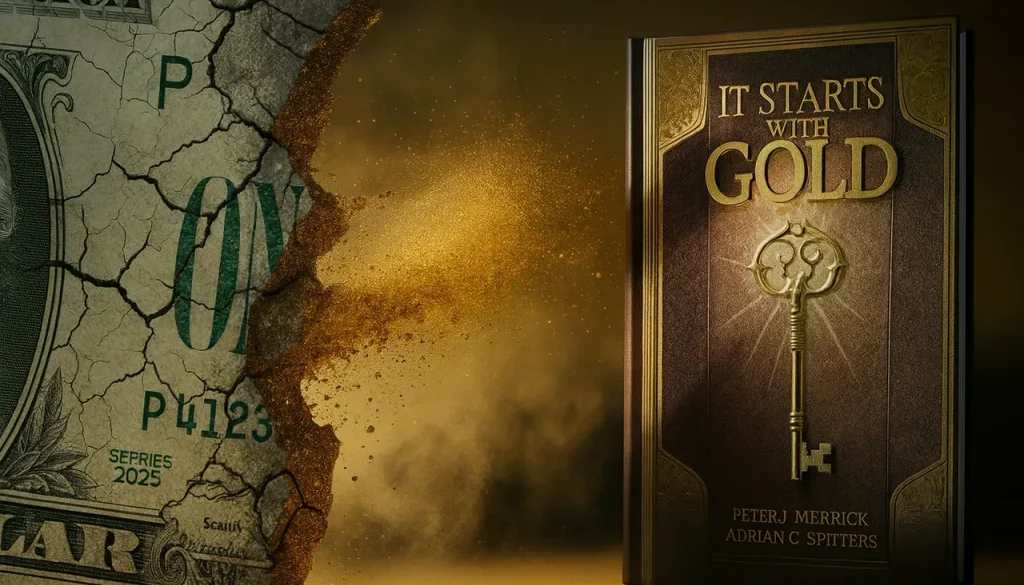
The world stands on the edge of a financial inversion few understand. The public watches for a real estate collapse or a stock market correction, unaware that the real danger lies at the heart of the system itself. The true bubble is not in housing or equities. It is inside the dollar.
When the measuring stick itself becomes unstable, everything measured by it distorts. Stocks, bonds, real estate, pensions, and even the meaning of work all depend on faith in the currency. Once that faith begins to erode, every layer of the economy tilts.
The symptoms are familiar, but the cause is not. The last crisis was born of leverage and fraud. The next will come from mathematics itself, the unavoidable consequence of debt compounding faster than the economy that supports it.
The tragedy is that most investors are still fighting the last war. They wait for another 2008-style crash, believing that prices will fall and bargains will appear. But the next crash is not deflationary. It is inflationary. The structure of risk has reversed.
👉 Subscribe to The Merrick Spitters Reset Report™ and receive a digital copy of our international bestseller, It Starts With Gold™, along with our white paper, Last Asset Standing™ and early updates on our forthcoming book, Killing Crypto™.
The Illusion of Safety
In 2008, the crisis began with real estate. Banks had leveraged toxic debt into the housing market, and when it collapsed, asset prices fell across the board. Cash was king. Those who held liquidity could re-enter at the bottom and profit from the recovery.
Today, cash is the risk. The U.S. federal government’s gross national debt has now surpassed thirty-eight trillion dollars. Annual deficits exceed 1.8 trillion. The government borrows just to service existing interest, and buyers of that debt are disappearing. Foreign central banks have begun selling Treasuries. Domestic pension funds are forced to absorb the excess under regulatory pressure.
This is no longer the same financial world. When the Federal Reserve must print money to pay interest on its own balance sheet, confidence in the dollar becomes fragile. The so-called “risk-free rate” turns into a risk itself.
What once seemed solid now rests on faith alone. The dollar is still the foundation of global trade, but it has become the very bubble it used to protect others from.
Monetary policy has become a weapon of necessity rather than a tool of stability. Interest rates are now used to defend the currency instead of managing the economy. Each increase buys temporary confidence at the cost of future insolvency. Confidence has become policy, not principle, and the cracks are beginning to show.
The Signals of Flight
The clues are everywhere for those willing to look. Gold has quietly become the primary barometer of confidence. As of October 2025, gold trades above 4,200 dollars per ounce, shattering all previous records. This is not speculation. It is a defence.
Central banks from China, India, Russia, and the Middle East are buying physical bullion at a pace unseen in modern history. They are diversifying away from Treasuries, not because they want to, but because they must. Every ounce of gold purchased is a silent vote against the stability of the dollar.
Even Western institutions, once skeptical, are accumulating physical metal. Private vaulting facilities in Switzerland and Singapore are reporting record inflows. This is capital seeking refuge, not return.
For individual investors, the same principle applies. Gold ownership is no longer a matter of speculation but one of survival. As the institutional shift accelerates, those who hold physical bullion outside the banking system preserve purchasing power that cannot be frozen or diluted. The strongest portfolios now include verifiable, allocated holdings through trusted channels that ensure full ownership and liquidity.
The signals point to something deeper than volatility. The system itself is turning inside out.
The Reverse Market Crash
Most investors still expect a crash that looks like 2008. They assume prices will collapse and cash will regain power. But the dynamics have flipped. In a reverse market crash, the currency itself loses value faster than asset prices can fall.
Markets may appear strong in nominal terms even as real wealth erodes. Stocks can rise, yet purchasing power collapses. This is what confuses the average investor. They see growth in their portfolio, but their grocery bill tells a different story.
Inflationary crashes hollow out the middle class. Wages lag, savings lose meaning, and financial institutions offer products that appear to protect but actually inflate away. Those holding cash will discover too late that their wealth has dissolved quietly, not through price collapse but through monetary dilution.
The Bubble Inside the Dollar
Debt is now the air that fills the bubble. The U.S. Treasury market, once considered the safest asset on Earth, has become the system’s weakest link. Yields fluctuate wildly, liquidity is thinning, and demand is increasingly artificial.
Foreign governments once trusted U.S. bonds as reserves. That trust is fading. Nations are creating bilateral settlement systems, trading oil, food, and energy directly without using the dollar. Each transaction bypasses the system America built after World War II.
History teaches that every empire expands through credit and declines through currency. When faith in the empire’s money fades, its influence follows. The United States now stands where Rome once stood when its denarius was debased beyond recognition.
The world’s reserve currency is losing its innocence, and with it, the assumptions that built modern investing.
The Investor’s Trap
Investors today face two opposing fears: the fear of loss and the fear of missing out. Most freeze between the two. If they hold cash, they lose purchasing power. If they chase inflated assets, they risk collapse.
That paralysis serves the system. It keeps people stationary while policy resets the rules. The solution is not to pick between inflation and deflation but to step outside the game entirely.
Owning assets that exist beyond the reach of central banks is the only real defence. Gold, farmland, and private real estate form the foundation of tangible wealth. They exist outside the permission structure of the financial system.
In a system built on promises that cannot all be kept, only tangible assets remain honest.
Gold in particular remains unmatched. It requires no trust, no signature, no digital network. It has no counterparty risk. Its value does not depend on political promises or fiscal policy.
Gold’s Return to Power
For those who refuse to remain trapped, the answer lies not in theory but in substance.
Gold’s resurgence is not a speculation on inflation. It is a recognition that paper money has reached its expiration date. The asset once dismissed as relic is now the anchor to reality.
Refiners in Switzerland and the United Arab Emirates are operating at full capacity to meet global demand. Central banks continue to take physical delivery instead of paper derivatives. This signals a profound shift: the world’s largest financial players no longer trust paper claims on gold. They want the metal itself.
Gold has resumed its historic role as the world’s neutral reserve. It is becoming once again what it was designed to be: the measure of honesty in an age of deceit.
In that return lies a quiet form of justice. Every coin and bar represents reclaimed sovereignty, an assertion that truth still carries weight.
As this revaluation continues, the gap between paper wealth and tangible wealth will widen. The illusion of prosperity will fade, replaced by a new hierarchy built on possession, not promise.
The Four Pillars of Asset Survival
History rewards those who prioritize Owning Assets in Order of Asset Security. Gold, productive land, income-generating private assets, and mutual life insurance have survived every monetary reset in recorded history. Each represents a step away from dependence and a step toward autonomy.
Gold is the foundation. It is the universal asset that requires no promise, no institution, and no trust. It is liquid, borderless, and incorruptible. It has preserved value through wars, defaults, and political upheavals. It is the first layer of real wealth.
The second pillar is productive land. Farmland and natural resources create the essential goods that societies cannot function without. They generate real output, feed populations, and provide lasting utility when paper markets fail. Ownership of land that sustains life is the truest form of independence.
The third pillar is private income-producing assets. These include private equity, private real estate, and private credit structures that generate consistent cash flow outside the public markets. They are shielded from the volatility and manipulation of large exchanges, preserving purchasing power through real utility and enduring demand.
The fourth pillar is mutual life insurance held through a participating policy with a financially strong mutual company. It provides stable, tax-efficient liquidity while compounding in value through dividend participation. It protects families, estates, and businesses when traditional capital markets seize.
Together, these four pillars form a hierarchy of security. Each tier strengthens the next. Wealth built upon this structure is not only preserved but also positioned to grow when the rest of the system resets.
The tipping point may come quietly. A failed Treasury auction, a downgrade of U.S. credit, or a liquidity shock in repo markets could expose what policymakers already know: the buyer of last resort has become the system itself.
The Treasury Market at the Breaking Point
The U.S. Treasury market is the cornerstone of the global financial system, yet it now shows cracks that can no longer be ignored. Primary dealers are struggling to absorb record issuance. Auctions fail more frequently. Yields hover above six percent, forcing the Federal Reserve System to intervene quietly through repurchase facilities and emergency liquidity lines.
Daily Treasury trading volumes now exceed one trillion dollars, but bid-to-cover ratios have fallen to decade lows. Foreign holdings of U.S. debt are down more than fifteen percent since 2022, leaving domestic institutions to fill the gap. This is the stage where confidence unravels from the top down.
When the cost of borrowing becomes uncontrollable, fiscal policy loses meaning. Each additional dollar printed to fund deficits undermines the credibility of the next one. It is a cycle that feeds on itself until the market demands either austerity or default, neither of which modern democracies can sustain.
Behind the scenes, pension funds and insurance companies are being encouraged to hold more long-term government debt. These institutions are becoming the shock absorbers of systemic risk. Their balance sheets are being used as ballast to prevent visible cracks in the structure. But this protection is temporary. The more the Treasury depends on captive buyers, the closer it moves to a command economy in disguise.
Global Contagion
The United States remains the world’s largest economy, but its currency is now the epicentre of instability. Every nation tied to the dollar through trade or reserves is pulled into the same current.
Canada’s banks, long seen as the world’s most stable, now carry record exposure to government securities and mortgage-backed debt tied to inflated property values.
Canada, the United Kingdom, the European Union, and Australia mirror the same pattern of excessive debt and shrinking productivity. Their currencies move in tandem with the dollar, and their inflation rates reflect imported monetary disorder. According to the Organisation for Economic Co-operation and Development (OECD), inflation across the G7 remains above five percent despite weakening growth, confirming that currency erosion is now global, not local.
This contagion is not only financial. It is political. Governments facing collapsing purchasing power often respond with control. Capital restrictions, digital identification systems, and programmable currencies are introduced as tools of “stability.” In truth, they are mechanisms to contain the fallout of policy failure.
These measures are not isolated reforms but components of a broader transition toward centralized digital governance. They represent the financial arm of a technocratic reset now unfolding globally.
What begins as a fiscal crisis ends as a sovereignty crisis. Citizens find their economic freedom quietly exchanged for access privileges. Every transaction becomes a data point. Every withdrawal becomes a request.
As governments tighten control, the most seasoned investors quietly loosen theirs.
Institutional Rotation into Tangible Assets
Those who understand what is unfolding are already preparing. Sovereign wealth funds, private family offices, and large pension administrators are rotating away from paper exposure into tangible assets. The most sophisticated investors are not buying volatility; they are buying permanence.
In the past two years, private allocations to gold, agricultural land, and infrastructure have doubled among ultra-high-net-worth clients. This migration is not speculative; it is defensive. These investors know that when money itself becomes the problem, the only protection is to hold something that cannot be replicated by policy.
This quiet rotation will define the next decade. The wealth of nations will increasingly rest on control of real assets: energy, food, water, and metals. Financial portfolios built solely on paper instruments will find themselves unanchored in a world that no longer trusts digits on a screen.
The Social Consequences
As savings decay, the social fabric frays. Homeownership declines, birth rates fall, and small businesses close under the weight of rising credit costs. The middle class, once the engine of democracy, becomes the casualty of financial engineering. What begins as monetary policy ends as social collapse.
A generation raised on cheap credit is now confronting the limits of debt. Young families cannot afford homes, graduates begin their lives underwater, and retirees discover that fixed incomes no longer cover basic living costs. Desperation grows quietly at first, then erupts into public anger when expectations no longer match reality.
Economic instability reshapes culture. When work no longer guarantees progress, people turn to the state for security. Dependency becomes policy. Every crisis justifies another layer of control. What starts as stimulus ends as surveillance.
Inflation erodes more than money; it erodes trust. Once trust disappears, societies fracture into factions competing for subsidies and protection. Civic unity dissolves into resentment, and citizens exchange freedom for a promise of stability that never arrives.
The Moral Reckoning
Every financial collapse carries a moral lesson. The present system was built on debt expansion justified as progress. Consumption replaced production. Policy replaced discipline. Each generation borrowed from the next, mistaking credit for wealth.
The reckoning will not only be economic but spiritual. When trust in currency dies, so does trust in the institutions that issued it. What remains is a question of character. Will people cling to illusion, or will they rebuild on truth?
Gold endures because it represents honesty in value. It cannot be printed, edited, or redefined by decree. It is proof of labour crystallized in metal. To hold it is to acknowledge that real wealth requires effort and restraint.
A New Hierarchy of Value
As this reverse market crash unfolds, a new hierarchy of value will emerge. At the top will be tangible assets: gold, productive land, and businesses that generate essential goods. Beneath them will sit financial instruments that rely on political permission to function. At the bottom will be fiat currency, the decaying measurement of everything else.
This transition will not be declared publicly. It will be felt through quiet shortages, sudden policy shifts, and the widening gap between nominal and real prosperity. By the time most recognize it, the transfer of wealth will already be complete.
But awareness still matters. Those who act now can still choose which side of history they occupy. Ownership is not only about money; it is about freedom. Every ounce of gold, every acre of land, every private enterprise represents a small act of defiance against dependence.
The Path Forward
There is no way to stop the cycle of debt from reaching its conclusion, but there is a way to step outside it. The solution is to rebuild personal economies on foundations that cannot be printed or frozen.
To implement this strategy effectively, investors need partners who specialize in acquiring and storing physical metals outside traditional financial institutions. We work closely with New World Precious Metals, an independent precious-metals firm trusted by Canadian and international investors alike that facilitates direct ownership and insured storage of gold and silver holdings through fully segregated accounts. Their approach aligns with our philosophy of protecting wealth through transparency, custody integrity, and accessibility.

At our firm, we help clients structure their wealth by Owning Assets in Order of Asset Security, beginning with the most secure forms of value and working outward to ensure that no single point of failure can destroy a lifetime of effort.
We teach that true diversification is not about owning many things; it is about owning the right things in the right order. Physical gold anchors that order. It is the base upon which all other assets gain stability.
Stay informed. Stay prepared. Act while choice still exists.
A Final Word of Hope
History reminds us that every reset is also a beginning. The collapse of one order gives birth to another. The difference lies in who prepares. Those who wait for permission will live under new rules written by others. Those who act early will write their own.
The urgent themes discussed here are expanded on in our #1 international best-selling book, It Starts With Gold™, co-authored by Peter J. Merrick, TEP® and Adrian C. Spitters, CFP®. In the book, we reveal how to establish a tangible-asset foundation, measure security across asset classes, and safeguard against systemic shocks while maintaining control of your future. Visit www.ItStartsWithGold.com.
👉 Sign up today for The Merrick Spitters Reset Report™ to receive a digital copy of our international bestseller, It Starts With Gold™, our white paper, Last Asset Standing™, and early updates on our upcoming book, Killing Crypto™.
Prefer a hard copy? Order It Starts With Gold™ on Amazon today.
References
- WTOP News – “U.S. Hits $38 Trillion in Debt After the Fastest Accumulation of $1 Trillion Outside of the Pandemic.” October 2025
- Reuters – “Gold Hits Record High Above $4,200 Per Ounce as Investors Flee Paper Markets.” October 15, 2025
- American Action Forum – “U.S. Treasury FY 2025 Deficit Totaled $1.8 Trillion.” October 2025
- Bloomberg – “Treasury Market Liquidity Nears Crisis Levels as Yields Surge.” October 2025
- World Gold Council – “Gold Demand Trends Q3 2025 – Record Central Bank Purchases Exceed 800 Tonnes.” October 2025
- Reuters – “China and Saudi Arabia Expand Yuan-Based Energy Trade.” September 2025
- Organisation for Economic Co-operation and Development (OECD) – “Inflation Indicators Across G7 Economies, October 2025”
- Preqin – “Global Alternatives Report 2025 – Private Capital Allocations to Real Assets Continue to Rise.” 2025
- Atlantic Council – “Central Bank Digital Currency (CBDC) Tracker.” 2025
Disclaimer
This publication is provided for informational and educational purposes only. It is not intended to constitute financial, legal, tax, or investment advice and should not be relied upon as a recommendation to buy or sell any security, asset, or financial product. The views expressed in this article reflect the professional opinions of the authors, Peter J. Merrick, TEP®, and Adrian C. Spitters, CFP®, and do not necessarily represent those of any affiliated or regulated firm.
Every effort has been made to ensure that the information presented is accurate and current as of publication. However, economic data, government policy, and market conditions are subject to rapid change without notice. No warranty, express or implied, is given as to the accuracy, completeness, or timeliness of the content.
All investments involve risk, including the potential loss of principal. Real estate, interest rates, and currency valuations may fluctuate significantly and can materially affect outcomes. Readers are strongly encouraged to seek personalized advice from a qualified financial, tax, or legal professional before acting on any information contained in this publication.
The discussion of economic events, asset classes, or investment strategies is presented for general insight only and should not be interpreted as personalized or specific advice. The authors provide professional services through independent affiliations with regulated advisory firms. Neither the authors nor any related entity accept responsibility for losses or damages arising from reliance on this content.
By reading this article, you acknowledge that you are solely responsible for any decisions made based on the information provided. For tailored financial guidance suited to your personal situation, please consult a licensed professional advisor.