What Happens to Your Money If the U.S. Sanctions Canadian Banks?
Sam Cooper warns that Canadian financial networks could face U.S. sanctions. If your bank became a target, how much control would you still have over your own money?
By Adrian C. Spitters, CFP®, FCSI®, CEA and Peter J. Merrick, TEP® | Co-Authors, It Starts With Gold™ | Co-Creators, The Merrick Spitters Reset Report™
When Your Bank Cannot Send Your Money
If U.S. sanctions shut a payment route your Canadian bank uses, money could remain in your account while a transfer is blocked. That could leave your business unable to pay an American supplier on time. Before putting more money with one bank, I would establish how essential payments would get through if its usual route were cut off.
Investigative journalist Sam Cooper warns that Canadian financial networks could become U.S. sanctions targets because of money laundering and ties to foreign governments and the groups acting for them. His warning puts a practical question before a business owner: how much of your ability to operate rests with one institution?
Cooper Names China and Iran
Cooper estimates that roughly $1 trillion is being laundered through Vancouver and Toronto real estate. He places China at the top of the networks he describes and alleges that Iran and state-sponsored crime groups are using Canadian banks. He also accuses Canadian banking, business and regulatory leaders of failing to deal with the problem.
His accusation against Iran goes further. Cooper alleges that Iran uses Canada’s banking system and corporations to evade sanctions and buy weapons used against U.S. forces. He argues that Washington has grounds to target the Canadian financial networks involved.
In the Westshore Terminals case, the host describes an alleged $6.2 million fraud trail through a TD account in Markham, numbered companies, a bullion dealer and accounts at all five major Canadian banks. In Cooper’s assessment, it fits the growth of Chinese underground banking networks into fraud against Canadian firms and municipalities.
Washington Has Already Shown Its Reach
On October 5, 2026, the U.S. Treasury’s sanctions office warned that foreign banks continuing to deal with sanctioned Iranian financial institutions could face sanctions without advance notice.
The TD case shows the cost of U.S. enforcement. In October 2024, TD Bank N.A. and TD Bank US Holding Company pleaded guilty in the United States. The Justice Department said three laundering networks moved more than US$670 million through TD accounts. TD reported resolution payments of about US$3.09 billion and growth restrictions on its two U.S. banks.
Follow the Payment You Need to Make
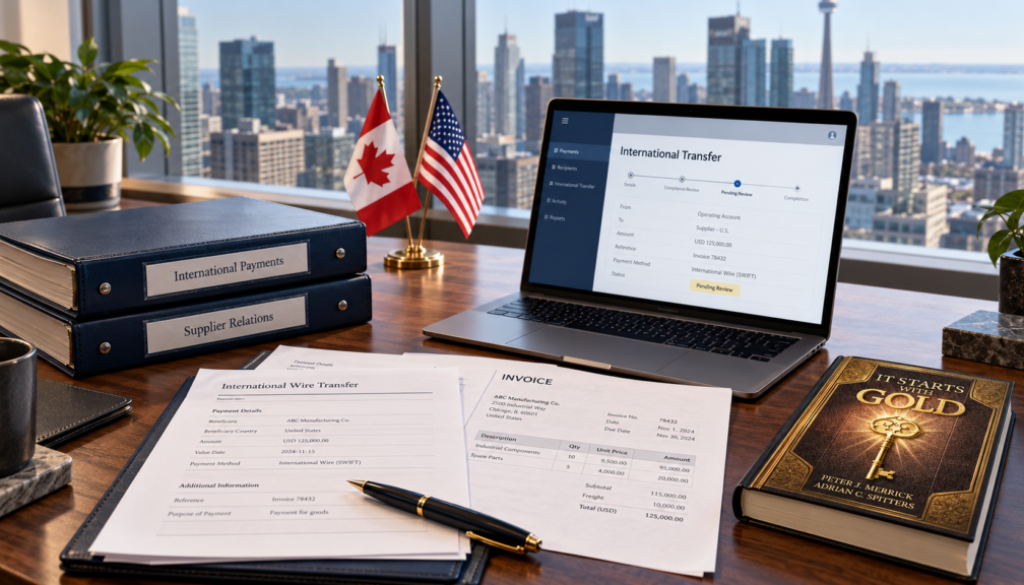
Consider this illustration. Your business owes US$50,000 for equipment from an American supplier. Assume your bank sends the payment through an account at a U.S. bank. A sanctions order cuts off that route. The transfer cannot proceed as planned, and the supplier delays the equipment until payment arrives. Your production date now rests on finding another lawful way to pay.
Start with a payment your business must make in the next month. Ask your bank to explain its route and the lawful alternative if that route closes. Confirm the timing, fees and transfer limits, and check that the receiving bank and supplier can accept the payment.
Canadian-dollar wires between participating Canadian banks use Canada’s Lynx system. For a U.S.-dollar payment, ask which American banking relationships are involved. Then check whether your second bank uses a different route and can send the required currency from an open, funded account.
Check the Protection Around Your Deposits
Review deposit protection alongside payment access. Suppose you hold C$300,000 in eligible deposits from a sale, all in your sole name at one Canada Deposit Insurance Corporation member. CDIC covers up to C$100,000, including interest, in that category at that member. At least C$200,000 exceeds the limit.
List the member institution behind each account and the category in which it is insured. Put investment accounts on a separate line and record who holds the assets. Three accounts in one insured category at the same member share that category’s limit.
Give Each Part of Your Money a Job
Our Owning Assets in Order of Asset Security™ framework tests Control, Access, Independence and Continuity. Applied here, it asks what must keep working for you to use your money. Review the institution, the payment route and the ownership documents before focusing on the interest rate.
I would first identify cash needed for bills and keep it accessible. Compare leaving the rest in cash, paying down debt and owning physical gold directly. Get the actual withdrawal terms, debt repayment charges and gold purchase, storage and sale costs before deciding.
Paying down debt reduces the balance on which interest is charged. Waiting to invest leaves money available while you settle the access questions. Directly owned physical gold held outside the banking system reduces reliance on a bank’s promise to repay. Establish what proves ownership and how you can collect or sell it.
In It Starts With Gold™, Peter says, “This is exactly why owning and taking physical possession or securely vaulting Gold is paramount.” For a buyer, that means examining the invoice, storage agreement and collection process, as well as the price.
Before adding more money to one bank, resolve the questions that determine whether you can use what you already hold. I would want a confirmed payment arrangement before accepting a little more interest.
Continue Your Asset Security Journey™
Follow The Merrick Spitters Reset Report™ for continuing research on money, ownership, Asset Security and family wealth. Subscribe and receive a complimentary digital copy of It Starts With Gold™.
Subscribe to The Merrick Spitters Reset Report™
If you are deciding how much money to keep with one bank, bring recent account and investment statements to a complimentary 45-minute virtual introduction with me. We can review where your assets are held, how you own them and how you could access money needed for your next payment or investment decision.
About The Authors
Adrian C. Spitters, CFP®, FCSI®, CEA
Adrian C. Spitters is President and Private Wealth Advisor of PFC Wealth Solutions™ through Performance Financial Consultants Ltd. He is also a Dealing Representative with Axcess Capital Advisors Inc., through which his securities transactions are conducted. He has nearly four decades of experience advising business owners, professionals, farmers, retirees and multigenerational families. Raised on a dairy farm in British Columbia’s Fraser Valley, he focuses on Asset Security, wealth preservation and coordinating specialized professionals around a family’s needs. Adrian is co-author of It Starts With Gold™ and co-publisher of The Merrick Spitters Reset Report™. Read Adrian C. Spitters’ full biography here.
Peter J. Merrick, TEP®
Peter J. Merrick is an international speaker, educator, cross-border specialist and estate planner with more than three decades of experience advising business owners, professionals and family enterprises across Canada and the United States. His work focuses on succession planning, long-term wealth preservation and helping families structure and transition wealth across generations. Peter is co-author of It Starts With Gold™ and co-publisher of The Merrick Spitters Reset Report™. Read Peter J. Merrick’s full biography here.
Disclaimer
Allegations attributed to Cooper and the interview host are their views, not independent findings or accusations made by Adrian C. Spitters or Peter J. Merrick. Cooper calls sanctions against Canadian financial networks a low-probability risk with serious consequences. His roughly $1 trillion estimate concerns Vancouver and Toronto real estate, with no currency or measurement period established in the interview. This article has not independently verified that estimate, the full Westshore civil claim or the wider allegations concerning China, Iran, weapons procurement and Canadian enforcement.
The OFAC notice does not name a Canadian bank. TD’s U.S. findings do not establish Cooper’s estimate, and its growth limits did not freeze Canadian deposits. Payment sanctions would be a separate action. Effects depend on the actual order; the hypothetical U.S.-dollar example does not establish a block on domestic Canadian-dollar payments or all accounts.
The Westshore account trail does not establish knowing participation by every bank. CDIC covers eligible deposits on member failure, not uninterrupted transfers or sanctions restrictions. Stocks, bonds and mutual funds are outside its coverage. A second bank can rely on shared payment systems.
Inflation reduces cash’s buying power. Debt repayment uses cash, may incur charges and does not assure future borrowing. Gold produces no income and its price can fall. Buying, selling, storage, insurance and tax costs affect the result. Selling gold may still require a dealer and a bank payment, so it cannot replace cash needed for an imminent invoice. Review ownership, storage and delivery terms before buying.
References
- Canada Deposit Insurance Corporation. What’s Covered. Accessed October 22, 2026.
- Commodity Futures Trading Commission and Financial Industry Regulatory Authority. 10 Things to Ask Before Buying Physical Gold, Silver, or Other Metals. Accessed October 22, 2026.
- Cooper, Sam. Interview in US Threatens To SANCTION Canadian Banks Over $1 TRILLION Fraud!. YouTube video, n.d. Transcript.
- Merrick, Peter J., and Adrian C. Spitters. It Starts With Gold™. 2025. Preview copy, 147–48. Accessed October 22, 2026.
- Merrick, Peter J., and Adrian C. Spitters. Owning Assets in Order of Asset Security™. The Merrick Spitters Reset Report™. Accessed October 22, 2026.
- Office of the Comptroller of the Currency. OCC Issues Cease and Desist Order, Assesses $450 Million Civil Money Penalty, and Imposes Growth Restriction Upon TD Bank, N.A. for BSA/AML Deficiencies. October 10, 2024.
- Payments Canada. Wire Payments. Accessed October 22, 2026.
- TD Bank Group. TD Bank Group Announces Resolution of AML Investigations. October 10, 2024.
- U.S. Department of Justice. TD Bank Pleads Guilty to Bank Secrecy Act and Money Laundering Conspiracy Violations in $1.8B Resolution. October 10, 2024.
- U.S. Department of the Treasury, Office of Foreign Assets Control. FAQ 156. Updated October 5, 2026.
- U.S. Department of the Treasury, Office of Foreign Assets Control. Notice to Foreign Financial Institutions Conducting Business with Iran. October 5, 2026.