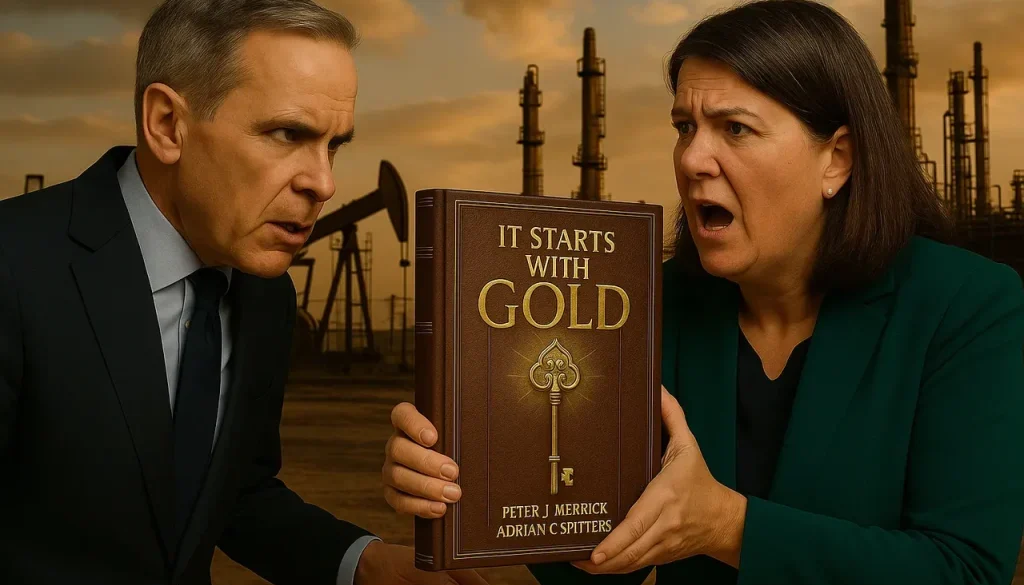
Who Profits From the Carbon Coup?
By Peter J. Merrick, TEP® and Adrian C. Spitters, CFP®, co-authors of the international bestseller It Starts With Gold™ and the forthcoming book Guns, Gold & Land™
This analysis continues a series of long-form investigations published in The Merrick Spitters Reset Report™
As Alberta Burns, Global Asset Managers Prepare to Buy It All
The urgent themes discussed in this article are expanded on in our #1 international best-selling book, It Starts With Gold™, co-authored by Peter J. Merrick and Adrian C. Spitters. In the book, we reveal how financial systems are collapsing and how individuals can prepare before it is too late. Visit www.ItStartsWithGold.com.
Canada faces an internal crisis masked as climate reform. The threat is not military and it is not weather. It is political. A quiet transformation is underway, dressed in green rhetoric and sold as progress. But at its core lies the dismantling of provincial sovereignty, local ownership, and the middle class.
At the centre of this engineered crisis is Alberta. And leading the resistance is Premier Danielle Smith, the only provincial leader who has publicly called Mark Carney’s net-zero mandate what it is: a carbon coup.
On April 15th, Prime Minister Carney ordered all provinces to implement net-zero power grids by 2035. The announcement was framed as leadership. But to Alberta, it landed as a death sentence. Natural gas plants face forced retirement. Electricity prices are expected to soar. Investment is fleeing. Carney’s policy is not grounded in regional realities. It is driven by global climate targets and international financial interests, prioritizing global ESG scoring over the well-being of Canadian households and the sustainability of provincial economies.
This Is Not Policy. This Is Profiteering.
Behind the language of sustainability is a clear financial strategy. Brookfield Asset Management, the multi-trillion-dollar investment firm where Carney served as Vice Chair, is well-positioned to profit. Brookfield thrives by buying distressed assets, including power grids, real estate, and infrastructure devalued by sudden regulatory shifts. Once Alberta’s utilities are deemed incompatible with net-zero compliance, they will be sold at bargain prices. Brookfield and similar entities are not responding to climate demands. They are anticipating forced asset surrender and preparing to buy.
This is not a theory. It is a global model in practice. Brookfield has long followed a pattern of leveraging environmental, social, and governance (ESG) mandates to trigger government policy shifts that depress asset valuations. It then steps in as a consolidator, acquiring long-term assets with short-term capital outflows and state-backed assurances. Carney’s deep ties to Brookfield were never severed. His policy prescriptions align perfectly with Brookfield’s acquisition strategy. He simply moved from the boardroom to the cabinet table.
They are not alone.
-
-
- BlackRock, the largest asset manager in the world, benefits directly from ESG mandates. Its Climate Transition Funds and global decarbonization ETFs flourish when countries legislate emissions standards. More regulations mean more capital inflows into ESG-labelled products.
- Macquarie Group, the Australian infrastructure powerhouse, has increased its Canadian presence over the past five years. It specializes in infrastructure privatization, especially in markets that are forced to offload public assets to meet international climate obligations. Macquarie profits from this policy-induced restructuring, often operating in partnership with federal governments and multilateral lending agencies.
- IFM Investors is targeting Canada’s core utility and transport infrastructure, including toll roads, pipelines, and water systems. As fiscal pressure mounts on provinces due to net-zero transitions, IFM is positioning itself as a stable buyer of public goods and regional infrastructure.
- KKR and Partners Group are now heavily invested in Canadian digital infrastructure and real estate, including energy transmission and distribution projects. They benefit when governments like Canada’s make traditional power sources economically unviable, allowing new operators to enter at steep discounts.
-
This is not environmental stewardship. It is a regulatory asset transfer on a national scale. It is the monetization of public pain. The middle class pays. Foreign equity profits.
Bill 54: The Last Defence Against Economic Siege
Danielle Smith’s response was legislative. Bill 54, now advancing through the Alberta legislature, lowers the threshold for citizen-initiated referendums. Critics from Ottawa to Davos decry it as populist. But in Alberta, where property rights, resource control, and economic independence are under constant threat, it represents a critical check on federal authority.
The bill reduces the threshold for petition signatures from 20 percent of eligible voters to just 10 percent, granting Albertans a direct voice on key issues like federal energy mandates, carbon taxes, equalization formulas, and environmental regulation. It does not guarantee separation. It guarantees self-determination.
Ottawa’s pushback has been immediate. Constitutional lawyers warn of chaos. Federal ministers hint at legal suppression. First Nations leaders have been mobilised to challenge the bill’s constitutional legitimacy. International groups, including the Council on Foreign Relations, have issued warnings that Alberta’s movement could inspire global secessionist waves. But for Albertans, the concern is not ideological. It is existential. Without control over its own energy and infrastructure, Alberta becomes economically subservient.
The Emergency Ottawa Ignores
While Carney attends climate finance summits in Glasgow and New York, Alberta is literally burning. Wildfires have forced evacuations. Spring floods have left communities underwater. Hospitals are overrun. Nurses have gone on strike. Ambulances are being rerouted. Despite this, Ottawa has withheld assistance, tying support to emissions targets and renewable energy commitments.
Why is Alberta’s suffering conditional? Because in Carney’s Canada, emergencies are not opportunities to unite. They are policy enforcement tools. Infrastructure grants, health transfers, and emergency funds are used as leverage to force compliance.
In It Starts With Gold, we reveal how collapsing financial systems use manufactured crises to transfer control. Local ownership is undermined. Currency is devalued. Productive industries are strangled through regulation. And real assets are handed to global institutions disguised as sustainability champions.
The Alberta Playbook Is Global
Carney’s playbook is not new. His roles at the World Economic Forum, the United Nations, the Bank of Canada, and the Bank of England are not disconnected. They form a policy ladder of top-down control, where unelected financial elites drive local restructuring through ESG criteria, climate metrics, and debt-to-carbon exchange systems.
Under his guidance, Brookfield expanded aggressively into ESG-labelled acquisitions. Under his political authority, the very same policies that made these assets distressed have been scaled nationally. Carney’s elevation to Prime Minister represents the culmination of the financialization of public policy.
Smith, in contrast, represents resistance. She speaks for tradespeople, entrepreneurs, farmers, and citizens who are now forced to comply with a carbon accounting regime designed on Bay Street and enforced in Brussels. Her pushback is not personal. It is survivalist.
Who Will Own What’s Left?
The issue is no longer climate. It is ownership. Canadians are being told that the path forward is green. But beneath that slogan lies an aggressive program to privatize the last standing public assets, grids, farms, water, and energy under the banner of international investment.
What remains of Canada’s economic independence will not be sold to the highest bidder. It will be handed to the best-connected bidder. That process is already underway.
The auction began the day net-zero mandates were imposed. It accelerates every time a province is forced to choose between compliance and collapse.
The Time To Choose Is Now
March 2026 marks the deadline for Alberta’s referendum petition. That date may prove to be the last opportunity for Albertans to reassert control over their land, their energy, and their economy.
Carney says his plan is about balance. But the results speak louder. Ownership is being transferred. Voices are being silenced. And a province that once powered the country is now being dismantled in real time.
To find out more, order your own copy of It Starts With Gold on Amazon today: https://mybook.to/GOLD