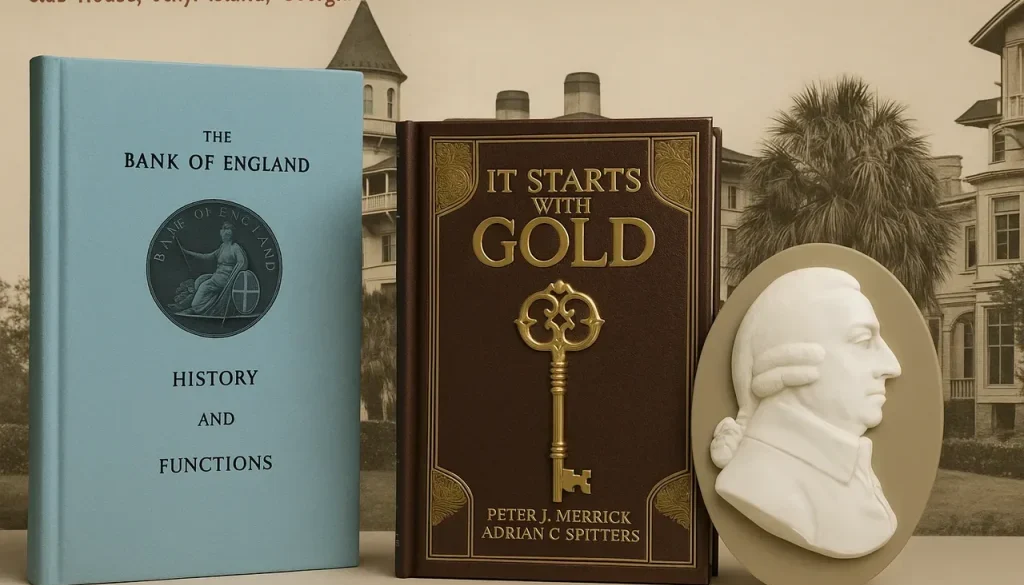
You And Your Government Will Never Get Out Of Debt. It Is Rigged
By Peter J. Merrick, TEP® and Adrian C. Spitters, CFP®, co-authors of the international bestseller It Starts With Gold™ and the forthcoming book Guns, Gold & Land™
This analysis continues a series of long-form investigations published in The Merrick Spitters Reset Report™
A Quiet Warning From Two Men Who Spent Their Lives Inside The System
We have carried this knowledge for most of our professional lives. We never sought to become experts in the architecture of global debt, yet exposure to the Financial Industrial Complex slowly revealed truths that were impossible to ignore. As we worked with families, business owners, farmers, and sovereign individuals, we learned that most people were born into a system they never had the chance to understand. They sensed something was wrong, yet lacked the language or historical context to name it. We know this feeling because we were once trapped in the same fog, unable to see the machinery operating around us. As we approach the later years of our careers, we feel responsible to share what we have learned before it is too late for those who are beginning to awaken.
Every country on Earth is in debt, and very few people stop to consider what this means. These numbers are not simply statistics found in economic reports. They represent a global structure that influences every aspect of daily life. The United States owes thirty-eight trillion dollars. Japan owes nine trillion dollars. The world owes three hundred and fifteen trillion dollars, which is roughly three times the size of the global economy. People hear these numbers with resignation rather than inquiry because the scale feels too large to understand. Yet once you begin asking the right questions, everything changes.
The first question is the most fundamental. If everyone owes money, who exactly is owed? When you follow the trail of creditors, you discover that the world owes money to itself. That revelation often confuses people until they learn how the system was designed. Debt has become the raw material of modern money. Debt is woven through governments, central banks, pension plans, financial institutions, and global markets in a way that makes repayment impossible. The system was constructed through a series of deliberate innovations over three centuries. To understand why no nation can escape the trap today, we must look at the four architects who built the framework the world now lives inside.
👉 Subscribe to The Merrick Spitters Reset Report™ and receive a digital copy of our international bestseller, It Starts With Gold™, along with our white paper, Last Asset Standing™ and early updates on our forthcoming book, Killing Crypto™.
William Paterson (1694): The Man Who Invented Permanent National Debt
The story begins with William Paterson, a Scottish merchant and financial thinker who lived from 1658 to 1719. In 1694, England was nearly bankrupt while fighting a war against France. King William III was desperate for money, yet no one wanted to lend to a government that had defaulted before. Paterson proposed something revolutionary. He gathered wealthy merchants willing to lend one point two million pounds to the government. The government agreed to pay interest forever and never repay the principal. This created the first permanent national debt.
Paterson also proposed creating the Bank of England to administer the arrangement. It became the first modern central bank and was granted permission to issue paper notes backed by government debt. This meant that debt itself became money. The more the government borrowed, the more money could be created. This innovation allowed nations to wage longer wars and finance larger governments. It also created a financial structure where debt was no longer something to be repaid, but something to be maintained indefinitely. Paterson did not set out to trap future generations, yet the system he designed made it inevitable.
Within decades, other European nations copied the model because it made governments powerful and bankers wealthy. France adopted it. The Netherlands adopted it. In 1790, Alexander Hamilton modelled the financial system of the United States on Paterson’s design. For the first time in history,the national debt was intended to be permanent. The world had accepted the first pillar of the modern debt system without understanding where it would lead.
Nathan Rothschild (1815): The Man Who Made Debt Global
The second architect was Nathan Mayer Rothschild, who lived from 1777 to 1836. Rothschild and his brothers built one of the most influential financial networks in history. By the early 1800s, most European governments relied heavily on debt, yet the system was still local. A default only affected a few lenders. Rothschild changed everything by turning sovereign debt into a global market. Governments borrowed from him, and he sold their bonds to investors across Europe.
This created a web of interconnected ownership. A bond issued by the British government might end up in the hands of investors in France, Austria, or Germany. Suddenly, defaulting on a national debt was no longer a local event. It risked destabilizing financial systems across multiple countries. Rothschild also used information as a strategic weapon. His courier network was faster than any government’s, allowing him to make financial moves before news reached the public. His influence became so great that governments depended on his banking house to finance wars, rebuild economies, and maintain stability.
Rothschild did not invent the concept of government borrowing. He transformed it into an international mechanism that governments could no longer escape. Once debt became global, a single country’s default threatened the economic stability of entire regions. The second pillar of the debt system was now in place. The national debt was no longer permanent. It had also become interconnected.
J. P. Morgan’s Circle (1913): The Men Who Created Infinite Debt
The third architect was not one man, but a circle of American bankers led by J. P. Morgan, who lived from 1837 to 1913. In the early twentieth century, the United States had a fragmented banking system and no central authority to stabilize the economy. After the financial panic of 1907, Morgan personally rescued the system by coordinating a private bailout. It became clear to him and his associates that a central bank was needed to prevent future collapses. Yet the American public distrusted central banks, so the plan had to be both brilliant and discreet.
In 1910, Senator Nelson Aldrich and several of Morgan’s closest associates met secretly on Jekyll Island to design what became the Federal Reserve System. Their goal was simple. They wanted a structure that appeared decentralized and democratic while ensuring that the most powerful banks retained influence. When the Federal Reserve Act was passed in 1913, it created an institution with the ability to buy government bonds using newly created money. For the first time, a government could borrow without limits.
This innovation made debt infinite. If the United States needed money, it issued Treasury bonds. The Federal Reserve could buy those bonds with money it created. There was no limit other than the willingness of the markets to continue believing in the system. Morgan did not live to see the full consequences of the system he helped design, yet his influence ensured that the United States would operate within a structure that required ever-increasing levels of debt. The third pillar of the system was now in place. Governments no longer had to default or repay. They could borrow forever.
Paul Volcker (1982): The Man Who Made Default Impossible
The fourth architect was Paul Volcker, Chairman of the Federal Reserve from 1979 to 1987. Volcker inherited an American economy facing severe inflation. To restore stability, he raised interest rates dramatically. This move crushed inflation in the United States but created a crisis for developing countries that had borrowed billions when rates were low. When rates rose, their interest payments became impossible to meet.
In 1982, Mexico announced it could no longer service its debt. This should have triggered a global financial collapse because American banks had lent heavily to developing countries. Instead of allowing the system to reset, the International Monetary Fund stepped in with rescue loans. These loans did not reduce debt. They reorganized it. They required governments to privatize industries, cut social spending, and open their markets to foreign investment. These measures ensured that the interest payments would continue indefinitely.
Volcker did not set out to create a permanent global debt cycle, yet his decisions solidified one. The fourth pillar of the system was now complete. When countries could not pay, they would not be allowed to default. They would be refinanced into deeper and more permanent obligations. The debt would never shrink. It would only grow.
👉 Subscribe to The Merrick Spitters Reset Report™ and receive a digital copy of our international bestseller, It Starts With Gold™, along with our white paper, Last Asset Standing™ and early updates on our forthcoming book, Killing Crypto™.
The Trap Tightens Around Ordinary Citizens
Most people encounter the consequences of the global debt system long before they understand its structure. They feel the weight of rising prices, stagnant wages, and constant financial pressure. They notice that their purchasing power seems to shrink each year, yet they cannot identify the force behind it. This quiet pressure builds slowly over time and becomes so familiar that people accept it as normal. They blame themselves or the government of the day rather than recognizing they are living inside a system designed to operate this way. When individuals finally see that the pressure they feel is structural rather than personal, they begin to understand that something deeper has been influencing their lives since birth.
Governments cannot repay their debts because modern money is created through borrowing. If nations attempted to eliminate their debt, the money supply would contract so severely that the global economy would collapse. Businesses would fail. Banks would fall. Household savings would disappear. This is why politicians talk about deficits with dramatic language yet never attempt to pay down the principal. The system does not allow it. What appears as political division is often a distraction from the deeper reality that the world is locked into a cycle it cannot escape.
The consequences reach every household. Pension funds rely on government bonds because they are considered safe. Insurance companies depend on them as core assets. Banks use them as a foundation for lending. Central banks influence economic conditions by adjusting interest rates on these bonds. Every interest payment governments make flows to institutions that hold this debt, which are often controlled by the wealthiest groups on Earth. This creates a quiet transfer of wealth from ordinary citizens to those positioned at the top of the financial hierarchy. It happens slowly enough that most people never recognize the pattern until they reach a stage in life where their assets no longer grow the way they expected.
People sense these shifts at an intuitive level. They feel something tightening in the background, even when they cannot articulate it. They see younger generations struggling to buy homes and older generations worried about whether their retirement will last. They notice that every crisis seems to push more wealth upward rather than redistributing opportunity. These observations create a quiet unease that grows over the years. When individuals begin to understand the historical architecture of the system, the unease becomes wisdom. With wisdom comes the ability to choose a different path.
Why We Are Raising the S.O.S Signal Now
We speak these truths with humility because we spent decades inside the Financial Industrial Complex learning them the hard way. We watched families lose wealth during economic downturns because their portfolios were built on assumptions that did not match how the world truly worked. We saw business owners face unnecessary risks because they trusted systems that were never designed with their interests in mind. We worked with professionals and farmers who did everything right yet still found themselves exposed to forces far outside their control. These experiences taught us that education, when given honestly and without fear, can become a lifeline.
As we approach the later chapters of our careers, we feel a growing responsibility to share what we know. The world is entering a period of transition where old models will no longer function the way they used to. People sense this change even if they cannot describe it. They feel uncertainty rising around them like a tide that refuses to recede. They watch the global debt climb and wonder how long it can continue. These are not irrational fears. They are signals that the cycle is shifting and that individuals must prepare themselves before the next stage begins.
This is not a message of alarm. Alarm clouds judgment. Instead, this is an invitation to awareness. When people begin to understand the architecture of global debt, they start to see the system with new eyes. They recognize where their families are vulnerable and where they have been relying on structures that may not hold in the future. Awareness strengthens sovereignty. Sovereignty creates stability. Stability allows individuals to make decisions with confidence rather than fear. This is why we are raising the S.O.S signal now. We believe people deserve to understand the system that shapes their lives so they can protect themselves before the next shift arrives.
Awakening as a Sovereign in a System Not Designed for You
Resilience does not come from fighting the system directly. It comes from understanding it deeply enough to navigate around its weaknesses. Once you see how the debt trap functions, you begin to identify which assets truly protect your sovereignty and which only create the illusion of security. Many individuals feel that something is off in the financial world, yet do not have the language to explain it. They sense that digital systems are becoming more centralized. They see inflation eroding their savings. They watch markets become more volatile. These observations are all clues that point toward the same conclusion.
When people awaken to these realities, they start to rearrange their financial lives. They move towards assets that exist outside the full control of institutions. They strengthen the parts of their portfolios that cannot be erased by monetary policy or economic instability. They begin to see wealth not as numbers on a screen but as something that must be anchored in reality. This shift is subtle at first, yet over time it becomes transformative. The moment individuals recognize that sovereignty is built on the order of the assets they own, they begin to step outside the system mentally, emotionally, and eventually financially.
We learned this truth from decades of observing what worked during periods of disruption. Every crisis revealed the same pattern. Individuals who held their wealth in fragile structures suffered the most. Those who built their financial lives on secure foundations not only survived but often found themselves in stronger positions when stability returned. Sovereignty is not about rebellion. It is about positioning. People who understand this no longer feel powerless in the face of global events. They begin to sense that they can create wisdom in a world that appears increasingly unpredictable.
Owning Assets In Order of Asset Security
This is why we created our framework called Owning Assets in Order of Asset Security. It is a structure designed to help individuals build stability from the bottom up. At the foundation are assets that hold value independently of the financial system, such as gold and precious metals. These assets have preserved purchasing power through wars, regime changes, inflationary periods, and currency resets. They are not dependent on digital networks or institutional promises. They simply exist and retain value because they are real.
Above that foundation are alternative investments that diversify income sources and reduce exposure to public markets. These assets add layers of protection because they are not tied directly to the same forces that influence stocks and government bonds. Beyond that, we incorporate private portfolio management that reduces counterparty risk and strengthens oversight. This allows individuals to navigate changing market conditions with informed guidance rather than emotional reactions. At the top of the structure are mutual life insurance instruments that provide long-term protection for families and businesses. These instruments are owned by policyholders, which aligns incentives and maintains stability even during uncertain times.
Each pillar has a purpose. Together they form a complete structure that shields individuals from the vulnerabilities built into the global financial system. This approach does not require people to abandon the system entirely. Instead, it allows them to stand outside its most dangerous areas. When wealth is arranged in the correct order, individuals feel more grounded and prepared. They begin to sense that their future is no longer tied entirely to economic trends or government policy. They feel a sense of wisdom returning to their decisions. That wisdom is the beginning of sovereignty.
Our Book and Why We Offer It Freely
In our book titled It Starts With Gold, we explain the full narrative of how the global debt system was built, where it is leading, and how sovereign individuals can protect themselves. We wrote the book not to alarm people, but to provide context. Once people understand the history, the present moment becomes easier to interpret. They begin to recognize patterns that had previously confused them. They feel less overwhelmed by economic news because they finally understand the forces behind it.
We offer a free digital copy of the book to anyone who signs up for The Merrick Spitters Reset Report™. This is our way of ensuring that people have access to the information they need without feeling financial pressure. Our newsletter allows us to share updates, insights, and strategies so individuals can continue learning at a steady pace. Education grows stronger when it is supported by consistent guidance. We created this space for people who want to awaken, prepare, and navigate the coming shifts with confidence.
This understanding naturally leads to a more personal moment, the point where information becomes action and awareness becomes preparation. It is at this stage that many individuals begin to consider the next step.
When You Are Ready
We have written these words with a quietly urgent heart. We do not claim to have all the answers, yet we have spent a lifetime learning how the Financial Industrial Complex functions. We offer this knowledge because we believe individuals deserve wisdom and protection in a world that is becoming more uncertain by the year. If you felt something stir within you as you read this, trust that feeling. It is the beginning of sovereignty. It is the part of you that knows you were meant to stand outside the systems that limit others.
We cannot walk your path for you. We can only shine a light on the ground ahead. If you sense that the world is shifting and you want to protect yourself before the next stage arrives, then allow yourself to explore the information we have made available. When you are ready, reach out.
For those who choose to take that step, the question becomes how to build real stability in a world shaped by debt, volatility, and institutional pressure. This is where our framework becomes essential.
The Four Pillars We Recommend for Certainty
Our team of professionals assist clients in structuring wealth by Owning Assets in Order of Asset Security. We prioritize the most secure assets and safeguard those that are most vulnerable using the four pillars that form the foundation of long-term financial certainty.
- Gold and precious metals hold real, tangible value.
- Alternative investments that reduce systemic risk.
- Private portfolio management that lowers counterparty exposure.
- Mutual life insurance instruments that protect capital and individuals.
In It Starts With Gold™, we describe how these four pillars operate as a unified structure to protect wealth and maintain continuity through economic and political uncertainty. Each pillar plays a distinct role: precious metals preserve purchasing power, alternative investments diversify and stabilize income, private portfolio management provides professional oversight, and mutual life insurance strengthens capital protection. Together, they form a balanced foundation that helps investors remain secure when one or more areas of the economy are tested.
Stay informed. Stay prepared. Act while choice still exists.
These insights connect directly to the themes explored in It Starts With Gold™, co-authored by Peter J. Merrick, TEP® and Adrian C. Spitters, CFP®. Inside the book, we show how to establish a tangible-asset foundation, measure security across asset classes, and safeguard against systemic shocks while maintaining control of your future. Visit www.ItStartsWithGold.com.
👉 Sign up today for The Merrick Spitters Reset Report™ to receive a digital copy of our international bestseller It Starts With Gold™, our white paper Last Asset Standing™, and early updates on our upcoming book Killing Crypto™.
Prefer a hard copy? Order It Starts With Gold™ on Amazon today.
References
- William Paterson (Founder of the Bank of England, 1694) Britannica – William Paterson biography
- Bank of England Charter & History (1694 Forward) Bank of England – Historical document
- Nathan Mayer Rothschild (Globalizing Sovereign Debt) Rothschild Archive – Waterloo financing & bond market history
- The Jekyll Island Meeting (Federal Reserve Creation, 1910) Federal Reserve History – Jekyll Island conference
- Paul Volcker & the 1980s Debt Crisis Peterson Institute for International Economics – Volcker crisis management
- Latin American Debt Crisis (1982) Federal Reserve History – Latin American default wave
- Current Global Debt – $315 Trillion Visual Capitalist – Global debt infographic and breakdown