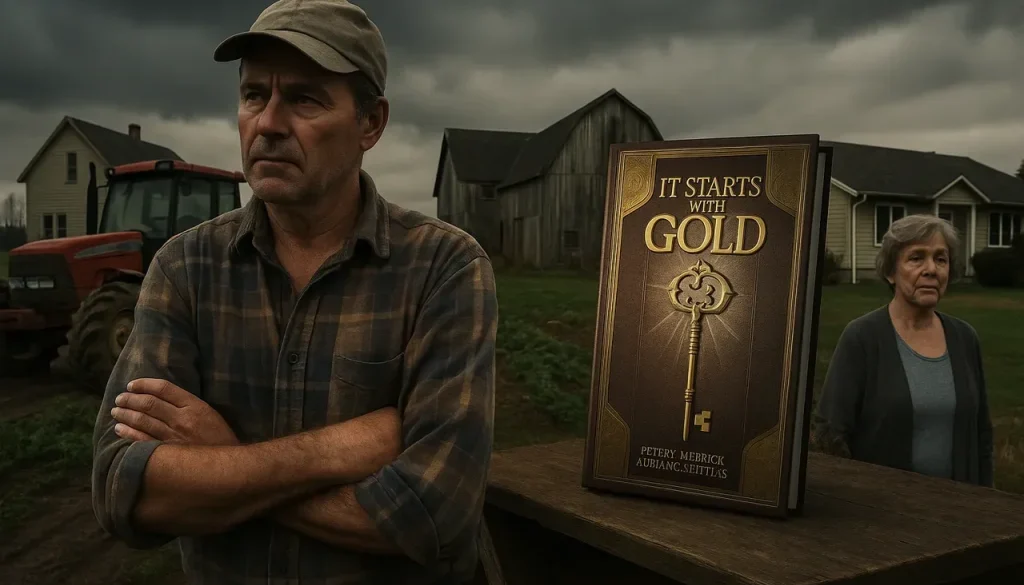
Your Private Property Rights Are Under Attack
By Peter J. Merrick, TEP® and Adrian C. Spitters, CFP®, co-authors of the international bestseller It Starts With Gold™ and the forthcoming book Guns, Gold & Land™
This analysis continues a series of long-form investigations published in The Merrick Spitters Reset Report™
The Beginning of Conditional Ownership
A recent British Columbia Supreme Court ruling has shaken the foundation of private property ownership in Canada. What began as a local land-title dispute now threatens to redefine sovereignty, wealth, and the right to own anything at all.
British Columbia is Now a Test Case for Canada and the Rest of the Western World
A court in British Columbia has just declared that your property may not truly belong to you. The British Columbia Supreme Court’s decision in Cowichan Tribes v. Canada (Attorney General) (2025 BCSC 1490) not only handed a small portion of land in Richmond to an Indigenous group. It redefined ownership itself.
The ruling affirmed Aboriginal title over 7 to 12 kilometres of land and submerged riverbed, once granted to private citizens and municipal authorities. It declared that Crown grants of private property were “defective and invalid.” Overnight, homeowners who had mortgages, deeds, and decades of tax receipts were told their titles might not stand.
This decision is now under appeal, but the precedent has been set. If it stands, every homeowner, farmer, and investor in Canada faces a new reality: ownership is conditional. The ground beneath your feet can be reassigned by judicial interpretation.
👉 Subscribe to The Merrick Spitters Reset Report™ and receive a digital copy of our international bestseller, It Starts With Gold™, along with our white paper, Last Asset Standing™ and early updates on our forthcoming book, Killing Crypto™.
The Legal Flashpoint That Changed Everything
The Cowichan case arose from overlapping land claims dating back more than a century. The Cowichan Tribes and allied First Nations asserted that their historical occupancy of the Fraser River delta was never surrendered through treaty or sale. British Columbia, unlike most provinces, never completed comprehensive treaties during Confederation.
Aboriginal title is a legal recognition of Indigenous peoples’ pre-existing ownership of land, carrying the same weight as private title once affirmed by a court.
Justice Alan Ross of the British Columbia (BC) Supreme Court accepted that argument. His decision granted Aboriginal title to the Cowichan over portions of Richmond and the Fraser River, rejecting the assumption that Crown grants extinguished prior rights. He ruled that private ownership interests derived from those grants were invalid to the extent they conflicted with Aboriginal title.
The provincial and federal governments, along with the City of Richmond and the Musqueam Indian Band, immediately filed appeals. Yet the damage is done. Once a court establishes a precedent that Aboriginal title can supersede fee-simple ownership, legal uncertainty spreads through every registry office and land-title system in the province.
Uncertainty Becomes a Systemic Risk
Private property is the foundation of all Western prosperity. It underpins mortgages, municipal revenues, business credit, retirement savings, and collateral for small-business loans. When ownership itself is questioned, the entire economic structure begins to wobble.
In Richmond, banks are already re-evaluating risk. Realtors whisper that buyers are backing away from affected areas. Insurance companies are watching closely. If titles can be declared defective after 150 years, what prevents another court from expanding that logic elsewhere?
The uncertainty is contagious. If the principle of fee-simple ownership can be invalidated in British Columbia, then no province is safe. From Ontario cottages to Alberta farmland, property values depend on the belief that land can be owned outright. When that belief erodes, so does the currency of wealth itself.
A Judicial Precedent or a Political Test?
British Columbia has become the testing ground for a larger global agenda. While the case was argued under Canadian constitutional law, its reasoning mirrors the language of the United Nations Declaration on the Rights of Indigenous Peoples (UNDRIP). UNDRIP was quietly adopted into British Columbia law through the Declaration on the Rights of Indigenous Peoples Act (DRIPA) in 2019. That legislation binds the province to “align its laws with the UN declaration.”
This sounds noble on paper, but embedded in UNDRIP is a powerful principle: that Indigenous nations have a right to ownership and control over traditional lands, even where governments have since granted those lands to others. When translated into domestic law, this principle collides with private property.
The Cowichan decision is the first to make that collision real. It transforms a moral statement into an economic weapon. It is a template for redefining ownership under the guise of reconciliation, a legal test case that will be watched by every Western nation aligned with Agenda 2030 and the World Economic Forum (WEF).
The Global Playbook for Ending Ownership
Across the Western alliance, including the United States, Canada, the United Kingdom, the European Union, and Australia, governments have signed climate and sustainability agreements that re-imagine ownership as stewardship. Under the WEF’s Agenda 2030 goals, citizens are to “own nothing and be happy.” Property is to be shared, leased, or digitally tokenized under central oversight.
The Cowichan ruling is the first legal implementation of that philosophy within a Western courtroom. By declaring Crown grants invalid, the court asserted that state-issued titles can be re-interpreted and revoked when political conditions change. That principle mirrors emerging financial policies like Central Bank Digital Currencies (CBDCs), where money itself can be programmed to expire, freeze, or be redirected based on compliance scores.
The common theme is control. Once the state or a transnational institution can re-classify ownership as a revocable privilege, the citizen becomes a tenant of the system. Land, money, and identity merge into a digital ledger of permissions now being built through UNDRIP, carbon tracking, digital identification (ID), and Environmental, Social and Governance (ESG) mandates.
The Human Cost Already Visible
In Richmond, elderly couples like Paul and Anna Wawitch spoke to media about their fear of losing their homes after living there for decades. They worry they could be forced to pay rent to a new title holder or be evicted if negotiations fail. “Someone could come and say we have to pay a lease of three thousand a month,” Anna told CBC News.
For many Canadians, that statement feels unthinkable, until they realize it is now legal. Families who paid property taxes, built equity, and passed homes to children must now wait for courts and governments to decide whether their titles still exist.
This is not reconciliation. It is re-feudalization, a return to a system where citizens hold land only by permission of the Crown or its appointed partners. For those who studied Agenda 2030 and WEF briefings, this moment was inevitable.
Sovereignty Versus Supranational Governance
The British Columbia ruling arrives alongside a pattern of policies that transfer national authority to global frameworks:
-
-
- The World Health Organization (WHO) Treaty on Pandemic Preparedness, granting the organization power to impose public-health restrictions across member states.
- The Organisation for Economic Co-operation and Development (OECD) global tax framework, coordinating financial reporting and minimum taxes across borders.
- The United Nations Framework Convention on Climate Change (UNFCCC) net-zero targets that mandate national energy policies.
-
Each policy reduces sovereign choice and moves control toward central systems governed by unelected institutions. When combined with legal precedents that undermine property rights, the trend is clear: sovereignty itself is being redefined.
If ownership is conditional on global values rather than constitutional law, then citizens no longer own anything at all. They merely administer it on behalf of those who set the values.
A New Age of Programmable Property
Imagine a future where your land title is a digital token on a government ledger. Its use can be restricted for climate targets or reconciliation quotas. Sell too many trees, exceed a carbon limit, or oppose policy publicly, and your token may be flagged for review. The Cowichan ruling creates the legal rationale for that transition.
Once the principle is established that ownership is subject to historical or political correction, the door opens to programmable property law. Digital registration then allows enforcement without courts, just as programmable money allows enforcement without banks.
In practice, this means ownership could be governed by algorithms rather than legal due process, making control instantaneous and unchallengeable.
Farms on the Front Line
For farming families in British Columbia the stakes are profound. Consider the scenario: a farm has been in the family for generations, collateralised for equipment, financed for irrigation, and valued on the assumption of unassailable land title. Now the Cowichan Tribes v. Canada (Attorney General) ruling calls into question whether that title is truly free and final. In zones where Indigenous title was never extinguished by treaty, even a long-held farm may face negotiation, lease-conversion, or forced restructuring. The legal uncertainty alone is a burden: banks may tighten lending, insurance costs may rise, and the value of the land as asset collateral may drop.
The value of a farm lies not just in the soil under it but in the legal certainty above it. Once that certainty is removed, the wealth effect cascades. Farmers borrow less, invest less, hire less. Rural economies contract. The interface between farmland, food-supply chains, collateralised debt, and intergenerational wealth becomes exposed.
This pressure risks forcing family farms to sell or consolidate under corporate or institutional ownership, accelerating the loss of local control over food production.
The Negative Wealth Effect
British Columbia’s real-estate market was already buckling before the Cowichan ruling. Prices in Greater Vancouver have fallen more than ten percent year-over-year, and sales volumes are at decade lows. The province’s housing correction, once called a soft landing, has turned into a slow-motion freeze. Rising interest rates, immigration pressure, and debt saturation had already drained liquidity from the system. Now the Cowichan decision injects a new toxin: legal uncertainty.
Every buyer, seller, and lender calculates confidence into price. Remove confidence, and wealth evaporates without a single sale. Economists call it the negative wealth effect, when people feel poorer because the paper value of their homes collapses. That feeling changes behaviour. Families delay spending. Retirees postpone downsizing. Businesses cut back as collateral shrinks.
In British Columbia, where 70 percent of household net worth is tied to property, this effect is catastrophic. A ten percent drop in home values erases roughly 250 billion dollars in perceived household wealth. A sustained correction of twenty percent would vaporize half a trillion, the equivalent of the province’s entire Gross Domestic Product (GDP). No government stimulus or rate cut can replace that. The moment confidence dies, velocity dies with it.
This is how financial resets begin. First, liquidity dries up. Then assets are repriced. Finally ownership itself is redefined. The Cowichan ruling does not just challenge property law; it could become the match that ignites a deflationary fire in a housing market already frozen by debt and fear.
As real estate weakens, other asset classes follow, reducing consumer spending and business investment, which in turn deepens recessionary forces.
British Columbia as a Laboratory for Global Policy
In 2019 the province of British Columbia passed the Declaration on the Rights of Indigenous Peoples Act (DRIPA), binding provincial law to the United Nations Declaration on the Rights of Indigenous Peoples (UNDRIP). UNDRIP recognizes collective land ownership “from time immemorial.” It requires governments to obtain consent before developing such lands. That phrase has no expiry date. When embedded in domestic law, it can override centuries of title. The Cowichan decision is the first judicial activation of DRIPA.
British Columbia has become a laboratory where global institutions test how sovereignty can be reframed through international frameworks rather than constitutions.
From UNDRIP to Agenda 2030: The End of Ownership
The World Economic Forum (WEF) and the United Nations have long promoted a vision where citizens own nothing and are happy. In their view, property should be shared, rented, or digitally tokenized to serve collective goals like climate neutrality and social equity.
UNDRIP and Agenda 2030 translate that vision into policy. By redefining ownership as stewardship, governments retain ultimate control. Citizens become custodians, not owners.
The Cowichan ruling aligns perfectly with that philosophy. It declares that private titles exist only under conditions that serve a higher political purpose. Tomorrow that purpose could be climate compliance, social equity, or digital-identity alignment.
Human Fallout in Richmond
For elderly couples like Paul and Anna Wawitch, who spoke to CBC News after the ruling, this is not theory. They fear being forced to pay rent on the home they already own. For them, reconciliation means displacement. For the rest of us, it is a preview of how the state and its partners intend to re-monetize private land.
This is not justice for First Nations communities either. It creates conflict between citizens and erodes trust in law. Indigenous peoples deserve partnership and prosperity, not to be used as a legal instrument for a global ownership reset.
Lessons for the Western Allies
Across the Western alliance, the same principles that now threaten Canadian property rights are taking shape in other nations. What began as legal experiments in environmental stewardship and reconciliation is evolving into a coordinated global redefinition of ownership itself.
-
-
- United States: America still protects private property under the Fifth Amendment, but new land-back movements and climate-based eminent domain initiatives echo Canada’s trajectory. Federal land control already covers more than one-quarter of the country. Once Central Bank Digital Currencies (CBDCs) are implemented, financial control may replace legal ownership as the state’s primary lever of influence.
- United Kingdom and European Union: The European Union’s Green Deal and Biodiversity Strategy 2023–2030 mandate large-scale rewilding and habitat restoration that can restrict farm ownership and private land use. Property law is being reshaped by environmental quotas rather than constitutional rights.
- Australia: Native title frameworks already integrate land ownership with resource royalties. The Cowichan ruling now gives international justification for extending similar claims into urban centres under the guise of equity and sustainability.
- Canada: If British Columbia is the testing ground, Ontario will be the next target. Land along the Great Lakes and major transport corridors will become strategic zones for climate-transition and digital infrastructure projects. The reclassification of property from ownership to leasehold is no longer hypothetical. It is a matter of timing.
-
The Western world’s pattern is unmistakable. Each policy, whether framed as reconciliation, rewilding, or climate compliance, moves individual ownership closer to managed stewardship under state and supranational authority.
Sovereignty Versus Central Authority
The pattern is global. From the WHO treaty on pandemic response to the OECD’s tax framework, decision-making is shifting from national governments to transnational bodies. Property, resources, and data are being folded into international systems that answer to no voter.
If a court can invalidate a home title based on a United Nations framework, Canada is no longer a sovereign nation. It is a franchise operating under a global license.
The United States, United Kingdom, European Union, and Australia are on parallel paths. Each is adopting the same language of shared stewardship and building the digital infrastructure for programmable ownership.
The Illusion of Safety
Many Canadians still believe that their property rights are secure, that a registered deed or a mortgage statement is absolute proof of ownership. That illusion is dangerous. The same government that froze bank accounts during political protests, introduced digital compliance systems for tax enforcement, and mandated health passports now holds a legal pathway to redefine private land ownership.
Every major Western ally is testing similar mechanisms. Property taxes are being reframed as usage fees. Carbon footprints are being tied to home energy audits. Central banks are developing programmable currencies designed to monitor and influence spending.
This is not coincidence. It is coordination.
Control is shifting from individuals to institutions. Property is becoming conditional, defined by policies that can be altered without public consent.
The average homeowner still believes they are safe because they have not been directly affected. That is exactly how systemic change begins. It creeps quietly, layer by layer, until the public realizes too late that their rights have become permissions.
What Happens Next
If the appeal fails, British Columbia will be forced to negotiate lease agreements for private citizens living on Cowichan title lands. That model will spread. Urban centres built on un-treatied territory could follow. The next targets are Vancouver, Victoria, and potentially sections of Calgary and Edmonton built on overlapping historic claims.
Once property is converted to leasehold, the state gains a permanent revenue stream. Home ownership becomes subscription ownership. It is a system tailor-made for a post-debt, digitally controlled economy.
A False Choice
The public is being trapped in a false choice: either support reconciliation and lose your property rights, or defend your property rights and be branded opposed to reconciliation. Both positions serve the same outcome, a state-managed economy where no individual owns anything outright.
We can acknowledge historic injustice while still protecting sovereign ownership, but that requires courage and clarity, qualities rarely found in bureaucracies aligned with global objectives.
What You Can Do Now
This is not a time for resignation. It is a time for strategy. Canadians can still protect their wealth and their sovereignty, but it requires changing how we think about ownership and risk.
-
-
- Rank Your Holdings by Security, Not Return: At our firm, we help clients structure their wealth according to the principle of Owning Assets in Order of Asset Security. We begin with what is most secure and work upward from there. Gold remains the foundation. Farmland and income-producing private real estate follow. Participating whole-life insurance and discretionary private portfolio management provide long-term stability. The least secure are assets held inside financial institutions, such as cash, bonds, stocks, and cryptocurrencies, which can be frozen or redefined overnight.
- Secure Tangible Assets Outside the System: Physical precious metals held in private vaults are beyond the reach of government reinterpretation. They cannot be digitally altered or seized by policy decree. They are the first line of defence against systemic confiscation.
- Diversify Jurisdictional Risk: Maintain exposure to regions with stronger constitutional protection for property rights. Work with advisors who understand cross-border planning and private asset custody to ensure resilience under multiple legal systems.
- Engage in the Public Debate: Silence is consent. Canada’s Charter of Rights and Freedoms does not enshrine property rights, and that omission now carries a cost. Citizens must demand constitutional reform to protect ownership from judicial and bureaucratic manipulation.
- Educate and Prepare Your Community: Help others understand that this is not a local legal dispute but a national turning point. Awareness spreads defense. When people understand what is being taken from them, they are far harder to control.
-
These principles are the foundation of financial sovereignty. By applying them, Canadians can build a wall of protection between themselves and the systemic reset already underway.
Reclaiming Agency
We still have a window to act. This moment can either be the end of ownership or the beginning of renewed sovereignty. By building our foundations on tangible assets and private structures, we opt out of the digital control grid being quietly constructed around us.
Canada’s constitution may not protect property rights, but we can. We can protect our wealth, our families, and our freedom by owning what cannot be seized or re-coded.
Next Steps for Protecting Your Wealth
👉 Sign up today for The Merrick Spitters Reset Report™ to receive a digital copy of our international bestseller, It Starts With Gold™, our white paper, Last Asset Standing™, and early updates on our upcoming book, Killing Crypto™.
Stay informed. Stay prepared. Act while choice still exists.
These insights connect directly to the themes explored in It Starts With Gold™, co-authored by Peter J. Merrick, TEP® and Adrian C. Spitters, CFP®. Inside the book, we show how to establish a tangible-asset foundation, measure security across asset classes, and safeguard against systemic shocks while maintaining control of your future. Visit www.ItStartsWithGold.com.
Prefer a hard copy? Order It Starts With Gold™ on Amazon today.
References
- Cowichan Tribes v. Canada (Attorney General), 2025 BCSC 1490
- Government of British Columbia – Attorney General News Release, Aug 2025
- Cassels Law Analysis, Aug 2025
- Land claim ruling ‘may compromise’ status of homeowners in Richmond, B.C. – CBC YouTube
- Richmond warns homeowners about impact of court ruling – CityNews YouTube
- Times Colonist – One battle after another’ for farmland in Cowichan title ruling: ex-councillor, Aug 2025
- BC Declaration on the Rights of Indigenous Peoples Act (2019)
- World Economic Forum – Agenda 2030 Overview
- Supreme Court must resolve Cowichan case, BC Conservative leader John Rustad says – Global News, September 25, 2025
- Rustad calls for Cowichan title case to go to Supreme Court of Canada – CBC British Columbia
- B.C. homeowners warned their land may not be theirs – CBC News, October 2025
Disclaimer
This publication is for informational and educational purposes only. It does not constitute financial, legal, tax, or investment advice. The views expressed are those of the authors and may not reflect those of any affiliated or regulated firm. Market conditions and government policies can change without notice and may materially affect the topics discussed. All investments carry risk, including loss of principal. Readers should consult a qualified financial, tax, or legal professional before making decisions based on this content.