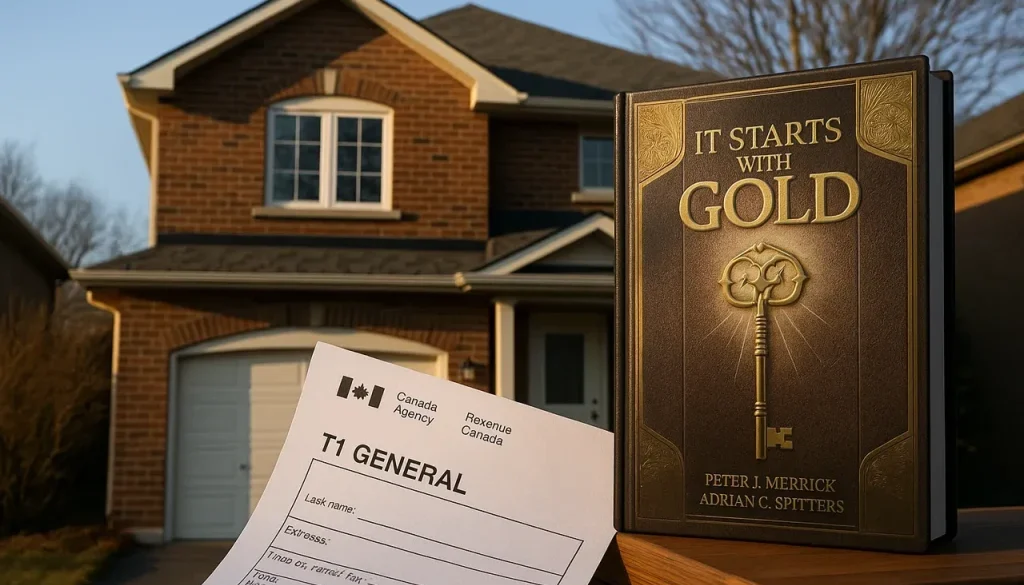
How a Stealth Tax Inside the CRA Could Reshape Home Ownership
By Peter J. Merrick, TEP® and Adrian C. Spitters, CFP®, co-authors of the international bestseller It Starts With Gold™ and the forthcoming book Guns, Gold & Land™
This analysis continues a series of long-form investigations published in The Merrick Spitters Reset Report™
A Stealth Tax Inside the Canada Revenue Agency Could Redefine What It Means to Own a Home in Canada
Owning a home has long been the symbol of Canadian security. It represented more than shelter. It was a form of savings, stability, and inheritance. Yet beneath the surface of familiar rules and long-standing tax exemptions, a new danger is emerging.
Canadians are beginning to discover that the Canada Revenue Agency (CRA) is reinterpreting how it views principal residences. What was once a straightforward exemption on the sale of a home could soon be turned into taxable income through administrative language rather than new law. The shift is not coming from Parliament but from within the bureaucracy itself.
This article explores how that process works, what it could mean for ordinary families, and how Canadians can protect what they still control.
👉 Subscribe to The Merrick Spitters Reset Report™ and receive a digital copy of our international bestseller, It Starts With Gold™, along with our white paper, Last Asset Standing™ and early updates on our forthcoming book, Killing Crypto™.
The Quiet Erosion of the Principal Residence Exemption
For decades, the Principal Residence Exemption (PRE) allowed Canadians to sell their home without paying capital gains tax. It was a policy grounded in fairness. The home was a necessity, not an investment. But that protection is being quietly re-engineered.
In recent audits, the CRA has begun examining the motives behind property sales and the financial relationships of those connected to the transaction. If a family member co-signed a mortgage or provided a loan, the agency may question whether the home was used for business purposes. Even the reasons for selling, such as a move to a larger home or an upgrade due to appreciation, are now being reviewed as potential indicators of profit intent.
The result is a dangerous precedent. If officials can argue that a sale was business-like, the gain is no longer taxed at 50 percent like a capital gain. It becomes 100 percent taxable as business income, retroactively.
The Canadian Taxpayers Federation has cautioned that the CRA’s broadening audit criteria could expose ordinary homeowners to taxation under interpretations of intent that are not clearly defined in law. The agency’s audit checklists already include factors like the intentions of other persons on title and factors motivating the sale. Those words are elastic. They give auditors discretion that can strip Canadians of long-standing rights without a single vote in Parliament.
The Political Denials and Administrative Reality
Federal leaders have publicly denied that a home equity tax is coming. During the 2025 election campaign, opposition leader Pierre Poilievre vowed that a Conservative government would never impose such a tax, saying it would never happen.
Yet the evidence shows a different story unfolding inside the bureaucracy. The reporting requirement introduced in 2016 forced every homeowner to declare the sale of their principal residence on their annual tax return. At the time, Ottawa said it was for data collection. Today, that database provides the foundation for future taxation.
The CRA states on its website that reporting the sale of a principal residence is required “to ensure compliance and fairness across all taxpayers.” Yet the scope of this reporting has quietly expanded since 2016, creating the infrastructure for potential taxation.
Since 2016, the CRA has required all homeowners to report the sale of their principal residence, giving the agency comprehensive visibility into ownership and transaction data nationwide. Once information is centralized, reinterpretation becomes policy with the stroke of a pen. The government does not need new legislation. It only needs administrative justification.
The Liberal government’s promise to expand automatic tax filing through the CRA, a system in which the tax collector also becomes the filer, adds another layer of control. When the same agency calculates your income and your liability, the potential for overreach multiplies.
How Bureaucratic Power Turns into Financial Confiscation
Most Canadians imagine taxation as a transparent process involving proposals, debates, and votes. But the modern threat is bureaucratic drift. When unelected officials gain discretionary power to define intent, they can reclassify transactions and wealth without political accountability.
A homeowner who accepts help from parents on a down payment can be audited. A retiree who sells because of market appreciation can be accused of seeking profit. A family that renovates and flips a home to relocate can be labelled as running a business.
Through this reinterpretation, the CRA can effectively convert private wealth into taxable revenue. It does so not through law but through policy. That is how a free nation slides from rule of law into rule by administrative discretion.
Canada’s auditor general has already raised concerns about inconsistent audit practices and overreach in small business taxation. The same pattern now threatens residential real estate, a cornerstone of household balance sheets.
This new form of taxation will not appear on a headline or a ballot. It will arrive in the form of audit reassessments, penalties, and retroactive claims, all justified under existing authority.
The Burden on Retirees and Working Families
The people most exposed to this back-door equity grab are not the wealthy. They are the middle-class homeowners who hold the majority of their net worth in real estate.
Retirees who downsize to fund their later years could lose a large portion of the proceeds to income tax. Families who bought modest homes decades ago and are now forced to move due to rising costs could face audits questioning their intent.
Many Canadians bought their homes believing that a stable policy would protect their equity. They budgeted, renovated, and saved in good faith. Watching new rules threaten that security leaves them feeling betrayed and uncertain about the future.
This is not only an economic issue. It is moral. Canadians were told that their homes were safe, that their effort and sacrifice would one day become a legacy for their children. Changing the rules after the fact is a betrayal of that promise.
The Fiscal Motive Behind the Move
Canada’s public finances are deteriorating. Federal debt has now exceeded 1.3 trillion dollars, and the 2025–26 Main Estimates project roughly 49 billion dollars in annual public debt charges, already surpassing Canada’s national defence allocation.
According to the Parliamentary Budget Office, federal debt charges are expected to rise to more than ten percent of total program spending by 2026 if interest rates remain elevated.
When governments overspend and exhaust politically palatable options, they turn to citizens’ assets. Real estate remains among the largest reservoirs of private wealth in Canada, widely estimated to exceed six trillion dollars in value. Bureaucrats see wealth as an opportunity.
Prime Minister Mark Carney has unveiled sweeping infrastructure and stimulus plans, suggesting the redirection of idle capital toward housing, social, and development goals. Although his government ended the federal consumer carbon tax earlier this year, it continues to pursue green-investment initiatives funded through private-capital mobilization. Citizens must understand that under this agenda, what appears dormant may be reclassified as taxable or regulated capital.
That is how fiscal necessity becomes the cover for confiscation.
Canada’s Growing Audit Machinery
Parliamentary reports show that the CRA’s annual budget has grown from roughly 4.2 billion dollars in 2015 to about 6.5 billion dollars in 2025, reflecting a sharp increase in audit and data analytics capacity.
Canada’s tax bureaucracy has grown significantly over the past decade, outpacing most of its OECD peers in staffing and administrative spending growth. The CRA’s workforce has expanded by more than 30 percent since 2016, growing much faster than the U.S. Internal Revenue Service on a per capita basis, reflecting Canada’s expanding bureaucratic footprint.
The agency’s technology and data analytics divisions have been upgraded to cross-reference banking data, mortgage filings, and property assessments. Under the guise of efficiency, the state has gained near-total visibility over private financial life.
As more Canadians face reassessments and document requests, the pattern becomes clear. The bureaucracy no longer merely collects taxes. It interprets economic intent.
Once intent becomes taxable, ownership loses meaning.
How Canadians Can Protect Themselves
The threats are structural, but so are the solutions. Canadians still have time to act.
The home should no longer be viewed as the ultimate safe asset. It sits in plain sight of government databases. At our firm, we assist clients in structuring wealth by Owning Assets in Order of Asset Security. This means anchoring portfolios in assets that are most difficult for governments or financial institutions to encumber and then working outward from there.
Physical precious metals, private income-producing real estate, and select private equity holdings offer insulation that bank-tethered assets cannot.
Homeowners should also maintain clear records of intent, financing, and occupancy. If audited, documentation can prevent arbitrary reclassification. Keep separate accounts for renovations, capital contributions, and rental activities.
Canada’s banks operate under bail-in legislation, giving them the authority to convert deposits to shares during crises. Having a portion of wealth outside that system, in physical assets or private custodial structures, protects against systemic risk and administrative seizure.
Finally, Canadians must stay informed. The policies shaping taxation and property rights are evolving quickly. Those who understand them now will not be blindsided later.
The Deeper Meaning Behind This Battle
This is not only a financial conflict. It is a philosophical one. The right to own property, to build, improve, and pass it to the next generation, is the foundation of freedom.
When governments claim the authority to reinterpret that ownership, democracy itself weakens. Each audit becomes a precedent. Each confiscation normalizes control.
Canada was once a nation where effort led to security. That security is now being rewritten by policy memos, not public debate.
We believe Canadians can still change the outcome. But they must understand the threat before they can resist it.
What Comes Next
The push for a back-door home equity tax is a symptom of deeper fiscal desperation. Ottawa’s appetite for revenue will not fade. It will simply evolve, taking new forms as old resistance hardens.
Canadians must decide whether they will continue to play by shifting rules or whether they will design their financial lives to exist outside those rules.
The path forward will belong to those who act early, protect privately, and understand that real ownership begins where government access ends.
👉 Sign up today for The Merrick Spitters Reset Report™ to receive a digital copy of our international bestseller, It Starts With Gold™, our white paper, Last Asset Standing™, and early updates on our upcoming book, Killing Crypto™.
Stay informed. Stay prepared. Act while choice still exists.
These insights connect directly to the themes explored in It Starts With Gold™, co-authored by Peter J. Merrick, TEP® and Adrian C. Spitters, CFP®. Inside the book, we show how to establish a tangible-asset foundation, measure security across asset classes, and safeguard against systemic shocks while maintaining control of your future. Visit www.ItStartsWithGold.com.
Prefer a hard copy? Order It Starts With Gold™ on Amazon today.
References
- Government of Canada – Deferral of Capital Gains Inclusion Rate Change (January 2025)
- Canadian Taxpayers Federation – Party Leaders Must Clarify Position on Home Equity Tax
- Pierre Poilievre Vows Not to Impose a Home Equity Tax
- CBC News – Automatic Tax Filing Plan Expands CRA Authority
- Investment Executive – CRA says it’s hiring more call centre staff, using AI to improve services (September 2025)
- RE/MAX Canada – Will Mark Carney Tax Home Equity?
- Reuters Canada – Investors brace for record Canadian government debt issuance as budget delayed (May 2025)
Disclaimer
This publication is intended for informational and educational purposes only. It does not constitute financial, legal, tax, or investment advice, and should not be relied upon as a recommendation to buy or sell any security, investment fund, or financial product. The views expressed are those of the authors and do not necessarily represent those of any affiliated organization or regulated firm. While every effort has been made to ensure accuracy, completeness, and reliability, no representation or warranty, express or implied, is made as to the accuracy or timeliness of the information contained herein. Market conditions, government policies, and economic environments are subject to change without notice, and such changes may materially affect the opinions or projections discussed. All investments carry risk, including the potential loss of principal. Past performance is not indicative of future results. Real estate values, interest rates, and government regulations can fluctuate significantly, impacting the outcomes of any financial or investment decision. Readers are encouraged to consult directly with a qualified financial advisor, tax professional, or legal expert before taking action based on the content of this article. The discussion of laws, markets, and asset classes is presented for general insight only and should not be interpreted as personalized advice. The authors, Peter J. Merrick, TEP®, and Adrian C. Spitters, CFP®, provide professional advisory services through independent affiliations with regulated financial firms. Neither the authors nor any related entity accepts liability for any losses or damages arising from reliance on this publication or the information contained herein. By reading this article, you acknowledge and agree that the authors shall not be held responsible for any actions taken based on the information presented. For personalized advice tailored to your financial situation, please consult with a licensed financial professional.