Why Banks Warn You Not to Buy Gold While They Hoard It
By Peter J. Merrick, TEP® and Adrian C. Spitters, CFP®, co-authors of the international bestseller It Starts With Gold™ and the forthcoming book Guns, Gold & Land™
This analysis continues a series of long-form investigations published in The Merrick Spitters Reset Report™
This article explores how financial institutions use digital products to retain control while hoarding the real wealth they tell investors to avoid.

Banks Tell You Gold is Outdated. Their Balance Sheets Say Otherwise
Owning gold has long represented independence. It is wealth without permission, immune to digital interference and institutional control. Yet today, the largest banks and asset managers dismiss it as a relic of a bygone era while quietly accumulating it behind the scenes. This contradiction is not an accident. It is a design.
👉 Subscribe to The Merrick Spitters Reset Report™ and receive a digital copy of our international bestseller, It Starts With Gold™, along with our white paper, Last Asset Standing™ and early updates on our forthcoming book, Killing Crypto™.
The Great Financial Sleight of Hand
Across the global financial system, a quiet contradiction defines modern investment advice. Banks, insurance companies, mutual fund firms, and brokerage houses publicly minimize the value of physical gold, even calling it obsolete. Yet within their own vaults and balance sheets, they are securing it in record amounts. They call it outdated, but treat it as irreplaceable.
Their public message urges investors toward the future of digital finance, from exchange-traded funds tied to cryptocurrencies to tokenized assets promising liquidity and innovation. What they rarely mention is that these digital instruments remain fully within the controlled perimeter of the financial system. Physical gold, by contrast, exists outside it. That difference is the foundation of this strategy.
When individuals buy physical precious metals, they are effectively withdrawing wealth from the banking network. The metals cannot be rehypothecated, frozen, or reprogrammed. They are wealth in its purest state. But when investors buy digital products, they reinforce the very system that thrives on control, fees, and dependence. The institutions understand this deeply, which is precisely why they warn against owning real gold while quietly hoarding it themselves.
The Double Standard Hidden in Plain Sight
Bank advisors often tell clients that gold is unproductive, that it pays no interest and offers no yield. Yet central banks across the world clearly disagree. According to the World Gold Council, they have been net buyers of gold for fifteen consecutive years, purchasing over nine hundred tonnes in both 2024 and 2025, the largest accumulation on record.
As of mid-2025, global central bank reserves surpassed thirty-seven thousand tonnes of gold, the highest since recordkeeping began in 1950, reflecting a deliberate shift away from reliance on the United States dollar as the world’s reserve currency.
Major financial institutions mirror this behaviour. They manage and own the world’s largest private gold vaults, from London to New York to Zurich. They hedge their balance sheets with physical bullion and use it as collateral for internal trades. Pension funds and insurance companies quietly allocate portions of their reserves to physical gold through private custodians. Meanwhile, the public is told to focus on digital portfolios.
This double standard reveals a deeper truth. The institutions that built the fragile financial system are now protecting themselves from it. The clients they serve are being told to chase yield and innovation while the institutions build a wall of tangible security for their own protection.
The Profit Motive Behind the Message
The incentives driving this contradiction are simple. When a bank sells an investor physical precious metals, it earns only a small, one-time commission. Once the metal changes hands, the transaction is complete. There are no management fees, no quarterly statements, and no recurring revenue.
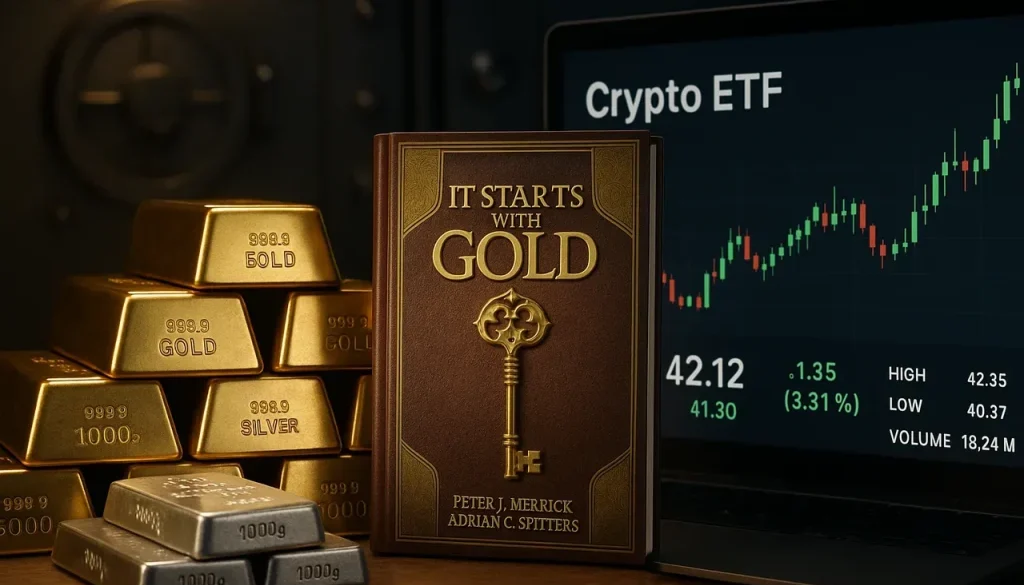
Digital assets are different. A crypto exchange-traded fund generates fees indefinitely. Each trade, rebalance, or contribution produces income. It remains on the institution’s platform, boosting total assets under management. Portfolio managers and advisors are often compensated based on the value of the assets they oversee, which means they are rewarded for keeping investors inside the system.
Physical gold, once purchased, leaves the system entirely. For an advisor, it represents a permanent loss of revenue. For an institution, it represents lost control. This is why the industry’s narrative promotes digital assets as the future and physical gold as a relic. The motivation is not philosophical. It is financial.
Why Crypto ETFs Are Not Freedom
Cryptocurrency was originally designed to liberate people from centralized finance. Yet as regulation tightened, banks and asset managers moved in. They created managed products that mimic decentralization but function like every other controlled asset.
When an investor buys a crypto exchange-traded fund, they do not own the underlying coins. They own a claim on them, mediated by custodians, auditors, and compliance officers. The asset cannot be moved or used independently. It sits inside a custodian’s account, governed by rules that can change at any time. This is not financial freedom. It is financial permission.
Meanwhile, the institution earns its fee every year, regardless of performance. The risk belongs to the investor; the reward belongs to the firm. This is the modern illusion of choice, a digital mirror of freedom that remains safely inside the system.
The Architecture of Control
Every digital asset is part of a monitored grid. Tokenized real estate, programmable bonds, and digital currencies all share one common feature: they can be tracked, taxed, and restricted. Their convenience is undeniable, but it comes at the cost of autonomy.
Once money exists entirely within a programmable system, it becomes subject to control. Transactions can be reversed, delayed, or denied. Access can be suspended or limited to approved uses. This is not a distant future; it is an emerging present.
Gold and silver represent the opposite. They are tangible, borderless, and permanent. They require no intermediary, no password, and no approval. They cannot be inflated, hacked, or deleted. That is why they remain the single greatest threat to a financial system built on perpetual control and fee extraction.
In Canada, similar digital controls are emerging through the Bank of Canada’s Central Bank Digital Currency pilot program and proposed federal digital identity frameworks. These initiatives are marketed as convenience upgrades but carry implications for surveillance and property rights that mirror international models.
How Banks Maintain the Illusion
To understand why banks discourage precious metals, it helps to look at how they measure success. The financial industry thrives on recurring fees, not independence. Its entire structure depends on retaining assets, not releasing them. When a client holds physical gold in a private vault, that wealth disappears from the firm’s books. It no longer contributes to quarterly earnings or shareholder returns.
The narrative that “gold is dead” or “crypto is the future” is not a reflection of belief; it is a reflection of business necessity. Banks need clients to remain dependent on products that generate revenue. Physical gold offers none of that. From a corporate perspective, that makes it a poor business model. From an investor’s perspective, it is the ultimate protection.
The Power of Simplicity in an Over-Engineered System
In a world of complex derivatives, synthetic assets, and tokenized wealth, simplicity has become rebellion. Gold and silver are not complicated. They exist. They endure. Their value does not depend on a promise from a counterparty or the stability of a network.
Every major financial collapse—from 1929 to 2008—has demonstrated the same truth. Paper claims and digital ledgers can evaporate overnight, but tangible assets remain. Gold is not an opinion; it is a fact of economic survival.
When an investor owns physical precious metals, they hold value that requires no validation. It cannot be deleted from a database or devalued by a central banker’s decision. It is the most honest form of wealth left in a system built on abstraction.
The Shift Toward Total Digital Dependency
The global financial architecture is moving toward programmable money and identity-linked assets. Central bank digital currencies are being designed to integrate directly with tax systems and climate reporting frameworks. Once implemented, these systems will allow spending to be tracked, limited, or even programmed to expire.
When money becomes code, control becomes absolute. Every purchase, donation, or transfer becomes data. That data can be analyzed, restricted, or weaponized. The convenience is undeniable, but so is the risk.
Physical gold and silver exist outside that structure. They cannot be reprogrammed or surveilled. They offer not just protection from inflation but from digital dependency itself. That is why their ownership remains the single most underappreciated act of financial sovereignty in the modern world.
Lessons from the Past
History offers a consistent pattern. In 1933, the United States government confiscated private gold under Executive Order 6102, promising citizens that paper was as good as metal. It was not. In 1971, the dollar was disconnected from gold, and inflation eroded the savings of millions. In 2008, the collapse of leveraged finance erased trillions of dollars and left taxpayers responsible for the rescue.
Today, the same institutions that engineered those crises are once again asking the public to trust in their new digital systems. The difference is scale. This time, the system is global and permanent. Once every asset is digitized and traceable, ownership itself will depend on permission.
Gold and silver are the exceptions. They remain outside the code. That is why central banks buy them, and why the public is told not to.
The Case for Physical Precious Metals
Owning precious metals is not speculation; it is protection. Allocating even ten to fifteen percent of one’s portfolio to physical gold and silver—stored securely outside the banking system—creates a firewall against both market and systemic risk.
Vaulted holdings retain liquidity when markets freeze. They preserve purchasing power during devaluation. They serve as collateral that cannot be encumbered or lent out without consent. Most importantly, they exist independently of institutional control.
Within a sound wealth strategy, precious metals form the top layer of asset security, followed by productive real assets such as farmland, multifamily rentals, and private infrastructure. This hierarchy ensures that each layer supports the next, reducing exposure to financial system shocks.
When the next financial reset occurs, it will not be those chasing digital trends who preserve their wealth. It will be those who hold real assets, immune from the failures of code and the fragility of promise.

Follow What They Do, Not What They Say
Banks are not foolish. They understand the cycles of history. Their analysts may dismiss gold in public reports, but their balance sheets tell another story. They accumulate what they publicly discredit because they know instability is inevitable.
Their message to clients discourages independence. Their actions reveal preparation. If you want to understand what is coming, ignore the slogans and follow the behaviour. When institutions that print money start buying gold, it is not superstition. It is self-preservation.
The logic is simple. If they earn a fee for managing what you own, they want to keep you in the system. If you own it outright, they cannot profit from it. That is why they warn you away from gold.
Reclaiming Control Through Real Assets
Awareness is only the first step. Protection requires action, and action begins by restructuring wealth around security, not speculation.
At our firm, we assist clients in structuring wealth by Owning Assets in Order of Asset Security. We prioritize the most secure assets and safeguard those that are most vulnerable. This approach begins with tangible, verifiable ownership and builds outward from the most resilient base.
We teach that financial security is not measured by paper returns but by control. A portfolio anchored in real assets is not only more stable, it is freer. Those who understand this principle are no longer at the mercy of the financial system. They are participants in their own protection.
👉 Sign up today for The Merrick Spitters Reset Report™ to receive a digital copy of our international bestseller, It Starts With Gold™, our white paper, Last Asset Standing™, and early updates on our upcoming book, Killing Crypto™.
These insights connect directly to the themes explored in It Starts With Gold™, co-authored by Peter J. Merrick, TEP® and Adrian C. Spitters, CFP®. Inside the book, we show how to establish a tangible-asset foundation, measure security across asset classes, and safeguard against systemic shocks while maintaining control of your future. Visit www.ItStartsWithGold.com.
Prefer a hard copy? Order It Starts With Gold™ on Amazon today.
The Final Lesson
This is not merely a question of finance but of freedom itself. When value can only exist with permission, liberty becomes a service instead of a right.
Real wealth has never been about returns. It has always been about control. Every digital innovation that promises convenience also deepens dependency. Precious metals do the opposite. They give individuals back the one thing no financial institution can sell them: sovereignty.
That is why gold and silver are not relics of the past. They are the anchors of the future.
It starts with gold.
Because in the end, only what is real endures.
References
- World Gold Council – Central Bank Gold Demand Trends Q2 2025
- World Gold Council – Central Bank Gold Reserves Survey 2025
- Reuters – Central Banks Eye Gold as Dollar Dominance Wanes (June 2025)
- Bank of Canada – Digital Canadian Dollar Public Consultation Report (2023)
- State Street – The Future of Digital Asset Custody: Building Trust at Scale (July 2025)
- HANetf – How Gold Is Custodied and Why It Should Matter to Investors (2025)
- HANetf – Six Things to Know About Investing in a Gold ETC (2025)
- OECD – Tokenization of Assets and Distributed Ledger Technologies in Financial Markets (January 2025)
- ScienceDirect – Tokenized Assets in a Decentralized Economy: Balancing Efficiency, Risk, and Value (2025)
- International Monetary Fund (IMF) – Tokenization and Financial Market Inefficiencies (2025)
Disclaimer
This publication is for informational and educational purposes only and does not constitute financial, legal, tax, or investment advice. The views expressed are those of the authors and do not necessarily reflect those of any affiliated organization or regulated firm. While every effort has been made to ensure the accuracy and reliability of the information provided, no representation or warranty, express or implied, is made as to its completeness or timeliness. Market conditions, regulations, and economic environments may change without notice, potentially affecting the opinions or projections discussed. All investments involve risk, including the possible loss of principal. Past performance is not indicative of future results. Readers should consult a qualified financial advisor, tax professional, or legal expert before making any decisions based on this content. Peter J. Merrick, TEP®, and Adrian C. Spitters, CFP®, provide professional advisory services through independent affiliations with regulated financial firms. Neither the authors nor any related entity accepts liability for losses or damages arising from reliance on this publication. By reading this article, you acknowledge and agree that the authors shall not be held responsible for actions taken based on the information herein.