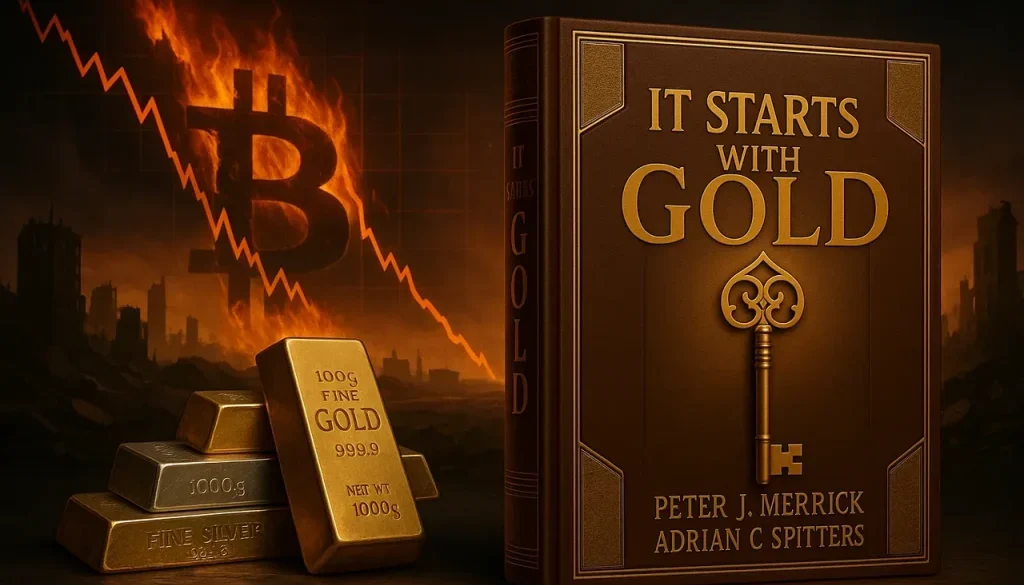
Crypto Crash, Central Control & The Return of Gold
By Peter J. Merrick, TEP® and Adrian C. Spitters, CFP®, co-authors of the international bestseller It Starts With Gold™ and the forthcoming book Guns, Gold & Land™
This analysis continues a series of long-form investigations published in The Merrick Spitters Reset Report™
How Market Collapses Keep Exposing the Risks of Digital Finance and Why Owning Real Assets Always Matters

Gold has always been the real test of value. It does not break, disappear, or depend on the internet to exist. When everything else burns, gold stands in the ashes, unbroken. What happens in cryptocurrency markets during major sell-offs is never just another correction. Each crash is a reminder that digital wealth is only as strong as the code that holds it.
In twenty-four hours, over 1.6 million traders were wiped out. More than nineteen billion dollars of leveraged crypto positions disappeared. That is not volatility. That is fragility. This liquidation occurred during the October 10, 2025, crypto market crash, one of the largest one-day collapses in digital asset history, exposing once again how fragile digital finance remains when liquidity vanishes and leverage unwinds.] The same markets that promised liberation from central banks showed their true nature, controlled by unseen hands, manipulated by insiders, and vulnerable to engineered collapse.
This is the story of how digital money became a tool of control and why gold, the most ancient and incorruptible form of wealth, is once again the final refuge for those who wish to stay free.
We warned our readers this would happen in our international bestselling book, It Starts With Gold™, and later in our white paper, Last Asset Standing™. Both works cautioned that the financial system would face a systemic failure driven by over-leverage, digital dependency, and institutional consolidation. Each new collapse continues to prove that those warnings were not a theory. They were prophecy.
👉 Subscribe to The Merrick Spitters Reset Report™ and receive a digital copy of our international bestseller, It Starts With Gold™, along with our white paper, Last Asset Standing™ and early updates on our forthcoming book, Killing Crypto™.
The Digital Illusion
For years, the world was told that cryptocurrency would decentralize power. Bitcoin was hailed as the people’s currency, Ethereum as the world’s computer, and blockchain as the foundation of a new financial order. It sounded noble. It sounded revolutionary. Yet beneath the slogans lay the same old architecture of control.
Most cryptocurrency trades happen on centralized exchanges. These platforms act as intermediaries, holding keys, setting leverage, and executing orders. They are not independent of governments, banks, or intelligence networks. They are digital banks dressed in rebel clothing.
When markets rise, people forget who runs the servers. When markets fall, they remember.
The promise of anonymity was always an illusion. Every transaction leaves a trail. Every node is a point of observation. Once traced and clustered, digital wallets reveal identities, networks, and behaviours. The National Security Agency (NSA) in the United States, the Government Communications Headquarters (GCHQ) in the United Kingdom, and other allied surveillance agencies already possess the quantum capacity to decrypt much of what people believe is private.
This is not the dream of freedom. It is the birth of programmable dependency.
The Anatomy of a Digital Collapse
In one of the largest sell-offs in digital-asset history, the crypto world faced its reckoning. As traders placed leveraged bets on Bitcoin, a single massive short position was placed thirty minutes before the United States administration announced a new wave of tariffs on China. Minutes after the announcement, the market imploded. Billions in positions were liquidated. The trader who placed the short reportedly earned nearly two hundred million dollars in less than an hour.
Then something else happened. Just as the market reached its bottom, institutional buyers, including BlackRock Inc. (BLK), the world’s largest asset-management company headquartered in New York City, began accumulating Bitcoin in bulk. They purchased an estimated forty-five thousand coins at depressed prices.
Was this a coincidence or coordination? The timing suggests design.
The event exposed how easily these markets can be moved by a few powerful entities. The decentralization narrative collapsed with the price.
This liquidation did not occur in isolation. It unfolded against a backdrop of global liquidity stress, record sovereign debt, and mounting derivatives exposure. As governments struggled to contain inflation and deficits, even minor shocks in digital markets became magnified through leverage. The crypto collapse was not a separate event. It was a signal of fragility across the entire financial system.
The Emotional Cost of Illusion
Behind every liquidation statistic is a person. A father, a daughter, a retiree. People who believed they had found the new safe haven in digital code. Some lost everything.
One trader wrote that his ten-year crypto fortune of thirty million dollars evaporated in minutes. Another confessed that his entire family savings were gone, his sister’s included. The despair was visible across forums and live streams. Screens smashed, accounts deleted, silence in digital communities that once spoke of the moon.
This is not just financial loss. It is spiritual disillusionment.
The digital dream promised freedom from the manipulation of central banks. Yet the same pattern repeated itself: leverage, greed, centralization, and collapse.
A Perfect Diversion from Real Assets
During the years when crypto was rising, global central banks were buying gold at the fastest pace in modern history. The People’s Bank of China (PBoC), the Reserve Bank of India (RBI), and the Central Bank of the Russian Federation (CBR) collectively increased their holdings by thousands of tonnes. Even the Central Bank of the Republic of Türkiye (CBRT) converted foreign reserves into gold.
While the public chased virtual coins, sovereign powers fortified with tangible reserves. This was no accident.
Crypto drained trillions of dollars away from real stores of value. The same institutions that mocked gold as a relic of the past were quietly stockpiling it. They let the public gamble on code while they secured metal.
Gold is no longer a hedge. It has become the quiet foundation of a parallel monetary order forming outside the Western debt system.
This was not innovation. It was orchestration.
In Canada, several cryptocurrency exchange-traded funds faced trading halts as liquidity vanished. Retail investors holding Bitcoin ETFs saw values plunge within hours while Canadian exchanges temporarily restricted withdrawals. The event revealed that even regulated products are vulnerable when underlying confidence breaks. It reminded investors that proximity to the banking system offers no true safety.
The Central Bank Digital Currency Trap
The next stage of control is not cryptocurrency. It is central bank digital currency, or CBDC. Unlike Bitcoin, a CBDC is issued directly by a central authority such as the Bank of Canada (BoC), the Federal Reserve System (Fed) in the United States, or the European Central Bank (ECB) headquartered in Frankfurt, Germany. It can be tracked, frozen, or programmed to expire.
CBDCs are being developed by over ninety percent of global central banks, according to the Bank for International Settlements (BIS) located in Basel, Switzerland.
This is the final step toward a fully programmable economy. Every transaction, donation, purchase, or act of dissent can be monitored and sanctioned. The architecture is not theoretical. It is already being tested.
When governments can disable an individual’s access to digital money, they no longer need to pass laws to control behaviour. They can simply rewrite code.
If this becomes reality, there will be no privacy, no property, and no protest without permission.
Western Nations at a Crossroads
The United States remains the world’s financial center. Canada is a resource powerhouse. The United Kingdom and the European Union (EU) are regulatory hubs. Australia anchors the Pacific. Together they form the Western Alliance, the last stronghold of private-capital freedom.
Yet even here, the pressure to centralize grows.
Canada’s Bill C-8 already grants the federal government the authority to suspend digital access for any specified person. In the European Union, the EU Digital Identity Wallet (EUDI Wallet) will soon link financial data to personal credentials. In Australia, the Reserve Bank of Australia (RBA) is testing the electronic Australian dollar (eAUD), a central-bank-digital prototype. In the United States, the Federal Reserve and the U.S. Department of the Treasury are developing the Digital Dollar Project (DDP) in partnership with Accenture plc (ACN).
This is the same pattern repeating under different flags. Once implemented, every citizen will be one policy away from exclusion.
The Hidden Hands Behind Collapse
Whenever there is chaos, ask who benefits.
When Bitcoin collapses and confidence evaporates, who profits from the panic? Those who short the market, those who acquire discounted assets, and those preparing to replace crypto with state-backed digital money.
This is financial warfare, not between nations, but between citizens and institutions.
The same global players who control debt markets, central-banking policy, and commodity pricing are preparing for a new monetary regime where ownership is replaced by access and privacy becomes a relic.
Every crash is a transfer of power.
The Rise of Physical Wealth
Physical assets are the antithesis of control. Gold, silver, farmland, and productive real estate cannot be deleted. They exist beyond code. They have intrinsic value.
Silver deserves equal attention. It is both monetary and industrial, bridging two worlds that define modern civilization. It is essential to energy infrastructure, solar production, and digital circuitry, making it one of the few assets that benefit from both scarcity and utility. As nations move toward electrification and renewable grids, demand for silver is set to outpace mine supply. This dual purpose gives silver a unique defensive and productive quality that complements gold’s stability
Gold is no one’s liability. It cannot default. It cannot be inflated away. Every ounce represents energy, time, and scarcity condensed into form.
When empires fall, gold survives. When currencies collapse, gold rebalances. When nations rebuild, gold becomes their foundation.
That is why, in every era, gold is not a commodity. It is civilization’s memory.

The Principle of Asset Security
At our firm, we assist clients in structuring wealth by Owning Assets in Order of Asset Security. We start with the unbreakable base, gold. Then we build upward into income-producing real assets like private real estate, farmland, and participating whole-life insurance through mutual life companies. Finally, we add carefully managed private portfolios with seasoned discretionary portfolio managers.
Each layer provides calculated exposure designed to protect the integrity of the core asset base.
We do not speculate. We build permanence.
This model shields investors from what we call systemic contagion, the chain reaction that occurs when markets fall, currencies lose confidence, or governments tighten control.
Silver extends that freedom to the working class. It allows ordinary families to participate in the same principles of protection and permanence that have safeguarded nations for centuries.
When you hold gold, you are not holding a commodity. You are holding freedom compressed into matter.
The Moral Lesson
This story is not just about money. It is about morality.
A system built on debt, surveillance, and speculation cannot serve the human spirit. It turns individuals into data points and communities into ledgers.
The purpose of wealth is not accumulation. It is stewardship. It is about protecting the ability to act, to give, to build, and to help others when the system breaks.
That is why the fight for financial sovereignty is a moral fight.
Those who hold real assets are not hoarders. They are custodians of continuity.
This responsibility extends beyond the present moment. The next generation will inherit not only our wealth but the conditions we leave behind. If we fail to secure real ownership today, our children may inherit dependency instead of freedom.
The Western Response
To survive the coming reset, Western nations must reclaim their sovereignty from global financial institutions. This means reintroducing gold into national reserves, defending the right of citizens to hold precious metals privately, and rejecting any digital currency that allows a central authority to control spending.
The United States should reassert gold as a reserve anchor for the U.S. dollar. Canada should use its resource wealth to back its own financial independence rather than foreign debt. The European Union and the United Kingdom must preserve competitive regulation that protects private ownership. Australia should continue expanding its rare-earth production to reduce dependence on external supply chains.
Sovereignty begins with control over money. Lose that, and the rest follows.
What You Can Do
Every person can take steps today.
First, hold physical gold or silver. Not certificates, not exchange-traded funds (ETFs), not promises. Actual metal in secure, verifiable custody.
Second, minimize exposure to debt-driven markets and avoid excessive leverage. The less you owe, the more free you are.
Third, diversify across real, productive assets. Land, businesses, and cash-flowing private investments endure when digital wealth evaporates.
Fourth, stay informed. Understand how digital-identity and currency systems evolve. Knowledge is defense.
Finally, prepare mentally. The next stage of this global shift will reward patience, prudence, and conviction.
The Paradox of Progress
Every technological leap carries a hidden cost. The internet connected the world but made privacy vanish. Smartphones offered convenience but bred dependence. Digital money promises efficiency but risks total control.
This is the paradox of our age. Every gain in convenience erodes a measure of freedom. The question is not whether progress is bad. The question is who owns it.
Gold cannot be programmed. That is its rebellion. It remains outside the reach of central planners. That is why it is being quietly accumulated by the same elites who told the public to chase digital coins.
They are preparing for the storm. So should you.
The Choice Before Us
You have two paths. You can trust the same digital systems that just erased nineteen billion dollars in a day, or you can own what has never failed.
If you trust the system, you depend on code you do not control, stored on servers you do not own, regulated by institutions you cannot see.
If you own gold, you hold wealth that has outlasted every empire, every crash, every lie.
One choice leaves you exposed. The other leaves you sovereign.
At our firm, we guide clients toward that sovereignty. We help them structure wealth by Owning Assets in Order of Asset Security. The principles we teach are not theory. They are lived reality.
Many readers ask what practical steps they can take right now. The path begins with education, assessment, and decisive action. It means understanding how to position wealth outside the reach of systemic risk before the next disruption arrives.
👉Book your complimentary review to learn how to structure your wealth around these principles.
👉 Sign up today for The Merrick Spitters Reset Report™ to receive a digital copy of our international bestseller, It Starts With Gold™, our white paper, Last Asset Standing™, and early updates on our upcoming book, Killing Crypto™.
Stay informed. Stay prepared. Act while choice still exists.
The Golden Future
This is not the end of innovation. It is a reset of values.
The future will not belong to those who gamble on algorithms but to those who own the foundation of civilization, tangible assets, strong families, and sound principles.
Every storm in history has tested the same truth: when trust collapses, gold endures.
These insights connect directly to the themes explored in It Starts With Gold™, co-authored by Peter J. Merrick, TEP® and Adrian C. Spitters, CFP®. Inside the book, we show how to establish a tangible-asset foundation, measure security across asset classes, and safeguard against systemic shocks while maintaining control of your future. Visit www.ItStartsWithGold.com.
Prefer a hard copy? Order It Starts With Gold™ on Amazon today.
References
- Bloomberg: “Crypto’s Biggest Crash Reveals a Market Littered With Pitfalls” (Oct 13 2025)
- Reuters: “After Record Crypto Crash, a Rush to Hedge Against Another Freefall” (Oct 13 2025)
- TradingView: “Crypto Crash: $19.5 Billion Wiped Out in Record-Breaking Liquidation Event” (Oct 11 2025)
- CoinDesk: “Altcoins Cratered in Oct 10 Crypto Flash Crash as Bitcoin Held Up” (Oct 12 2025)
- CCN: “October 2025 Crypto Crash: Coordinated Attack On-Chain Evidence” (Oct 11 2025)
- CCN: “Oct 10 Crypto Flash Crash: Exchanges, Whales, and Traders Who Lost” (Oct 12 2025)
- YouTube: “Was Friday Crypto COLLAPSE Engineered by the Elites – IT DOESN’T ADD UP” (Oct 12 2025)
- Vidal-Tomás, D., Briola, A., & Aste, T. (2023). FTX’s Downfall and Binance’s Consolidation: The Fragility of Centralized Digital Finance. University College London Centre for Blockchain Technologies
- Tu, C., D’Odorico, P., & Suweis, S. (2018). Critical Slowing Down Associated with Critical Transition and Risk of Collapse in Cryptocurrency. Complex Systems Laboratory
- Mukhia, K., Rai, A., et al. (2024). Complex Network Analysis of Cryptocurrency Markets During Crashes. Institute of Physics
- Cointelegraph: “Centralized Crypto Exchanges Underreport Liquidations, Analysts Claim” (Sept 2025)
Disclaimer
This publication is intended for informational and educational purposes only. It does not constitute financial, legal, tax, or investment advice and should not be relied upon as a recommendation to buy or sell any security, investment fund, or financial product. The views expressed are those of the authors and do not necessarily reflect those of any affiliated organization or regulated firm. Every effort has been made to ensure accuracy, completeness, and reliability; however, no representation or warranty, express or implied, is made as to the accuracy or timeliness of the information contained herein. Market conditions, government policies, and economic environments may change without notice and could materially affect the opinions or projections discussed. All investments involve risk, including the potential loss of principal. Past performance is not indicative of future results. Real estate values, interest rates, and government regulations can fluctuate significantly, impacting financial outcomes. Readers are encouraged to consult directly with a qualified financial advisor, tax professional, or legal expert before taking any action based on this article. The discussion of laws, markets, and asset classes is provided for general insight only and should not be interpreted as personalized advice. The authors, Peter J. Merrick, TEP®, and Adrian C. Spitters, CFP®, offer professional advisory services through independent affiliations with regulated financial firms. Neither the authors nor any related entity accepts liability for losses or damages arising from reliance on this publication. By reading this article, you acknowledge and agree that the authors shall not be held responsible for actions taken based on the information presented. For advice tailored to your personal financial circumstances, please consult a licensed professional.