Trade Wars, Energy Battles, and the Next Commodity Supercycle
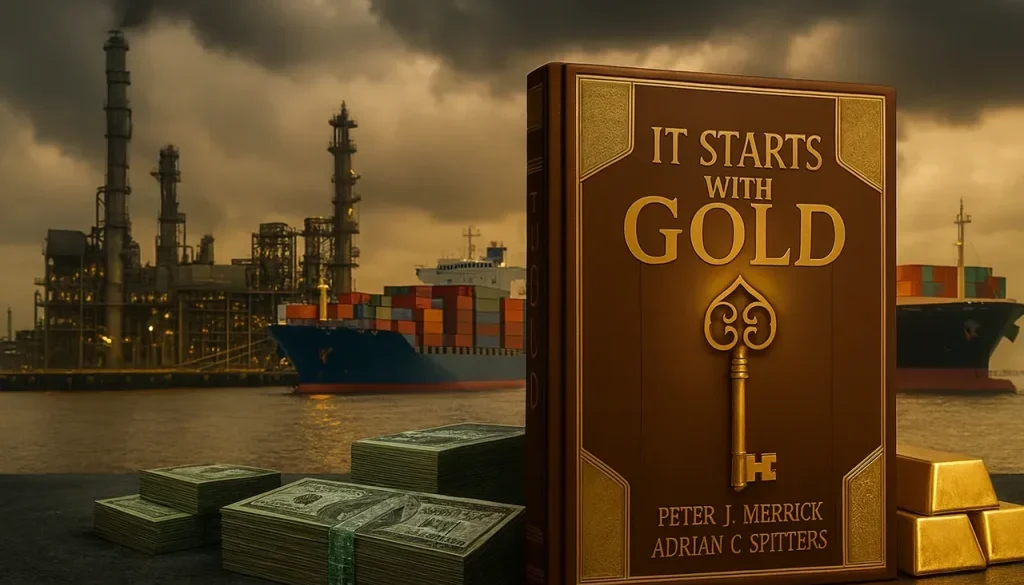
By Peter J. Merrick, TEP® and Adrian C. Spitters, CFP®, co-authors of the international bestseller It Starts With Gold™ and the forthcoming book Guns, Gold & Land™
This analysis continues a series of long-form investigations published in The Merrick Spitters Reset Report™
How Tariffs, Resource Weaponization, and a Global Scramble for Real Assets Will Reshape Wealth and Power, and Why Tangible Assets Like Gold Are the Last True Defence
By Peter J. Merrick, TEP® and Adrian C. Spitters, CFP® Co-authors of the international bestseller It Starts With Gold™ and the forthcoming Killing Crypto™
This article concludes our three-part series exploring the great financial reset transforming North America’s economy. Part One examined mortgage renewals and banking fragility; Part Two explored programmable money and digital control.
A New Economic Battlefield
The global economy is entering a new and more volatile era, one defined not by central bank policies or stock market bubbles, but by trade wars, resource weaponization, and an intensifying battle over commodities that underpin the modern world. These shifts are not future possibilities. They are already reshaping economies, trade alliances, and investment strategies across North America and beyond.
As of October 2025, these shifts are no longer theoretical forecasts. Tariffs, resource restrictions, and energy export realignments are being implemented across major economies, confirming that the transition toward strategic economic nationalism is already well underway.
For Canada, the stakes are especially high. As the United States reasserts its economic dominance through tariffs and industrial policy, Canada stands dangerously exposed to forces beyond its control. At the same time, the weaponization of energy and natural resources is rewriting the rules of geopolitical power, and a structural commodity supercycle is beginning to unfold that could last decades.
In this new environment, the assets that matter most are not digital abstractions or speculative paper claims. They are tangible: gold, energy, farmland, water, and critical minerals, and they are becoming the foundation of wealth and sovereignty. As global trade fractures and financial systems become increasingly programmable and politicized, investors must rethink how they protect and grow their wealth. The next era will reward those who understand the dynamics of trade, energy, and commodities, and punish those who cling to old assumptions.
The evidence already visible in current trade and energy data supports this structural change rather than a short-term cycle.
👉 Subscribe to The Merrick Spitters Reset Report™ and receive a digital copy of our international bestseller, It Starts With Gold™, along with our white paper, Last Asset Standing™ and early updates on our forthcoming book, Killing Crypto™.
Key Takeaways
-
-
- Strategic Nationalism Is Replacing Globalization: As of October 2025, tariffs, trade barriers, and industrial policies are reshaping how nations compete for economic power. Free trade is being replaced by reciprocal trade.
- Canada Faces Structural Exposure: More than 70 percent of Canada’s exports still flow to the United States. Recent U.S. tariff increases and supply-chain re-shoring threaten Canada’s margins, jobs, and fiscal stability.
- Energy Is the New Battleground: The United States has re-emerged as the world’s energy superpower, while Canada remains constrained by its own regulations and infrastructure delays. Energy policy now defines geopolitical leverage.
- The Commodity Supercycle Has Begun: Underinvestment, population growth, and geopolitical fragmentation are driving a long-term repricing of physical resources such as energy, metals, and food.
- Farmland, Water, and Gold Are Defensive Assets: Tangible resources that produce real utility and cash flow are outperforming financial instruments in a world of digital controls and political risk.
- Investors Must Re-Anchor in Reality: A resilient portfolio in the 2020s requires exposure to precious metals, energy infrastructure, farmland, and water rights, while keeping liquidity outside programmable financial systems.
-
Section I: Canada’s Vulnerability to Trade Wars and Tariff Shocks
The first front in this new era of economic conflict is trade. The United States, long the champion of global free trade, is pivoting toward a more protectionist strategy built on reciprocity, domestic production, and strategic leverage.
Under new trade policies announced in 2025, tariffs on foreign goods have surged. Steel, aluminum, autos, and key manufacturing components are being hit with duties as high as 35 percent under Section 232 of U.S. trade law. Products from countries not complying with new North American supply chain standards face steep penalties. The result is a fundamental shift in how goods move across borders, and a profound challenge for Canada.
These measures reflect the real-world tariff schedule announced by the United States in early 2025, including duties of up to 35 percent on metals and automotive components.
Canada’s Trade Exposure and Dependence on the U.S.
The numbers tell the story. As of August 2025, Canada’s merchandise exports fell by 3 percent, and the trade deficit widened to 6.3 billion Canadian dollars, one of the sharpest monthly deteriorations in years. More than 70 percent of Canadian exports still flow to the United States, leaving Canada deeply dependent on access to a single market it cannot control.
This imbalance gives Washington enormous leverage in trade negotiations and exposes Canadian industries to economic shocks over which they have little influence.
The Strategic Shift Behind U.S. Tariffs
The return of tariffs is not just about protecting U.S. jobs. It is part of a larger effort to reengineer supply chains for strategic advantage. The United States is reshoring critical manufacturing capacity, imposing tariffs on Chinese electric vehicles and solar panels, and tightening export controls on advanced technologies.
It is also investing heavily in domestic mining, refining, and semiconductor production to reduce reliance on foreign suppliers. In this emerging order, trade policy is no longer just about economics. It is a tool of national security and geopolitical influence.
Canada’s Economic and Political Limits
For Canada, this shift poses existential risks. Key sectors of the economy, from autos and aerospace to agriculture and forestry, depend on frictionless access to U.S. markets. Tariffs and supply chain reconfigurations threaten to erode margins, reduce competitiveness, and trigger job losses.
Agriculture, one of Canada’s strongest export industries, faces particular vulnerability. If Washington imposes new restrictions on fertilizer, grain, or livestock imports, Canadian producers could be cut off from their largest customer. Similar risks loom over lumber, metals, and manufactured goods.
The imbalance of power is also political. Canada has limited tools to respond to U.S. tariffs without harming its own economy. Retaliatory measures often invite further escalation, and alternative export markets cannot easily replace American demand.
Implications for Investors
The hard truth is that Canada’s economy has been built on the assumption of stable, rules-based trade, an assumption that no longer holds. Without a fundamental rethinking of its trade strategy, Canada risks becoming a subordinate player in a world where economic power is increasingly wielded through coercion and control.
For investors, the implications are profound. Tariffs increase costs throughout supply chains, fueling inflation and eroding consumer purchasing power. Companies exposed to cross-border trade face greater volatility and political risk.
Foreign investment could retreat if Canada is seen as an unreliable partner or a policy taker rather than a policy maker. And because trade is the foundation of Canada’s resource-driven economy, sustained disruptions could ripple through housing, employment, and government finances.
The New Reality
The lesson is clear. In a world of escalating trade conflicts, nations that control supply chains, set the terms of trade, and secure access to critical materials will wield disproportionate power. Those who do not will find their sovereignty compromised and their economic futures dictated by others. For Canada, and for investors who depend on its stability, the time to adapt is now.
If these tariff frameworks remain in place through 2026, Canada’s export-dependent sectors could face compounding pressures that reshape employment and investment decisions nationwide.
Section II: Energy Realignment and the Geopolitics of Power
Trade wars are only one dimension of the new economic conflict. The other is energy, and it may prove even more decisive.
As of October 2025, the United States remains the world’s largest combined oil and gas producer, and liquefied natural gas exports have reached record highs, underscoring the country’s restored energy dominance.
Global energy markets are undergoing a profound transformation as nations compete for control over production, transportation, and technology. The result is a realignment of geopolitical power that will shape the global order for decades.
The United States as an Energy Superpower
The United States is positioning itself as the world’s preeminent energy superpower. Driven by record-breaking production and massive investment in liquefied natural gas (LNG) infrastructure, the U.S. has become a dominant supplier to Europe and Asia.
Its LNG exports have surged more than 40 percent since 2022, providing Washington with strategic leverage over allies and adversaries alike. The U.S. is also reshoring domestic manufacturing capacity and imposing tariffs on foreign-made solar panels, batteries, and electric vehicles, with the goal of securing its control over the clean energy transition.
Energy, once seen as a global commodity governed by market forces, is now firmly understood as a geopolitical weapon.
China, Russia, and the Global Energy Chessboard
Other major powers are following the same playbook. China continues to invest heavily in global energy infrastructure and still controls roughly 70 percent of global rare-earth-element processing capacity, according to 2025 market data. These minerals are essential for electric vehicles, wind turbines, and advanced electronics, industries that will define the future of energy and technology.
China is also signing long-term oil and gas supply deals with Russia, Iran, and Gulf states, building a parallel energy system less dependent on Western markets. This strategy not only secures China’s domestic energy needs but also strengthens its geopolitical influence across Eurasia and the Global South.
OPEC+ nations, meanwhile, are reasserting their power by tightening production and pushing oil prices higher. Russia continues to weaponize its energy exports, using supply disruptions to pressure Europe and influence conflicts.
Canada’s Missed Opportunity
Canada, despite its enormous natural resource wealth, remains sidelined in this great realignment. It holds some of the world’s largest reserves of oil, natural gas, uranium, and critical minerals, yet regulatory barriers, infrastructure delays, and political indecision have stunted its potential.
Pipeline projects are slowed or cancelled, LNG terminals remain underbuilt, and investment in extraction and refining lags far behind global demand. Federal climate policies, designed to meet Net Zero emissions targets, have further constrained the sector, prioritizing environmental goals over energy sovereignty.
Federal regulatory uncertainty, especially regarding emissions caps and pipeline permitting, continues to deter capital investment as of Q3 2025.
This self-imposed stagnation has serious consequences. Energy is not just a commodity; it is the foundation of national power. Nations that fail to secure their energy supply chains become dependent on those that do.
The Cost of Inaction
By failing to build export capacity and assert control over its resource base, Canada risks ceding influence to foreign powers and missing out on one of the largest wealth transfers in modern history. Its vast uranium reserves could power the global nuclear renaissance, yet other nations are capturing that market.
Its natural gas could help reduce global emissions while providing geopolitical leverage, yet it remains trapped behind policy paralysis.
Energy accounts for more than 10 percent of Canada’s GDP and supports hundreds of thousands of jobs. It is also one of the country’s most important tools of foreign policy. Without a coherent energy strategy, Canada will remain a price taker in global markets, vulnerable to policy decisions made in Washington, Beijing, or Riyadh.
Opportunities for Investors
For investors, the energy realignment presents both significant risks and once-in-a-generation opportunities. Price volatility will remain elevated as supply chains shift and geopolitical tensions intensify. Government intervention, through tariffs, subsidies, and export controls, will continue to distort markets.
Yet the demand for reliable energy and critical minerals is rising sharply, driven by electrification, industrial reshoring, and population growth. Investors who anticipate these shifts and position themselves in strategic sectors such as LNG, uranium, rare earth elements, and energy infrastructure will be positioned to benefit from the structural tailwinds of the coming decade.
Canada could and should be a major player in this new order. But unless it acts decisively, it will remain a passive supplier of raw materials in a system controlled by others. The stakes are not just economic but existential. In the geopolitics of energy, nations that fail to control their resources do not control their futures. Current market indicators show that energy infrastructure and uranium equities have outperformed broader indices through 2025, reinforcing investor recognition of this shift.
Section III: The Global Commodity Supercycle and Agriculture
The structural shift underway in global markets appears, as of 2025, to be more than cyclical. Analysts from multiple commodity houses describe conditions consistent with a long-term supercycle driven by underinvestment, geopolitical fragmentation, and chronic supply constraints.
The result is a repricing of all things physical. This is not a boom in commodities; it is a new order.
Agriculture, Fertilizer, and Food Security
Canada already plays a crucial role in the global food supply. We are a leading exporter of wheat, canola, potash, and pulse crops. But the pressures are mounting.
Fertilizer shortages driven by underinvestment in natural gas and phosphate supply, export controls from major producers, and climate-driven volatility in yield have squeezed margins globally.
In 2025, global fertilizer demand is expected to outpace supply by as much as 10 percent, forcing prices upward and increasing the appeal of direct ownership of farmland and agri-infrastructure.
Even simple food exports are now being weaponized in trade conflicts. Export bans on rice, wheat, and corn triggered sharp food price volatility in Asia and Africa in late 2024 and early 2025. Canada’s position as a trusted supplier may see higher strategic value and premium pricing as other exporters impose controls under domestic food security mandates.
The FAO Food Price Index, as of September 2025, remains 11 percent above its five-year average, reflecting these compounded pressures.
Sovereign Wealth Funds Pivot to Real Assets
Major sovereign wealth funds are already adjusting. Norway’s Government Pension Fund Global, one of the world’s largest, has been increasing allocations to renewable infrastructure, mining, and agricultural land to reduce reliance on oil revenue.
Saudi Arabia’s Public Investment Fund is doubling down on mining and energy transition infrastructure. China’s state funds are pouring capital into rare earth mining and mineral processing globally.
These allocations reflect a deep conviction that the commodity supercycle is not a trend but a regime shift.
Recent filings confirm these reallocations, with Norway’s fund increasing its exposure to infrastructure and commodities by roughly 5 percent in 2025.
Investor Strategy: Positioning for the Shift
Putting this all together means thinking differently about portfolio construction. In a world where capital is constrained, currency policies are under stress, and trade blocs are fragmenting, strategy must be anchored in real assets.
-
-
- Allocation to Precious Metals: Gold, silver, and even platinum become foundational anchors. In Q2 2025, central banks added nearly 900 metric tons of gold, their highest single-quarter purchase in modern history.
- Commodity Exposure: Positioning in copper, uranium, lithium, potash, and agricultural supply chains becomes less speculative and more strategic.
- Farmland and Water Rights: Farmland offers cash flow protection through food demand. Water rights give access to a resource whose scarcity will intensify.
- Energy & Infrastructure: Controlling pipelines, LNG terminals, grid assets, and mineral processing plants means controlling margins and value.
- Balanced Financial Exposure: Retain some liquid assets for opportunistic trades, but never let your core wealth live exclusively in programmable finance instruments.
-
In practice, a diversified and resilient portfolio might look like: 20 to 30 percent precious metals, 20 percent energy or infrastructure, 15 percent farmland and water, 10 percent high-quality commodity equities, with the rest in liquid strategies designed to defend against volatility.
These portfolio concepts are strategic examples, not fixed prescriptions, and their relevance will depend on ongoing policy and market conditions.
Water Rights: The Overlooked Strategic Asset
In this new landscape, water is not just a utility; it is a strategic asset. Rivers, aquifers, and water treatment infrastructure will become increasingly precious, especially in regions threatened by drought or contested access.
Farmland without reliable water rights loses value quickly. Municipal water systems, pipelines, and irrigation networks will command premium valuations. Owning water rights offers both utility and sovereignty. You cannot have energy, food, or agriculture without water.
In a truly resource-based economy, water shifts from background to core valuation.
Clean Exit: The Final Line of Defence
As of October 2025, the convergence of trade, energy, and resource realignment continues to affirm that tangible assets remain central to global power and capital flows.
All of these changes, trade wars, energy realignment, agricultural stress, and sovereign fund shifts, are converging on the same truth. The world is rewriting its value map around what is tangible and essential.
The final chapter of this series has a clear thesis: gold and tangible assets are the ultimate store of value in a system turning digital, conditional, and controlled.
Gold stands apart. As of mid-2025, central banks added roughly 900 metric tons in the first half of the year, the strongest accumulation pace in more than a decade. It remains globally recognized, impossible to program, and immune to default or censorship.
Tangible assets, from energy infrastructure to farmland, water rights to critical minerals, anchor portfolios in reality. They produce utility, they bear demand, and they resist being deleted, frozen, or reprogrammed.
These are not speculative bets in the new order. They are defensive lines and building blocks of sovereignty.
In the coming decades, the value of financial assets will become conditional, based upon compliance, access, identity, and consent. But the value of what is real, physical gold, resource infrastructure, land, water, will not.
They will be the core assets around which all wealth and power rotate. Because when the system changes, those who control the earth’s fundamental resources will define the future of money itself.
If current trajectories persist, control of tangible resources may well determine how future monetary systems are structured and governed
The Series in Perspective
This concludes our three-part series examining the great financial and geopolitical reset reshaping North America and the world.
-
-
- Part One revealed how mortgage renewals, credit stress, and banking fragility are quietly eroding household balance sheets, signalling a slow-moving financial reset.
- Part Two explored how programmable money, digital identity systems, and climate-driven financial policies are transforming the very nature of money and control.
- Part Three, this article, traced how trade wars, energy realignment, and the global scramble for tangible resources are redrawing the boundaries of wealth and power.
-
Together, these pieces tell a single story: a shift from the illusion of digital prosperity toward the reality of tangible security. In this new era, wealth will belong to those who hold assets that cannot be programmed, diluted, or erased.
Your Next Step
At our firm, we help clients structure their wealth by Owning Assets in Order of Asset Security™, building outward from what is most secure and tangible to what is most exposed to systemic risk.
👉 Sign up today for The Merrick Spitters Reset Report™ to receive a digital copy of our international bestseller, It Starts With Gold™, our white paper, Last Asset Standing™, and early updates on our upcoming book, Killing Crypto™.
Stay informed. Stay prepared. Act while choice still exists.
These insights connect directly to the themes explored in It Starts With Gold™, co-authored by Peter J. Merrick, TEP® and Adrian C. Spitters, CFP®. Inside the book, we show how to establish a tangible-asset foundation, measure security across asset classes, and safeguard against systemic shocks while maintaining control of your future. Visit www.ItStartsWithGold.com.
Prefer a hard copy? Order It Starts With Gold™ on Amazon today.
References
- Gold Demand Trends: Q2 2025 – World Gold Council
- Strong Investor Interest Drives Gold Demand Higher – World Gold Council Press Release
- Global Gold Demand Up 3% in Second Quarter – Reuters
- Canadian International Merchandise Trade, August 2025 – Statistics Canada
- Canada’s August Trade Deficit Widens as Exports Drop – Reuters
- Trump Increases Tariff on Canada to 35% from 25% – Reuters
- Canada to Remove Many Retaliatory Tariffs on U.S. – Reuters
- Gold Demand and Supply by Country – World Gold Council
- Tariffs in the Second Trump Administration – Wikipedia
- Foreign Policy of the Second Trump Administration – Wikipedia
- 2025 United States Trade War with Canada and Mexico – Wikipedia
- EIA Expects U.S. LNG Exports to Rise to 15 Bcf/d in 2025 – U.S. Energy Information Administration
- Liquefied Natural Gas Exports June 2025 – U.S. Department of Energy
- U.S. Records Highest Ever LNG Exports in August 2025 – Reuters
- FAO Food Price Index – Food and Agriculture Organization of the United Nations
- World Food Prices at More Than Two-Year High, FAO Says – Reuters
- OECD-FAO Agricultural Outlook 2025-2034 – OECD and FAO Joint Report
- LNG Exports and U.S. Power Price – Institute for Energy Economics and Financial Analysis (IEEFA)
- The U.S. LNG Industry Risks Becoming Victim of Its Own Success – Reuters
- Wealth funds warm to active management and China – Reuters, July 2025
- Norway’s Sovereign Wealth Fund: How It Works, and How It’s Changing – Bloomberg
- Saudi Public Investment Fund Doubles Mining and Energy Allocations – Arab News
Disclaimer:
This publication is intended for informational and educational purposes only. It does not constitute financial, legal, tax, or investment advice, and should not be relied upon as a recommendation to buy or sell any security, investment fund, or financial product. The views expressed are those of the authors and do not necessarily represent those of any affiliated organization or regulated firm. While every effort has been made to ensure accuracy, completeness, and reliability, no representation or warranty, express or implied, is made as to the accuracy or timeliness of the information contained herein. Market conditions, government policies, and economic environments are subject to change without notice, and such changes may materially affect the opinions or projections discussed. All investments carry risk, including the potential loss of principal. Past performance is not indicative of future results. Real estate values, interest rates, and government regulations can fluctuate significantly, impacting the outcomes of any financial or investment decision. Readers are encouraged to consult directly with a qualified financial advisor, tax professional, or legal expert before taking action based on the content of this article. The discussion of laws, markets, and asset classes is presented for general insight only and should not be interpreted as personalized advice. The authors, Peter J. Merrick, TEP®, and Adrian C. Spitters, CFP®, provide professional advisory services through independent affiliations with regulated financial firms. Neither the authors nor any related entity accepts liability for any losses or damages arising from reliance on this publication or the information contained herein. By reading this article, you acknowledge and agree that the authors shall not be held responsible for any actions taken based on the information presented. For personalized advice tailored to your financial situation, please consult with a licensed financial professional