BC at a Crossroads: Land, Governance, and Control
By Peter J. Merrick, TEP® and Adrian C. Spitters, CFP®, co-authors of the international bestseller It Starts With Gold™ and the forthcoming book Guns, Gold & Land™
This analysis continues a series of long-form investigations published in The Merrick Spitters Reset Report™
A Recap of the Abbotsford Right Choice BC Town Hall on Land, Authority, and Ownership
This article is a recap of the Abbotsford Right Choice BC Town Hall titled “BC Is at a Crossroads: Land, Governance, and the Future of Our Rights,” held January 22 at the Sandman Hotel & Suites Abbotsford. The meeting examined how land ownership, authority, and long-term continuity are being reshaped in British Columbia.
The gathering was not partisan and not political. It was informational. It was convened because a growing number of British Columbians are experiencing a quiet but profound shift in how land functions inside the province, even though formal ownership still appears unchanged.
The evening did not present slogans or rallying cries. It presented structure.
Across four presentations, a single system came into focus. Each speaker addressed a different layer of the same transformation. What emerged was not a theory, but a pattern that is already operating.
Manjit Gholia: Setting the Question That Framed the Evening
Manjit Gholia is an Abbotsford-based business owner with ongoing involvement in agricultural and land-related community initiatives. His experience reflects practical engagement with farming, land stewardship, and local governance issues.
Before the formal opening of the Town Hall, the evening was framed by brief remarks from Manjit Gholia, delivered as a continuation of the conversation that began at the inaugural December 11 Community Town Hall.
Manjit made a clear distinction at the outset. This was not a political discussion and not an ideological debate. It was a practical inquiry into how land, authority, and control are now operating in British Columbia. Rather than surveying a wide range of governance issues, the focus was deliberately narrowed to land, not as a talking point, but as the foundation of financial security, family continuity, and intergenerational legacy. He emphasized that while legal ownership of land often remains intact, the framework governing how land can be used, accessed, financed, and transferred has changed through the implementation of the Declaration on the Rights of Indigenous Peoples Act (DRIPA). Authority has shifted in ways that feel unfamiliar to many landowners, even though formal title has not changed.
Manjit reminded the audience that for generations, Canadians invested in land because it provided stability. It produced food, supported businesses, built equity, and allowed families to pass something tangible to the next generation. Many in the room, or their parents or grandparents, came to Canada for exactly that reason, often from countries where those assumptions slowly eroded through changing conditions and rules applied after the fact. That history led directly to the question now facing British Columbia. Over the last three decades, have similar changes begun to take hold here, and if so, what does that mean for families whose futures are tied to land?
With that framing established, the evening moved into its formal opening.
Don McDonald: Opening Remarks and Purpose of the Town Hall
Don McDonald is a lifelong Abbotsford resident, a retired Chartered Professional Accountant, and a Certified Financial Planner.
Watch Video🎥 Why This Town Hall Was Convened
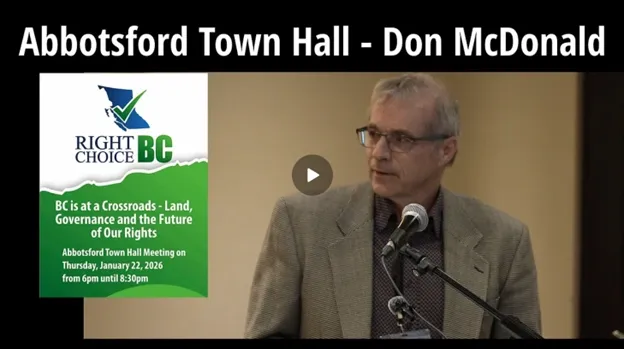
The Town Hall opened with remarks from Don McDonald, one of the local organizers responsible for bringing the event together. His introduction established the tone and purpose of the evening before any formal presentations began.
McDonald welcomed attendees to the Sandman Hotel and Suites Abbotsford and acknowledged the grassroots effort behind the gathering, including the volunteers and members of the BC Research Group who worked behind the scenes to organize the event. He emphasized that the Town Hall was built by citizens, for citizens, with the sole purpose of education and understanding rather than political advocacy.
He made a deliberate distinction that would shape the rest of the evening. This was not a political event, and it was not focused on party dynamics or electoral outcomes. The focus was governance, authority, and the long-term structures that increasingly shape how land, rights, and responsibilities function in British Columbia.
McDonald framed the evening as a response to growing uncertainty felt across the province. Many British Columbians sense that something fundamental has changed in how decisions are made about land, infrastructure, and risk, yet struggle to identify where authority now resides. The purpose of the Town Hall was to raise awareness, share accurate and timely information, and encourage informed discussion that could extend beyond the room into families and communities across the province.
He described the gathering as the beginning of a longer journey rather than a one-night event. The path forward, he noted, does not begin with politicians. It begins with informed citizens who understand the systems shaping their lives and who are willing to engage with those systems thoughtfully and constructively. Knowledge, shared openly, becomes the foundation for confidence and agency.
This framing provided the backdrop for the evening’s presentations. The Town Hall was grounded in the same core question explored in the article Why Land and Authority Now Operate Differently in British Columbia. If ownership still exists, but authority feels diminished, where did that authority move, and through what mechanisms is it now exercised?
With that context established, the evening moved into a structured examination of how land ownership, governance, and control have been quietly redefined across British Columbia.
Why British Columbia Became the Test Case
British Columbia did not wake up one morning and decide to abandon private property. No legislation announced such a move. No authority declared it openly.
Instead, British Columbia became the ideal testing ground for a different model, one that allows ownership to remain visible while authority migrates quietly into process.
The province lacks constitutional protection for private property. Most of its land is legally classified as unceded territory. It operates under a mature administrative state with strong planning powers. It also sits at the intersection of global environmental commitments, reconciliation frameworks, and climate adaptation mandates.
None of these elements on their own remove ownership. Together, they change how ownership behaves.
The Town Hall was convened to make that distinction visible.
Rita Niehaus: Ownership Without Authority
Rita Niehaus is a Chief Financial Officer in the construction industry, as well as a researcher and writer focused on issues affecting the long-term economic health and resilience of British Columbians.
Watch Video🎥 You Still Own the Land You No Longer Control
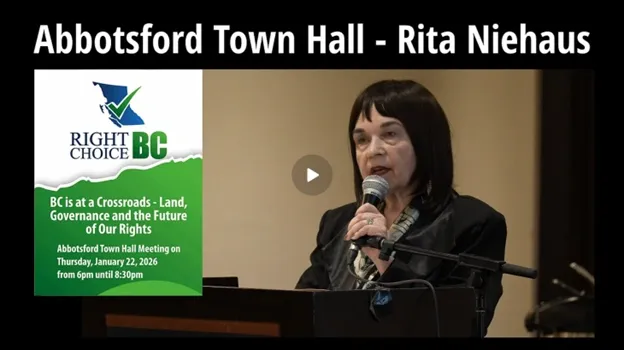
Rita Niehaus opened the evening by naming what many landowners already sense but struggle to articulate.
Land in British Columbia is still privately owned. Titles still exist. Taxes are still paid. Insurance remains mandatory. Mortgages are serviced. From the outside, the system appears stable.
Yet in practice, authority over land has thinned.
Decisions that once belonged to the title holder are now shaped by layered approvals, policy alignment, emergency designations, environmental overlays, and consultation frameworks. Each layer may appear reasonable in isolation. Over time, they accumulate.
What has changed is not ownership itself, but the meaning of ownership.
Where ownership once implied final authority, it now implies standing within a process. Landowners remain responsible for costs and liabilities, while discretion over use, adaptation, and timing becomes conditional.
This shift did not arrive with a single law or announcement. It emerged gradually through policy design. That gradualism is what makes it difficult to confront. Nothing was taken outright. Control was diluted.
Rita’s presentation is grounded in the article You Still Own the Land You No Longer Control, which documents how ownership can remain legally intact while authority migrates into administration. Responsibility stays private, while decision-making becomes shared, deferred, or externalized.
Adrian C. Spitters: How the System Was Built
Adrian Spitters is an international best-selling author and wealth advisor who specializes in property rights, financial governance, and systemic-risk analysis.
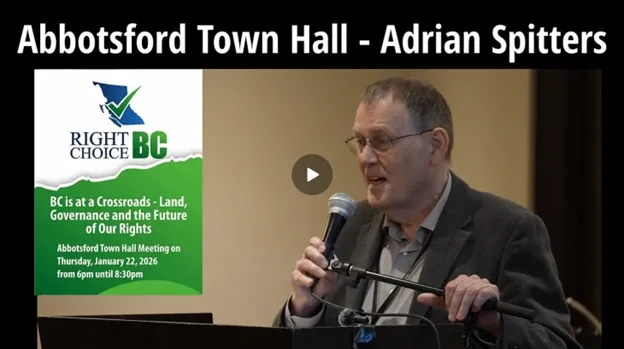
To understand how British Columbia arrived at this point, the analysis must move beyond provincial politics and into structural design.
The shift began long before recent headlines.
In 1992, the United Nations Conference on Environment and Development introduced Agenda 21. It did not call for land seizure or the abolition of private property. Its innovation was conceptual. Land was reframed as a system to be managed across regions to achieve environmental, social, and economic outcomes.
This introduced a durable principle. Land does not need to be publicly owned to be publicly governed. It only needs to be planned, measured, and aligned with approved objectives.
Agenda 21 later evolved into Agenda 2030, which replaced aspiration with targets. Governments committed to measurable outcomes related to climate, biodiversity, water, food security, and land use. Canada accepted those commitments at the federal level.
Because land and agriculture fall under provincial jurisdiction, the implementation burden flowed downward.
British Columbia already had an administrative framework capable of absorbing this logic. The Agricultural Land Reserve fixed land in place and centralized authority over its use. While created to protect farmland from development, it also created land that could be governed indefinitely without altering title.
The decisive shift occurred in 2019, when British Columbia embedded the United Nations Declaration on the Rights of Indigenous Peoples (UNDRIP) into provincial law through the Declaration on the Rights of Indigenous Peoples Act (DRIPA). This legislation did not transfer ownership. It redistributed authority.
Every existing and future provincial law must now be aligned with the Declaration. Interpretation is left to ministries, regulators, and courts. No hierarchy of rights was clarified. No final resolution mechanism was created.
Adrian’s presentation is grounded in the article Canadian Property Rights Under Attack, which examines how evolving legal and governance frameworks reshape land authority without changing ownership. Authority migrates into interpretation and process, while title remains intact.
Marcella Desjarlais: When Governance Meets Physical Reality
Marcella Desjarlais has experience across real estate, the government sector, and Indigenous organizations. She is a researcher, event organizer, and public speaker with a focus on land, governance, and community-level impacts.
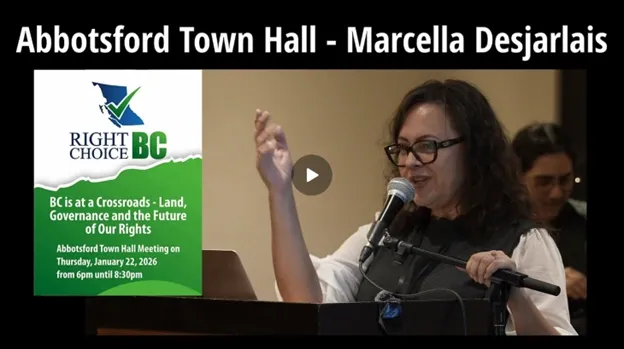
Marcella Desjarlais brought the analysis out of policy and into geography.
Some systems tolerate delay. Reclaimed land does not.
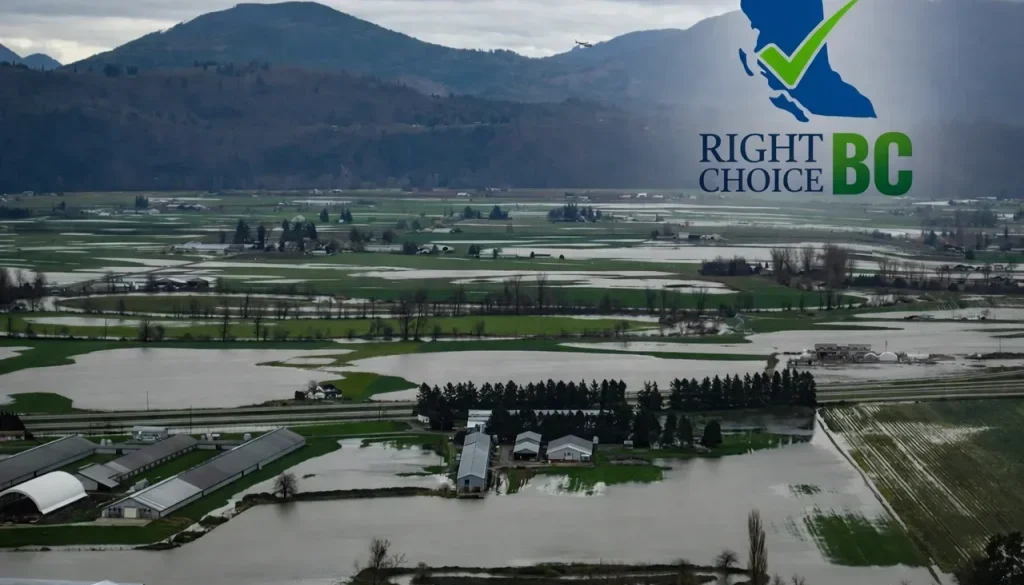
Sumas Prairie exists because water was removed and kept out. Its stability depends on pumps, dikes, drainage, and continuous coordination. These systems fail under indecision.
Layered governance does not remain theoretical when it intersects with physical systems. Consultation timelines, environmental reviews, infrastructure delays, and overlapping authority create time gaps. On a reclaimed lakebed, time gaps fill with water.
No authority has ordered the return of Sumas Lake. No policy announces such an outcome. Yet delay accumulates in a place where delay has physical consequences.
Marcella’s presentation is grounded in the article While Ownership Remains, Control Weakens, which documents how delayed infrastructure and fragmented authority reshape outcomes without altering title. Control weakens through time rather than decree.
How the System Sustains Itself
What emerged by the end of the evening was not a collection of isolated concerns, but a fully formed governance pattern.
British Columbia now operates as a mature administrative property jurisdiction. Ownership provides standing, but not final authority. Decisions are rarely denied outright. Instead, they are reviewed, deferred, reinterpreted, or paused within evolving frameworks.
This model is durable precisely because it avoids confrontation.
Expropriation creates resistance. Administrative delay creates compliance.
Landowners continue to pay taxes, maintain insurance, and absorb risk. Responsibility remains private. Authority operates through discretionary approvals, alignment requirements, and procedural sequencing.
Financial institutions respond mechanically. Banks price governance risk into lending decisions. Insurers adjust coverage, exclusions, and premiums. Capital becomes more cautious where authority lacks finality. What appears political at the surface resolves through financial constraint rather than decree.
No single decision ends ownership. Instead, control migrates into process.
Why This Matters Beyond British Columbia
British Columbia is not unique.
It is early.
What is visible here is beginning to appear elsewhere in Canada and the United States. Administrative systems rarely reverse once established. They embed into institutions, budgets, and workflows. Over time, complexity becomes protection. Accountability diffuses.
This is why the Town Hall was not a protest and not a campaign event. It was an exercise in literacy.
People cannot respond strategically to systems they do not understand. Seeing the structure does not dictate a single response, but it restores agency.
Multiple Perspectives, One Constraint
Farmers experience this system as uncertainty. Crop planning, infrastructure investment, and succession decisions all depend on predictable land use authority. When approvals, flood mitigation, or environmental requirements remain subject to reinterpretation, long-term planning becomes conditional rather than strategic.
Developers encounter the same structure as delay risk. Projects stall not because they violate established rules, but because those rules remain open to alignment, review, and revision. Time becomes a cost center, and capital becomes exposed to administrative sequencing rather than market demand.
Trustees and family offices experience the constraint as continuity risk. Assets intended to endure across generations now depend on the stability of governance frameworks rather than the clarity of title. When authority is exercised through policy rather than final decision, fiduciary responsibility becomes harder to discharge with confidence.
Private capital allocators interpret this environment as jurisdictional risk. Capital seeks predictability. Where authority lacks finality, capital either demands a premium or migrates. This is not ideological. It is mechanical.
Each group encounters the same system from a different angle. The language differs. The consequences vary. The constraint does not. Authority has shifted from ownership to administration, and every participant must now operate within that boundary.
The Quiet Test
Ownership still exists.
Payment remains mandatory.
Control has weakened.
This is the quiet test now unfolding across British Columbia.
No law announces the end of private property. No authority declares a transfer of title. Instead, a system has been constructed in which ownership remains visible, while decision-making authority is distributed across layered governance, administrative discretion, and time-dependent approval processes.
The result is not chaos. It is order without finality.
Landowners remain responsible for taxes, insurance, maintenance, and liability. At the same time, their ability to act decisively is conditioned by policy alignment, consultation requirements, infrastructure dependency, and regulatory interpretation. Authority no longer resides in a single place.
It exists within a system that can defer decisions indefinitely without formally denying them.
This design is quieter than expropriation, and more durable.
Expropriation creates resistance. Administrative architecture creates compliance. Because ownership is preserved in form, financial responsibility remains private. Because control is exercised through process, accountability becomes diffuse.
Over time, delay itself becomes the enforcement mechanism.
Seeing this clearly does not force a conclusion or prescribe a response. It simply restores literacy.
But refusing to see it clearly is still a choice, and it is the choice the system depends on.
What Comes Next
The structure outlined in this article is not theoretical, and it is not confined to British Columbia. It is simply more visible here.
Administrative systems rarely reverse once established. They embed themselves into institutions, planning processes, financing decisions, and risk frameworks. Over time, complexity becomes protection. Accountability diffuses. Authority migrates quietly, while responsibility remains fixed.
What the Town Hall demonstrated is that many people are already sensing this shift in their own communities. Farmers see it in land-use uncertainty. Developers encounter it through delay and reinterpretation. Families feel it when succession planning becomes conditional. Capital recognizes it as jurisdictional risk.
The purpose of these Town Halls is not to tell people what to think or what to do. It is to make the structure visible. Once people can see how the system operates, conversations change. Questions become sharper. Decisions become more deliberate.
That is why additional Town Halls are being planned.
The next gathering will not be announced as a rally or a campaign. It will follow the same format as Abbotsford. Informational. Grounded. Focused on land, governance, and long-term continuity. It will bring together local voices, lived experience, and structural analysis specific to each community.
These discussions reflect themes explored in greater depth by Peter J. Merrick, TEP® and Adrian C. Spitters, CFP®, through their ongoing work on land, governance, and asset continuity, as documented in The Merrick Spitters Reset Report™.
Future Town Halls will continue to build on this foundation, one community at a time.
These conversations are moving from one neighbourhood to the next because the issues are not isolated. They are systemic, and they surface differently depending on geography, industry, and history.
For those who want to understand what is unfolding before it reaches a crisis point, watching for the next Town Hall in your area is the natural next step.
Details will be shared as locations and dates are confirmed.
About the Authors
Adrian C. Spitters, CFP® Adrian C. Spitters is a veteran private wealth advisor with more than thirty-eight years of experience in risk management, long-term financial planning, and asset protection. Raised on a dairy farm in British Columbia’s Fraser Valley, he brings a grounded understanding of land stewardship and the economic pressures facing Canadian families. Adrian advises business owners, professionals, and farm families on practical strategies to safeguard their wealth from financial, legislative, and global-system risks. His work integrates strategic planning with real-world insight from decades in the financial sector. Read Adrian C. Spitters’ full biography here.
Peter J. Merrick, TEP® Peter J. Merrick is an international speaker and educator in the fields of succession, pension, and wealth preservation. He has spent more than three decades advising business owners, professionals, and family enterprises on how to structure, protect, and transition wealth across generations. His work blends technical expertise with clear, accessible guidance that helps Canadians prepare for economic and legislative uncertainty. Peter has authored multiple bestselling books and continues to contribute to national discussions about financial resilience and sovereignty. Read Peter J. Merrick’s full biography here.