Canada is Sitting on $14 Trillion in Oil and Refusing to Use It
By Peter J. Merrick, TEP® and Adrian C. Spitters, CFP®, co-authors of the international bestseller It Starts With Gold™ and the forthcoming book Guns, Gold & Land™
This analysis continues a series of long-form investigations published in The Merrick Spitters Reset Report™
This article reflects the authors’ opinion and is intended to inform and invite respectful dialogue on Canadian public policy and economic strategy.
Canadian Energy Policy Locks Away Wealth and Undermines Sovereignty
Some argue that Canada is showing climate leadership. Others believe the country is surrendering its greatest economic lever to a technocratic ideology that answers to no voters.
Canada sits atop an estimated 170 billion barrels of recoverable oil, ranking third globally after Venezuela and Saudi Arabia. At an average of 80 US dollars per barrel, the value of this resource exceeds 13.6 trillion US dollars or approximately 18.5 trillion Canadian dollars. This immense potential could eliminate Canada’s federal debt, significantly lower taxes, rebuild infrastructure, and restore prosperity across the country.
But instead of using this advantage to empower citizens, Canada is restricting access to its own wealth. Sweeping climate mandates are locking the resource base underground before its value is realized.
This is not conventional economic stewardship. It reflects a strategic restraint shaped by international climate frameworks that may not fully align with Canadian economic interests.
Oil Wealth That No One Is Allowed to Touch
Most of Canada’s oil sits beneath the Alberta oil sands. These reserves have remained largely stable for over a decade. Technology has made extraction safer and more efficient. The opportunity is there. What is missing is the political will.
Canada has committed to net-zero emissions by 2050. This includes an aggressive reduction in oil and gas emissions and an expanding Clean Fuel Standard. Combined with punitive carbon pricing, these measures discourage domestic production while ceding market share to countries with weaker environmental standards.
This transition is not being driven by Canadian households or communities. It is being shaped by outside actors and international climate frameworks. These policies are implemented by institutions that are not accountable to Canadian voters, and the cost is borne by the people.
The Missed Opportunity in Numbers
If Canada captured even 30 percent of the value of its recoverable oil as royalties, the benefits would be staggering:
-
-
- Total Royalty Revenue: $5.55 trillion CAD
- Per Canadian Citizen (40 million): $138,720 CAD
- Years Canada’s Healthcare Gap Could Be Funded: 139 years
- Years of Fully Funded Infrastructure Investment: 92 years
- Portion of Federal Debt Covered: 449%
-
Instead, these potential gains are locked beneath the ground while debt, taxes, and service shortfalls climb above it.
Economic Outcomes If We Harvested Our Oil
If Canada tapped even half its oil wealth over the next 30 years, it would generate more than 7 trillion dollars in gross revenue. That could lead to:
-
-
- Elimination of federal debt, currently over 1.2 trillion dollars
- Reduction or removal of personal income taxes
- Repair of an overburdened healthcare system with worsening wait times
- Investment in housing and national infrastructure to address affordability and economic stagnation
-
Compared to Norway, whose sovereign wealth fund now exceeds 1.6 trillion US dollars, Canada has no federal energy fund despite holding more than 20 times the oil reserves.
A Nation Held Hostage by Foreign Interests
Canada’s climate strategy has been drafted in boardrooms beyond its borders. Programs like the Net-Zero Industry Tracker from the World Economic Forum offer sweeping blueprints for energy transition. These frameworks are not voted on, yet they increasingly shape policy at the national level.
Environmental, Social, and Governance investing now dominates Canadian capital markets, with over 3 trillion dollars in ESG-aligned assets. Many of these funds are managed by international firms that reward climate alignment and penalize domestic resource development. This puts Canadian producers in a regulatory and financial stranglehold.
A 2023 C.D. Howe Institute report confirms that billions in private capital are being redirected away from Canadian energy projects, even when they meet or exceed global ESG criteria.
Alberta: Ground Zero for the War on Oil
Alberta, home to the lion’s share of Canada’s oil reserves, has borne the brunt of these policies. Carbon taxes have raised production costs, making investment less attractive. Pipeline projects like Northern Gateway and Energy East were cancelled under pressure from regulatory and political forces.
Ottawa’s proposed Emissions Cap Framework is a new constraint that could cripple Alberta’s oil sector. While the province pushes back, the federal government presses ahead with its climate agenda.
Canada is not scaling back oil production out of necessity. It is doing so by policy choice under pressure from international frameworks.
The Green Iron Curtain
Canada has constructed a green iron curtain around its most valuable resource. It is now harder, costlier, and riskier to develop oil in Canada than in virtually any other major producing nation.
This is not unique to Canada. Across the Western world:
-
-
- The Netherlands is forcing farmers off their land to meet nitrogen reduction targets
- Germany has closed its nuclear plants, only to restart coal-fired plants
- The United Kingdom is promoting 15-minute cities and digital zoning under climate policy
-
While framed as environmental protection, these policies often result in expanding administrative control over land use, production, and private enterprise.
Manufactured Scarcity Is the New Normal
Policies are conditioning citizens to accept reduced access to goods, services, and freedoms as a necessary trade-off for environmental compliance. Less fuel, less heat, less meat, and fewer rights. Canada’s prosperity is being restricted by design, and its people are being asked to accept this as moral progress.
Meanwhile, nations with weaker democratic institutions are expanding their reach. China, Saudi Arabia, and Russia are increasing production and buying up energy markets. Canada is retreating while authoritarian economies surge forward.
What Could Have Been: A Dystopia of Lost Opportunity
If Canada had used its energy wealth instead of suppressing it, the nation would be in a vastly different place:
- Alberta and Newfoundland would be flourishing. Newfoundland’s offshore oil sector has lost over 15,000 jobs since 2014
- Canada could export liquefied natural gas to reduce emissions abroad, yet it has zero operational LNG export terminals today
- National infrastructure, from housing to rail, could be funded through royalties
- Indigenous communities could receive long-term revenue from responsible development
Projects like Cedar LNG, led by the Haisla Nation, show how Indigenous ownership and energy development can coexist.
Instead, Canadians are being told to embrace austerity while their wealth is buried.
Conclusion: We Are Burning the Barrel Before It’s Pumped
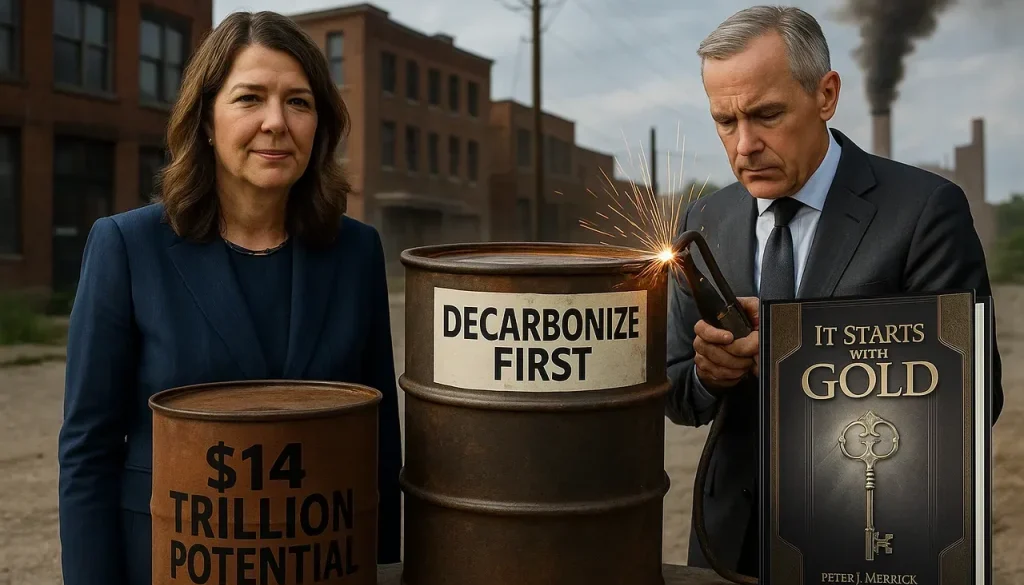
The barrel labelled “$14 Trillion Potential” now sits beside another labelled “Decarbonize First.” This is more than symbolism. It is a national strategy.
Canada’s oil wealth is real. Its suppression is political. The consequences, including rising debt, declining services, and shrinking economic power, are already here.
Canadians must decide whether to remain passive observers or active stewards of their national wealth. The path forward demands rejecting imported frameworks and reclaiming local control over our economic destiny.
We still have a choice. We can chart a new path forward. Sovereignty, prosperity, and environmental responsibility are not mutually exclusive. But that path will require reclaiming Canada’s national interests in alignment with the will of its citizens.
The urgent themes discussed in this article are expanded on in our #1 international best-selling book, It Starts With Gold™, co-authored by Peter J. Merrick and Adrian C. Spitters.
In the book, we reveal how technocratic control over energy, land, and money has reshaped Canada’s economy and future. Visit www.ItStartsWithGold.com.
We can still make a difference. We go into great detail on the solutions that remain available to us and the urgent decisions Canadians must now consider.
To find out more, order your own copy of It Starts With Gold from Amazon today. CLICK HERE
Canadian Oil Wealth and Economic Context
- Statista – Proven Oil Reserves in Canada
- Natural Resources Canada – Crude Oil Facts
- Alberta premier says province working on proposal for new crude oil pipeline to Port of Prince Rupert
- Canada Introduces Bill to Speed Up Project Approval, Dismantle Trade Barriers
Economic Indicators and Fiscal Position
- Bank of Canada – Interest Rates and Bond Yields
- Canada Revenue Agency – Statistical Overview 2022
- Fraser Institute – Wait Times for Healthcare in Canada
Canadian Net-Zero Policy Framework
International Influence and ESG Pressures
- World Economic Forum – Net-Zero Industry Tracker
- Responsible Investment Association – Canadian Market Overview
Global Policy Parallels
- Reuters – Netherlands Farm Buyouts
- DW – Germany Nuclear Plant Shutdown and Coal Revival
- UK Parliament – Debate on 15-Minute Cities
- ‘This is political expediency’: how the Tories turned on 15-minute cities