Carney Comes For Your House But Keeps His
By Peter J. Merrick, TEP® and Adrian C. Spitters, CFP®, co-authors of the international bestseller It Starts With Gold™ and the forthcoming book Guns, Gold & Land™
This analysis continues a series of long-form investigations published in The Merrick Spitters Reset Report™
Why a Home Equity Tax May Be the Next Step in Canada’s Financial Reset if April 28 Delivers a New Mandate
The World Watches Canada’s Federal Election on April 28, 2025. Why a Home Equity Tax May Be the Next Step in Canada’s Financial Reset, If April 28 Delivers a New Mandate to Dismantle a Sovereign Canada.
Prime Minister Mark Carney recently sent shockwaves across Canada’s housing market with one carefully crafted phrase: “Untapped housing equity must contribute to economic fairness.”
Yet, while Canadians who have paid off their mortgages brace for the possibility of a new tax on their most valuable asset, Carney himself remains fully insulated. He owns a home in Rockcliffe Park, one of Ottawa’s most exclusive neighbourhoods, valued at $1.3 million in 2012. Based on a conservative annual appreciation of 5 percent, its estimated market value in 2025 is approximately $2.45 million.
During his years at the Bank of England, Carney and his family lived rent-free in luxury homes in Hampstead, London, with one later listed for over £5.5 million. While Carney did not own these properties, he enjoyed rent-free accommodation paid by a £250,000 annual housing allowance. Now, as Prime Minister, he enjoys the use of taxpayer-funded residences at Rideau Cottage and Harrington Lake.
Beyond visible privileges, financial disclosures and reporting suggest that Carney and his wife, Diana, have placed significant wealth in blind trusts. While these holdings are opaque, independent analysts estimate their combined net worth, including assets held directly and through trusts, to exceed $30 million. Some experts believe it could be much higher, factoring in Brookfield stock options, advisory fees, real estate holdings, and inherited family wealth.
For millions who sacrificed to own their homes outright, Carney’s message sounded less like a proposal and more like a threat. The mortgage-free life they worked for is being reframed not as a personal achievement but as a problem to be solved.
While no home equity tax has been formally introduced, the signs are unmistakable. As we outlined in It Starts With Gold, the process always begins the same way: first with research papers, then with bureaucratic groundwork, followed by soft language about equity and sustainability, and finally, legislation. If Carney becomes Prime Minister on April 28, Canadian homeowners, especially those who have paid off their homes, may find themselves on the frontlines of the next phase of wealth redistribution.
A Country Out of Options, and a Government Looking at Your Equity
Canada’s fiscal position is dire. Federal debt has more than doubled since 2015, now exceeding $1.2 trillion. Ottawa spends more on interest payments than it transfers to provinces for health care. The state has exhausted conventional tax strategies and must now look elsewhere.
This is where housing equity enters the picture. Canadians currently hold trillions in home equity. That money is real, but it is tied up in private property and, critically, it has so far remained outside the reach of federal taxation.
For a government that has already taxed income, small business, and carbon emissions to the breaking point, the largest pool of untouched value left is the equity sitting in people’s homes.
“Fairness” Is the New Framing for Seizure
Carney’s use of the term “untapped housing equity” is no accident. It echoes the language used in several CMHC-funded research studies that explored the possibility of an annual surtax on homes valued over $1 million. These proposals were met with overwhelming public resistance. CMHC’s own internal analysis showed 95 percent of Canadians opposed the idea.
And yet, each time the backlash faded, the idea quietly resurfaced.
In this emerging paradigm, paid-off homes are no longer seen as symbols of financial security and independence. Instead, they are framed as evidence of inequality, assets that must be tapped to fund housing initiatives, climate agendas, or economic fairness.
This is precisely the pattern we described in It Starts With Gold. The shift begins with the redefinition of ownership. Before long, the conversation is no longer about protecting what you built, but about how much of it you should be expected to give up for the greater good.
Build Canada Homes: Who Really Benefits?
Carney’s marquee housing plan, Build Canada Homes, promises to double the nation’s housing output to 500,000 units per year. It relies heavily on the mass deployment of modular housing. At first glance, it seems bold. But scratch beneath the surface, and a different story emerges.
Build Canada Homes will be backed by over $25 billion in government financing, with additional subsidies flowing into modular housing manufacturers and affordable housing developers. But according to veteran builder Ellery Broder, the math simply does not work.
Broder, with over 40 years of experience in modular housing, says Carney’s plan is “completely disconnected” from reality. The projected $70,000-per-unit construction cost does not account for essential infrastructure, land acquisition, or service hook-ups. He also notes that Canada does not have the trades, the zoning approvals, or the labour force required to triple housing output in less than a decade.
More concerning is who stands to profit most from this prefab push
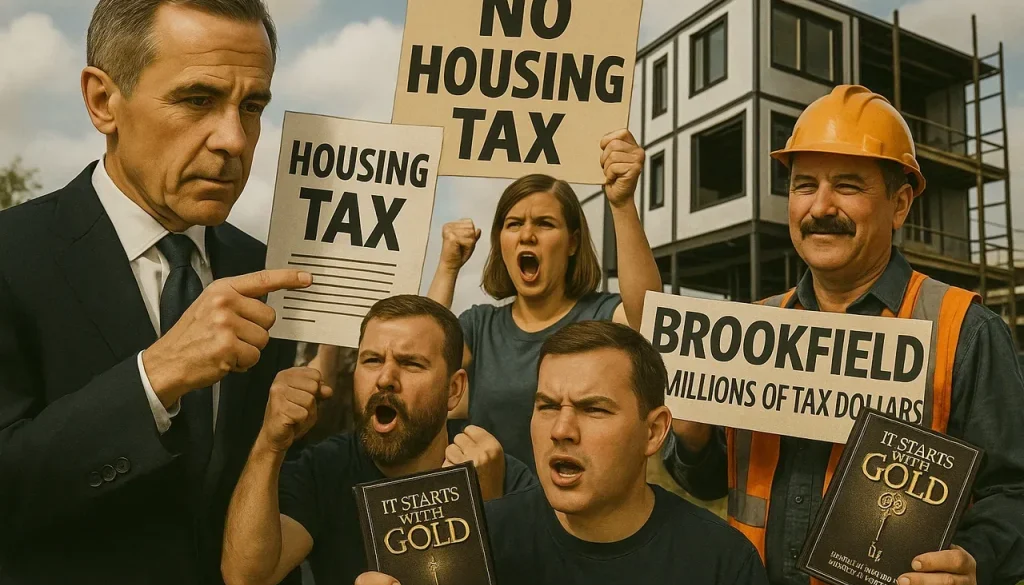
Carney chaired Brookfield Asset Management prior to entering politics. Under his leadership, Brookfield acquired Modulaire Group, a major player in the global modular housing industry. If government financing supercharges prefab housing in Canada, Brookfield is well positioned to benefit, directly or indirectly, from the surge.
In other words, Build Canada Homes is not just a plan to build homes. It is a plan that could funnel taxpayer dollars into firms that are part of Carney’s past and possibly still linked to his personal fortune via blind trusts or deferred compensation arrangements.
A New Class of “Lucky” Canadians: Homeowners with Equity
It is important to understand how Ottawa’s shifting view of homeownership will impact the everyday Canadian. Homeowners are now being labelled “lottery winners.” Not because they inherited their homes or gamed the system but because they had the discipline to save, budget, and buy when prices were still reasonable.
This new narrative reframes responsible ownership as an unfair advantage. It paves the way for surtaxes, equity charges, and policy tools that penalise success under the banner of intergenerational fairness.
Meanwhile, Carney himself remains insulated. He will not be affected by the very taxes and programmes that could be imposed on ordinary Canadians. He has the lawyers, the trusts, the accountants, and the exemptions. You do not.
What to Expect if Carney Is Elected on April 28
Should Carney win the federal election, the pieces are already in motion for a fundamental shift in housing policy.
-
-
- The groundwork has been laid for a home equity tax. It may begin as a surtax on $1 million homes, but thresholds are rarely fixed for long.
- Homeowners with fully paid-off properties will likely become the primary target. They will be told their equity must now contribute to the solution.
- Modular housing programmes, backed by taxpayer dollars, will enrich corporations such as Brookfield, not build sustainable communities for Canadians.
- Ownership will gradually be replaced by access. Housing becomes a utility, administered and taxed by the state. Homeownership becomes conditional.
-
These are not predictions. They are trajectories, clearly observable in the policies, proposals, and pilot programmes already introduced. Whether it happens in the next budget or the next term, the direction is unmistakable.
We Warned You And We Are Warning You Again
In It Starts With Gold, we wrote that true ownership is under attack. That governments, when pressed, will reach not for cost-cutting but for what you own. The next stage of the reset will not begin at the pump or in your investment portfolio. It will begin with your home.
The best time to prepare is before they open the door to a home equity tax. The second best time is now.
📘 Order your copy of the #1 International Bestseller, It Starts With Gold, on Amazon today.
Now available on Amazon → Buy here
Because when your name is on the title, but the government sees it as a line item on their balance sheet, understanding the pattern may be your last line of defence.